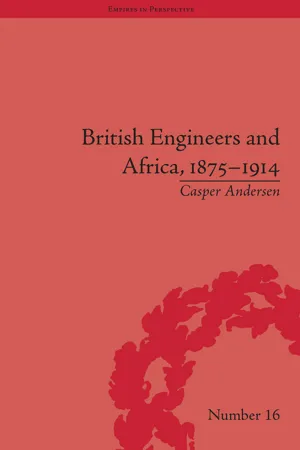
Using a wide range of primary sources that include correspondence, diaries, technical reports, institutional minutes and periodicals, Andersen reconstructs the networks and activities of Britain's engineers while focusing on London as a centre of imperial expansion.
- 256 pages
- English
- ePUB (mobile friendly)
- Available on iOS & Android
eBook - ePub
British Engineers and Africa, 1875-1914
About this book
1 AFRICA, IMPERIAL COMMUNICATION AND THE ENGINEERING PRESS
The engineer is no mere technician. In the new gospel of industrial awakening the engineer is the missionary. The mechanic, not the farmer, is the modern pioneer. The hammer leads the plough into the wilderness.Charles Buxton Going (1899)1
In their cultural history of technology Marsden and Smith rightly emphasize that ‘one of the products of the long nineteenth century in Britain was a plethora of engineering in print’.2 Indeed, by the late nineteenth century vibrant information milieus and communication systems had developed around the engineering profession. This chapter analyses how issues relating to the British empire were debated within these milieus and systems. The first section identifies channels through which the engineers who take centre stage in this book addressed issues of engineering and imperialism and it reconstructs a line of reasoning that enabled the members of the profession to argue for the indispensability of their contribution to British presence and future influence in Africa. The analysis then focuses on engineering periodicals – the publications that constituted the cornerstones in the vibrant communication milieu. Specifically, it analyses five influential journals and magazines edited from London, a location that in this period was emerging as the centre of an imperial press system in which news and information flowed back and forth between Britain and the colonies.3
Engineering periodicals are particularly important for this study because these widely circulated publications connected large communities of engineers across distances by transferring knowledge, news and opinions relevant to reading engineers. They are therefore useful for examining the dynamics of the connections that were developed between Britain and Africa in the engineering world. Moreover, questions relating to the British empire and imperialism featured prominently in the periodicals, but in very different ways. In exploring this aspect the analysis takes inspiration from studies of science in Victorian periodical literature and focuses on the producers as well as the users of the journals.4 The producers were the publishers, editors and journalists who made a living from writing, collecting, ‘repacking’ and disseminating news and knowledge from the world of engineering. These agents were in a position to influence and shape continuously the outlook of engineers but have hitherto received very little attention in the historiography. The analysis also explores what functions the journals served for the users, those who bought and read the periodicals and whose interests the producers rarely could afford to ignore. By examining the dynamics between producers and users of the journals, the analysis traces the diverse ideas that circulated among engineers and the often conflicting imperial identities that the journals appealed to and further nurtured.
Civil Engineering, Commerce and Civilization
The late nineteenth century was characterized by a widespread belief in the civilizing potential of technology. With the rapid imperial expansion after 1880 into South East Asia, the South Pacific and Africa, the gap between Europe and the rest of the world seemed wider than it had in the first half of the century. Western technological superiority was – for a short period – unchallenged. This had a huge impact on European culture, provoking ‘a fiercer assertion than ever before of Europe’s cultural mission to be the world’s engine of material progress and also its source of religious and philosophical truth’.5 The idea of an intimate link between civilization and technology had a strong hold in Britain; ‘the workshop of the World’, that had carved out the biggest empire after the Industrial Revolution and the Napoleonic Wars partly thanks to a head start in the development of key ‘tools of empire’ such as river steamers, guns and railways.6 Indeed, in the eyes of many late Victorians and Edwardians the level of technological capacities and the level of civilization were perceived to advance hand in hand. The superiority of technologies was frequently seen as an indication or even a proof of British cultural superiority as well. From there it was a short step to identifying the implementation of infrastructural technologies as an important component in the ‘civilizing mission’ of the British empire.7
This idea of the link between technological capacity and cultural rank influenced the outlook of many engineers with African connections in this period. Members of the profession were among the groups who strongly emphasized the civilizing potential of technology in the shape of railways, telegraphs and even guns. There was no singular and distinct vision of engineering imperialism for Africa, but the basic tenets of the gospel preached were ‘civil engineering, commerce and civilization’: infrastructure would create political stability, encourage investment and commerce, and thus allow the African continent with its allegedly backward populations to take its place as supplier of raw produce in a world economy based on London. From there, however, disagreements began – also among the engineers who are central to this book. When Frederic Shelford, consulting engineer to the British Government Railways in West Africa, spoke to the members of the African Society in London on ‘Sierra Leone in the Making’, he claimed that the great dividing line in the history of the colony was the introduction of the railway in the late 1890s. Prior to this the colony had been subjected to ‘the efforts of the missionaries to impart some measure of Christianity into these pagan savages’ but Shelford claimed that in spite of their efforts the colony was still ‘struggling as a second-class British possession in which no one took any interest’.8 In his analysis this only changed fundamentally when the British commenced equipping the colony with a proper infrastructure in the shape of a narrow-gauge railway – replacing the Livingstonian C of Christianity with the C of civil engineering.
Not all engineers saw things this way. Francis Fox, consulting engineer to the British South Africa Company for more than three decades, in one of his autobiographies asserted that:
Engineers in the execution of great works visit all parts of the world, and I would ask them to uphold the truth. It is, I am sure, unnecessary to appeal to them to uphold our national honour, or to conduct themselves as gentlemen, for no English man worthy of the name would be found in wanting in these virtues; but I would ask them to go much farther than this – to use their influence to suppress drink, to protect the honour of women and the innocency [sic] of children, to maintain the observance of Sunday or the Lord’s day, to encourage all true missionary work, and to sympathise with the missionaries themselves, who in consequence of many and great difficulties, are frequently liable to be depressed and cast down.9
Like many Victorian engineers Fox was a religious man. He took great pride in having served as consultant engineer to projects carried out to restore Christian buildings of worship including Winchester Cathedral, the Church of St Sophia in Constantinople and the dome of St Paul’s in London. In his London offices the work day began with a communal morning prayer.10 To Fox it was not a question of civil engineering replacing Christianity as the tool of civilization. Indeed, engineering without Christianity would be of little avail for a colonizing nation.
In fact, few engineers argued that Christianity and civil engineering were mutually exclusive but their relative importance as levers in the civilizing mission was a contested issue among the members of the profession. Guildford Molesworth, a London-based engineer with a long career in Ceylon and later chief inspector to the Uganda Railway, saw no problem and thought that civil engineering and Christianity would advance together. Instead he devoted numerous books and pamphlets to a fierce attack on what he believed was the real problem of the British empire and the engineering profession; the ‘Cobdenite’ influence on Britain’s fiscal policies.11 In his view the dogmas of free trade were rapidly undermining Britain’s industry thereby preventing British engineers from winning contracts even within the boundaries of the empire. For Britain to excel in any kind of civilizing mission ‘the insane worship of the baneful fetish of Free Trade’ should be rejected, claimed Molesworth in 1902, and called for a tariff union within the empire. Only under the umbrella of such a union would Britain and the civilizing influence of her engineers thrive.12
Questions of economic policy constituted another contested issue among engineers with African connections. John Coode, consulting engineer to several harbours constructed in West and southern Africa in this period, did not, however, share Molesworth’s pessimism. When Coode took the chair to address his peers as president of the ICE in 1889, he spoke on the subject ‘British Colonies as Fields of Employment of the Civil Engineer, Past – Present – Future’. He listed the work carried out by engineers across the British empire and assured his audience:
So long as the present dispensation may last, so long will there be a continuous progress in the science and practice of every branch of labour in the field appertaining to the Civil Engineer. Neither to the Engineer, nor indeed to any other disciple of natural science, would it seem to have been announced – I say it with all reverence – ‘Thus far shalt thou go, but no farther’.13
In Coode’s view it would take more than a failed fiscal policy to discontinue the advance made by the engineers throughout the empire. Progress was guided by deeper rules, natural laws of progress that only the Deity could alter should he wish.
Engineering Periodicals, the Empire and Africa
Leading engineers in London expressed differences of opinion in relation to the imperial role of the British engineering profession but what must also be emphasized is the diversity of the channels through which these issues were discussed. In the cases above Shelford wrote for a journal of a learned society, Molesworth authored politico-economic books and pamphlets, Fox published autobiographies and Coode spoke from the rostrum of the ICE. Civil engineers had entered the public arena where ideas and opinions about the future of the British empire were exchanged. The profession, moreover, had its own well-established communication channels with periodicals constituting the most important intellectual platforms. Indeed, technical journals, gazettes, reviews and magazines were a seminal part of the intellectual and professional life of a late-nineteenth-century engineer.14 This periodical literature reveals much about what were the important issues for engineers and about how and among whom these issues were discussed. The most widely circulated publications counted their subscribers in thousands and every week or every month they reported and debated issues from the world of engineering – issues which during these decades very often concerned the British empire in relation to the engineering profession.
The engineering literature of the period has not been systematically explored and hitherto little has been written about the people who took part in producing it and even less about those who read it and the reasons they had for doing so. Yet, there are useful historiographical pointers about how to approach this literature. In a perceptive essay Eugene S. Ferguson has rightly pointed out that technical journals were not neutral conveyors of news from the world of engineering. Rather they were highly ideological publications that reflected the urgent agendas of the writers, editors, publishers and proprietors who produced them.15 These agents were at the same time operating in a dynamic marketplace with many competitors also vying for the favour of potential readers and advertisers.16 In order for their business to stay afloat and to pursue their other pressing agendas producers had to position themselves according to the perceived needs and wishes of those who invested money in the journals either as subscribers or advertisers. A constant negotiation was therefore going on between producers and users of journals and this pervaded the publications front to back. Unravelling this dynamic ‘communication circle’ between producers, media and users is crucial for getting at the underlying messages in the published texts.17 Furthermore, in order to reach a deeper understanding of how the journal came across to readers, attention must be paid to all sections of the journals including advertisements and editorial announcements as a way of unravelling the many functions they served.18
By the last quarter of the nineteenth century numerous journals, magazines and reviews devoted to engineering, trade and industry circulated among engineers and groups affiliated with the profession. This literature was as diverse as it was vast. Engineering Magazine, launched in 1897 as a ‘review of reviews’ of technical literature, based its monthly digest of literature relevant to engineers on a list containing more than 80 different periodicals.19 The analysis here focuses on five of the most influential of these periodicals: two competing weeklies, Engineer (1856–) and Engineering (1866–), the leading general engineering journals in the English-speaking world at the time; two competing engineering reviews, Engineering Magazine (1897–1923) and Feilden’s Magazine(1899–1914),20 both successful ‘reviews of reviews’ of technical literature; and finally the monthly journal African Engineering (1904–17),21 whic...
Table of contents
- Cover
- Half Title
- Title Page
- Copyright Page
- Table of Contents
- Dedication
- Acknowledgements
- List of Tables
- Introduction
- 1 Africa, Imperial Communication and the Engineering Press
- 2 Engineers in Imperial London
- 3 Engineering Networks and the Great George Street Clique
- 4 Empire in the Institution of Civil Engineers
- 5 Explorer-Engineers and Gentlemen in the Public Eye
- 6 Vandals and Civilizers in Aswan and London
- Conclusion
- Notes
- Works Cited
- Index
Trusted by 375,005 students
Access to over 1.5 million titles for a fair monthly price.
Study more efficiently using our study tools.
Frequently asked questions
Yes, you can cancel anytime from the Subscription tab in your account settings on the Perlego website. Your subscription will stay active until the end of your current billing period. Learn how to cancel your subscription
No, books cannot be downloaded as external files, such as PDFs, for use outside of Perlego. However, you can download books within the Perlego app for offline reading on mobile or tablet. Learn how to download books offline
Perlego offers two plans: Essential and Complete
- Essential is ideal for learners and professionals who enjoy exploring a wide range of subjects. Access the Essential Library with 800,000+ trusted titles and best-sellers across business, personal growth, and the humanities. Includes unlimited reading time and Standard Read Aloud voice.
- Complete: Perfect for advanced learners and researchers needing full, unrestricted access. Unlock 1.5M+ books across hundreds of subjects, including academic and specialized titles. The Complete Plan also includes advanced features like Premium Read Aloud and Research Assistant.
We are an online textbook subscription service, where you can get access to an entire online library for less than the price of a single book per month. With over 1.5 million books across 990+ topics, we’ve got you covered! Learn about our mission
Look out for the read-aloud symbol on your next book to see if you can listen to it. The read-aloud tool reads text aloud for you, highlighting the text as it is being read. You can pause it, speed it up and slow it down. Learn more about Read Aloud
Yes! You can use the Perlego app on both iOS and Android devices to read anytime, anywhere — even offline. Perfect for commutes or when you’re on the go.
Please note we cannot support devices running on iOS 13 and Android 7 or earlier. Learn more about using the app
Please note we cannot support devices running on iOS 13 and Android 7 or earlier. Learn more about using the app
Yes, you can access British Engineers and Africa, 1875-1914 by Casper Andersen in PDF and/or ePUB format, as well as other popular books in History & British History. We have over 1.5 million books available in our catalogue for you to explore.