eBook - ePub
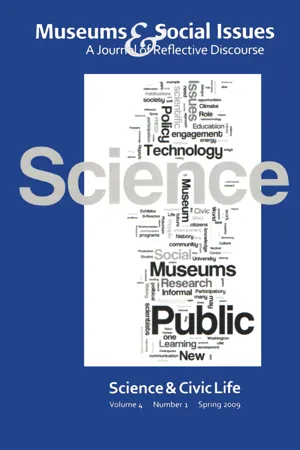
Science & Civic Life
Museums & Social Issues 4:1 Thematic Issue
- 142 pages
- English
- ePUB (mobile friendly)
- Available on iOS & Android
eBook - ePub
About this book
This book promotes the idea and the practice of a scientific culture in science museums, art museums, gardens, libraries, coffee houses, school meetings and social gatherings. It encourages common man to think about, use and sometimes contribute to science.
Making Peace With Plutonium
The B-Reactor and the Future Stewardship of Nuclear Landscapes
Douglas Mercer
Abstract
A legacy of the Cold War plutonium production effort is thousands of square miles of contaminated land, among them the 586 square mile Hanford nuclear site in southeastern Washington. The Department of Energy (DOE) is responsible for cleanup and disposition of much of the property. Because of cost and technological limitations, some of the disposed land will remain hazardous for certain land uses. Ensuring the safe, post-disposition use is the long-term stewardship mission of the DOE. This article argues that the National Park Service should become the lead agency responsible for Hanford's B-Reactor, the world's first full-scale plutonium production reactor and now a National Historic Landmark. The author argues that the site should become the principal venue for continued civic discussions concerning cleanup – the vita activa of long-term stewardship.
About the author
Douglas Mercer earned a PhD from the University of Washington, where he is now an Adjunct Professor of Geography. His areas of specialization include risk analysis, cultural landscape, environmental history, environmental perception, nature-society relations, and land use. He sits on the Hanford Advisory Board.
Introduction
The 2009 federal Omnibus bill includes $190,000 for the Department of Energy (DOE) to study a gravel spur road off State Highway 24 in Washington State.1 The landscape eastward is dominated by sage, cheat grass and sky, separated by the distant outline of the White Bluffs. It could be a road to nowhere.
To a cultural geographer such as myself, landscapes are more than what meets the eye. To be sure what we see–and also smell, touch and taste–of a place is a shared experience, but that is only the half of it. A landscape is equally, necessarily imbricated (to use academic jargon) with the cognitive assembly of memories and emotions that consciously and subconsciously frame direct sensory experience. To a cultural geographer this road, any road, leads into both Cartesian and cognitive landscapes.
In the Cartesian sense this road leads to the first full-scale plutonium production reactor in the world. The matrix of graphite rods within its utilitarian cement walls, cooled by Columbia River snow melt, jumbled uranium atoms until some became plutonium, the fissile material that lit the landscape at Trinity, and leveled a city named Nagasaki.
Search Google Maps for "B Reactor" and you will see a few buildings, a network of dirt roads between dirt moving projects, and the Columbia River. Pan back and the access road funded by the Omnibus Bill comes into view. Pan back more, just past halfway on the zoom bar, and you will see the Columbia flowing under the Vernita Bridge of SR 24, past the B/C area, reaching north around the islands and salmon beds, then southeast past the Tri-cities of Richland, Kennewick and Pasco.
Verdant green pivot irrigation circles outline much of the over 586 square miles that fall within the Hanford nuclear reservation. The southwest boundary is traced by Rattlesnake Ridge whose southern slope is the terroir of a fine wine appellation. Terroir is everything to vintners, but they will admit their neighbor poses a branding challenge. Hanford's terroir is among the most contaminated on earth.
While most of the perimeter of the site remains pristine, held as a buffer zone in case of a nuclear accident, fifty years of plutonium production left many visible scars on the landscape. Lurking under the surface revealed by the satellite images are hundreds of square miles of subsurface contamination—trichlorethelene, cesium, strontium, plutonium, and much more—some bound to the soils and some others creeping toward the Columbia River or seeping through the ancient basalt flows to groundwater. An estimated 270 billion gallons of groundwater is contaminated. The soil at some of these sites exceeds EPA standards by orders of magnitude. The scar in the middle of the satellite image is the central processing area for plutonium operations. Lacking environmental oversight, DOE's predecessor agencies (the Manhattan Engineering District and the Atomic Energy Commission) indiscriminately dumped millions of gallons of toxic chemicals amidst the surrounding sagebrush. Most they disposed of in holding tanks, 177 of them, now all well beyond their design life. Some have leaked. The scars along the Columbia's southern bank are the nine plutonium production reactors, including "B." Within a stone's throw of the river are disposal sites and evaporation ponds used for interim storage of fuel rods and waste products.
The cleanup mission of the Department of Energy's Environmental Management Program will be far more difficult than was the production of plutonium itself. This may ring as hyperbole, but it isn't. DOE's goal is to clean most of the Hanford site to standards that would allow future residential, commercial, industrial, and recreational use. In the nearly twenty years since cleanup began in earnest there has been considerable progress, but far more remains to be done.2
Cleanup can be dangerous. Workers operate heavy equipment in full hazardous material protection suits and respirators. Recently a heavy equipment operator unexpectedly unearthed a safe. The workers used the backhoe to open it on the site and found a jar of plutonium. Inhaled, one speck of plutonium will kill a person. Despite the hazards, the DOE and its contractors' worker safety record is exceptional, far surpassing industry standards.
Cleanup is expensive. Hanford's average annual budget ranges between $1-2 billion and is expected to take at least three more decades.3 The American Recovery and Reinvestment Act earmarked $1.9 billion for Hanford: however, the mass media has been losing interest in the site (Mercer, 2004).
Planned cleanup activities will not leave the site "clean" in the common sense of the term. The 200 Area, where plutonium was extracted from other fission byproducts, will be a waste disposal area in perpetuity. Groundwater under much of the site will remain contaminated, albeit (hopefully) at levels that do not pose present or future risk to human health or the environment for thousands of years. Anticipating future land use is critical to present day remedial investments (Hersh, Probst, & Wernstedt, 1997; see also Resources for the Future, 1997).
The Department of Energy's goal is to shrink the footprint of the site to 75 square miles by 2015. Ensuring the safety of future users of the remaining land is the so-called "stewardship mission" of the Department of Energy. DOE did not take on this responsibility without a fight. The Office of Long Term Stewardship (now the Office of Legacy Management) was established in 1999 as part of a settlement agreement stemming from a National Resource Defense Council legal challenge (Natural Resources Defense Council, et al. v. Richardson, et al., 1998). Two years later the Office of Long Term Stewardship published a guidance document (DOE, 2001). In it they define long-term stewardship as "the physical controls, institutions, information, and other mechanisms needed to ensure protection of people and the environment at sites where DOE has completed or plans to complete cleanup" (Ibid; see http://lts.apps.em.doe.gov/for all DOE stewardship documents and reports). The "other mechanisms" include fences, signs, and deed restrictions. The National Research Council studied the DOEs plan, and concluded it would not work (National Research Council, National Academy of Sciences, 2000).4 Where the Egyptians failed, we—Americans who developed and deployed these technologies, for better and for worse—are obligated to succeed.
A Proposition
Hanford's original plutonium production factory, now managed by the Department of Energy, has the greatest potential for advancing the stewardship mission. If interpretive responsibilities are turned over to an agency, probably the National Park Service, and civic dialog is employed alongside more traditional curatorial designs, the site could create a sense of propinquity with nuclear landscapes worldwide. Long-term stewardship desperately needs the regional and national awareness that a museum can generate. Traditional interpretive strategies won't do, however. Sustaining the political will to live up to cleanup obligations and subsequent stewardship requires that the B-Reactor be a site of continued civic dialog about the site, every living day connecting the past and the future through the actions of the moment.
There is irony in this proposition: the plutonium produced by the B-Reactor was an instrument of environmental devastation and mass death. Understanding the irony is to confront the moral ambiguities of making, testing and deploying atomic weapons. Making peace with ambiguity will require that we accept the responsibility to steward despoiled land, ecosystems and people without recourse to blame.
Revisiting the B-Reactor
At least two museums presently recount the B-Reactors story. The larger is at the public and private funded Columbia River Exhibition of History, Science and Technology (CREHST) Museum. The west wing of the building houses the Hanford exhibit, largely assembled from materials the Department of Energy displayed when it had its own museum in the Federal Building.
CREHST visitors first encounter a diorama of shrub-steppe flora and fauna emblematic of the Hanford nuclear site. The first main room chronicles the acquisition of the Hanford site lands for the Manhattan Engineering District, life in the residential halls, and building and operating the various facilities. The museum has recreated a typical engineers office. On its desk are a slide rule and reports. In the next large room are reproductions of the infamous double shelled tanks that contain the witches' brew of radiological and conventional waste generated throughout the Cold War, plutonium production decades. One leaves the room with the impression that the waste has been responsibly managed and that there is a clear plan, vitrification, that will ensure future safe disposal of the waste. No mention that the vitrification plat is already a decade behind and billions over budget, or that the prospective long-term repository at Yucca Mountain remains without a permit. Not a word of the residual environmental contamination at the site. The engineering marvel of "B" and the assiduous cleanup effort attempt to hold visitors in a thrall in their traverse to the east wing lined with the displays of technology firms that trumpet their contributions to advancement of technology and science. To carry the story home visitors can purchase a CREHST-produced film about the B-Reactor, titled Atomic Fortress, recapitulating the museum's interpretation.
The docent that accompanied me had worked at "B." His memories are clear, and his imagination remains active. With a nearly boyish bubble, he recounted a story of how he and other engineers and physicists figured out that the nuclear reaction was creating a byproduct, xenon, which inhibited the reaction, slowing plutonium production. (They fixed it by adding more fuel slugs.) His story fits the narrative arc of the hero's journey. He arrived in the Washington desert a young physicist working at the margins of human understanding. Despite the challenges, he and his colleagues advanced science, technology, and peace. His pride is justified: "B" is rightfully a chapter in engineering and technology history. It represents scientific imagination, an engineering marvel, miraculous procurement, and the expression of the virtuosic coordination of federal, university and corporate entities. We can thank my docent and other engineers who first recognized the B-Reactors historical significance. National mechanical and civil engineering associations designated it as a landmark in 1976 and 1994, respectively.
That he must sometimes face the slings and arrows of society is only part of the hero's journey. Nuclear engineers of the "greatest generation" often view public perceptions of the dangers posed by the environmental legacy as overblown, sometimes even histrionic. They do not deny the facts; they are engineers, after all. They just believe that, on balance, their labors were justified, and the CREHST story sufficient.
Bit-by-bit, fact-by-fact, memory-by-memory, the story of "B" has become more complicated. For many, the B-Reactor marks the ascendance of a Weberian military-industrial complex, excesses of scientific authority, technological hubris, and the mushrooming moral conundrums of the Trinity test.
Public interest in preserving the B-Reactor as part of a national network of Manhattan Project historic sites led to a Congressionally authorized study, to be performed by the National Park Service (NPS), to study the feasibility of a unified network of sites, including "B", the Trinity Test Site in New Mexico (which used B-Reactor fissile material), the X-10 Reactor at Oak Ridge, Tennessee, and Fermi's Chicago Pile I. The NPS Special Resource Study/Environmental Evaluation is slated to be delivered to Congress in late 2009 (a draft, very likely to be delayed, was to be available for public comment in Spring 2009).5 Concurre...
Table of contents
- Cover
- Title
- Copyright
- Contents
- Editor's Note
- Introduction: Exhibits are Not Enough
- Science in the Obama Administration
- Engaging the Public in Public Policy
- Mind the Gap: Science Museums as Sources of Civic Innovation
- Science and Technology Policy and Ethics: What Role Should Science Museums Play?
- Historical Perspective on Participatory Approaches in Science and Technology
- Making Peace with Plutonium
- Addressing Climate Change in the Adirondacks
- Book Review
- Event Review
- Resources for Science & Civic Life
Trusted by 375,005 students
Access to over 1.5 million titles for a fair monthly price.
Study more efficiently using our study tools.
Frequently asked questions
Yes, you can cancel anytime from the Subscription tab in your account settings on the Perlego website. Your subscription will stay active until the end of your current billing period. Learn how to cancel your subscription
No, books cannot be downloaded as external files, such as PDFs, for use outside of Perlego. However, you can download books within the Perlego app for offline reading on mobile or tablet. Learn how to download books offline
Perlego offers two plans: Essential and Complete
- Essential is ideal for learners and professionals who enjoy exploring a wide range of subjects. Access the Essential Library with 800,000+ trusted titles and best-sellers across business, personal growth, and the humanities. Includes unlimited reading time and Standard Read Aloud voice.
- Complete: Perfect for advanced learners and researchers needing full, unrestricted access. Unlock 1.5M+ books across hundreds of subjects, including academic and specialized titles. The Complete Plan also includes advanced features like Premium Read Aloud and Research Assistant.
We are an online textbook subscription service, where you can get access to an entire online library for less than the price of a single book per month. With over 1.5 million books across 990+ topics, we’ve got you covered! Learn about our mission
Look out for the read-aloud symbol on your next book to see if you can listen to it. The read-aloud tool reads text aloud for you, highlighting the text as it is being read. You can pause it, speed it up and slow it down. Learn more about Read Aloud
Yes! You can use the Perlego app on both iOS and Android devices to read anytime, anywhere — even offline. Perfect for commutes or when you’re on the go.
Please note we cannot support devices running on iOS 13 and Android 7 or earlier. Learn more about using the app
Please note we cannot support devices running on iOS 13 and Android 7 or earlier. Learn more about using the app
Yes, you can access Science & Civic Life by Kris Morrissey,Robert Garfinkle in PDF and/or ePUB format, as well as other popular books in Business & Amministrazione museale. We have over 1.5 million books available in our catalogue for you to explore.