eBook - ePub
The Value Trail
How to Effectively Understand, Deploy and Monitor Successful Business Models
- 150 pages
- English
- ePUB (mobile friendly)
- Available on iOS & Android
eBook - ePub
The Value Trail
How to Effectively Understand, Deploy and Monitor Successful Business Models
About this book
The Value Trail offers a comprehensive approach to competitive analysis and strategy, considering value as a central theme and from a customer based perspective. It fully develops a disruptive new model of strategic analysis (namely the Three Dimensions of Value model) that approaches the drivers of success within a business from a value-based perspective: how value is understood by the customer (Appreciation of Value), and how it is boosted (Concentration of Value) or subtracted (Predation of Value) by different business agents. From this business-level perspective, the book progressively moves down to a company level to allow the reader to understand how companies can set corporate goals and leverage internal resources to deliver successful value propositions. To close the circle, special attention is paid to the definition of an integrated monitoring system based on both market (outside-in perspective) and company (inside-out perspective) metrics. On top of that, the book also identifies, in line with this new theory, the most relevant existing competitive models, together with a comprehensive analysis of their strategic approach and success drivers. If you are an entrepreneur looking for a solid and understandable guide to fully cover all company stages, a manager seeking to improve the implementation of operational and strategic processes or a practitioner in search of a disruptive approach to competitive analysis, this is the book you've been waiting for.
CHAPTER 1
APPROACHING COMPETITION
1.1 THREE STORIES
There are many clichés and misconceptions about business management. Myths that tell about leaders bound to succeed virtually from the cradle due to astonishingly intuitive business acumen, and companies touched by a magical wand. Clichés about a set of predefined rules about competition and success constituting a sort of shared conventional wisdom. Misconceptions that make us believe that this conventional wisdom is unchangeable and 100 percent reliable.
Real life, however, is pretty different: magical wands are very rare, and intuition is frequently wrong. In turn, there are other resources available that are precious to successful managers and practitioners alike and configure a completely different approach to competition. Thus, before we jump into discussing competitive strategy, let us reflect on these resources to create a necessary common ground for what is coming next. We shall do so through three brief stories.
1.1.1 Apple and Dell
In 1996, Apple was a very different company from the one we all know today. Moving from its past days of glory, and under the direction of Michael Splinder, first, and Gilbert Amelio, secondly, the company was immersed in a cost-cutting and somehow drifting strategy that caused a $69 million loss. Steve Jobs would completely reverse this situation some years later, implementing an aggressive shift back toward the foundational roots of the company. Although it would take some time, in 1997 Jobs drew up the framework for the Apple we know nowadays, announcing a $150 million-dollar investment from Microsoft which would allow the company to move back to producing its original core products. The controversy over the future of Apple, however, still remained the subject of debate.
Meanwhile, Dell was the solid new leader in the PC manufacturing business. Based on online selling, and through a disruptive strategy based on cost rationalization, value chain optimization and simplification, the company made its way to the top. While the average research and development (R&D) expenditure was around 5 percent of sales for top PC manufacturing companies in early 1990s, Dell devoted less than 1 percent of its revenue to that purpose.
On October 6, 1997, at a Gartner Symposium in Orlando, when asked about how to address the issues of the then-troubled Apple Computer Co., Michael Dell, founder and CEO of Dell (and at that time one of the most praised and respected businessmen worldwide), said (Appleinsider, 2006): “What would I do? I’d shut it down and give the money back to the shareholders.”
This was a few months after Steve Jobs’s comeback, in July 1997. Though Jobs probably didn’t like it very much at that time, he sure had the chance to have sweet revenge some years after. In 2006, when Apple’s market capitalization overpassed Dell’s (Chart 1.1), Jobs sent an email to all Apple employees (Appleinsider, 2006): “Team, it turned out that Michael Dell wasn’t perfect at predicting the future. Based on today’s stock market close, Apple is worth more than Dell. Stocks go up and down, and things may be different tomorrow, but I thought it was worth a moment of reflection today. Steve.”
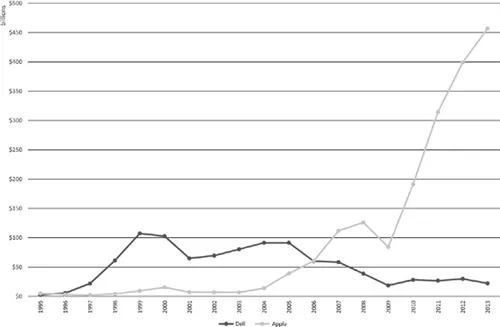
Chart 1.1 Apple versus Dell market capitalization (1995–2013)
Source: Data from Ycharts, 2013.
1.1.2 Leo Messi
This second story is about football and one of the most famous sports club worldwide, FC Barcelona. It’s also about its main star: the four-time winner of the FIFA Player of the Year and captain of the Argentina national team Lionel (Leo) Messi.
In 2006, Juan Carlos Unzué (Futbol Club Barcelona’s (FCB) goalkeepers’ coach back then) noticed that a young Leo Messi, barely a freshman player on the FCB team, closely observed Ronaldinho and Deco while they were practicing free-kicks after everyday training (Así se entrenó Messi, 2012). When he asked Messi if he wanted to try himself, Leo replied, “Not yet” without removing his eyes from his teammates.
Six years later, during an interview given to Mexican newspaper Record, Leo Messi stated:
I am practicing free kicks after training every day. I had been told that mastering free kicks was a matter of practicing over and over again to acquire a good technique. They told me that I will find my way if I kept on practicing, and now I am scoring goals that years ago I didn’t.

Chart 1.2 Free-kick goals scored by Leo Messi by season (2008–13)
Source: Data from Todos los Goles de Messi, 2013.
It certainly seemed that Leo’s intense workout paid off. At least, this is what his statistics show—a significant improvement after 2011 summer (see Chart 1.2).
1.1.3 The Real Estate Bubble in Spain
On July 2, 2003, four years before the start of undoubtedly the worst recession in modern history in Spain, and while the signs of a real estate bubble where starting to be blatant, the Spanish newspaper El País published an interview (Aparicio, 2013) with some of the so-called most significant experts on the matter. Both Rodrigo Rato, Spanish Minister of Economy back then, and Jose Luis Estevez, Vice-President of the Spanish Valuation Society, denied any sign of what was about to come:
“There is no real estate bubble in the Spanish market, just a strong demand. This is, no doubt, a good moment to borrow money.” (Rodrigo Rato)
“House prices will never decrease, but just softly land towards stability. That is to say: there will be no bubble burst.” (José Luís Estévez)
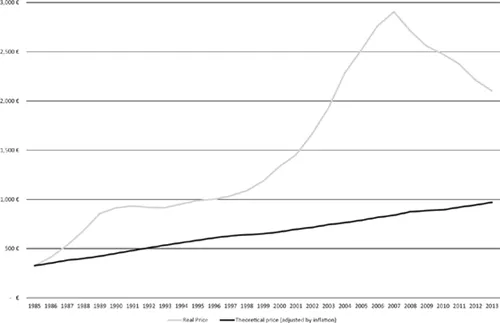
Chart 1.3 Evolution of average nominal price of houses in Spain (in €/m2)
Source: Data from Sociedad de Tasación, 2013.
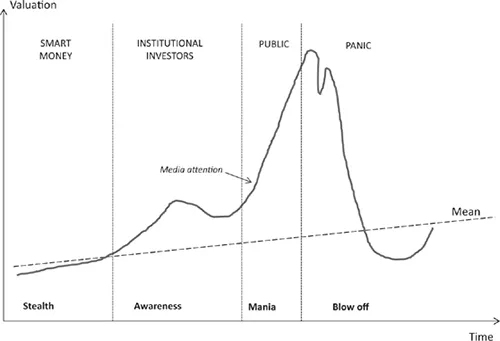
Chart 1.4 Stages of a speculative bubble
Source: Author’s chart, based on Rodrigue, 2008.
Chart 1.3 reflects the evolution of housing prices in Spain from 1994 to 2014 (forecast). Take a look again and compare it with the classic stages of a speculative bubble depicted in Chart 1.4. Do you find any similarity? Awesome, isn’t it? It certainly seems that, back in 2003, the Spanish real estate bubble was entering its public stage, and hence capturing the attention of the media (El Pais would probably agree on that). Now, assuming that both the Spanish Minister of Economy and the CEO of the Valuation Society in charge of assessing most housing transactions did have relevant information about price evolution and macroeconomic trends in Spain, and were also knowledgeable about the basics of speculative economics theory, we have to conclude that they were either consciously lying or trying to shape reality according to their previous assumptions.
1.2 EPILOGUE AND TAKEAWAYS
Each one of these stories teaches us a lesson about some of the most important pillars concerning strategic analysis and competition in itself.
The first story tells us about the difference between an opinion and an analysis (even for a respected businessman). Although highly overrated, an opinion is basically a statement with no solid basis and it is dangerous to use it as a substitute for a planned strategy. In the aforementioned example, Michael Dell basically predicted a dull future for Apple from the compromised situation it was in at the time. Besides, he was definitely influenced by the self-indulgence of Dell’s dominant position at the time and did not take into consideration the viability of the fresh turn in Apple’s strategy. Exchanging opinions is funny and definitely an enriching experience but will never be able to substitute a solid, fact-based strategy. Think about it: imagine that you are planning to invest in art and seeking professional advice. Would you rather base your decision on a one-minute chat with an apparent connoisseur, or gather as much information from as many sources as possible?
Remember: know the difference between opinion and analysis. An opinion is for a chat over a coffee, not for business purposes.
The second story tells us about the importance of practice over talent. Talent is important but extremely overestimated from an overall perspective and absolutely useless without proper execution. Identifying specific improvement areas and working on them are the basis for future success. If Leo Messi, probably the best football player of all time, advocates a continuous improvement perspective to critically assess his performance, we should all be applying it. The identification of these improvement areas should be based on a thoughtful and step-by-step analysis that envisions both business and company-level indicators.
Remember: success is very rarely achieved in first instance. Persistence and hard work are key to achieving results.
The third story makes us think about the convenience of questioning conventional wisdom to transcend everyday reality and gain focus on the real challenges we should be tackling. Only from an enriched, inclusive perspective will we be able to zoom out to get the big picture of the situation, whether this is an economy report or a threat assessment of our current competitive position. The game theory suggests that all good strategy should include an evaluation of the incentives for all players to behave the way they do, and, accordingly, a later adaptation of our next movements.
A proper approach to competition (as summarized in Figure 1.1), therefore, requires solid strategic planning to overcome our day-to-day routine, consolidate future plans, maximize our chances of success and should be based on something solid and traceable enough that allows further processes of revision and mistake identification. This definitely requires moving from the world of ideas to the ruthless battleground, or, in other words, looking for continuous improvement to translate what is planned into concrete terms. Having a solid strategy won’t prevent your business from failing—you may want to think of it as learning how traffic lights work: crossing the street when the light is green does not guarantee that you won’t be run over by a car, but doing it randomly may eventually kill you.
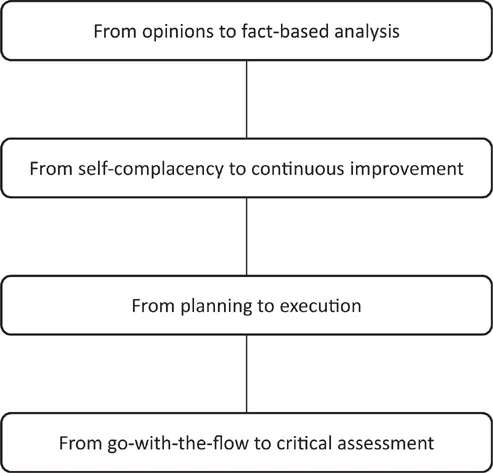
Figure 1.1 The approach for competition
These initial requirements will help us configure a conceptual path toward successful business competition. This path is divided into three main stages, which will be covered in the following chapters:
1. Strategic planning and analysis to understand, on one hand, the competition rules and the different business agents, together with the dominant value propositions and the potential drivers of growth, and, on the other hand, the differential capabilities of your company.
2. Strategy deployment and execution, to define a set of coherent corporate goals and to understand the available tools to reach them—aligning all existing resources within the company and accurately defining the actions to be taken, while creating a solid, winning culture along the way.
3. Monitoring and reassessment, to move from an intuition-based to a data-driven, market-focused organization—a process to make strategy accountable and to create a model which ensures efficiency and verifies customer attractiveness.
CHAPTER 2
THE ANALYTICAL PROCESS: AN OVERVIEW
2.1 AN INITIAL APPROACH TO BUSINESS
You don’t start building a house from the roof, and neither do you start planning your strategy without having solid foundations. To start discussing what foundations are here, let’s take one step back and think about how we usually conceive business.
As depicted in Figure 2.1, the most frequent way of approaching a business starts with the idea for a new product or service (stage 1). This is a so-called offer-focused approach (that is to say, its gravity center and trigger is the product or service itself) and as we move on we’ll try to explain why this is essentially risky. Of course, every newborn product is conceived to be a winner. The problem is that the winning condition is not an inherent feature of the product, but determined exclusively by our customer, and, cons...
Table of contents
- Cover Page
- Title Page
- Copyright Page
- Dedication
- Contents
- List of Figures
- List of Charts
- List of Tables
- Preface
- 1 Approaching Competition
- 2 The Analytical Process: An Overview
- 3 Out There and Back: Business and Environment
- 4 The Internal Creation of Value
- 5 Measuring and Controlling Your Results
- Epilogue
- References
- Index
Trusted by 375,005 students
Access to over 1.5 million titles for a fair monthly price.
Study more efficiently using our study tools.
Frequently asked questions
Yes, you can cancel anytime from the Subscription tab in your account settings on the Perlego website. Your subscription will stay active until the end of your current billing period. Learn how to cancel your subscription
No, books cannot be downloaded as external files, such as PDFs, for use outside of Perlego. However, you can download books within the Perlego app for offline reading on mobile or tablet. Learn how to download books offline
Perlego offers two plans: Essential and Complete
- Essential is ideal for learners and professionals who enjoy exploring a wide range of subjects. Access the Essential Library with 800,000+ trusted titles and best-sellers across business, personal growth, and the humanities. Includes unlimited reading time and Standard Read Aloud voice.
- Complete: Perfect for advanced learners and researchers needing full, unrestricted access. Unlock 1.5M+ books across hundreds of subjects, including academic and specialized titles. The Complete Plan also includes advanced features like Premium Read Aloud and Research Assistant.
We are an online textbook subscription service, where you can get access to an entire online library for less than the price of a single book per month. With over 1.5 million books across 990+ topics, we’ve got you covered! Learn about our mission
Look out for the read-aloud symbol on your next book to see if you can listen to it. The read-aloud tool reads text aloud for you, highlighting the text as it is being read. You can pause it, speed it up and slow it down. Learn more about Read Aloud
Yes! You can use the Perlego app on both iOS and Android devices to read anytime, anywhere — even offline. Perfect for commutes or when you’re on the go.
Please note we cannot support devices running on iOS 13 and Android 7 or earlier. Learn more about using the app
Please note we cannot support devices running on iOS 13 and Android 7 or earlier. Learn more about using the app
Yes, you can access The Value Trail by Marc Sanso in PDF and/or ePUB format, as well as other popular books in Business & Business General. We have over 1.5 million books available in our catalogue for you to explore.