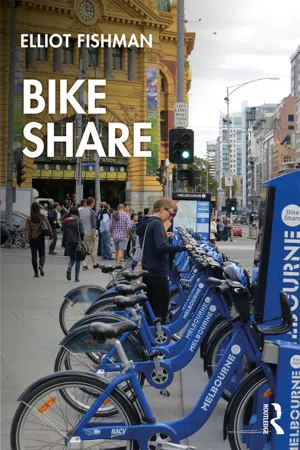
There are now over 2,000 cities with a bike share program. Bike Share examines all the major developments in the 50-year history of bike share. The book provides a detailed focus on contemporary bike share programs, including many of the most prominent systems, such as those in Paris, London, and New York, as well as the rapidly emerging dockless bike share sector. This book also addresses how rapid technological innovation, particularly in terms of mobile internet devices and electric assist bicycles may change the face of not just cycling, but urban mobility more generally.
By the end of 2018 it was estimated that there are more than 20 million bicycles in the global bike share fleet, with most of these dockless, coming online only in the last three years. Consequently, research examining bike share has not kept pace with the rapid deployment of this new form of urban mobility.
Bike Share addresses a number of key themes such as:
The urban age, contextualising bike share within a wider urbanism movement and how it sits within the growing sharing economy.
The impact of bike share, looking at systems in China, Europe, North America and Australia to see how these programs have changed travel patterns and consequent impact on car use, emissions, congestion, public health and safety.
The bike share business model, including how ride sourcing services like Uber and Lyft are beginning to integrate their business with bike share service providers.
Public reaction to bike share.
Bike share gone wrong, looking at systems that have failed to achieve their ridership estimates.
And the future of bike share including public transport smart card integration, mobile payments, and electric assist bicycles.
The book provides scholars, city planners, transportation practitioners and students with a resource that captures the most pertinent scientific findings and practical lessons that have been from bike share programs around the world.
The year 2007 marked a monumental shift in the evolution of human settlement. For the first time in human history, more than 50% of the world’s population lived in cities (World Health Organization, 2010), and this trend is set to see this grow to 70% by 2050. Commentators have described the current epoch as the Urban Age, characterised by a service-led economy where cities are the economic powerhouse of nations, responsible for a growing proportion of the population and GDP. The focus of this book is bike share, but prior to addressing the myriad of topics within this burgeoning new mobility option, it is necessary to contextualise bike share within wider transformations in urban transport. The changes brought about in the decades following the Second World War act as the foundation upon which ‘transport alternatives’, such as bike share began to emerge.
As urban populations have grown upwards and outwards, in combination with increasingly attainable motor vehicles, transport systems have come under unprecedented strain. The growth in motor vehicle ownership continues to grow, even though there is some evidence that per capita car usage is beginning to reduce in some developed countries (Goodwin & Van Dender, 2013).
Bike share is inextricably linked with the emergence of the sharing economy generally. What was once a relatively stagnant set of transport choices in cities has now seen a widening of options that include App-based ride sourcing platforms (e.g., Uber, Didi), peer-2-peer car share (e.g., Snappcar, Getaround), and on demand, App-based public transport. To a greater or lesser extent, these non-traditional forms of transport have diversified mobility options in cities, which have the potential to reduce car ownership (Shaheen & Cohen, 2018). These developments are now categorised as Mobility as a Service (MaaS) and also include the burgeoning shared e-scooter sector,1 which has rapidly developed in North America during the 2017–2019 period, with many other markets beginning to see e-scooters emerge as an additional transport option.
Business models are changing as well, with traditional vehicle manufacturers buying large stakes in ride sourcing service companies (e.g., GM investing $500 million in Lyft) and ride sourcing service companies buying up bike share companies (e.g., Lyft buying Motivate, the largest bike share company in the United States). In April 2018, Uber acquired JUMP, the NYC-based bike share company that operates electric bike share in San Francisco, Washington, D.C., and a number of other cities. The key value proposition for cities and communities from these platforms is that they offer mobility without the need for ownership. This helps to grow transport choices and can encourage a more rational use of the car.
1.1 Car Dependence
The urban environment was radically transformed in most developed world cities in the decades following the end of the Second World War, to accommodate the insatiable space requirements of large-scale motorised transport. The space efficiency rating of different modes of transport is shown in Figure 1.1. It shows that a 3.5 m lane can carry 2,000 people by car2 per hour, 9,000 by bus and 14,000 by bicycle. Whilst public transport is most efficient in this regard, the bicycle is the most efficient vehicle that can be used individually, without adherence to a timetable.
Figure 1.1 Carrying capacity of different modes, 3.5 m carriageway.
The effort cities across the globe went to in an attempt to accommodate the space requirements of the car have been catalogued elsewhere (e.g., see Givoni & Banister, 2010; Hickman & Banister, 2014; Newman & Kenworthy, 1999). Needless to say, these efforts have been among the largest reallocation of public space in the modern history of cities. Town squares, riverbanks, oceanfronts and forest have all given way to the space requirements of large-scale car use. Approximately half of urban land is paved to facilitate mass car use (in Los Angles this rises to 61%) according to Manville and Shoup (2005).
Car-based urban transport mentalities have, over decades, resulted in what transport researchers Professors Newman and Kenworthy coined automobile dependence (Newman & Kenworthy, 1999), in which the travel choices people make became constrained as spending on urban freeways grew and public transport investment decreased. The broadening geography of cities made the automobile the default mode for many, and this had a self-reinforcing circle that Ivan Illich captures succinctly in the passage below taken from Energy and Equity (Illich, 1973):
Beyond a certain speed, motorized vehicles create remoteness which they alone can shrink. They create distances for all and shrink them for only a few.
The cycle of car dependence is illustrated in Figure 1.2.
Figure 1.2 Cycle of car dependence.
The Cycle of Car Dependency illustrated in Figure 1.2 is particularly prevalent in the outer suburbs of North American and Australian cities, in which almost all trips are driven, often with an occupancy rate of around 1.1 people per vehicle. This phenomenon has been termed forced car use by Professor Graham Currie et al. (2007), where people must drive, regardless of what their preference might be, as it is the only viable mode of transport on offer. Figure 1.3 provides an illustration of mode share across a range of cities. Melbourne, Los Angeles and Sydney all show the car accounts for more than half of all trips. Berlin, Beijing and Shanghai demonstrate a more diversified mix of transport modes, with no single mode type making up more than 35% of all trips.
It is important to recognise that for all the cities shown in Figure 1.3 (with the exception of Beijing and Shanghai), the data relate to the journey to work. However, whilst it is common to focus on this journey type, in reality, it constitutes only a small percentage of overall travel (usually between 15% and 20% of all trips). Figure 1.4 provides a snapshot of journey types for Paris and London, demonstrating that the commute represents a minority of trips. Importantly, non-work trips tend to be of shorter distance and duration than commute trips (Transport for NSW, 2014). This is important as it is the trips between 1 and 7 km that are most easily transferred to bike share, as longer trips become uncompetitive with motorised transport.
Figure 1.3 Mode share, selected cities.
Figure 1.4 Journey purpose, London and Paris.
One possible reason for the rise in the popularity of bike share is the high number of trips occurring in cities that are within a cyclable distance. For instance, in Sydney, over 6 million car trips currently take place on an average weekday that are under 5 km, according to the Sydney Household Travel Survey (Transport for NSW, 2014). Similarly, in London, a third of car trips are less than 2 km (Transport for London, 2012). This underlines the potential for bike share to act as an effective replacement for the millions of short car trips taking place in the world’s major cities every day. Conventional understandings of transport mode choice recognise that travel choice is a balance between time competitiveness, cost and convenience (Schwanen & Mokhtarian, 2005). Interestingly, there is also some evidence that difficulty finding a car park can be a central motivation for using non-car-based transport options (Transport for NSW, 2014). This underlines a central theme within this book; people do not make transport decisions in isolation. They consider the pros and cons of the various modes available. Bike share, if it is to be well used, needs to be competitive on a time, cost and convenience basis. It also needs to feel safe, and a lack of bike infrastructure is a principle barrier to higher levels of cycling in many cities (Pucher & Buehler, 2011, 2012).
More recently, the public transport planner Jarrett Walker has outlined some of the simple rules of geometry that make widespread car use unsuitable for growing cities (Walker, 2016). Walker explains that as a city’s population grows faster than the land area it consumes, there is less space per person, and because cars take up a lot of space, congestion is the inevitable consequence of a policy fixated on maintaining current levels of car use. As Walker said recently, ‘if it doesn’t scale, it doesn’t matter’ (Walker, 2018), meaning that if a certain mode of transport does not effectively move large volumes of people in a space-efficient manner, it is not a mode of transport suitable for densifying cities.
Autonomous vehicles are anticipated by some to become a reality on city streets over the next 5–15 years. Already, a large number of companies are testing driverless cars on public streets. In 2018, Waymo, the computer-driven car unit of Google parent company ‘Alphabet’, was given approval to test cars without a safety/backup driver on public roads in California. These driverless cars are likely to open up affordable ‘robo-taxis’ that whilst potentially improving road safety could exacerbate car use and congestion (Fagnant & Kockelman, 2015). People too old or young to drive cars may be able to summon them in the future. The cost of e-hailing a robo taxi could be equivalent to a public transport ticket, encouraging more people to opt for the door-to-door convenience of car use over the more space-efficient public transport service. People may also choose to live further away from their work, as they no longer have to engage in the act of driving, freeing them to do other things. Some researchers also speculate that driverless cars (especially if privately owned) may contribute to the so-called ‘empty miles’ where a car without any occupants is summoned to make a pickup. All these scenarios are plausible and result in greater vehicle kilometres travelled (VKT).
1.2 Individually Owned Cars Were Never a Good Match for Cities
Cars and cities were never a good match....
Table of contents
Cover
Half Title
Title Page
Copyright Page
Table of Contents
Acknowledgements
1 Introduction
2 Bike Share’s History
3 The Growth of Bike Share
4 The Benefits of Bike Share
5 Demographics of Bike Share Users
6 Bike Share Innovation and Technologies
7 The Challenges of Dockless Bike Share Parking
8 The Business of Bike Share
9 When Bike Share Goes Wrong
10 Factors Determining Bike Share Use
11 Bike Share Catchment and Station Location Planning
12 Getting the Most Out of Bike Share: Designing a User-Orientated System – Summary of Key Factors
13 Conclusion
Index
Trusted by 375,005 students
Access to over 1.5 million titles for a fair monthly price.
Study more efficiently using our study tools.
Frequently asked questions
Yes, you can cancel anytime from the Subscription tab in your account settings on the Perlego website. Your subscription will stay active until the end of your current billing period. Learn how to cancel your subscription
No, books cannot be downloaded as external files, such as PDFs, for use outside of Perlego. However, you can download books within the Perlego app for offline reading on mobile or tablet. Learn how to download books offline
Perlego offers two plans: Essential and Complete
Essential is ideal for learners and professionals who enjoy exploring a wide range of subjects. Access the Essential Library with 800,000+ trusted titles and best-sellers across business, personal growth, and the humanities. Includes unlimited reading time and Standard Read Aloud voice.
Complete: Perfect for advanced learners and researchers needing full, unrestricted access. Unlock 1.5M+ books across hundreds of subjects, including academic and specialized titles. The Complete Plan also includes advanced features like Premium Read Aloud and Research Assistant.
Both plans are available with monthly, semester, or annual billing cycles.
We are an online textbook subscription service, where you can get access to an entire online library for less than the price of a single book per month. With over 1.5 million books across 990+ topics, we’ve got you covered! Learn about our mission
Look out for the read-aloud symbol on your next book to see if you can listen to it. The read-aloud tool reads text aloud for you, highlighting the text as it is being read. You can pause it, speed it up and slow it down. Learn more about Read Aloud
Yes! You can use the Perlego app on both iOS and Android devices to read anytime, anywhere — even offline. Perfect for commutes or when you’re on the go. Please note we cannot support devices running on iOS 13 and Android 7 or earlier. Learn more about using the app
Yes, you can access Bike Share by Elliot Fishman in PDF and/or ePUB format, as well as other popular books in Technology & Engineering & Urban Planning & Landscaping. We have over 1.5 million books available in our catalogue for you to explore.