eBook - ePub
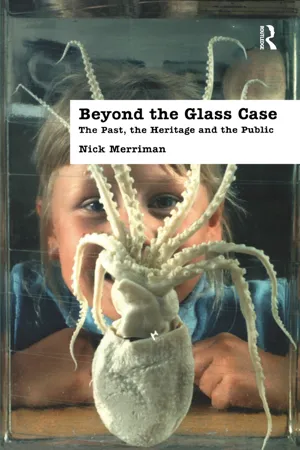
Beyond the Glass Case
The Past, the Heritage and the Public, Second Edition
- 200 pages
- English
- ePUB (mobile friendly)
- Available on iOS & Android
eBook - ePub
About this book
The book is the result of a nationwide survey in the UK that measured public use of and attitudes to the past, archaeology and collecting. The author reviews this research in the light of contemporary theory on ideology and representation and goes on to develop a convincing explanation for the failure of museums and similar institutions to connect with the majority of the public. Merriman marshals the empirical and theoretical work to make a powerful case for a new approach to attract the under served populations; one which encourages a view of the museum as a service helping its public to see, understand and engage with its own personal, local and multi-faceted past.
Introduction
'The most remarkable aspect of Western ideology is its leechlike addiction to its past'
(J. H. Plumb, The Death of the Past, Macmillan, London, 1969: 51)
Access to the past
The premise of this book is that the past is something that belongs to all, irrespective of the circumstances of their birth and upbringing. Consequently everyone should have the right to gain access to their history, even if they choose not to avail themselves of this opportunity. Museums and similar organisations are one of the principal means by which people can gain access to the past, and everyone should thus have the opportunity to visit them and feel at home in them. Their role as guardians of the heritage thus makes them different from other cultural institutions such as cinemas, where there is little concern to bring in a public that reflects the diversity of the total population.
For a long time museums have been seen by curators as educational institutions just as much as places as diversion, and their potential to provide universal access to knowledge has long been accepted. This aim has been adopted by the Museums Association (1945: 33) and has been enshrined in numerous international resolutions (e.g. UNESCO 1982) and in the founding charters of many museums. The British Museum Act of 1753, for example, explicitly constitutes the museum as being 'not only for the inspection and entertainment of the learned and the curious, but for the general use and benefit of the public' (quoted in Crook 1972: 39). Particular emphasis has at times been placed on the potential that museums have to be 'people's universities', acting as institutions for the promotion of lifelong learning within the community, especially giving a second opportunity for education for those who did not take full advantage of the formal schooling process (Chadwick 1980, Millas 1973). More recently, with the proclamation of a 'new museology' (Mayrand 1985) the potential of museums as a positive social force has been raised with renewed vigour. It is argued that museums should now be actively involved in their communities, helping them to build their own past for themselves whether in rural areas (Teruggi 1973) or in the inner cities (American Association of Museums 1972) while at the same time raising awareness of contemporary issues such as famine, racism and drug abuse (Hancocks 1987).
There is, then, a considerable body of opinion attesting to the democratic potential of museums, and a body of recommendations and legislation enshrining the principle of public access for all. The well-documented existence of a heritage boom (Hewison 1987) might in fact be taken as a demonstration that museums are fulfilling their functions well and helping a large public to gain a sense of their history. However, the expansion in heritage presentations has not been accompanied by an expansion in the range of people visiting them. Time and time again surveys show that individuals of above average income and affluence are represented far out of proportion to their numbers in the population as a whole (English Tourist Board 1982a, HMSO 1981, Prince 1983). At present, it seems that this democratic potential of museums is still not being fulfilled. One reason for this must be that, ever since their inception, museums have been associated with the elite, and their imposing architecture and their glass cases have symbolically and literally excluded large sections of the population from them. In order to explore their full potential, we must now work to dismantle the cultural barriers that have been deterrents to wider participation in museums.
This book principally focuses on opening up access to museums, but in order to do this it has been necessary to examine the public's relationship with the past in a broader way, because the premise of accessibility raises fundamental questions concerning ideology, the role of museums, and the nature of the past, before even the premise itself can satisfactorily be accepted. At the heart of this enterprise is an engagement with the theoretical issues that concern the social context of museums and museum visiting within our society. Until recently, most literature about museums consisted of technical reports of exhibitions and equipment, proceedings of conferences, a few histories (e.g. Bazin 1967) and even fewer examinations of the social and educational role of museums (Adam 1939, Wittlin 1949). It was only the art history field, because of the nature of its subject matter and the strong academic tradition of art curators, that showed much interest in the theory of representation and interpretation in museums. Only in the last few years has it become recognised that theory has a place in museum training because hitherto the prevailing ideology amongst museum workers has been that their duties (collection, documentation, preservation, research, interpretation) are all commonsense techniques requiring perhaps discussion of method but not of underlying philosophy. The lack of debate about the nature and role of museums has led to the impression that museums are somehow different from the rest of society and not the product of specific historical circumstances, and that the knowledge they produce is in some way objective and value-free. Thankfully, over the last fifteen years or so the situation has improved greatly partly from pressures within museums from a new generation of workers schooled in these debates, and partly as a result of the increased number of postgraduate courses in museum studies. Museum studies has moved on from the learning of technical processes to a more all-encompassing enquiry of the underlying philosophies of practice.
The assimilation of debates from the wider social sciences has led to the gradual realization that both the institutional framework within which museums operate, and the information they disseminate, are not neutral or natural, but are the product of very particular social conditions and have a definite social and political role beyond that of simply telling people about the past (or present). The development and flourishing of museums in Western society has occurred under particular historical circumstances and they had, and still do have, a particular social and ideological role, which has by and large been associated with the dominant classes. Once we accept, as we must, that museums have a social role, we must then ask what this is (or indeed what different roles it plays for different groups of people). The study of this aspect of museums then becomes an exercise in the historical and contemporary sociology of a particular institution. In order to do this, then, we must study, critically, the history of museums, and combine this with an understanding of how they function in contemporary society. There can be many branches to this study, ranging from analyses of the culture of the museum profession to the ideology expressed in the exhibitions. This contribution to the debate attempts to understand how people themselves think about the past and museums and how they use them, rather than how analysts think they use them.
The production and consumption of the past
Western society's obsession with the past, noted in Plumb's opening quotation, has been reflected for centuries by the study and popularisation of history, and in recent years by a proliferation of organisations that present the past to the public. Most critical reaction to the latter phenomenon has been negative. In particular, the rise of the pejoratively-termed 'heritage industry' has been seen as a symptom of the failure of modern society to face the future after the decline of industry. Instead, society is looking back to a more glorious past, but this past, as portrayed in displays led by marketing policies, is a romanticised fiction. Worse, it has become a commodity devoid of specific content, that ultimately supports the dominant ideology by showing the past as being the same as the present, and thereby prevents any conception that society could be different and thus silences any potential dissent and conflict. In Chapter 2, these arguments are presented in summary form to represent current thinking about presentations of the past. Most of these analyses take the form of formal critiques of the production of the past in the shape of such things as museum exhibitions. The consumption of the past, the way in which people think about history, and visit museums and other presentations, has rarely been studied, except in the form of superficial and repetitive surveys of the characteristics of museum visitors.
The key to providing this extra dimension, and to opening up museums to a wider public, has to be the people who visit them. In order to gain a fuller understanding of the meaning of this Western obsession with the past, we must investigate the different ways in which people use the past and its material manifestations. It is only when this is done that we will be in a position to establish whether the tradition of museum visiting and the phenomenon of the rise of heritage presentations can be explained purely by successful marketing and by the power of the dominant classes to persuade people to visit these institutions and accept the ideology encapsulated within them, or whether, as is favoured here, 'heritage' can have very positive connotations as well as negative ones, and can play a crucial, creative role in the lives of different communities.
In order to provide this dimension, a survey was undertaken of 1500 adults throughout Great Britain, on the patterns of people's heritage visiting, their attitudes to them, their images of the past, and on other, non-museum, ways in which they experience the past. At a basic level this would be useful information for those working in the field, and at a deeper level it would provide some information on how presentations of the past are consumed, and what the consumers, rather than the producers, think of them. Full details of the survey are given in Appendix 1.
The results of the survey show, as a crucial benchmark, that the majority of the population attach some value to knowing about the past. However, images of the past are, surprisingly, not nostalgic but overwhelmingly adverse. Rather than wanting to retreat to the past as a haven from today's problems, most people believe they are much better off in the present. Beneath this agreement about the harshness of the past, however, lurks a great deal of variety. Clear links exist between people's current social position and their images of the past. Those who are less fortunate in the present are more likely than any others to see the past as better in many respects than the present, while those who are well-off now see few redeeming features in the past. Images of the past, then, being rarely articulated, are an important personal way in which individuals can come to terms with themselves and their circumstances, and they can also be seen as an unspoken discourse on the present. The work on people's images of the past thus shows that people use the past creatively, and this in turn opens up the possibility that museums can act as institutions which can promote this creative and non-dogmatic use of the past. If this role for museums can become established, then the ideal of opening them up to as wide a public as possible becomes less problematic.
Having established that people use the past creatively and that museums are therefore not solely to be seen as agents of the dominant ideology, the rest of the book proceeds with exploring the aim of opening up heritage presentations to the community. Chapters 4 and 5 present central data on museum and heritage visiting on a national scale. It is confirmed that visiting is still primarily the preserve of those who are better educated and more affluent than average, but that participation has widened greatly in recent years. Deterrents to visiting are examined in detail, and it is found that cultural barriers are far more important than structural ones in influencing whether someone thinks of a visit to a museum or historic building as being a worthwhile leisure activity.
Explanations for these patterns are reviewed in Chapter 6, where it is argued that the psychological and sociological approaches both have valuable elements in them. The work of Bourdieu is particularly useful in providing a social theory which can accommodate museums, although he is unable to explain their recent popularity. A fusion of both approaches is attempted by looking at related developments in leisure theory, and by examining the history of museums. Museums still suffer from their historical associations with power and authority, which manifest themselves in the persistence of a negative image. This image is still true, to a certain extent, as museums still act as symbols of social divisions. Broadly, society can be divided up into those who see museum visiting as part of their culture, and those who reject it. More and more people, however, are taking up museum visiting as a result of their improved social status: the connotations of museum visiting make it an appropriate leisure activity with which to signal a change in status. While museums are still at root socially divisive, then, their openness allows more people to visit them, but these increased visits are to a large extent taking place because of museums' persistent social connotations.
How then are we fully to dismantle these cultural barriers around museums that still signal their association with the dominant fractions of society? One way in which this might be done is by examining non-museum approaches to the past to see if they offer any clues as to how museums might widen their appeal. In Chapter 7, a case study is made of attitudes to, and participation in, an academically sanctioned activity (archaeology) and ones that are not sanctioned (treasure hunting, beliefs in UFOs and the like). This finds that participants in both are very much like one another in terms of demographic characteristics. What distinguishes those who participate in non-sanctioned activities tends to be their enjoyment of the romantic elements of the past and its discovery, and, in some cases, their disillusionment with the present. None of the activities, however, is regularly participated in by the sort of people who tend not to go to museums and other heritage presentations.
The same is true of the other non-museum activities reported on in Chapter 8. It is the heritage-keen 'culture vultures' who are also most likely to research their family tree, collect old objects and join history and collectors' societies. When it comes to conventional means of gaining access to the past, it seems that there is a great gulf between those who undertake a wide range of activities, and those who do nothing. Crucially, it is discovered that the main way that the latter group prefers to experience the past is at home, and that the most important sense of the past for them is personal and local.
This suggests that we can best conceive of the past as two distinct fields. The first, common to all, is the personal sense of the past which relies on memory and attachment to places and things. The second, which is dominated by the educated and affluent, is the sense of an impersonal heritage which overlays the personal sense of the past. The impersonal heritage is that which has no direct connection with one's personal past, being expressed in terms of the history of other people, of the region, the nation, or the world.
With the discovery that those who do not visit museums find the personal sense of the past most appealing, a further dilemma then arises for the museum worker attempting to break open the museum beyond its narrow confines. Until recently, museums were associated with the educated bourgeoisie and aristocracy, from amongst whom the staff were recruited, and whose history was portrayed in the displays. There was thus a congruence between the public, the staff, and the contents of the presentations. Now, however, it has become abundantly clear that history cannot entirely be constituted of this world view, and that a plurality of pasts exist, often conflicting with each other. This development has now been accepted by a great many museum staff, who then have to work with this within a framework which sees little of this development reflected in recruitment into the profession, or in museum displays. Now that history has been burst open to reveal this plurality of conflicting views, how do museum curators reflect this in their work? If they do nothing, museums will be seen as shipwrecked bastions of monolithic history, peripheral to the debates raging around them, and continuing to reflect outdated ideas and practices. If the curator does wish to open up museums to reflect the diversity of historical viewpoints, he or she is then faced with the dilemma of being accused of appropriating and taming the history of nonwhite and non-middle class culture into an institution associated with the dominant groups of society.
Possible solutions to this dilemma are suggested in the final chapter, which looks at practical ways in which museums might change from being institutions which produce a single past to be consumed uncritically by a restricted public, to being services which enable a broad public to produce, in a critical way, diverse pasts of their own. When we begin to move along this road, the marvellous potential envisaged for museums for well over a century, may begin to be realised.
The scope of the book
This book is based on a large-scale postal survey, and the desire to achieve nationwide coverage of the survey has meant that analysis has had to be conducted at a very broad level, as is the case with all large surveys. Consequently, the book has only dealt with the concept of 'the museum' rather than with specific types of museums or individual museums. Deliberately, too, an undefined and generalised sense of 'the past' has been studied rather than particular periods of the past. For similar reasons, the broadness of the data means that the complexity and fine-grain of people's images of the past or their attitudes to museums have been glossed over. Thus, not all who read this book will find here the detailed answers to specific problems that they might have been expecting. Most will be able to find examples of individual museums that do not conform to the patterns described here: it can only be stressed that the general national patterns revealed here have some validity and usefulness of their own. This work was designed to examine museums as a social phenomenon at a very broad level, and ideally this now needs to be supplemented with complementary in-depth analyses of specific elements of museums, conducted in the manner of the ethnographer.
Reflecting the author's background as a prehistorian, the focus of analysis has been on the past and on museums and other insitutions that present the past. Despite this, it is recognised that not all museums concern themselves wholly or even partly with the past, and good museums should also concern themselves with the present and future. It is to be hoped, nevertheless, that some of the conclusions arising from the book apply equally to those areas of museums that are not concerned with the past.
The presentation of the data
Over 12,000 simple crosstabulations are possible with the survey data; 800 using only the main explanatory variables. Clearly some sort of selection process has to be undertaken. Tables that are essential to the argument have been presented in the main body of the text to enable easy inspection. Others that are important are found in an appendix and referred to in the text. Finally, all of the survey data are on deposit at the SERC Data Archive at the University of Essex, where they are available on-line to researchers.
All statistics presented in the tables are significant at the p=.05 level except where indicated. All percentages are rounded up to the nearest whole number, and for ease of discussion the five...
Table of contents
- Cover
- Half Title
- Title
- Copyright
- Contents
- Dedication
- List of tables
- Acknowledgements
- 1 Introduction
- 2 The death of the past and the growth of heritage
- 3 The past as discourse
- 4 Patterns in museum and heritage visiting
- 5 Public attitudes
- 6 Explaining the consumption of heritage
- 7 Archaeology and alternatives - sanctioned and non-sanctioned approaches to the past
- 8 Gaining a sense of the past
- 9 Opening up museums
- Notes
- Appendix 1: The survey method
- Appendix 2: Additional tables
- Bibliography
- Index
Trusted by 375,005 students
Access to over 1.5 million titles for a fair monthly price.
Study more efficiently using our study tools.
Frequently asked questions
Yes, you can cancel anytime from the Subscription tab in your account settings on the Perlego website. Your subscription will stay active until the end of your current billing period. Learn how to cancel your subscription
No, books cannot be downloaded as external files, such as PDFs, for use outside of Perlego. However, you can download books within the Perlego app for offline reading on mobile or tablet. Learn how to download books offline
Perlego offers two plans: Essential and Complete
- Essential is ideal for learners and professionals who enjoy exploring a wide range of subjects. Access the Essential Library with 800,000+ trusted titles and best-sellers across business, personal growth, and the humanities. Includes unlimited reading time and Standard Read Aloud voice.
- Complete: Perfect for advanced learners and researchers needing full, unrestricted access. Unlock 1.5M+ books across hundreds of subjects, including academic and specialized titles. The Complete Plan also includes advanced features like Premium Read Aloud and Research Assistant.
We are an online textbook subscription service, where you can get access to an entire online library for less than the price of a single book per month. With over 1.5 million books across 990+ topics, we’ve got you covered! Learn about our mission
Look out for the read-aloud symbol on your next book to see if you can listen to it. The read-aloud tool reads text aloud for you, highlighting the text as it is being read. You can pause it, speed it up and slow it down. Learn more about Read Aloud
Yes! You can use the Perlego app on both iOS and Android devices to read anytime, anywhere — even offline. Perfect for commutes or when you’re on the go.
Please note we cannot support devices running on iOS 13 and Android 7 or earlier. Learn more about using the app
Please note we cannot support devices running on iOS 13 and Android 7 or earlier. Learn more about using the app
Yes, you can access Beyond the Glass Case by Nick Merriman in PDF and/or ePUB format, as well as other popular books in Business & Museum Administration. We have over 1.5 million books available in our catalogue for you to explore.