- 208 pages
- English
- ePUB (mobile friendly)
- Available on iOS & Android
eBook - ePub
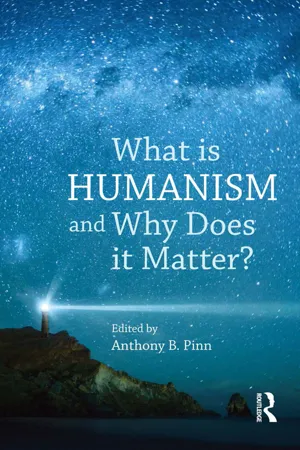
What is Humanism and Why Does it Matter?
About this book
We live in a world of social, political, economic, and religious rupture. Ideologies polarise to fuel confrontation within communities, nations and regions of the world. At this point in the twenty-first century, humanism's focus on reason, ethics and justice offers the potential to rethink and re-engage in new ways. "What Is Humanism, and Why Does It Matter?" brings together leading humanist thinkers and activists to examine humanism and how it can work in the world. Humanism is often misunderstood. The movement includes both atheists and agnostics, who seek to make ethical sense of the world based on shared human values and a concern for human welfare, happiness and fulfillment. "What Is Humanism, and Why Does It Matter?" presents an overview and exploration of the meaning and nature of humanism, both as a philosophy and as a way of engaging with the challenges of the world.
Information
PART I. WHAT IS HUMANISM?
1. HUMANISM AS EXPERIENCE
Howard B. Radest
Of all things the measure is man, of the things that are, that [or “how”] they are, and of things that are not, that [or “how”] they are not.
—Protagoras
I am a man, nothing human is alien to me.
—Terence
WHAT IS HUMANISM?
When visiting with humanists in their varied habitats,1 I often hear arguments about world-shaking ideas. I see little of the acts that ought to follow from them in personal and social life. Perhaps all this talk is a search for stability in a chaotic world; perhaps it is inevitable, given our roots in the academy and the pulpit. But still I am haunted by these repetitions of “metaphysical” arguments like the being or non-being of the deity, or institutional arguments like whether humanism is secular or religious. There is, too, a less than critical liberal politics most of us share that at times borders on self-righteousness.
I know that reason easily turns into rationalism and that acts are more elusive than words. Nor is humanism immune to the Platonic temptation, the escape to the “heaven beyond the heavens” Of course, I take pleasure in words and word-games—I am a philosopher by training after all! At the same time, I am a pragmatist. So I ask: What difference to the world we live in does our talk make? What practical consequences does it have for me and for others? Soon enough, my humanism becomes uncomfortable.
To be sure, there is something about us that enjoys the word. The Talmudist and the Scholastic among our more traditional brothers and sisters testify to this. We humanists are not alone. Nevertheless, our frequent inattention to justification by results prevails despite the fact that modern humanism takes its being from participatory democracy and from the sciences. Thus:
The basic idea is presented … scientific theories are instruments or tools for coping with reality … What is essential is that theories pay their way in the long run—that they can be relied upon time and again to solve pressing problems and to clear up significant difficulties confronting inquirers … though we must always allow for the possibility that it will eventually have to be replaced by some theory that works even better.2
Words can be powerful, stirring passions like those that played no minor part in the American and French revolutions. They were inspired by the Enlightenment with its salons and pamphlets, its arts and literature, and not least of all its philosophes and Diderot’s Encyclopedia. In the nineteenth century, although he denied the humanist label, Felix Adler established Ethical Culture, a non-creedal reformist religious movement that surely deserves the adjective, humanist. A charismatic speaker, Adler condemned the self-satisfied churches and temples of his day and called instead for a religion of the “deed.” Thus, in resigning the presidency of the Free Religious Association in 1882, he said
What has Boston done for the honor of our principles? What great charitable Movement has found its source here among those who maintain the principle of the freedom of religion? What living thing for the good of mankind, for the perfecting of morality among yourselves and others emanated within the last twenty years from the Free Religious circles of this city? I say to you friends … these annual meetings will not answer.3
Adler and the Ethical Culture societies followed with a dramatic record of achievements in education, housing, law, business, politics, health care, settlement houses, and so on. He and his colleagues created a legacy of the act that still motivates his successors nearly 150 years later.
Adler had company. Unitarian radicals in the first half of the twentieth century, ministers like Curtis Reese, formerly a Southern Baptist preacher, John Dietrich, formerly a minister in the Reformed Church, and Charles Potter, formerly a Baptist minister, led the way to institutional and organizational change. The move—and not just among Unitarians—toward ethical and naturalist religion gained momentum here and abroad. With that move, the market place and the laboratory joined the academy and the pulpit as the scene of religious reform. From that move in religion and philosophy emerged consequences for person and society, and, indeed, for inquiry itself. For example, Dietrich wrote:
There are two theories of the world—the theistic view, which holds that the world is under the control of a supernatural being … and that without his will nothing can be done. The other is the Humanistic view, which teaches that everything that is done in this world is done by man in accordance with the laws of nature … it depends upon man what the world shall be like. The adherents of this view hold that if man wants more water, he must build reservoirs and lay pipelines; if he wants freedom from pestilence, he must develop medical science; if he wants food, he must cultivate the soil; if he fears natural forces, like fire and water, he must devise his own protection, build dikes and form fire companies; if he would eliminate his woes, he must do it himself … Man in his own strength must grapple with the forces of nature. Man in his own strength must face and solve his problems. Man in his own strength must work out his own salvation … the good fairies are gone forever.4
Humanism thus received its inspiration and its agenda; people less enamored of the traditions found in ethical and liberal religion a new home.
Not too long after these pioneering moments, the humanist habit of issuing manifestos (1933, 1973, 2003) emerged, joined also by less formal statements such as “A Secular Humanist Declaration”5 or, more recently, “Neo-Humanist Statement of Secular Principles and Values: Personal, Progressive, and Planetary”6 These tried in vain to offer in humanist guise an equivalent to Martin Luther’s 95 Theses nailed to the church door. Nor was the word “manifesto” accidental. It was intended to offer an alternative to Marx’s Communist Manifesto. Rooted in the urban and intellectual middle class, however, modern humanism failed to gain a popular following in either religion or politics.
Following on the first manifesto, humanists, led by Ed Wilson, organized the American Humanist Association (AHA) in 1941. Then and now, however, there have been many more humanists than are counted in the membership of humanist organizations. Over and over again, here and abroad, I have met women and men who claim they are “humanists.” When asked, they answer with language and feeling that looks very much like faith, all the while denying that they are religious. They cite or paraphrase the statements cited above. All of them refer to the “dignity and worth” of the human being. They affirm with the intensity of belief that reason, science, and free inquiry are the only reliable methods of knowing, and that participatory democracy is the only morally acceptable form of political and social institution. To be sure, the substance of their passions may be differently nuanced and may include all or only some of the following: free thought, atheism, naturalism, secularism, ethical religion, or even a romantic or esoteric revision of the deity or deities.
Humanism at times calls itself a “movement” In reality, it is an agglomeration of individuals and a plurality of small organizations. Modern humanism, like its Enlightenment predecessor, affirms democratic values like autonomy and moral competence of the person. But it lacks the coherence of a movement and the instruments for continuing research into the epistemic and metaphysical status of the ideas it uses or their import for personal and social conduct. Typically, it relies on a literature that more often than not fails to identify itself as humanist. Absent disciplined inquiry, the language of humanism becomes commonplace, trite.
Humanists do not exhibit strong commitment to humanism’s organizations. They are for the most part “non-joiners”7 A relatively well-off urban middle class, they are “non-givers” too. So humanist organizations struggle to survive. As it were, humanists long ago discovered the non-responsible notion that they could be humanist without associating formally or otherwise with other humanists, a phenomenon now visible among more traditional faiths, too, where we find people, particularly the young, claiming to be “spiritual” without being “religious” On the whole then, most humanists are what I may call humanists by themselves. A pervasive and erosive individualism, perhaps another instance of Dewey’s “ragged individualism,”8 subverts modern humanism.
The Enlightenment was an incarnation in naturalistic and democratic terms of the Classical, Catholic, and Renaissance humanisms that preceded it in the West. Like them, it celebrated the richness of the world and the powers of the person. Unlike them, it turned to a nature that was being illuminated by the sciences and to a human being able to play a responsible role in the arts, sciences, politics, and cultures. Denied were the kings, princes, and priests of history who had once provided humanism’s resources and who received the status of cultural leadership as the reward for their generosity, such as many of Catholicism’s high churchmen. With the Enlightenment, the demands of science, technology, and democracy, a new politics and a new knowledge, reshaped institutions and gave birth to less romantic bourgeois governments and pseudo-governmental organizations, such as the corporation, today’s not-for-profits. These organizations grew with their rules, technologies, and bureaucracies. By the twentieth century, they had evolved in a counter-humanist direction, that is, toward depersonalization and blandness, a verification of the alienation that Marx and the left-Hegelians had predicted.9 Humanism has yet to figure out how to challenge the modern corporate organization with an effective alternative. Instead, while critical of corporate behavior, it uncritically accepts the mechanistic and imitative structure of organization typical in the for-profit and not-for-profit world, that is, the illusion that an organizational form can simply be transported from one kind of institution to another.
The first Humanist Manifesto illustrated humanism’s failure as well as its success. It called for a new religion but relied on existing organizations, such as liberal, and not-so-liberal, churches, to carry its banner. Except for a nod toward a “socialized and cooperative economic order” in the fourteenth of its fifteen affirmations, it did not call for establishing the organizations or the leadership and the authority needed to do the work. While it was a creature of some of the better-known intellects of the period, they had other organizational locations, such as a church, a university, and so on. The Manifesto had its lead figures but no single charismatic figure as its publicly identifiable author. Its mode of creation forecast the committee as its style. Thus, thirty-four men signed it (women and people of color had yet to be discovered by humanism). About a third were academics and the rest were liberal ministers. Manifestos II and III and the efforts that followed its inspiration grew in verbiage and complexity. Lacking the elite impulse of the original document, the numbers of their signers (I was among them) grew as well. These successor statements reflected the emerging world of mass populations, of problematic moral and political situations, and of a pace of change unknown to human history.
The humanist message, unconnected to place and party, was all too easily lost in a world of ever-expanding and by now nearly anarchic communication. It is alien to the minimalist speech popular in today’s culture. To be sure, the hero or saint with his or her rallying cry is still sought in the larger society and many have borne humanist values if not humanist identities. Save the rare political or religious genius—a Gandhi, a Martin Luther King, a Nelson Mandela, an Eleanor Roosevelt—the search is unsuccessful, and probably inevitably so in our times. To be sure, the demagogues of left or right, the madmen and madwomen of politics ...
Table of contents
- Cover Page
- Half Title Page
- Title Page
- Copyright Page
- Table of Contents
- Preface
- Acknowledgments
- Part I: What Is Humanism?
- Part II: Why Does Humanism Matter?
- Part III: What Do We Do With Humanism?
- Appendix: Humanist Manifestos
- Notes
- Select Bibliography
- Contributors
- Index
Trusted by 375,005 students
Access to over 1.5 million titles for a fair monthly price.
Study more efficiently using our study tools.
Frequently asked questions
Yes, you can cancel anytime from the Subscription tab in your account settings on the Perlego website. Your subscription will stay active until the end of your current billing period. Learn how to cancel your subscription
No, books cannot be downloaded as external files, such as PDFs, for use outside of Perlego. However, you can download books within the Perlego app for offline reading on mobile or tablet. Learn how to download books offline
Perlego offers two plans: Essential and Complete
- Essential is ideal for learners and professionals who enjoy exploring a wide range of subjects. Access the Essential Library with 800,000+ trusted titles and best-sellers across business, personal growth, and the humanities. Includes unlimited reading time and Standard Read Aloud voice.
- Complete: Perfect for advanced learners and researchers needing full, unrestricted access. Unlock 1.5M+ books across hundreds of subjects, including academic and specialized titles. The Complete Plan also includes advanced features like Premium Read Aloud and Research Assistant.
We are an online textbook subscription service, where you can get access to an entire online library for less than the price of a single book per month. With over 1.5 million books across 990+ topics, we’ve got you covered! Learn about our mission
Look out for the read-aloud symbol on your next book to see if you can listen to it. The read-aloud tool reads text aloud for you, highlighting the text as it is being read. You can pause it, speed it up and slow it down. Learn more about Read Aloud
Yes! You can use the Perlego app on both iOS and Android devices to read anytime, anywhere — even offline. Perfect for commutes or when you’re on the go.
Please note we cannot support devices running on iOS 13 and Android 7 or earlier. Learn more about using the app
Please note we cannot support devices running on iOS 13 and Android 7 or earlier. Learn more about using the app
Yes, you can access What is Humanism and Why Does it Matter? by Anthony B. Pinn in PDF and/or ePUB format, as well as other popular books in Philosophy & Humanism in Philosophy. We have over 1.5 million books available in our catalogue for you to explore.