eBook - ePub
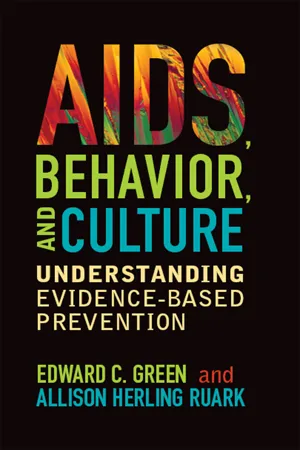
AIDS, Behavior, and Culture
Understanding Evidence-Based Prevention
- 300 pages
- English
- ePUB (mobile friendly)
- Available on iOS & Android
eBook - ePub
AIDS, Behavior, and Culture
Understanding Evidence-Based Prevention
About this book
AIDS, Behavior, and Culture presents a bold challenge to the prevailing wisdom of "the global AIDS industry" and offers an alternative framework for understanding what works in HIV prevention. Arguing for a behavior-based approach, Green and Ruark make the case that the most effective programs are those that encourage fundamental behavioral changes such as abstinence, delay of sex, faithfulness, and cessation of injection drug use. Successful programs are locally based, low cost, low tech, innovative, and built on existing cultural structures. In contrast, they argue that anthropologists and public health practitioners focus on counseling, testing, condoms, and treatment, and impose their Western values, culture, and political ideologies in an attempt to "liberate" non-Western people from sexual repression and homophobia. This provocative book is essential reading for anyone working in HIV/AIDS prevention, and a stimulating introduction to the key controversies and approaches in global health and medical anthropology for students and general readers.
Information
Chapter 1
AN ANTHROPOLOGICAL APPROACH TO AIDS PREVENTION
Anthropology as a discipline focuses on culture as a complex, adaptive system. Culture, in the famous words of E. B. Tylor in 1871, is “that complex whole which includes knowledge, belief, art, law, morals, customs and any other capabilities and habits acquired by man as a member of society.” There have been many definitions of culture since Tylor’s, including some that emphasize cognitive, linguistic, and communicative aspects to a greater degree. In the 1980s, postmodernist anthropologists questioned the entire concept of culture, arguing that it is not as uniform and static as traditional definitions had implied. But Tylor’s classic definition has held up over time as being general, descriptive, and inclusive, even if contemporary anthropologists might use more cognitively oriented definitions.
Anthropology offers a holistic view of behavior, society, and culture—of complex issues in their entirety—that transcends disciplines. Anthropologists today are trained in quantitative survey methods, but our discipline arose through a method almost unique to anthropology, that of qualitative participant-observation research. This type of research required that the researcher live with the people under investigation, under the same conditions that they do. For example, while Green was conducting his PhD research in the early 1970s, he lived in a thatch hut in a Maroon village in the Amazon rain forest, conducting fieldwork in the Saramaka language.
Anthropology prides itself on taking a comparative view, one that avoids ethnocentrism, or viewing unfamiliar behaviors and institutions through the eyes of one’s own traditions. According to the principle of cultural relativism, we strive to not judge the behavior and social patterns of others, particularly in societies different from our own, by the standards of our own culture. We analyze each culture on its own terms and in most matters strive to suspend value judgments. Of course, this cultural relativism does not necessarily mean moral relativism, and we are not suggesting that anthropologists should suspend value judgments on matters, for instance, such as rape and violence.
In the early years of the discipline, anthropologists deliberately sought to study cultures as different from their own cultures as possible. That meant studying hunting and gathering bands, tribally organized minority peoples, or disempowered peasants during the colonial and postcolonial eras. As anthropologists immersed in the lives of non-Western people, we typically underwent a profound transformative process whereby we came to see the world through the eyes of people whose culture was very different from ours. Because our fieldwork was “on the ground” and involved intense interpersonal interaction and sharing the hardships of subsistence, we could not fail to see the injustices faced by the people with whom we lived. For example, postindependence governments often pressed ahead with modernization with little consideration for tribal rights over large tracts of rainforest (or other resources), leading to trampling of land rights and human rights among minority populations. As anthropologists, we developed empathy and sympathy for these “Fourth World” peoples (a term referring to minorities in the Third World) and often found ourselves fighting for protection and justice for the underdog.
This was sometimes called advocacy or action anthropology, a form of applied anthropology in which anthropological tools are used to solve problems that face a people or a community of study, or, more broadly, to achieve specific social and policy goals. Anthropologists developed an inclination to criticize and challenge prevailing political authority, as well as conventional wisdom, which often meant criticizing a Western or European perspective. At times, we identified and exposed the economic self-interests of elite groups such as multinational corporations, when their interests and actions were at odds with the well-being of minority or otherwise disempowered groups.
This type of total immersion fieldwork in an alien culture for one or two years—once the norm—is becoming less common. Qualitative methods are still a hallmark of anthropology, and among qualitative methods, long-term participant observation has perhaps been the gold standard. Qualitative methods are well suited to studying sensitive or complex subjects, such as human sexual behavior or drug addiction. These methods are particularly useful when we don’t know much about the subject area or when the information sought is of a sensitive nature. In the first case, we would not know what questions to ask in a survey, let alone how to ask them. Nor would we have a framework for understanding the resulting answers. Second, information may relate to private, highly personal behavior such as sexual intercourse or bodily excretion, or to something illegal, such as drug use. In such a case, surveys would also be unlikely to elicit accurate (valid) information.
For example, to gain knowledge about crack cocaine addicts and their subculture, anthropologists have “hung out” on the street and in crack houses, immersing themselves in the subculture and befriending the addicts, part-time users, dealers, and criminals caught up in this lifestyle. Crack Pipe as Pimp, edited by Mitch Rattner (1993) and providing accounts from anthropologists in cities across the United States, provides a good example of this type of powerful, gripping inside account. Anthropologist Jack Weatherford, well known for his ethnography of the U.S. Congress (1985), worked as a clerk in a pornography shop in Washington, DC, to learn about the particular subculture surrounding pornography (1986). He was accepted into the subculture in part because he was willing to provide some addicts with “clean” urine of his own, so that the addicts could pass tests intended to detect drug use. Anthropologists such as Terri Leonard and Deborah Pellow brought ethnographic methods to the study of another high-risk group: commercial sex workers and their clients, both in the United States and in Africa (Leonard 1990; Pellow 1977).
THE CHECKERED HISTORY OF ANTHROPOLOGY’S STUDY OF SEXUALITY
Some anthropologists argue that the discipline of anthropology was slow to take on sexual behavior as a significant or even valid domain of research. Anthropology’s relationship to the study of sexual behavior has been complex and contradictory, and neither particularly courageous nor paradigm-shifting (Davis and Whitten 1987; Vance 1991). This may be partly because of a dubious legacy that anthropology has had to live down, which began with explorers and missionaries who told tales of unrestrained sexuality in Africa and other exotic locales. For instance, Richard Burton (an explorer regarded by many contemporaries as an anthropologist) wrote descriptions of African sexual practices to titillate the imaginations of prudish, sexually repressed Victorian readers—descriptions that anthropologist Quentin Gausset (2001) suggested might be better called ethnopornography.
It was sometimes difficult to distinguish anthropological accounts of sexual behavior from those of missionaries, explorers, or other amateur ethnographers. Leading anthropologists gave the world titles such as The Sexual Life of Savages (Malinowski 1929). Such works soon became something of an embarrassment, especially as once-remote tribal peoples become more urban and educated, sometimes earning PhDs in anthropology and studying Western cultures.
As anthropologist Carol Vance wrote in 1991, the prevailing cultural view was that “sexuality is not an entirely legitimate area of study, and that such study necessarily casts doubt not only on the research but on the motives and character of the researcher” (p. 875). Fear of being confused with ethnopornographers or of having prurient interests inhibited anthropological studies of sexual behavior from the 1950s to the early AIDS pandemic, some 30 years later. Although there have been major advances since 1991, the study of sexuality is still somewhat ill defined, at least in part because it transcends disciplinary boundaries.
To paraphrase a review of anthropological contributions to studies of sexuality, these include the social construction of sexuality (whether or not in antipathy to biomedical constructs) and of gender, identity, and sexual institutions such as prostitution. Sexuality may refer to behavior or to identity including biological identity (maleness or femaleness). Wider definitions, including those used by anthropologists, include the social foundation of sexual behavior, institutions, and structures. A third focus incorporates both orientation and preference (homosexuality, bisexuality, etc.) as well as passion, desire, and sexual response (Manderson et al. 1999).
With the rise of the AIDS pandemic, anthropologists were suddenly in demand to help gather accurate information on sexuality to explain why HIV was spreading so quickly in certain populations and parts of the globe. According to Gausset (2001), citing Fasin (1999):
The state of “anthropological emergency,” and the desire to save lives lowered the level of ethical, theoretical and methodological self-control of the researchers. … Like the first studies of African sexuality, it was once again the “exotic, traditional, irrational and immoral practices” that were the focus of the research. (p. 511)
To the extent that they have done fieldwork in the area of sexuality, most anthropologists have historically followed what is called the “cultural influence model.” This model “acknowledges cross-cultural variation in the expression of sexuality,” but “the manifestation of sexuality and its assumed biological impetus and ultimate reproductive function is generally viewed as universally consistent” (Parker and Easton 1998). Traditional anthropology has viewed key elements of sexual behavior as culturally universal (Vance 1991), yet has also documented great variability in behavior, supplying a comparative perspective that becomes essential, for example when dealing with AIDS (Parker and Easton 1998; Vance 1991). Another strength of the cultural influence model has been its use of the tools of relativism and cross-cultural variability to “question the uniformity and inevitability of Western sexual norms and mores” (Parker and Easton 1998).
Conventional anthropology also emphasizes the roles of culture and learning in shaping sexual behavior and attitudes, such as in rites of passage that initiate adolescents to adulthood and appropriate gender roles and identities. Anthropologists have long provided ethnographic accounts of societies in which sexual customs are markedly different from those in the West. Within the cultural influence model, the core of sexuality is reproduction. Thus, marriage, pregnancy, reproduction, childbearing, child rearing, menstruation, and menopause were all given due attention, but there was little investigation of nonreproductive sexuality or erotic pleasure-seeking, nor did theoretical constructs develop in this area (Vance 1991:879). Although culture is thought to shape sexual expression in the form of behavior, norms, and customs, within the cultural influence model, the foundation of sexuality (known as the sex drive or sex impulse) is assumed to be universal and biologically determined (Vance 1991:878).
In recent years, social construction theory has largely replaced the cultural influence model among anthropologists and virtually all who study sexuality. Social construction theory challenges the notion that biology determines sexual identity and behavior and criticizes the cultural influence model for being essentialist and holding that certain phenomena such as sex roles are natural and inevitable (Irvine 1990, cited in Delamater and Hyde 1998). Within social constructionism, the idea of an objectively knowable truth does not exist; Knowledge is seen as an artifact constructed through social interpretation and the subjective or emic influences of a particular group, and hence influenced by values, language, and culture in general. Social constructionism holds that identity based on sexuality is an achieved status and is molded by specific historical and cultural settings (including language and discourse) rather than a biologically determined inherited status. Sexual identity is plastic and malleable, and gender roles are performed following recognizable “cultural scripts” (Parker and Gagnon 1995).
In much recent anthropological research on sexual behavior, emphasis has shifted to the social organization of sexual interactions, to these sexual scripts found in different social and cultural settings, and to the complex relations between meaning and power and how they constitute sexual experience. Foucault’s pioneering work has led to a focus on the investigation of diverse “sexual cultures” and how they are perceived (Parker and Easton 1998) and hierarchically arranged.1 Nonacademic activists have been the primary force behind the development of social construction theory, and feminist theory and activism have greatly influenced both social construction theory and anthropologists operating within the sexual liberation paradigm.
Considering the overwhelming evidence of diversity of women’s roles cross-culturally, historically, and generationally, feminist theory also contests the implicit biological determinism in Western constructs of sexual behavior and gender differences, thereby validating social construction theory:
The existence of cross-cultural variation contradicts the notion of universal gender roles and uniform female sexuality. This attention to the cultural variability of gender roles inspired an analytical reconfiguration of the categories of sexuality and gender, fueled by the struggle for reproductive rights. (Parker and Easton 1998)
Even with the advent of social constructionism, some anthropologists have criticized their discipline for being slow to discard essentialist views of sexuality. Vance, writing in 1991, warns against a return to the cultural influence model as the “commonsense, anthropological approach to sexuality.” She observes:
The recent development of a more cultural and non-essentialist discourse about sexuality has sprung not from the centre of anthropology but from its periphery, from other disciplines (especially history) and from theorizing done by marginal groups. The explosion of exciting and challenging work in what has come to be called social construction theory during the past 15 years has yet to be felt in mainstream anthropology. (p. 865)
But nonessentialist thinking about sex roles began much earlier, with the “founding mothers” of anthropology, Margaret Mead and Ruth Benedict. Mead and Benedict, in addition to being pioneers in anthropology, also struggled to make room for women in the university and scientific establishment. Benedict was in feminist rebellion against patriarchal systems at Columbia University and she soon enlisted Mead in her efforts. Both were students of Franz Boas, considered the father of American anthropology; Boas, for his part, was determined to challenge biological determinism, the prevalent thinking of his day, by showing how much of human life is shaped by culture. Mead and Benedict also planted other seminal ideas in the field of anthropology, such as notions that sex roles are simply social inventions and are not determined by biology.
In her 1928 classic Coming of Age in Samoa, Mead popularized the idea of sexual freedom, especially for young females, famously claiming that the Samoans enjoyed lives of free love and pre- and extramarital liaisons without the burden of shame, guilt, or sexual jealousy. Coming of Age was tremendously popular, and, even after Mead’s death 50 years later, was still selling 100,000 copies a year (Dalrymple 2000). The unsubtle subtext to Mead’s work was that adolescent sexual behavior (and sexual behavior generally) should not be controlled, and that attempts to do so were antipleasure and would have negative effects. Such a message was embraced by many who felt that Western culture was repressed and that fewer sexual constraints would lead to the end of guilt, shame, jealousy, anxiety, frustration, hypocrisy, and confusion. When the first panel on gay issues was held at the 1974 American Anthropological Association meeting in Mexico City, Margaret Mead served as one of the discussants and was described as “at her best … there with her transsexual secretary, relatively open about her bisexuality, [and] absolutely tremendously supportive” (Amory n.d.).
The quality and validity of the fieldwork for which Mead is best known was later called into serious question by careful, longer term research that found that Samoan teenage girls were actually about as sexually liberated as girls in Victorian England. Anthropologist Derek Freeman, beginning with his 1986 book Margaret Mead and Samoa: The Making and Unmaking of an Anthropological Myth (and continuing through two additional books), challenged virtually all of Mead’s findings on empirical grounds.2 He found and interviewed some of Mead’s key informants, one of whom (Fa’apua’a Fa’amu) testified that she and another Samoan woman, both young women at the time, had made up stories for Mead, according to the common Samoan practice of hoaxing known as taufa’ase’e. According to Fa’amu, Mead “failed to realize that we were just joking and must have been taken in by our pretences” (Freeman 1986:viii). As a result of investigation by Freeman and others, many anthropologists today regard Mead’s fieldwork in Samoa to have little or no scientific value. But that work marked the beginning of a revolution in understanding the impact of culture, and Mead’s portrayal of Samoa found fertile ground (in anthropology and beyond) among people who wanted to believe in a society without sexual inhibitions, jealousy, or constraints to sexual expression.
We should remember that Mead (and Benedict) had no data on sexual behavior to go by and that in the 1920s there was little appreciation of the influence of culture. They lived in an age when Freud’s ideas about the power of libido operating at an unconscious level were gaining popularity in the academic world and among educated people. Herbert Marcuse would further develop Freud’s idea (presented in Civilization and Its Discontents) that the all-powerful sex instinct is unnaturally repressed by society, with Marcuse making the case that society can and should overthrow this repression and free Eros (the god of love). On the other hand, Freudian diagnostic language was used to label virtually all exceptions to heterosexual norms and behavior as pathological, which interfered with objective appraisal of variance in sexual cultures (Herdt 1999).
The developing sexual liberation paradigm also owed much to philosop...
Table of contents
- Cover
- Half Title
- Title Page
- Copyright Page
- Table of Contents
- Acknowledgments
- Abbreviations and Acronyms
- Introduction
- 1. An Anthropological Approach to AIDS Prevention
- 2. Sex, Culture, and Disease
- 3. How the Global AIDS Response Went Wrong
- 4. Refocusing HIV Prevention on Primary Prevention
- 5. Primary Prevention in Concentrated Epidemics
- 6. Facts and Myths about HIV Prevention in Generalized Epidemics
- 7. Primary Behavior Change and HIV Decline
- 8. HIV Prevention and Structural Factors
- 9. Gender, Marriage, and HIV
- 10. An Endogenous Response to AIDS
- Conclusion: Where to from Here?
- References
- Index
- About the Authors
Trusted by 375,005 students
Access to over 1.5 million titles for a fair monthly price.
Study more efficiently using our study tools.
Frequently asked questions
Yes, you can cancel anytime from the Subscription tab in your account settings on the Perlego website. Your subscription will stay active until the end of your current billing period. Learn how to cancel your subscription
No, books cannot be downloaded as external files, such as PDFs, for use outside of Perlego. However, you can download books within the Perlego app for offline reading on mobile or tablet. Learn how to download books offline
Perlego offers two plans: Essential and Complete
- Essential is ideal for learners and professionals who enjoy exploring a wide range of subjects. Access the Essential Library with 800,000+ trusted titles and best-sellers across business, personal growth, and the humanities. Includes unlimited reading time and Standard Read Aloud voice.
- Complete: Perfect for advanced learners and researchers needing full, unrestricted access. Unlock 1.5M+ books across hundreds of subjects, including academic and specialized titles. The Complete Plan also includes advanced features like Premium Read Aloud and Research Assistant.
We are an online textbook subscription service, where you can get access to an entire online library for less than the price of a single book per month. With over 1.5 million books across 990+ topics, we’ve got you covered! Learn about our mission
Look out for the read-aloud symbol on your next book to see if you can listen to it. The read-aloud tool reads text aloud for you, highlighting the text as it is being read. You can pause it, speed it up and slow it down. Learn more about Read Aloud
Yes! You can use the Perlego app on both iOS and Android devices to read anytime, anywhere — even offline. Perfect for commutes or when you’re on the go.
Please note we cannot support devices running on iOS 13 and Android 7 or earlier. Learn more about using the app
Please note we cannot support devices running on iOS 13 and Android 7 or earlier. Learn more about using the app
Yes, you can access AIDS, Behavior, and Culture by Edward C Green,Allison Herling Ruark in PDF and/or ePUB format, as well as other popular books in Medicine & AIDS & HIV. We have over 1.5 million books available in our catalogue for you to explore.