eBook - ePub
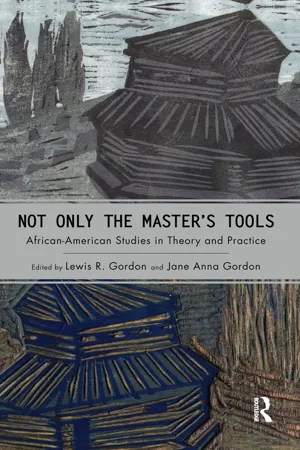
Not Only the Master's Tools
African American Studies in Theory and Practice
- 328 pages
- English
- ePUB (mobile friendly)
- Available on iOS & Android
eBook - ePub
Not Only the Master's Tools
African American Studies in Theory and Practice
About this book
Not Only the Master's Tools brings together new essays on African American studies. It is ideal for students and scholars of African studies, philosophy, literary theory, educational theory, social and political thought, and postcolonial studies.
Information
PART ONE
THE GEOPOLITICALITY OF AFRICAN-AMERICAN EPISTEMIC STRUGGLES
1
African-American Philosophy, Race, and the Geography of Reason
Reason was confident of victory on every level. I put all the parts back together. But I had to change my tune. That victory played cat and mouse; it made a fool of me. As the other put it, when I was present, it was not; when it was there, I was no longer.
—Frantz Fanon
African-American philosophy is one of the most recently developed areas of theoretical reflection in African-American Studies. Its emergence is in many ways marked by the realization of many scholars that philosophy offers much to the enterprise of studying the African diaspora, and that the unique categories of thought endemic to that diaspora offer many challenges to modern and contemporary philosophy. Central to this development has been the importance of philosophical anthropology in the study of race and the challenges posed by race to our understanding of philosophical anthropology. Added to this insight is the anxiety that is a function of studying Africana communities and the ideas they stimulate.
African-American philosophy is an area of Africana philosophy. By “Africana philosophy” I mean the set of philosophical problems and their critical discussion raised by the historical political situation of the African diaspora. African-American philosophy focuses on the New World aspect of that diaspora.
Although Africans in America preceded the introduction of Europeans and even the conception of “America,” “Europe,” and “Africa,” the convergence of the three is, for the most part, a modern affair. The peculiarity of that convergence has the form of what Michel Foucault, in “Society Must Be Defended,” calls “subjugated knowledge." It is a form of thought that relates to modernity in much the same way as does the “unconscious” in Freudian psychoanalysis—that is, as a repressed reality. But as Jean-Paul Sartre pointed out in his discussion of bad faith in the first part of Being and Nothingness, the “unconscious” seems to have a rather clear point of view. The African-American experience of repression has been both psychoanalytical and political. The psychoanalytical aspect pertains to psychosocial invisibility. The political aspect, which also has historical implications, concerns the set of repressive practices that mark the modern world’s relation to black communities—relations of colonization and racism. The consequence is one not only of social and political invisibility but also of historical amnesia. That people have been settling in the southern hemisphere of the New World for more than 40,000 years suggests that the question of African America poses a double movement of people to the New World, whom we, people of today, could recognize as those we call black people, and then subsequently, with respect to more recent black people from Africa, whom we could call modern black people.1 The tendency to locate blackness as a fundamentally modern phenomenon means, however, that those premodern, morphologically dark people who lived in the Americas for so many millennia before Columbus’s 1492 expedition should properly be designated not as black people but simply as early or premodern Americans. We may ask, as well, how we should place premodern Scandinavians such as Leif Erikson and his crew of Vikings, who made it to the northern New World as early as 1001 a.c.e. By the same stroke of reasoning that would make it ridiculous for us to say that Erikson was not “white” because of the absence of the epistemic framework for such an identity until the nineteenth century, we should be able to admit, at least, that those settlers in ancient South America nearly 40,000 years ago were black simply because the only morphologically white people around at that time were the Neanderthals in Europe and Western Asia. In this sense, then, Black American history has a large premodern set of chapters to be written.
Complicating the matter, however, is that not all people who are designated African in the contemporary world are also considered black anywhere. And similarly, not all people who are considered in most places to be black are considered African anywhere. There are nonblack Africans who are descended from people living on the African continent who can be traced back more than a millennium, and there are indigenous Pacific peoples and peoples of India whose consciousness and life are marked by a black identity. One could claim that in the context of North, Central, and South America, “black” and “African” are sufficiently identical to warrant their functioning as synonyms. A problem, however, is that such a view raises important questions of what it means to study blacks and to study Africans and to study their convergence in African America. For example, black studies, although it includes much of Africa, also extends beyond its reach. To accommodate this extension, one needs to add the term “diasporic,” and with that addition, one would expect some isomorphism with the term “black.” But even that does not work since, as we have just seen, the modern African diaspora is very different from its premodern notion. The premodern or, better, primordial African diaspora is, after all, humanity itself since it refers to the initial groups of people who spread across the earth from Africa during those times. Unless it is simply by fiat, we thus cannot avoid struggling with the distinctiveness of the categories “black” and “African.”
Let us, then, simply use the term African American to refer specifically to the convergence of African and black in the New World continents and regions of the modern world. And by African-American philosophy let us then mean the modern philosophical discourse that emerges from that diasporic community, including its Francophone, Hispanophone, and Lusophone creolizations. To articulate the central features and themes of the thought based on that intellectual heritage, I would like to begin by outlining the ideas of two men who have been the greatest influences on many (if not most) of us in the field—namely, W. E. B. Du Bois and Frantz Fanon.
W.E.B. Du Bois is important to the study of blacks and the development of black thought in the New World because he articulated most of the important themes of this area of inquiry. If there is any doubt, a consultation of nearly every text in the field would reveal his influence. Although many concepts have been generated by this great writer’s work, I should like to focus on just two here, since in many ways they have proven to be the most persistent in the thought of subsequent generations of Africana thinkers.
Du Bois and the Theodicean Problematic
Du Bois recognized that the question of black people was of philosophical importance. He formulated it hermeneutically, in The Souls of Black Folk, as the meaning of Negro/black. He understood, from his earlier empirical work on blacks in Philadelphia, that studying black people was not like studying other peoples. In his essay “The Study of the Negro Problems,” he made this clear in terms of the challenges it posed to positivistic science. In the first chapter of The Souls of Black Folk, he put it thus: “What does it mean to be a problem?” I have provided a detailed discussion of the implications of this question in the fourth chapter of my book Existentia Africana. For our purposes here, however, I should like simply to point out that the question has an implicit methodological position: People should be studied as human beings, but what do we do when the humanity of some groups is challenged? We need, in other words, to find a way to study black people without black people becoming problems-in-themselves.
The question of problem-people also raises a theodicean question. From the conjunction of the Greek words “Zdeus” (which became “deus,” “theus,” and then “theo”) and “dike,” the term “theodicy” refers to God’s justice or the justice of God. It is an area of inquiry in which one attempts to find an account of the compatibility of an all-good and all-powerful God with a world marked by injustice and evil. Theodicean problems emerge, as shown in John Hick’s Evil and the God of Love and Kwame Gyekye’s An Essay on African Philosophical Thought, from any system of thought in which God or a perfect set of gods is the source both of being and of value. Most theodicean arguments defend God’s goodness as compatible with God’s omniscience and omnipotence either through an appeal to our ignorance of God’s ultimate plan for us all or through an appreciation of the freedom endowed to us by God. In the first instance, the conclusion is that things only appear bad because serving God’s purpose is ultimately good. In the second, injustice and evil are our fault because they are consequences of our free will, which is, in the end, a good thing. In either formulation, God is without culpability for evil and injustice. In the Modern Age, theodicy has paradoxically been secularized. Whereas God once functioned as the object, the rationalization, and the legitimation of an argument, other systems have come into play, such as systems of knowledge and political systems, and they have taken up the void left by God. The clear system of knowledge is modern science and the modes of rationalization it offers. Political systemic rationalization avers an intrinsic goodness and justice of the given political system. Thus, unlike the Foucauldian model in Discipline and Punish that queries the phantom head of the king in nondiscursive practices, we face here the persistent grammar of theodicy even in an avowed-secular age. In the context of modern attitudes toward and political treatment of black folks, a special kind of theodicean grammar has asserted itself. The appeal to blacks as problem-people is an assertion of their ultimate location outside the systems of order and rationality.2 The logic is straightforward: A perfect system cannot have imperfections. Since blacks claim to be contradictions of a perfect system, the imperfection must either be an error in reasoning (mere “appearance”) or lie in black folk themselves. Blacks become rationalized as the extraneous evil of a just system.
The formation of such systems and their theodicean rationalizations lead to the generations of new forms of life—namely, those in the system and those outside the system. The “outside” is an invisible reality generated, in its invisibility, as nonexistent. The effect, then, is that a new link with theodicy emerges and the result is theobiodicean—that is, characterized by the rationalization of forms of life that are inherently justified versus those that could never be justified under the principles of the systems that form both. The result is, as Du Bois famously observed, the splitting of worlds and consciousness itself into the normative and its contradictions.
Du Bois outlines the relationship of blacks to the political and epistemic order of the modern world in The Souls of Black Folk and in the section on white folks in Darkwater through the lived-reality of double consciousness. Discussion of this concept is vast in the secondary literature on Du Bois, which I will not outline here.3 Instead, I should like simply to focus on my reading of the concept as fundamentally coextensive. It manifests itself, in other words, in several organizing motifs. The first, negative formulation is of the psychological constitution of the self. There, one is yoked to a self-image that is entirely a function of how one is seen by others. To be black, in that sense, means to be so in exclusively white terms. Another version of double consciousness emerges from the double standards of citizenship, whereby one is, say, born an American but discovers that one is not fully a citizen by virtue of being racially designated black. Why, we may ask, is being black treated as antipathetic to being an American? This leads to the notion of irreconcilable doubleness, whereby being black does not equal being an American—yet much of what is original about being an American, as Ralph Ellison showed in Going to the Territory, comes from blacks in America. This insight is crucial because the mainstream (i.e., white) American self-image is one of supposedly being an original site from which blacks play only the role of imitation. Think of Toni Morrison’s brilliant exploration of this thesis in The Bluest Eye, in which, as Gary Schwartz (1997) showed, blackness suffered the plight of being a mere imitation of life. To be an imitation is to stand as secondary to another standard—namely, the original or the prototype. We see this view of blacks in popular culture, where the adjective “black” is added to things white to suggest imitation: black Jesus, black Mozart, Ms. Black America, and so on. Blacks are even treated as imitations of their own artifacts. Few today realize, for instance, that rock ’n’ roll is a form of black music, and most of the people following the Jewish and Christian faiths imagine them to be European in origin instead of East African and from the colored Middle East.
There is also an epistemological dimension of double consciousness. The correlate of normative knowledge is the set of mainstream disciplines and their approaches to the study of black folk. The standard view is that things white represent universality and things black are locked in the web of particularity. The problem with this view from the perspective of double consciousness is that it relies on denying the contradictions of the system. Thus, only the false, self-deceiving image of a pristine, all-encompassing (white) America is offered. Blacks in America exemplify the contradictions of the political and epistemological system; they are the nation’s dirty laundry. The exposure of contradictions means that whereas whiteness relies on a narcissistic self-deceptive notion of the American social and political system’s completeness, blackness relies on pointing out the system’s incompleteness, imperfections, and contradictions. This is the insight behind the black folk adage: “One mind for the white man to see/Another that I know is me.” In short, the black world is more linked to truth than the white world because the black world realizes that the domain over which truth claims can appeal is much larger than the white world in general is willing to admit. The black world and the white world in this formulation do not refer to every individual black or white person but to those who live by the value systems of these worlds. For instance, whites who study America through the lens of Black Studies often develop the same outrage that blacks and other people of color share. Unlike the popular claim that the purpose of Black Studies is to offer the narcissism of images of the self in the form of instructor, a view totally compatible with white-centric studies but in black face, the more awkward reality is that it offers something sufficiently lacking in the (white) dominant disciplines to stimulate such ire on the part of students—namely, truth. It is not that there is no truth in most areas of the humanities and the social sciences, as well as the life sciences; rather, there is limited truth in these areas precisely because of the imposition of white normativity as a subtextual mode of legitimation. One could argue that pursuing truth in the way demanded by Black Studies might be too much to demand of instructors from other disciplines, but such an excuse could hardly be accepted by Black Studies scholars, all of whom have to work through the tenets of a minimum of two disciplinary perspectives—the white normative one and the contradictions they see from the standpoint of the world of color. What they take the time to learn is exactly what students think scholars and teachers committed to knowledge and learning should do: Explore the full domain of their subject matter, which includes taking its contradictions seriously. They may not be perfect in such an endeavor, but the spirit of such an approach offers a set of obligations responding to which would constitute a more rigorous pursuit of truth.
Epistemological doubling leads to axiological questions emerging from white normativity. Here the problem of value can be examined through, ironically, Friedrich Nietzsche’s Will to Power, on the one hand, and Anna Julia Cooper’s “What Are We Worth?” from A Voice from the South, on the other. According to Nietzsche, values suffer the symptomatic fate of nihilism when undergoing the social process of decay. When healthy, the response to the adversities of life takes the form of bringing about life-affirming values. The unhealthy response is to seek the elimination of adversity instead of issuing a constructive response to it. From a white normative perspective, white people are healthier than black people because of the absence of social pathologies associated with black people. Yet, an immediate black response is that most white people could not live in the shoes of black folk. Think, for instance, of the statistics on suicide: A mere 1 or 2 percent rise in unemployment, as Alvin Poussaint and Amy Alexander show in Lay My Burden Down, leads to suicide among whites, while many blacks, particularly black men, consistently experience an unemployment rate that is double that of their white counterparts. The travails faced by blacks in the modern age stimulated the leitmotif of modernity—namely, the blues. Although whites, too, suffer the blues, the fact is that the blues came out of black, not white, America. The litany of contributions—from George Washington Carver’s discoveries of hundreds of things to do with a peanut to African Americans’ development of unique religious institutions and innovations in mathematics and physics, despite lynchings, American Apartheid, and systematic policies of underdevelopment—suggests, from the Nietzschean perspective, a greater degree of health in black America than might be expected. Added to this observation is Cooper...
Table of contents
- Cover
- Half Title
- Title Page
- Copyright Page
- Dedication
- Table of Contents
- Introduction
- Acknowledgements
- Part I: The Geopoliticality of African-American Epistemic Struggles
- Part II: Transfigurations of African-American Being and Doing
- References
- Index
- About the Editors and Contributors
Trusted by 375,005 students
Access to over 1.5 million titles for a fair monthly price.
Study more efficiently using our study tools.
Frequently asked questions
Yes, you can cancel anytime from the Subscription tab in your account settings on the Perlego website. Your subscription will stay active until the end of your current billing period. Learn how to cancel your subscription
No, books cannot be downloaded as external files, such as PDFs, for use outside of Perlego. However, you can download books within the Perlego app for offline reading on mobile or tablet. Learn how to download books offline
Perlego offers two plans: Essential and Complete
- Essential is ideal for learners and professionals who enjoy exploring a wide range of subjects. Access the Essential Library with 800,000+ trusted titles and best-sellers across business, personal growth, and the humanities. Includes unlimited reading time and Standard Read Aloud voice.
- Complete: Perfect for advanced learners and researchers needing full, unrestricted access. Unlock 1.5M+ books across hundreds of subjects, including academic and specialized titles. The Complete Plan also includes advanced features like Premium Read Aloud and Research Assistant.
We are an online textbook subscription service, where you can get access to an entire online library for less than the price of a single book per month. With over 1.5 million books across 990+ topics, we’ve got you covered! Learn about our mission
Look out for the read-aloud symbol on your next book to see if you can listen to it. The read-aloud tool reads text aloud for you, highlighting the text as it is being read. You can pause it, speed it up and slow it down. Learn more about Read Aloud
Yes! You can use the Perlego app on both iOS and Android devices to read anytime, anywhere — even offline. Perfect for commutes or when you’re on the go.
Please note we cannot support devices running on iOS 13 and Android 7 or earlier. Learn more about using the app
Please note we cannot support devices running on iOS 13 and Android 7 or earlier. Learn more about using the app
Yes, you can access Not Only the Master's Tools by Lewis R. Gordon,Jane Anna Gordon in PDF and/or ePUB format, as well as other popular books in Social Sciences & Education Theory & Practice. We have over 1.5 million books available in our catalogue for you to explore.