eBook - ePub
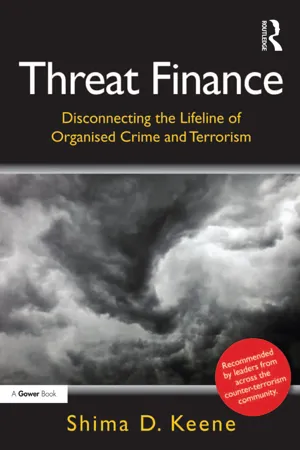
Threat Finance
Disconnecting the Lifeline of Organised Crime and Terrorism
- 328 pages
- English
- ePUB (mobile friendly)
- Available on iOS & Android
eBook - ePub
About this book
Criminal and terrorist organisations are increasingly turning to white collar crime such as fraud, e-crime, bribery, data and identity theft, in addition to more violent activities involving kidnap and ransom, narcotics and arms trafficking, to fund their activities and, in some cases pursue their cause. The choice of victims is global and indiscriminate. The modus operandi is continually mutating and increasing in sophistication; taking advantage of weaknesses in the system whether they be technological, legal or political. Countering these sources of threat finance is a shared challenge for governments, the military, NGOs, financial institutions and other businesses that may be targeted. Shima Keene's Threat Finance offers new thinking to equip any organisation regardless of sector and geographical location, with the knowledge and tools to deploy effective counter measures to tackle the threat. To that end, she brings together a wide variety of perspectives - cultural, legal, economic and technological - to explain the sources, mechanisms and key intervention methodologies. The current environment continues to favour the criminal and the terrorist. Threat Finance is an essential read for fraud and security practitioners, financial regulators, policy-makers, intelligence officials, judges and barristers, law enforcement officers, and researchers in this field. Dr Keene offers an antidote to the lack of good, applied, research; shortcomings in in-house financial and forensic expertise; misdirected financial compliance schemes; legal and judicial idiosyncrasies; unhelpful organisation structures and poor communication. She argues convincingly for a coherent, aggressive, informed and cross-disciplinary approach to an ever changing and rapidly growing threat.
Information
1
Understanding the Threat Environment
… the financing of terrorism is a sub/terranean universe governed by secrecy, subterfuge, and criminal endeavours; but also a good measure of sophistication and an understanding of the global financial system. It is best described as an octopus with tentacles spreading across vast territories as well as across a wide range of religious, social, economic and political realities.1
Dr Nimrod Raphaeli
Overview
The threat environment in relation to terrorism and related organised crime may be broadly described as falling into one of two broad categories. The first is in relation to the threat posed by the adversary. As such, the first part will provide an analysis of the adversary in terms of its motivation, modus operandi and capability, which in turn has a direct impact on the understanding of its financial requirements. Another important element that requires closer examination is the environment in which these adversaries, as well as those who attempt to counter them, operate within. In the second part, an assessment of the broader ‘threat environment’ will be provided, with special focus on key issues such as the impact of globalisation, cultural asymmetries and technological advancements.
Adversary Analysis
The adversaries examined in this section will include terrorist organisations with special focus on al-Qaeda and associated organisations as elaborated in Chapter 1.
ISLAMIC TERRORISM
Islamic terrorism, also referred to as jihadist terrorism, falls under a dimension of terrorism referred to as ‘new’ terrorism, a term broadly accepted by the academic community to include terrorism relating to Islamic extremism.2 ‘New’ terrorism differs from ‘modern’ terrorism in that the latter is used to describe an era between 1967 and 1990 referring to politically motivated terrorism.3 The recognition of the start of this period is marked by the upsurge of political terrorism by the Palestine Liberation Organisation (PLO) founded in 1964,4 and led by Yasser Arafat.
The term ‘modern’ terrorism is also used to describe other terrorist organisations, during the same period, such as the Irish Republican Army (IRA), the Basque Fatherland and Liberty (ETA) in Spain, the Abu Nidal Organisation (ANO), also known as Fatah Revolutionary Council, Arab Revolutionary Brigades, Black September and the Revolutionary Organisation of Socialist Muslims, as well as ideological based terrorist groups such as the Red Brigades in Italy.
‘New’ terrorism, on the other hand, is marked by different motives, actors, sponsors, greater lethality and generally flatter hierarchical structures.5 According to Amir Taheri, the exportation of the fundamentalist Islamic revolution from Iran in 1979 had started the ‘new kind of terrorism’.6 Whilst past terrorist movements were politically driven, these ‘new’ Islamic terrorists would be insulted if their actions were described as ‘political’ violence, as their ultimate aim is global domination in that the movement aims to convert all mankind, through choice or force, to the teachings of Muhammad.7
In addition, the National Commission on Terrorism also found that the main motivation of ‘new’ terrorism is fanaticism, as opposed to political interests, and that terrorists are more unrestrained than ever before in their methods.8 Earlier concerns about alienating people from supporting the cause are no longer important to many of today’s terrorist organisations.9 Rather than focusing on conventional goals of political movements, today’s religiously motivated terrorists seek destruction and chaos as ends in themselves.10
Although the al-Qaeda network of international terrorists is a prime example of ‘new’ terrorism, Islamic extremism is not the only form of apocalyptic and catastrophic terrorism. Aum Shinrikyo, the Japanese religious cult responsible for the first major chemical attack on a Tokyo subway in 1995, as well as the bombing of the Alfred P. Murrah Federal Building in Oklahoma by right-wing American militants, provides other examples of ‘new’ terrorism.11 However, the central focus of this publication is on ‘Islamic’ terrorism, otherwise referred to as ‘jihadist’ terrorism. As such, it is important to understand the concept of jihad which is its key driver.
THE CONCEPT OF JIHAD
The Islamic term ‘jihad’ is frequently used in the media and is arguably the most recognised Islamic concept by the West. The term jihad is widely understood to mean ‘holy war’. However, the word ‘jihad’ in reality means ‘struggle’ or ‘striving’ in the way of Allah or to work for a noble cause with determination. It should be noted that the word ‘war’ in Arabic is harb and ‘holy’ is muqadass. Therefore the true meaning of the term jihad, also referred to as the ‘sixth’ pillar of Islam, is frequently not well understood.12
Throughout history, even Muslims themselves have disputed the meaning of jihad.13 In the Qur’an, it is normally found in the sense of fighting in the path of Allah and was used to describe the warfare against the enemies of the early Muslim community or ummah. In the hadith, the term jihad is used to mean armed action, and most Islamic theologians and jurists in the classical period14 of Muslim history understood this obligation to be in a military sense.15
In classical Islam, the world is divided into two parts: dar al-harb meaning the house or abode of war, and dar al-Islam meaning the house of Islam. Muslims have an obligation to convert dar al-harb into dar al-Islam. In fact, dar al-harb and dar al-Islam were considered to be in a permanent state of war unless a truce or treaty had been agreed.16 Over time, the jurists have articulated that jihad can be qualified in four ways: jihad of the heart, tongue, hands and sword. Jihad al-sayf, the jihad of the sword, is always understood to mean fighting although the word for fighting is qital. In addition, there is a hadith that reveals a distinction between the greater and lesser jihad. The greater jihad is deemed to be jihad al nafs, the struggle against oneself, relating to the daily and never ending struggle to overcome one’s baser instincts. The lesser jihad is considered to be the jihad against the enemies of Islam.17
The relevance to counter terrorist-finance (CTF) is to understand that jihad does not necessarily refer to a physical act of war. Jihad can be achieved in numerous ways whether it is through communication, achieved through the use of propaganda ultimately leading to the recruitment of those to carry out terrorist acts, as well as to identify sponsors for the attacks. Assisting in the ‘cause’ through raising finances for terrorist purposes and assisting in the transfer of those funds is also considered to be a form of jihad. A full understanding of jihad will encourage lateral thinking in relation to CTF and counter-terrorism in general.
AL-QAEDA: A HISTORIC OVERVIEW
We – with God’s help – call on every Muslim who believes in God and wishes to be rewarded to comply with God’s order to kill the Americans and plunder their money wherever and whenever they find it. We also call on the Muslim ulema,18 leaders, youths, and soldiers to launch the raid on Satan’s US troops and the devil’s supporters allying with them and to displace those who are behind them so that they may learn a lesson.
Declaration of War by Osama bin Laden, together with leaders of the World Islamic Front for the Jihad against the Jews and the Crusaders, Afghanistan, 23 February 1998.
Al-Qaeda was established by the late Osama bin Laden in the late 1980s to bring together Jihadists who fought against the Soviet Union in Afghanistan. Despite the death of bin Laden in May 2011,19 the ambitions of al-Qaeda remains unchanged under the new leadership of Ayman al-Zawahiri.20 Its aim continues to be to establish a pan-Islamic Caliphate throughout the world by working with allied Islamic extremist groups to overthrow regimes it deems to be ‘non-Islamic’, and to expel Westerners and non-Muslims from Muslim countries. Al-Qaeda issued a fatwa under the banner of ‘the World Islamic Front for Jihad against the Jews and Crusaders’ in February 1998 proclaiming that it was in the duty of all Muslims to kill US citizens, civilian or military, and their allies everywhere.21
Al-Qaeda is the first truly global terrorist group of the twenty-first century and it confronts the world with a new kind of terrorist threat. Since the contemporary wave of terrorism began in the Middle East in 1967, no groups resembling al-Qaeda have previously emerged. The organisation has moved terrorism beyond the status of a method or technique of protest and resistance and turned it into a global instrument with which to compete and challenge Western influence in the Muslim world. It is a worldwide movement capable of mobilising a new and hitherto unimagined global conflict.22
Since 9/11, al-Qaeda has become a radical Islamic phenomenon held together through its global network of communities, whether it be a virtual community that is Internet-based or a physical network. In some instances a local command and control structure may exist, but in many cases this is not the case. The networks are united by a simplistic hatred of the West, based on the perception of victimisation of the Muslim community and the thirst for revenge through non-negotiable, religiously legitimised violence. Jihad is portrayed to many vulnerable young Muslims as a romantic struggle against the evil powerful West.
The leader and the first key financier of al-Qaeda was Osama bin Laden. Osama bin Muhammad bin Laden was born in Riyadh, Saudi Arabia on 30 July 195723 and was the seventeenth of 52 children of the Saudi construction magnate Muhammad bin Awdah bin Laden. He attended the Abdul Aziz University in Saudi Arabia where he became inspired by tape recordings of sermons by Abdullah Azzam, a Palestinian and a disciple of Qytb.
It is interesting to note that Bin Laden’s influence which led to his leadership and iconic status in international terrorism was as a result of money. He was conspicuous among the Afghan volunteers not because he showed evidence of religious learning but because he had access to some of his family’s fortune. Although he took part in at least one actual battle, he became known chiefly as a person who generously helped fund the anti-Soviet jihad,24 highlighting yet again, the significance of money.
Bin Laden understood better than most of the volunteers, the extent to which the continuation and eventual success of the jihad in Afghanistan depended on an increasingly complex, global organisation. This organisation included a financial support network that came to be known as the ‘Golden Chain’, put together mainly by financiers in Saudi ...
Table of contents
- Cover Page
- Dedication
- Title Page
- Copyright Page
- Contents
- List of Figures and Table
- List of Cases
- List of Statutes and Statutory Instruments
- About the Author
- Acknowledgements
- Reviews of Threat Finance
- Introduction
- Chapter 1 Understanding the Threat Environment
- Chapter 2 Emerging Threats: Security and Legal Challenges in the Cyber Environment
- Chapter 3 Terrorist Finance
- Chapter 4 Mechanisms of Illicit Funds Transfer
- Chapter 5 Money Laundering
- Chapter 6 Key Methods of Intervention
- Chapter 7 Addressing Key Challenges
- Chapter 8 Conclusions and the Way Forwards
- Bibliography
- Index
Trusted by 375,005 students
Access to over 1.5 million titles for a fair monthly price.
Study more efficiently using our study tools.
Frequently asked questions
Yes, you can cancel anytime from the Subscription tab in your account settings on the Perlego website. Your subscription will stay active until the end of your current billing period. Learn how to cancel your subscription
No, books cannot be downloaded as external files, such as PDFs, for use outside of Perlego. However, you can download books within the Perlego app for offline reading on mobile or tablet. Learn how to download books offline
Perlego offers two plans: Essential and Complete
- Essential is ideal for learners and professionals who enjoy exploring a wide range of subjects. Access the Essential Library with 800,000+ trusted titles and best-sellers across business, personal growth, and the humanities. Includes unlimited reading time and Standard Read Aloud voice.
- Complete: Perfect for advanced learners and researchers needing full, unrestricted access. Unlock 1.5M+ books across hundreds of subjects, including academic and specialized titles. The Complete Plan also includes advanced features like Premium Read Aloud and Research Assistant.
We are an online textbook subscription service, where you can get access to an entire online library for less than the price of a single book per month. With over 1.5 million books across 990+ topics, we’ve got you covered! Learn about our mission
Look out for the read-aloud symbol on your next book to see if you can listen to it. The read-aloud tool reads text aloud for you, highlighting the text as it is being read. You can pause it, speed it up and slow it down. Learn more about Read Aloud
Yes! You can use the Perlego app on both iOS and Android devices to read anytime, anywhere — even offline. Perfect for commutes or when you’re on the go.
Please note we cannot support devices running on iOS 13 and Android 7 or earlier. Learn more about using the app
Please note we cannot support devices running on iOS 13 and Android 7 or earlier. Learn more about using the app
Yes, you can access Threat Finance by Shima D. Keene in PDF and/or ePUB format, as well as other popular books in Derecho & Negocios en general. We have over 1.5 million books available in our catalogue for you to explore.