- 216 pages
- English
- ePUB (mobile friendly)
- Available on iOS & Android
eBook - ePub
About this book
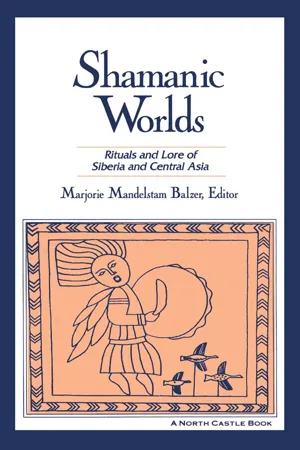
The ancient heartland of shamanism is no longer forbidden territory - to travelers or to the spirits. But the spirits never left the vastnesses of Siberia and Central Asia, as these writings reveal. Russian and native experts, and an American cultural anthropologist who has done fieldwork in the region, introduce us to shamans as the poets, therapists, healers, and even leaders of their communities. Among the special features of this collection are remarkable transcriptions of shamanic exhortations and a pathbreaking study of shamanic tales and rituals.
Information
Part I.
Debates, Definitions, and Indigenous Perspectives
Chosen by the Spirits
Is the Shaman Sane?
The occupation of shaman required vigorous health, as well as numerous skills. The Eskimos acknowledged only healthy persons as shaman. The Nenets shaman was expected to have a strong frame. And among the Saami in ancient times, only a person at the height of physical and mental health could be a shaman. A man older than fifty years, especially one who had lost his teeth, could not be a servant of the spirits.
But the life of a shaman involved a condition alien to healthy individuals. One thing about the shamans has always impressed observers: the incoherent exclamations and movements, the foaming at the mouth, vacant stare, and total loss of consciousness at one of the most critical moments of the ritual. In the nineteenth century, this was usually given a simple and obvious explanation: the shamans were adroit deceivers and swindlers, feigning possessions by “demons” in order to fleece their trusting tribesmen. At the beginning of our century, a different opinion prevailed: the shamans were persons of a disordered mind, neuropaths. While the suggestion is still very muted in V. M. Mikhailovskii (1892), by 1905 N. N. Kharuzin was proposing “to recognize that the true shamans … are first and foremost neuropathic persons, in whom the nervousness has developed in a particular direction.” V. G. Bogoraz asserted that, among the shamans known to him, “many were almost hysterical, and some were literally half-insane.” “Shamanism”—he declared in 1910—”is a form of religion created by selection of the most nervously unstable persons.” G. V. Ksenofontov published The Cult of Madness in Ural-Altaic Shamanism in 1929. D. K. Zelenin wrote in 1935 that a healthy individual could not even become a shaman: only a neuropath, whom “the spirits are continually entering,” could cure those suffering from “spirit possession” without risk to personal health. “The shaman … is a neuropath, obliged by the community of the clan to assume a peculiar medical function-to personally absorb the demons of disease from the sick of the community”—writes Zelenin. Similar views prevailed in Western European scholarship. The Danish investigator A. Ohlmarks, for example, linked shamanism to the severe Arctic climate, which he claimed produced mental anomalies suitable to the development of shamanism.

During the seance, the shaman consorted with spirits in a state of ecstasy. A special assistant maintained this state by chanting or accompanying on the drum. In the photo: a Nganasan shaman with his assistant (1978).
We find the clearest and most concise argument in favor of regarding the shaman as a neuropath in S. A. Tokarev: “All observers unanimously report that the shaman is most notably a nervous, hysterical person, prone to seizures, occasionally an epileptic…. The shamanic seance itself has much similarity to an hysterical attack.”1
The inherited character of shamanism (among most peoples) led to the belief that special mental qualities “characteristic” of shamans were passed on through heredity. A. V. Anokhin wrote in 1929 that shamans “receive their predisposition to the shamanic vocation from their ancestors alone, through a nervous ‘falling’ sickness, epilepsy. Against this wearisome, often fatal disease, the natives have no recourse other than the seance. The seance offers the epileptic a release from illness. And observations show that while performing, the shaman is in fact not sick.” A person becomes a shaman (in Anokhin’s estimation) for “purely physiological” reasons.
L. Ia. Shternberg is more cautious: “In order to become a shaman, it is essential to have a particular morbid neural organization, extreme excitability, a tendency to ecstatic fits, a susceptibility to various kinds of hallucination, and so forth—in a word, to suffer from some degree of hysteria. And hysteria, we know, is easily transmitted by heredity.” Shternberg emphasizes that the “shamanic illness,” accompanied by fits, fainting spells, and hallucinations, usually occurs “in the so-called transitional years, at the onset of sexual maturity.”
Thus, it was patently clear that shamans were persons with a deranged mind! And the hypothesis, never verified, triumphantly proceeded from one work to another. As frequently happens in science, an opinion once received is no longer doubted. Even the renowned neuropathologist S. N. Davidenkov in 1947 talked of shamanism as a “cult of hysteria,” “a socially organized neurosis, taking a finished and stable form.” (These remarks were based on information taken from the literature.)
The view of the shaman as mentally ill reigned in science for nearly half a century. True, S. M. Shirokogorov (1919), I. N. Kosokov (1930), and I. M. Suslov (1931) did not agree, but their objections went unnoticed. In the West, one of the first to reject this opinion was N. Chadwick in 1936, but this criticism did not result in abandonment of the former concept. Only in the past twenty or thirty years has a marked change occurred: the assertion that the mind of the shaman is characterized by deviations from the norm is no longer satisfactory to many scholars. However, the idea of the neurasthenic shaman is still alive today.
Is it correct? Is the shaman sane? It is time to have a clear answer to this question. The shaman is not a haphazard figure in the history of humanity. He is a person who has taken on the functions dictated by the norms of his culture. Today, the view of the shaman as a sick person is difficult to accept, as it is in conflict with a broad range of facts. Our purpose is to examine these facts. In order to refute the hypothesis of the neurasthenic shaman, we shall consult the identical materials giving rise to it—the observations of the ethnographers.
First of all, the ethnographic material does not support the “biological” basis of the “shamanic illness,” which allegedly appears during the years of age-related changes in the organism associated with sexual maturation. To be sure, there are many reports of the illness beginning to perturb the future shaman at the age of puberty. But the literature also abounds in information on those who began to shamanize after the age of twenty, thirty, or even forty. “A Selkup who is to become a shaman would take ill at different ages, from fourteen to fifteen, but usually later, twenty or twenty-one,” writes E. D. Prokof’eva. “The onset of the calling of shaman ranges between those six and fifty years of age. The largest percentage occurs in the twentieth year,” we read in Anokhin. The number of such statements is huge. According to my materials, a good many Uzbek shamanesses underwent the “shamanic illness” well after marriage, already having one to three children. I met an Uzbek shaman to whom the spirits appeared when he was around sixty years old. Thus, “shamanic illness” is not necessarily and naturally linked to age-related changes in the body, and it may be presumed that it is caused by factors of a different quality.
It is more accurate to seek these factors in the particularities of the early forms of human culture. Beginning in remote antiquity, it was thought that insanity and nervous disorders occur by the will of the spirits. Granted this fact, a person in possession of the spirits should exhibit attacks, fainting spells, and behavior that is inexplicable to the sound mind. The necessity of the attacks and madness may have been suggested to the shaman by the traditions of his people. He who was chosen by the spirits would fall into a fit not because he had epilepsy or a neurosi...
Table of contents
- Cover
- Half Title
- Title Page
- Copyright Page
- Dedication
- Table of Contents
- About the Editor and the Contributors
- Introduction
- Part I. Debates, Definitions, and Indigenous Perspectives
- Part II. Wedding Theory an Field Data
- Part III. A Final Tribute
- Bibliography
Trusted by 375,005 students
Access to over 1.5 million titles for a fair monthly price.
Study more efficiently using our study tools.
Frequently asked questions
Yes, you can cancel anytime from the Subscription tab in your account settings on the Perlego website. Your subscription will stay active until the end of your current billing period. Learn how to cancel your subscription
No, books cannot be downloaded as external files, such as PDFs, for use outside of Perlego. However, you can download books within the Perlego app for offline reading on mobile or tablet. Learn how to download books offline
Perlego offers two plans: Essential and Complete
- Essential is ideal for learners and professionals who enjoy exploring a wide range of subjects. Access the Essential Library with 800,000+ trusted titles and best-sellers across business, personal growth, and the humanities. Includes unlimited reading time and Standard Read Aloud voice.
- Complete: Perfect for advanced learners and researchers needing full, unrestricted access. Unlock 1.5M+ books across hundreds of subjects, including academic and specialized titles. The Complete Plan also includes advanced features like Premium Read Aloud and Research Assistant.
We are an online textbook subscription service, where you can get access to an entire online library for less than the price of a single book per month. With over 1.5 million books across 990+ topics, we’ve got you covered! Learn about our mission
Look out for the read-aloud symbol on your next book to see if you can listen to it. The read-aloud tool reads text aloud for you, highlighting the text as it is being read. You can pause it, speed it up and slow it down. Learn more about Read Aloud
Yes! You can use the Perlego app on both iOS and Android devices to read anytime, anywhere — even offline. Perfect for commutes or when you’re on the go.
Please note we cannot support devices running on iOS 13 and Android 7 or earlier. Learn more about using the app
Please note we cannot support devices running on iOS 13 and Android 7 or earlier. Learn more about using the app
Yes, you can access Shamanic Worlds by Marjorie Mandelstam Balzer in PDF and/or ePUB format, as well as other popular books in Theology & Religion & Politics. We have over 1.5 million books available in our catalogue for you to explore.