eBook - ePub
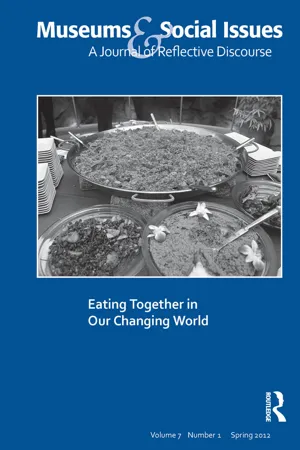
Eating Together in Our Changing World
Museums & Social Issues 7:1 Thematic Issue
- 136 pages
- English
- ePUB (mobile friendly)
- Available on iOS & Android
eBook - ePub
Eating Together in Our Changing World
Museums & Social Issues 7:1 Thematic Issue
About this book
This is Volume 7, Number 1, Spring 2012 edition of Museums and Special Issues reflective discourse journal. This edition looks at Eating Together in Our Changing World and the questions of What is the food movement? Were we talking about new food technologies? Community gardens? Depictions of food by artists? Seed banks? Health? All rooted in food, all relevant, all happening in museums, but what was the heart of the issue? Why are we talking about food? Perhaps it is because when we talk about food, we are talking about our most basic connection to each other and the earth we share.
Trusted by 375,005 students
Access to over 1.5 million titles for a fair monthly price.
Study more efficiently using our study tools.
Information
Subtopic
Agricultural Public PolicyIndex
BusinessTapas from Across and Outside the United States
Art Meets Beast
A Bison Roast at MCA Denver (Colorado)
Sarah Rich and Sarah Baie
We were having lunch at Denver’s equitable eatery, SAME Café, when the bison idea charged through our brainstorming session and settled itself as the centerpiece of Art Meets Beast. In fact, before the bison, there was no beast—just a seed of an event that would explore the intersection of art and food.
Bison may not seem like the natural bridge between the two, but in an era when Lady Gaga poses in a dress made of meat and butchery is an elevated form of craft; and in a state that prides itself on both its livestock industry and its wilderness, bison might just be the poster animal of Colorado’s modern culinary art.
And so it was decided: We’d find a rancher who could supply a whole Colorado bison, and the roasting and butchering of the beast would be, in itself, a live installation and educational demonstration. We’d lure some of the city’s best chefs to participate in the spectacle, and the community would be invited to an epic feast.
To really anchor this plan in its art museum context, the event would need some meat, so to speak. First, there would be a Mixed Taste evening, one of Museum of Contemporary Art (MCA) Denver’s signature programs, bringing two speakers together, each speaking on his or her topic for 20 minutes and then taking questions and answers on both topics at the same time. For this event, the pairing would be cave painting and Buffalo Bill. And there would be an intellectual main course.

Pete Marczyk discusses animal musculature while butchering a whole bison. The meat was later distributed to chefs and used for the bison feast. Photograph by Travis Broxton.
For this, MCA Denver partnered with the national event series Foodprint Project to put together a live conversation about the connections between meat, design, and the city. How much can there be to say about the design of meat? Quite a lot, as it turns out.
Foodprint Project invited five local guests to sit in the hot seat for rapid-fire interviews. The discussion began at the smallest scale, examining the architecture of cattle musculature and the engineering feats of the meat industry aimed at maximizing animals’ edible output. Animal scientist Keith Belk, from Colorado State University, discussed some of the high-tech tools he’s developed for refining the quality of beef, including the science fictionally titled BeefCam, based on a technology previously applied to denim manufacturing. Next, neighborhood culinary ringmaster Pete Marczyck talked about the art of cutting an elegant filet and the shock and awe the shop creates among some customers by hanging whole animals in its butcher room window. Holly Arnold, owner of The Fort, described the interplay between the architecture of her legendary family restaurant and the experience of eating bison within its walls. The Fort was constructed in 1963 out of 80,000 handmade adobe bricks—a replica of the old fur-trading post, Bent’s Fort. Year-round, while diners dip into an appetizer of Prairie Butter—the broiled femur marrow of a buffalo—a maintenance crew continuously patches the earthen exterior. The conversation scaled up to meat-packing with Elizabeth Dunn, associate professor of geography at UC Boulder, who described cattle as a dynamic bridge between urban life and the natural world. At the same time, she pointed out that in today’s food industry, cattle often amount to little more than a machine for generating money, with efficiency trumping all. Tying it up with a macro view, Peter Decker joined the conversation—a resident rancher, historian, and probably the only former commissioner of agriculture to have played a penguin in Andy Warhol’s “It’s a Dog’s Life.” Decker debunked the myth that ranching damages land, positing that ranchers are smarter than to destroy the territory on which their cows—those bovine money machines—depend.

The Beast Roast. Rows of community tables filled the perimeter, as diners gathered for a communal feast. Photograph by Travis Broxton.
But enough talk. It was time for the main event. The audience decamped to the Flower Garage where the great beast roast was underway. Rows of community tables filled the space, while around the perimeter some of Denver’s best chefs stood ready to serve their own variations on the buffalo theme. A topical soundtrack designed by Los Angeles-based Machine Project played intermittently, bringing conversations either to a crescendo or a halt, depending on cocktail intake. An audio stampede circled the room, escalating to a deafening roar before fading out as the animals virtually disappeared over the horizon.
The beast eaters eventually filed out, stuffed, tipsy, and more intimate than ever with Colorado’s wooly mascot. One had to wonder: if this was to be the first in a string of annual events merging art and food, what on earth could top the great beast roast? We’ve got a few ideas up our sleeves…
Sarah Rich is the digital editor for Gastronomica: The Journal of Food and Culture and curator of the international conversation series, “Foodprint Project.” Sarah Baie is the director of programming at the Mueum of Contemporary Art Denver.
The Living Cookbook
Busting Silos One Meal at a Time (Oregon)
Lexa Walsh
I moved to Portland, Oregon, in 2009 to attend the MFA program in Art and Social Practice at Portland State University. Throughout my tenure in Portland, I have collaboratively produced an assortment of cookbooks with/for/about different publics. These are catalysts for building relationships, conversation, and resource sharing. Most of these were facilitated with group meals and recipes exchanges through my inclination for being a host. I am also the Artist in Residence in the Education Department at Portland Art Museum, and I have an interest in using hospitality both in the front of the house and behind the scenes. I will discuss one of these projects, “Meal Ticket.”
I am part of a lineage of artists using food in their work. Allison Knowles created fluxus scores for making giant salads. Gordon Matta-Clark started the Soho restaurant “FOOD,” which was a platform for many food-related conceptual art projects. Rirkrit Tiravanija fostered hospitality in the gallery by cooking and serving pad Thai to its guests. Michael Rakowitz’s “Enemy Kitchen” teaches his mother’s Iraqi-Jewish recipes to willing participants, which prompts lively discussion. In Pittsburgh, Jon Rubin and Dawn Weleski started “Conflict Kitchen,” serving food from countries (and cultures) the United States is in conflict with, providing a platform for cross-cultural conversation and education. Chicago’s Smart Museum of Art states that artist-orchestrated meals such as their exhibition Feast: Radical Hospitality in Contemporary Art “can offer a radical form of hospitality that punctures everyday experience, using food as a means to spark encounters and perceptions that aren’t otherwise possible within our fast-moving and overly segmented society.”

Meal Ticket is a monthly silo-busting cross-department meal at the Portland Art Museum. Photo courtesy of author.
Community cookbooks have a long legacy of identifying and celebrating communities, such as museum docents, church groups, and junior leagues. They have often been used not only for fundraising, but also as collective memoirs of place and culture. They give a voice to a group of individuals, mostly women, often published for the first and only time in their lives. They carry on traditions otherwise lost, and mark the hybridization of generations of recipes. I find the cookbooks I/we have made fitting nicely in the genre of the community cookbook.
My interest in hospitality begs for a deeper investigation. Many years ago I researched and made works based on Emily Post. Post’s 1922 book Etiquette offered advice on good taste, making etiquette accessible to many women, across financial means. My mother had a copy and adhered to it religiously. When one is the host—a woman for example—she has control in the manner of a curator. She makes aesthetic choices, selects guests, and seats them as she feels appropriate. She assembles an experience as she curates, say, a dinner party. She also has control of the act of nurturing—one of the few acts of control a woman has had, historically. She is an experience maker.
“Meal Ticket” is a project I am currently doing with the staff of Portland Art Museum, where I play host. The structure of “Meal Ticket” is a monthly silo-busting cross-departmental meal I cook and share with staff members. The luncheon provides an equal playing field for staff of every department, in a boardroom usually saved for trustees and upper management, in an organization that normally has a strict hierarchy. Everyone is treated to a home cooked meal, replete with seating charts and wine glasses. I seat guests to encourage cross-departmental exchange, for example seating someone from security across from someone from accounting; someone from education across from someone from events. I employ a recipe exchange as a conversation starter. There is a responsibility in this exchange system for good communication. The meals result not only in temporary lunchtime utopias, but also in access to personal stories. The recipes are not only for food but also for experiences, and they, too, are telling. The resulting cookbook is both a play on the tradition of community cookbooks and a gesture to generate relationships and conversation. As a collection, the recipes reveal our cultural references, upbringings, similarities, and differences. Recipes come with stories, about place, family, and culture. The “Meal Ticket Cookbook” was published in May 2012 with an accompanying public meal.
There are both primary and secondary audiences for these cookbooks, and there is something for each audience. Each cookbook is intended not only for the community that has created it but also for the public. The cookbooks are made as an experience. That experience can live on through the relationships built through it, through the use of the book and recipes, through the cookbook as memoir, or as an ethnographic study of the group that made it. A result of “Meal Ticket” is a notable recent effort by human resources at Portland Art Museum to create more silo busting programs. The cookbooks are a residue of the experience, artworks, and tools. Those that have multiple, complex functions might read as most successful, but perhaps the longevity of the user’s relationship to these experiences, each other, and this food is the evaluation of success—success that cannot yet be measured.

Some participants offered recipes for food, others for experiences. We learned a curator is also a painter from this recipe. Photo courtesy of author.
Lexa Walsh is an artist and musician based between Portland, Oregon, and Oakland, California. Her work engages the public in conversation, cheer, song, dance, and food. She is a recent graduate of Portland State University’s Art & Social Practice MFA program and was an artist in residence at Portland Art Museum.
Food: The Medium and the Message
(Kansas)
Rachel Epp Buller
Foodie, gourmet, epicure, gastronome. Carnivore, omnivore, locavore, vegetarian, vegan, ovolactarian, gluten-free, lactose-free. Our language provides us with a host of adjectives to describe our eating, not only the specifics of our diets but also the attentions we devote to food growth, preparation, and consumption. In the wake of such literary best-sellers as Barbara Kingsolver’s Animal, Vegetable, Miracle (2008) and Michael Pollan’s The Omnivore’s Dilemma (2006), both individual artists and larger communities have turned to the production and consumption of food as issues of import. In October 2009, Ann Resnick curated Omnivore’s Delight, an exhibition held at Project Gallery in Wichita, Kansas. Bringing together artists who address food in varied ways, Resnick framed the show as a celebration of America’s renewed interest in local food, low-impact living, community gardening and good cooking (Resnick, 2009).
Many of the artists exhibiting in Omnivore’s Delight hailed from the Midwest, America’s heartland of food production. Perhaps fittingly, then, some addressed growth and manufacturing processes. In many of her photographs, Dana Fritz underscores the human desire to control and replicate nature even through artificial means. In Night Harvest: Tomatoes and Night Harvest: Haricots Verts (both 2009), Fritz suggested the control impulses found among growers who harvest at night in the hopes of yielding the best possible produce. In Twittervore (2009), Mike Odom created a video mash-up of the countless images of food preparation and presentation found on social media sites. For this installation, Odom juxtaposed the video projection with United States map imagery, making reference to the geographies of food production.

Kevin Mullins, detail of BBW, 2009. Local beet juice and beeswax on paper.
Other contributors approached food from specific consumption references. In Past, Repast (2009), Resnick adorned a table as if for a ceremonial feast. Draping the table with delicately burnt paper reminiscent of lace cloth and topped with cast paraffin candles and candleholders, Resnick invited her viewers to contemplate the manner of their eating. How often do we take the time to honor and enjoy our food and those with whom we eat? Patrick Duegaw’s Breakfast with Elizabeth (2000) offered an answer, monumentalizing in paint and sheetrock a daily, ordinary occurrence.
In some cases, food became the medium to deliver the message. Kevin Mullins used beeswax and beet juice to create a series of geometrically patterned works on paper. Emphasizing the importance of supporting area growers, Mullins identified both the beet juice and beeswax as local food-media. In The Choad Parade (2009), Kristin Beal-DeGrandmont transformed egg shells into phallic stacks of varied size and shape. My own series of screenprints, The Food Landscape (2007–2008), employed a variety of foods as inks. Chronicling the end of my breastfeeding journey and my youngest child’s entry into solid foods, I kept a log of the foods my ...
Table of contents
- Cover
- Title Page
- Copyright Page
- Contents
- Introduction
- Because Food Can Change the World
- The Good Food Story: From Slavery to the Good Food Revolution
- Cooking Our Native Landscapes, Eating Our Indigenous Cultures
- What’s Cooking, Uncle Sam?
- Cape Cod Children’s Museum’s Little Sprouts Kids’ Garden
- Food and Scientific Illiteracy
- A Jar of Pickles, a Glass of Tea, a Bowl of Borscht: Conversations in a Changing Ukraine
- Tapas from Across and Outside the United States
- Book Review
- Program Review
Frequently asked questions
Yes, you can cancel anytime from the Subscription tab in your account settings on the Perlego website. Your subscription will stay active until the end of your current billing period. Learn how to cancel your subscription
No, books cannot be downloaded as external files, such as PDFs, for use outside of Perlego. However, you can download books within the Perlego app for offline reading on mobile or tablet. Learn how to download books offline
Perlego offers two plans: Essential and Complete
- Essential is ideal for learners and professionals who enjoy exploring a wide range of subjects. Access the Essential Library with 800,000+ trusted titles and best-sellers across business, personal growth, and the humanities. Includes unlimited reading time and Standard Read Aloud voice.
- Complete: Perfect for advanced learners and researchers needing full, unrestricted access. Unlock 1.5M+ books across hundreds of subjects, including academic and specialized titles. The Complete Plan also includes advanced features like Premium Read Aloud and Research Assistant.
We are an online textbook subscription service, where you can get access to an entire online library for less than the price of a single book per month. With over 1.5 million books across 990+ topics, we’ve got you covered! Learn about our mission
Look out for the read-aloud symbol on your next book to see if you can listen to it. The read-aloud tool reads text aloud for you, highlighting the text as it is being read. You can pause it, speed it up and slow it down. Learn more about Read Aloud
Yes! You can use the Perlego app on both iOS and Android devices to read anytime, anywhere — even offline. Perfect for commutes or when you’re on the go.
Please note we cannot support devices running on iOS 13 and Android 7 or earlier. Learn more about using the app
Please note we cannot support devices running on iOS 13 and Android 7 or earlier. Learn more about using the app
Yes, you can access Eating Together in Our Changing World by Kris Morrissey,Emily Sparling in PDF and/or ePUB format, as well as other popular books in Business & Agricultural Public Policy. We have over 1.5 million books available in our catalogue for you to explore.