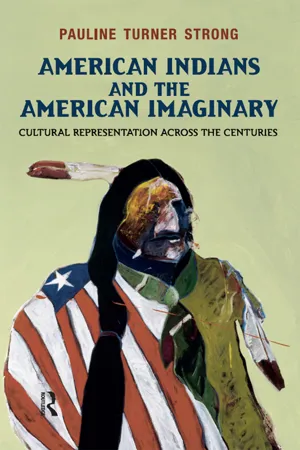
eBook - ePub
American Indians and the American Imaginary
Cultural Representation Across the Centuries
- 272 pages
- English
- ePUB (mobile friendly)
- Available on iOS & Android
eBook - ePub
American Indians and the American Imaginary
Cultural Representation Across the Centuries
About this book
American Indians and the American Imaginary considers the power of representations of Native Americans in American public culture. The book's wide-ranging case studies move from colonial captivity narratives to modern film, from the camp fire to the sports arena, from legal and scholarly texts to tribally-controlled museums and cultural centres. The author's ethnographic approach to what she calls "representational practices" focus on the emergence, use, and transformation of representations in the course of social life. Central themes include identity and otherness, indigenous cultural politics, and cultural memory, property, performance, citizenship and transformation. American Indians and the American Imaginary will interest general readers as well as scholars and students in anthropology, history, literature, education, cultural studies, gender studies, American Studies, and Native American and Indigenous Studies. It is essential reading for those interested in the processes through which national, tribal, and indigenous identities have been imagined, contested, and refigured.
Information

PART ONE
INTRODUCTION
Squanto, Pocahontas, Geronimo. Apaches, Winnebagos, Cherokees. Squaws, redskins, half-breeds. Tepees, totem poles, sweat lodges. Tomahawks, tom-toms, feathers. Representations of American Indians as stereotypical “others” have circulated widely since the earliest reports of Columbus’s voyages. Building on age-old tropes central to Western primitivism—notions of the natural, the wild, the savage, the heathen, the tribal, the free—these representations have spread from travel and colonial literature into an ever-widening set of cultural domains. These include art, architecture, and museums; fiction, drama, and scholarship; law, policy, and social movements; sports, games, and the classroom; photography, film, and Web sites; and advertising, gaming, and tourism. With the growing prominence of Native American intellectuals, artists, and activists over the past several decades, representations by cultural outsiders have been criticized, subverted, and supplemented—if not replaced—by indigenous self-representations. Nevertheless, certain representations dating to the earliest colonial encounters have been remarkably persistent.
This book explores this representational territory, with an emphasis on the emergence, use, and transformation of representations in the course of social life. The concept of representation has emerged in the last few decades as central to many disciplines in the humanities and social sciences—and perhaps the single most important concept in the interdisciplinary field of cultural studies. The ethnographic approach taken in this book employs a theory of representational practice that allows us to consider the ways in which representations are significant parts of power-laden social and cultural processes. Outlined in Chapter 1, this approach examines the interwoven politics, economics, poetics, and technology of representation considered as a social practice.
Each of the subsequent chapters considers a particular form of representing Native Americans in American culture, addressing various theoretical issues along the way. We begin, in Part Two, with representations of tribal, indigenous, and national identity. Chapter 2, “Tribe and Nation,” concerns one of the most pervasive and significant ways in which Native Americans are represented: as the members of tribes, a term that has connotations ranging from the highly pejorative to the deeply romantic to the pragmatically political. The chapter explores the history and contemporary state of the contested relationship between Native tribalism and American nationalism. Preparing the ground for the chapters that follow, “Tribe and Nation” discusses how Native Americans are simultaneously symbolic of and excluded from American collective identity, and how the existence of American Indian tribal nations both constitutes and challenges what I call the American imaginary.
Chapter 3, “Five Hundred Years,” focuses on public struggles over representation during the observance of the Columbian Quincentenary, a milestone represented as either a celebration of discovery (the dominant trope), a commemoration of five hundred years of encounter and exchange (a newer trope widely employed in 1992), or an assertion of a half-millennium of conquest, resistance, and survival (an oppositional discourse employed globally by indigenous movements). Chapter 4, “Indian Blood,” turns to the long-standing and pervasive notion that the essence of indigenous identity is somehow located “in the blood.” Considering the tropes of Indian blood, pure blood, mixed blood, and tribally specific blood (Cherokee or Choctaw blood, for example) brings us to the heart of complex debates about Native American racial and cultural identity.
The historically persistent themes of captivity, adoption, and cultural transformation are considered in Part Three. Chapter 5, “Captivity in White and Red,” concerns the stereotypes of the White captive and Indian captor found in colonial American captivity narratives, such as the famous tale of Captain John Smith. This chapter contrasts stereotypical representations of captivity with the complexity of historical reality, including the Euro-American practice of taking Native American captives and the indigenous practice of adopting certain Euro-American captives. The remaining chapters in Part Three look at the resonances of frontier captivity imagery in more contemporary tales of captivity and adoption: the novel Indian Killer by the Native American author Sherman Alexie (Chapter 6), and media representations of the twenty-first century “war on terror” (Chapter 7).
Various forms of performing identity and otherness are the focus of Part Four. Chapter 8, “Crafting American Selves,” examines the role of “playing Indian” in the socialization of American youth, particularly in scouting and other youth organizations. This chapter discusses the practices of racial mimesis and cultural appropriation characteristic of these organizations’ traditions, as well as recent changes in their representational practices. In Chapter 9, “Animated Indians,” Disney’s Pocahontas and Paramount’s The Indian in the Cupboard are viewed as films whose critiques of objectification and appropriation are undercut by the strategies through which they were marketed. The tenth chapter, “The Mascot Slot,” probes the use of racist tropes such as “chief” and “redskin” in amateur and professional sports, arguing that these tropes reveal an exclusionary form of cultural citizenship allocated to Native Americans.
Part Five, “Indigenous Imaginaries,” considers some of the indigenous and collaborative representations that have emerged at the turn of the twenty-first century. Chapter 11, “Sovereignty, Indigeneity, and Ethnographic Representation,” discusses contemporary trends in ethnographic research and writing, highlighting the relationship between representational practices and indigenous projects. The twelfth chapter, “A Native Space on the National Mall,” focuses on indigenous self-representation as practiced in the new National Museum of the American Indian in Washington, DC. This chapter is especially concerned with the use of representational practices in legitimizing Native American claims to national space. These final chapters explore powerful challenges to some of the dominant representational practices considered in the earlier parts of the book, challenges that point the way toward overcoming the heritage of colonialist representation in the American imaginary.
CHAPTER ONE
THE ETHNOGRAPHY OF REPRESENTATIONAL PRACTICES
Manifestly, the indian is an occidental misnomer, an overseas enactment that has no referent to real native cultures or communities.
—Gerald Vizenor
The Anishinaabe scholar Gerald Vizenor (1999) has written astutely that the indian is a “simulation and ruse of colonial dominance” (vii). Departing from Vizenor’s insight, this book explores how various practices associated with this simulation—including calculating “Indian blood,” adopting “Indian” mascots, assuming “Indian” names, and “playing Indian”—work to establish and maintain colonial dominance. Just as importantly, though, we will consider oppositional representations that challenge dominant power structures—as Vizenor does himself in promoting the powerful notion of “postindian survivance” (1999).
This first chapter, which sets the stage for the more concrete case studies that follow, surveys the main scholarly approaches to the study of representation as a context for the approach used in this book, which I call the ethnography of representational practices. Following Vizenor’s lead, I try to reserve the misnomer Indian for representations, and use tribal designations (Anishinaabe, Lakota, Osage) or the collective terms Native, Native American, and indigenous to refer to “real cultures or communities” (vii) (although this notion, dealing as it does with concepts of authenticity, is itself problematic). There will be many necessary exceptions, however, including quotations, the titles of publications, the names of organizations, and certain conventional phrases such as “Indian tribe,” “Indian treaty,” “Indian reservation,” “Indian policy,” and “Indian Country.” Indeed, as we will see, there is an argument to be made for preserving phrases such as these precisely because of the legal rights they entail, regardless of the misnaming involved.
“The Indian’s Image-Maker”: Scholarship on Representational Practices
The study of representations of American Indians first emerged in the fields of literary and intellectual history, notably with the publication in 1953 of Roy Harvey Pearce’s The Savages of America (better known under its 1965 title, Savagism and Civilization: A Study of the Indian and the American Mind). In speaking of “the American mind” in the singular, Pearce assumed a degree of cultural homogeneity and consensus that is unconvincing today (Abu-Lughod 1991; Jackson 1995; Brightman 2006). Nevertheless, he anticipated contemporary approaches to the construction of identity and otherness in his analysis of the Indian as a figure who “became important for the English [colonial] mind, not for what he was in and of himself, but for what he [presumably] showed civilized men they were not and must not be” (Pearce 1965, 5). Presumably, I add, because the construction of “savagery” and “civilized” were, as Vizenor puts it, the most basic “ruse of colonial dominance.”
Pearce is known primarily for his interpretation of literary representations, but Savagism and Civilization also considers the work of such nineteenth-century scholars as Henry Rowe Schoolcraft and Lewis Henry Morgan. For Pearce (1965), the “idea of savagism” as a “morally inferior and historically anterior” state of hunting and warfare (105) culminated in the studies of these scholars. This is true in two senses: although the idea of savagery (which we would now, more precisely, call an ideology, discourse, or paradigm) generated Schoolcraft’s and Morgan’s systematic investigations of Native American cultures (the first sense), the complexity and diversity their research revealed ultimately undermined the idea of savagery itself (the second sense). This led to the development of new interpretive frameworks centered on the concept of the primitive—a concept that, in turn, would be questioned and dismantled by subsequent scholars. There is, in other words, a tendency for representations of otherness (the savage, the primitive, the tribal) to develop and then implode (Strong 1986), only to be replaced by other representations that repeat the interpretive cycle.
Pearce opened up a productive area of inquiry that has been developed in major works in a variety of fields. Of several historical studies published in the wake of Savagism and Civilization, Brian Dippie’s The Vanishing American: White Attitudes and U.S. Indian Policy (1982) is particularly worthy of mention. Dippie traces the relationship between US policy and popular attitudes, showing the connection between nineteenth-century removal and reservation policies on the one hand, and the widespread belief that Native Americans were doomed to vanish on the other. The trope of the vanishing Indian, most familiar in James Earle Fraser’s widely reproduced sculpture, The End of the Trail (see Figure 1), is central to the pervasive practice that Johannes Fabian (1983) has called “allochronism,” that is, the representation of contemporary peoples as mere “survivals” or “remnants” of a more authentic past.
Until fairly recently, the search for exoticism and “authenticity” has led anthropologists and others to ignore or disdain significant contemporary or hybrid aspects of indigenous life. For example, Mick Gidley (1998) and others have shown how the photographer Edward Curtis erased clocks and other signs of modern life in his widely distributed photographs of Native individuals. Similarly, as David Samuels (1999, 2004) reveals, scholars’ fascination with traditional Apache music has led to an underappreciation of the importance of mainstream popular music in Apache life. Jean O’Brien’s Firsting and Lasting: Writing Indians Out of Existence in New England (2010) and Philip Deloria’s Indians in Unexpected Places (2004) address the tropes of Indians vanishing or frozen in time with analyses that probe the relationship among colonialism, modernity, and primitivism.
Robert Berkhofer’s aptly named The White Man’s Indian: Images of the American Indian from Columbus to the Present is a more general work that connects popular and scholarly representations to the history of US Indian policy. Over the many periods and multiple cultural domains he surveyed, Berkhofer perceived a basic coherence and persistence in what he called “the image of the Indian.” Like Pearce, Berkhofer presented the “White man’s Indian” as a negation of features associated with what today would be called White masculinity. The same image of savagery might be evaluated as “noble” or “ignoble,” according to Berkhofer, depending on whether it is used to validate or critique Euro-American “civilization.”

Figure 1. James Earle Fraser, American, 1876–1953, The End of the Trail. Widely reproduced image of the “vanishing Indian.” Earlier versions of this sculpture were displayed at the 1893 World Columbian Exposition in Chicago and the 1915 Panama-Pacific International Exposition in San Francisco. 1918, bronze, height: 111.8 cm (44 in.), bequest of Arthur Rubloff Trust, 1991.325, The Art Institute of Chicago. Photography © The Art Institute of Chicago.
Berkhofer’s (1978) genealogy of scholarship ends with the warning that contemporary anthropologists’ “cultural conception of the Indian” might come to “appear as biased and mythical” as the more overtly objectionable imagery of nineteenth-century social evolutionism and scientific racism (68–69). Berkhofer was prescient in this regard (if unaware that in its emphasis on coherence and persistence his own analysis of the “White man’s Indian” uses a monolithic concept of culture that would itself come to appear mythical). Even before the publication of The White Man’s Indian, critical questions had been raised about the anthropological concept of culture and the discipline’s methodology of fieldwork. Most influentially, the Lakota scholar Vine Deloria, in Custer Died for Your Sins (1969), castigated “anthropologists and other friends” for their arrogance, intrusiveness, and lack of accountability to Native American communities. Internal critiques emerged at this time as well. For example, soon after Custer appeared, Dell Hymes (1972) published an influential collection that aimed to “reinvent anthropology” as a more critical, reflexive, and politically transformative discipline. Such critiques prompted the development, over the next four decades, of more collaborative and activist research methods (Biolsi and Zimmerman 1997; Field 2004; Lassiter 2005).
During the same period, the Lakota anthropologist Beatrice Medicine and her Tewa Pueblo colleagues Edward Dozier and Alfonso Ortiz played important roles in convening the First Convocation of American Indian Scholars, a landmark event held at Ortiz’s institution, Princeton University, in 1970. D’Arcy McNickle, the Flathead novelist and chair of the anthropology department at the University of Saskatchewan, also participated in the convocation. As the Osage scholar Robert Warrior (1998) argues, together with Deloria’s book and the award of the 1969 Pulitzer Prize to the Kiowa novelist N. Scott Momaday, the convocation marked “the emergence of Native American voices into contemporary public and academic life” (116).
Anthropologists were well represented in this emergence. Among the issues discussed at the conference was the need to abandon the discipline’s “litany of Indian exotica and assorted trivia” in order to consider the “philosophical and spiritual values” of Native Americans and thei...
Table of contents
- Cover
- Half Title
- Title Page
- Copyright Page
- Dedication
- Table of Contents
- List of Illustrations
- Acknowledgments
- PART ONE INTRODUCTION
- PART TWO REPRESENTING HISTORY AND IDENTITY
- PART THREE CAPTIVITY, ADOPTION, AND THE AMERICAN IMAGINARY
- PART FOUR PLAYING INDIAN
- PART FIVE INDIGENOUS IMAGINARIES
- Epilogue
- References
- Sources and Credits
- Index
- About the Author
Trusted by 375,005 students
Access to over 1.5 million titles for a fair monthly price.
Study more efficiently using our study tools.
Frequently asked questions
Yes, you can cancel anytime from the Subscription tab in your account settings on the Perlego website. Your subscription will stay active until the end of your current billing period. Learn how to cancel your subscription
No, books cannot be downloaded as external files, such as PDFs, for use outside of Perlego. However, you can download books within the Perlego app for offline reading on mobile or tablet. Learn how to download books offline
Perlego offers two plans: Essential and Complete
- Essential is ideal for learners and professionals who enjoy exploring a wide range of subjects. Access the Essential Library with 800,000+ trusted titles and best-sellers across business, personal growth, and the humanities. Includes unlimited reading time and Standard Read Aloud voice.
- Complete: Perfect for advanced learners and researchers needing full, unrestricted access. Unlock 1.5M+ books across hundreds of subjects, including academic and specialized titles. The Complete Plan also includes advanced features like Premium Read Aloud and Research Assistant.
We are an online textbook subscription service, where you can get access to an entire online library for less than the price of a single book per month. With over 1.5 million books across 990+ topics, we’ve got you covered! Learn about our mission
Look out for the read-aloud symbol on your next book to see if you can listen to it. The read-aloud tool reads text aloud for you, highlighting the text as it is being read. You can pause it, speed it up and slow it down. Learn more about Read Aloud
Yes! You can use the Perlego app on both iOS and Android devices to read anytime, anywhere — even offline. Perfect for commutes or when you’re on the go.
Please note we cannot support devices running on iOS 13 and Android 7 or earlier. Learn more about using the app
Please note we cannot support devices running on iOS 13 and Android 7 or earlier. Learn more about using the app
Yes, you can access American Indians and the American Imaginary by Pauline Turner Strong in PDF and/or ePUB format, as well as other popular books in Social Sciences & Cultural & Social Anthropology. We have over 1.5 million books available in our catalogue for you to explore.