![]()
1 Buongiorno, un caffè per favore
Good Morning, A Coffee Please
In this unit you will learn about:
- Ordering a drink or a snack
- Greetings and simple courtesies
- Introducing Italian nouns, with indefinite articles, e.g. ‘a coffee’, ‘an orangeade’; nouns ending in -o and -a
- Prices
- Numbers 1–10, 20–100, 200 etc.; 1,000, 2,000 etc.
- Singular personal pronouns, e.g. ‘I, she’ etc.
- The verbs ‘to be’ and ‘to have’ in the singular, e.g. ‘am’
Cultural Point
First things first, let’s get a drink. In Italy the bar (bar or caffè) is a popular meeting place as well as being a place to drop in for a coffee, a glass of water on a hot day, a snack or an ice cream. Many bars have terraces where, in the summer, people sit outside chatting, reading the newspaper or watching everyone else go by. Of course there are bars of all sorts, from the very elegant to the simple and down to earth. Popular drinks are:
caffè a small very strong black coffee, also called espresso
cappuccino a small, very strong, black coffee with frothy milk added, often sprinkled with powdered chocolate
vino, bianco o rosso wine, white or red
acqua minerale, naturale o gassata (bottled) mineral water, still or fizzy
tè, con latte o con limone tea, with milk or with lemon
tè freddo iced tea, a refreshing drink in hot weather
birra beer
succo di frutta fruit juice
succo di pera, di mela, di arancia pear, apple, orange juice
spremuta di arancia, limone, pompelmo juice of a freshly squeezed orange, lemon or grapefruit
You can also order un panino, a bread roll with a filling, for example ham, egg or mozzarella and tomato; un toast, a toasted ham and cheese sandwich; or, for the sweet-toothed, una pasta ‘a pastry’, or una brioche ‘a brioche’ or un gelato ‘an ice cream’.
If you have the recording, for this and all dialogues, see if you can understand without looking at the book. Good practice for real life situations! Answer the question below. You may need to listen more than once but persevere.
Al bar
A group of friends order drinks.
- Among the drinks ordered are some not explained above. Can you pick them out and guess what they are?
CAMERIERE: | Buongiorno. Prego. |
PAOLO: | Una birra, per favore. |
ANNA: | Per me, un caffè. |
TOMMASO: | Un vino bianco. |
MARISA: | Un’aranciata. |
FILIPPO: | Una Coca-Cola. |
CAMERIERE: | Una birra, un caffè, un vino bianco, un’aranciata e una Coca-Cola. Va bene. |
The drinks not explained were un’aranciata ‘an orangeade (fizzy)’ and una Coca-Cola. No prizes for guessing that! You will find answers to questions and exercises in the ‘Key to exercises’ at the back of the book.
Vocabulary Notes
prego lit. ‘I pray, I beg’. Here an invitation to order. Prego is also used to reply when someone thanks you for something: ‘don’t mention it, not at all, you’re welcome’.
per favore ‘please’
per me ‘for me’
va bene ‘fine, OK’. Va bene is used not just in casual speech, like OK. It is acceptable in a formal context too.
Language Point
Introducing Italian Nouns and Indefinite Articles
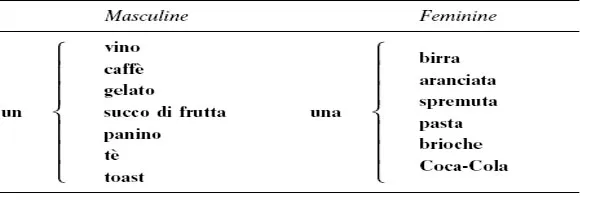
Italian nouns are either masculine or feminine. This is sometimes related to sex, in the cases of people or animals for example, but not always. The word for ‘a, an’ is un with a masculine noun and una with a feminine noun.
Note: When una comes before a noun beginning with a vowel, such as acqua, it is usual to drop the a of una and just say un’. When speaking, it comes naturally to run one vowel into another. When writing this, ...