- 592 pages
- English
- ePUB (mobile friendly)
- Available on iOS & Android
eBook - ePub
About this book
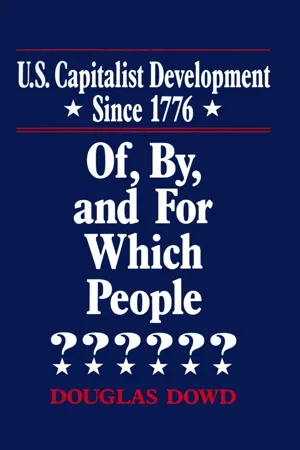
First Published in 1994. This comprehensive work views U.S. history through the analytical framework of the capitalist process. The highlights of the book are: it weaves together economic history with the history of economic ideas to give a new perspective on the contemporary connections between the economic and social processes; provides an analytical and historical explanation of capitalism as a socioeconomic system; discusses the past and present functioning of the business system, as 'a system of power', with emphasis on the 1970s, 1980s and the stagnation of the 1990s; analyses the relationship between structures of income, wealth and power and class, color and gender; and critically looks at the development and nature of the capitalist state.
1
Economics and Economies, Past and Present
O this is not spring but in me
there is a murmuring of new things.
This is the time of a dark winter in the heart
but in me are green traitors. . . .1
there is a murmuring of new things.
This is the time of a dark winter in the heart
but in me are green traitors. . . .1
"The American Dream" has always been complex, never single-minded. Both in its nature and in the struggles fought over its realization, the dream has encompassed a broad range of economic, political, and social aspirations. Still, what stands out most in U.S. history, what has most persistently and effectively absorbed the energies of its people, is without question the individual and national aim of economic advancement —accompanied each step along the way by its vital companion, geographic expansion. Sitting at the center of our personal and national selfesteem has been the pride of material achievement; the frame of reference for national policy has had its limits and its directions set mostly by what is compatible with economic criteria; as a people, what has most frequently moved us to political excitement have been economic hopes and fears—until, perhaps, yesterday.2
The United States has long been the business society par excellence, with few questions asked, except in periods of perceived hard times: for farmers and urban workers in the last decades of the nineteenth century, workers and some urban intellectuals before World War I, and perhaps a majority in the depression-wracked 1930s.
Then, in the 1960s, the grounds for opposition and protest changed, as many, especially, but not only, the young, argued that our business society at its best (as it was, in the 1960s) is none too good: it is cold and dehumanizing, unjust, abrasive, and bellicose. The widespread dissent affected the society in important ways, some positive, some negative. But the inability of the dissidents or their arguments to achieve lasting influence or power was due less to their own political naivete than to the stubborn great strength of capitalist ideology, militarism, and racism in the United States.3
All that, taken together with the emerging U.S. and world economic crisis of the 1970s, soon called "stagflation," paved the way for a swing back to a 1920s-like enthusiasm for the political economy of "rugged individualism"—with Ronald Reagan alternately playing the roles of Harding, Coolidge, and Hoover (while perhaps imagining himself as Teddy Roosevelt).
Even as the 1960s, their struggles and their personnel, faded into memory, however, it soon became politically impossible to ignore looming natural and social disasters, many already accomplished, others well on their way: the poisoning of the air, the soil, the rivers, streams, lakes, even the oceans; the steady destruction of the atmosphere; the seemingly insoluble problems of waste disposal (nuclear and chemical, and Himalayas of garbage) in a society which, as will be argued later, cannot have its version of "prosperity" without always more waste; and, joined to the spoliation of nature, a comparable process of social deterioration: poverty that becomes crueler as it also spreads and deepens, shuddering systems of transportation and education, and the most scandalously inadequate and, costly health care system of the industrial world.
But perhaps all this is not too high a price to pay for a strong economy? Perhaps no, probably yes; but now it is commonly acknowledged that the U.S. economy is considerably weak in its production sector, and always more so in confrontation with the Japanese and German economies. Connected with that, the decade of the 1980s produced what has seemed to be the greediest and most unconstrained generation of capitalists ever who, as the economy was "financialized," assaulted, rendered fragile, and even destroyed significant elements of its industrial and financial capacities. All this and more moves a growing number of hither-to indifferent citizens to a state of perplexity and worry that allows them too to wonder if a business society at its best is good enough, and sane or safe enough, perhaps also because its best now becomes a memory.4
Be that as it may, those now concerned to rid the United States of the ugly and threatening dynamics that transform dream into nightmare must also question a long-standing assumption about the capitalist social process. Our ingrained belief has been that personal and national economic improvement would prevent, eliminate, or facilitate the resolution of noneconomic problems. Now, by contrast, it seems increasingly likely that our very means of achieving economic success—in industry, agriculture, and the services—have worsened, even created, that lengthening list of social and environmental "problems" plaguing our society.
Thus, in later chapters it will be argued that racism (and other forms of oppression), neither initiated in nor confined to capitalism or to the United States, has been "good for business" (not only by keeping wages lower than they otherwise might be, but also by deflecting the politics of the white population away from issues vital to them); that the spread of coercion and militarization in our domestic and foreign policies and the dependence upon military production, whatever their important harmful effects on the economy, nature, and society, have, through their vast expenditures, been decisive in avoiding serious economic depressions and, not less important, instrumental in creating and shaping the vital world economy since World War II; that the plight of virtually all our cities, burdened by intractable fiscal, environmental, educational, and health crises, though complex in its origins, has been much worsened by that businesslike callousness that can never find sufficient reasons for the well-off to pay the (tax) costs of a decent society.5
And all this is closely connected at the local and national levels to corruption in private and public life, by no means confined to the United States, that far outdistances anything that happened in the scandalized Twenties, Fifties, or Sixties. To which it may and must be added that going hand in glove with the quantitative economic achievements of the U.S. economy in recent decades has been the ever-tighter grip of centralized and concentrated power, economic and political, business and governmental, which, taken together with the always advancing secrecy, manipulation, and dishonesty that such a pattern requires and enables, presides over all: another very large, very frightening skeleton in the closet of this proudly democratic, free market society. It must be a sorry time to be young.6
Hidden within that melancholic dirge are of course some cheerier notes, not the least of them that many seek to set aright what so badly goes askew. But nothing will be set aright without understanding why it is wrong. The question why, when asked of social processes, is always historical; whatever else is also necessary, understanding of a social present requires understanding of how it came to be.
"The American Dream" that now seems so twisted became so over time, but it was inherent in key elements of the dream itself. For present purposes, the dream's beginning may be related to two events of the year 1776, putting together dramatic ideas with dramatic social changes. The first was Adam Smith's Wealth of Nations; the second was the Declaration of Independence. They had considerably more in common, in origin, intent, and consequences than is usually supposed. In the intervening centuries the laudable spirit that motivated both events has been vitiated by the emerging domination of the troublesome "key elements" referred to above: a fervent, expansionist, and unquestioned (if also understandable) nationalism, and often blind dependence upon "the invisible hand" of market competition and economic individualism to render unnecessary any broader or deeper guiding social ethic.7
What has ensued since 1776, what became economics and what the United States has become, have moved in directions neither expected nor intended by their originators. Adam Smith and Thomas Jefferson (who wrote the Declaration) were not in agreement, the former seeking industrialization and the latter an "agrarian democracy," but we may be certain that both would have been deeply affronted by what has been created in their name.
To understand the how and the why of that history requires understanding the dynamics of capitalist development (at least), which in turn requires understanding how very much a capitalist economy requires of its associated social and political framework (and all the more so as time goes on).
The defining characteristics of a capitalist economy are that the means of production—mines, mills, factories, land, and so on—are privately-owned, and operated for the profit of the owners. All decisions --what and whether to produce, when, how much, where, who and how many to hire (or fire); whether to expand or contract productive capacity and change technology; advertising, marketing, and financial decisions; all these and other decisions are made by a relatively few individuals for their individual or corporate benefit, and the "bottom line."
The "free market economy," today's term for capitalism, is thus one in which those privileged, clever, or ruthless enough to have acquired productive assets are entitled to use them as they see fit, to their own anticipated advantage. The ideology that developed along with the capitalist process presumes that the benefits of such a system will be shed on all, from the owners down to the entire population: they will "trickle down."
Capitalism has existed for only a brief fraction of history, no more than two centuries anywhere, and much less than that everywhere else. The seeds were planted in medieval Europe, especially in the trading cities of Italy, and given much nourishment by the overseas expansion of the sixteenth and seventeenth centuries. By then, the first recognizably capitalist economy, that of the Dutch, appeared. But it was not until the late eighteenth century, in Britain, that capitalism may be said to have become an unstoppable development.
Special circumstances, in a process of violent change, were required to bring capitalism into existence; its continuation has depended upon a precariously balanced set of social institutions and economic processes: power must be held by the relatively few who own productive property, or by others who move in harmony with the needs of capitalism, in order to allow the exploitation8 intrinsic to capitalist development; and the economy must continually expand, both in its production and in its geographic sway. The interaction of these imperatives over time weaves together the economic, political, and social relationships that give capitalism its life, its strength, its dynamics, its virtues, and its defects.
Adam Smith and those called "the founding fathers" (men like Jefferson, Madison, Hamilton, Franklin, etc.) were sophisticated thinkers, discerning of the complex web of relationships and processes required and enhanced by capitalist development. But, much as they disagreed among themselves, they viewed these matters through the rose-colored lenses of the upper crust of society. Their optimism and their social values led them to emphasize the real gains possible from capitalist development while minimizing or ignoring its social and human costs—or to assume that the material successes of capitalism would render such costs negligible.9
There have always been some who have thought otherwise; now there are many more. These are the critics who sense, who believe, and who understand that the social costs of capitalism are far too high and that much of its material achievement is not achievement at all: that too many are exploited and oppressed (and befuddled) in too many ways for too little and for the benefit of too few, that capitalist economic expansion is heedless, too costly to human beings and to the rest of nature.
The historical and analytical support for these assertions constitutes the heart of this book. Suppose for the moment that the assertions are valid. It would seem that to understand their whys and wherefores it would be necessary to understand what is now called economics. That is not so, but it is necessary to develop an analytical perspective on the U.S. economy. It is both fortunate and unfortunate that mastery of economics is neither sufficient for gaining the needed perspective, nor necessary in order to do so.
Quite apart from an ideological basis (and bias) that accepts the status quo, mainstream economics is neither broad enough in its reach nor deep enough in its penetration to suit today's analytical needs. This is not to overlook the existence of valuable elements within it which, happily, could and should be incorporated into a more appropriate framework. But thinking and working solely within the framework of conventional ("neoclassical") economics does more to obstruct than to provide the possibilities of understanding the U. S. economy; it does not so much lubricate as act like sand in the gears of thought.10
Much the same can be said of the analytical state of affairs in the other social sciences and in history. What is needed badly are not further refinements of existing conventional economics and of the other social sciences, but the development of a dynamic social science that starts with our world, our needs, our possibilities. Central in that development must be a dynamic new political economy, one that allows us analytically to integrate contemporary with historical developments, and economic with political and social life.
This book is an attempt to take a step along that long and difficult path, a step that, were it to succeed, would contribute to a perspective helpful in the development of more specific and more theoretical inquiries. Now some definition of terms is necessary, in order both to clarify and to demystify "economics."
Classical and Neoclassical Economics
When the term economics is used here or, generally, by contemporary economists, the reference is to conventional ("mainstream") economic theory. Today's economics is an outgrowth and modification of classical political economy; as such, it is called neoclassical economics (not, it will be noted, neoclassical political economy). The usage of these classifications is by no means standardized. Marx, for example, saw classical political economy ending in the early nineteenth century, and Keynes viewed all economists up to himself as classicists. Here classical political economy will be seen as having its first great thinker in Adam Smith, and its last in John Stuart Mill (1806-1873). Neoclassical economics will be viewed as having begun to take hold in the 1870s, with its ultimately most influential thinkers being Alfred Marshall (1842-1924) and John Maynard Keynes (1883-1946). Karl Marx (1818-1883) and Thorstein Veblen (1857-1929), unlike the classical and neoclassical economists, were profound critics of capitalism and of the economists of their own time; their ideas and their social values provide much of the guiding framework for this book's analysis.
All these thinkers were unusually sensitive to the nature, the needs, and the possibilities of their times; all were theorists; all were critics, reformers, or revolutionaries. Most decisive of all, and it was this that made them great, was that the values, analyses, and purposes they expressed coincided with significant social interests in their day, and were thus reflected in practice. They not only studied society; in some measure they changed it. And all were concerned with capitalism—lovingly, worriedly, or angrily.
Adam Smith (a Scot) was the first to be so concerned in a fully systematic manner, and the first theoretician of capitalism as a system. He laid the groundwork of what became the methodology of classical political economy, altered in form but not in ideology by neoclassical economics, thoroughly criticized, transformed, and transcended by both Marx and Veblen.
All theory, social or physical, works from and within a methodological framework, which guides the theorist in what is examined, what ignored, what emphasized, what relegated to secondary consideration, what taken as "given" and what come to be the main "variables" to be studied and analyzed. For social theorists, methodology is developed in accord with basic social values, with their conceptions of human nature and of society, with...
Table of contents
- Cover
- Half Title
- Title
- Copyright
- Dedication
- Contents
- Figures and Tables
- Preface
- Acknowledgments
- 1. Economics and Economies, Past and Present
- 2. Capitalism
- 3. Business as a System of Power
- 4. Growth and Development, Prosperity and Depression
- 5. Income, Wealth, and Power
- 6. Nature and Nurture; Country and City; Waste and Destruction
- 7. World Economy and Imperialism
- 8. The State
- 9. Needs and Possibilities
- Name Index
- Subject Index
Trusted by 375,005 students
Access to over 1.5 million titles for a fair monthly price.
Study more efficiently using our study tools.
Frequently asked questions
Yes, you can cancel anytime from the Subscription tab in your account settings on the Perlego website. Your subscription will stay active until the end of your current billing period. Learn how to cancel your subscription
No, books cannot be downloaded as external files, such as PDFs, for use outside of Perlego. However, you can download books within the Perlego app for offline reading on mobile or tablet. Learn how to download books offline
Perlego offers two plans: Essential and Complete
- Essential is ideal for learners and professionals who enjoy exploring a wide range of subjects. Access the Essential Library with 800,000+ trusted titles and best-sellers across business, personal growth, and the humanities. Includes unlimited reading time and Standard Read Aloud voice.
- Complete: Perfect for advanced learners and researchers needing full, unrestricted access. Unlock 1.5M+ books across hundreds of subjects, including academic and specialized titles. The Complete Plan also includes advanced features like Premium Read Aloud and Research Assistant.
We are an online textbook subscription service, where you can get access to an entire online library for less than the price of a single book per month. With over 1.5 million books across 990+ topics, we’ve got you covered! Learn about our mission
Look out for the read-aloud symbol on your next book to see if you can listen to it. The read-aloud tool reads text aloud for you, highlighting the text as it is being read. You can pause it, speed it up and slow it down. Learn more about Read Aloud
Yes! You can use the Perlego app on both iOS and Android devices to read anytime, anywhere — even offline. Perfect for commutes or when you’re on the go.
Please note we cannot support devices running on iOS 13 and Android 7 or earlier. Learn more about using the app
Please note we cannot support devices running on iOS 13 and Android 7 or earlier. Learn more about using the app
Yes, you can access US Capitalist Development Since 1776 by Douglas Dowd in PDF and/or ePUB format, as well as other popular books in Economics & Business General. We have over 1.5 million books available in our catalogue for you to explore.