eBook - ePub
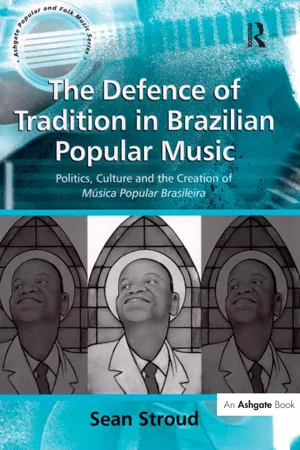
The Defence of Tradition in Brazilian Popular Music
Politics, Culture and the Creation of Música Popular Brasileira
- 222 pages
- English
- ePUB (mobile friendly)
- Available on iOS & Android
eBook - ePub
The Defence of Tradition in Brazilian Popular Music
Politics, Culture and the Creation of Música Popular Brasileira
About this book
Sean Stroud examines how and why Música Popular Brasileira (MPB) has come to have such a high status, and why the musical tradition (including MPB) within Brazil has been defended with such vigour for so long. He emphasizes the importance of musical nationalism as an underlying ideology to discussions about Brazilian popular music since the 1920s, and the key debate on so-called 'cultural invasion' in Brazil. The roles of those responsible for the construction of the idea of MPB are examined in detail. Stroud analyses the increasingly close relationship that has developed between television and popular music in Brazil with particular reference to the post-1972 televised song festivals. He goes on to consider the impact of the Brazilian record industry in the light of theories of cultural imperialism and globalization and also evaluates governmental intervention relating to popular music in the 1970s. The importance of folklore and tradition in popular music that is present in both Mário de Andrade and Marcus Pereira's efforts to 'musically map' Brazil is clearly emphasized. Stroud contrasts these two projects with Hermano Vianna and Itaú Cultural's similar ventures at the end of the twentieth century that took a totally different view of musical 'authenticity' and tradition. Stroud concludes that the defence of musical traditions in Brazil is inextricably bound up with nationalistic sentiments and a desire to protect and preserve. MPB is the musical expression of the Brazilian middle class and has traditionally acted as a cultural icon because it is associated with notions of 'quality' by certain sectors of the media.
Information
Chapter 1
Musical Nationalism and the ‘Cultural Invasion’ Debate
A central theme underpinning this study is how popular music in Brazil has frequently interlinked with political and cultural ideologies since the 1920s. An essential component of that linkage has been the idea of musical nationalism, which has periodically surfaced on the cultural scene ever since the publication in 1928 of Mário de Andrade’s formative work Ensaio Sôbre a Música Brasileira.1 This chapter sets out to demonstrate how that current of musical nationalism has manifested itself, how it has been opposed, and how it also laid the foundations for the idea of musical tradition that is still so potent in Brazil. The chapter consists of three parts, the first of which starts by relating the origins of nationalist trends within music in both Europe and Brazil. This is followed by a brief section that draws some parallels between the work of Cecil Sharp and the English Folk-Song Society in the early years of the twentieth century and Mário’s influential nationalistically-flavoured writings on music that were to serve as a basis for much of the thinking on Brazilian popular music until the 1960s.
The second part of the chapter discusses how the theme of protectionist musical nationalism was continued and developed through the work of several writers and journalists between the 1940s and 1960s, and how the latter were responsible for the creation of ‘invented traditions’ that formed the ideological starting point for the foundation of a hierarchy of values within Brazilian popular music.
The final part of the chapter focuses on the closely linked debate about the fear of foreign ‘cultural invasion’ within Brazil that has been waged in the media and debated in public since the 1930s. I demonstrate how this debate intensified in the 1960s and 1970s and how that intensification is exemplified by the clash between the writings of José Ramos Tinhorão and alternative views that arose in the wake of the Tropicália movement. This section continues with a discussion of the reactions of some of those working in Brazilian radio to the impact of increasing levels of imported popular music, and the chapter concludes with an analysis of the efforts of the APMPB to redress the balance in favour of national music.
Musical Nationalism in Europe and Brazil
Musical nationalism is generally considered to be a movement that began in Europe during the second half of the nineteenth century and which placed a strong emphasis on the national characteristics of a country’s musical tradition. This trend began as a reaction against the domination of German music at the time by composers in other countries who considered that the heritage of their own national melodies and dances could serve as the means by which they could move their nations from the musical periphery to the forefront.2 In the last quarter of the nineteenth century composers in England, Norway, Spain and Sweden started to mine the folk aspects of their respective cultures for inspiration. Musicians and composers returning from Europe transported these ideas to Brazil, and to other Latin American countries, at the end of the nineteenth century.
The rise of musical nationalism can be viewed within the wider context of ideas about ‘folk’ and national culture that originated in the Baltic provinces during the eighteenth century. Johann Gottfried Herder (1744–1803) has been credited with popularizing the theory that it was the rural isolation of peasant communities that protected them from the ‘corrupting’ influences of the wider world, which enabled them to develop their own individualistic national cultures. Herder contended that the oral peasant tradition contained the very soul or essence of a nation and that it was essential that any unifying national culture had to be grounded in that original, foundational peasant culture. As Herder’s theories gained a wider circulation, folk culture was appropriated as a symbol of nationalism and national identity, not only within Europe but further afield.3
Cecil Sharp and the English Folk-Song Society
This approach was potentially problematic in a nation lacking a recognizable peasant class such as Edwardian England. For that reason, collectors of English folk song and dance sought to gather their raw material from the inhabitants of remote rural areas, as the collectors considered that the latter seemed to be the most likely repository of examples of ‘uncontaminated’ culture. There is an irony to this that John Francmanis has highlighted:
… Membership of this elusive sub-stratum of English society was imposed rather than self-ascribed when, their deficiencies recast as virtues, selected elements of the unsophisticated rural population found themselves transformed into the ‘folk’.4
Cecil Sharp (1859-1924) was the dominant figure of the English Folk-Song Society at this time, an organization that he joined in 1901. Sharp’s ambitious approach and energetic drive revolutionized the society from merely collecting folk material into a movement whose aim was to instill patriotism in schoolchildren through the use of folk song. By re-popularizing ‘simple ditties which have sprung like wild flowers from the very hearts of our countrymen’5 Sharp believed that a new generation of English children would develop a greater awareness of their cultural heritage and that this would make them better citizens and patriots. Thus, Sharp hoped that a musical renaissance would lead in turn to a revival of the nation itself.6
Cecil Sharp’s initiative was hampered by opposition from other members of the English Folk-Song Society who disagreed with his methods and sweeping conclusions. As Francmanis points out: ‘effectively, he had determined who the ‘folk’ were, what constituted their art, which were their songs and dances, and what they represented’.7 Nevertheless, the issue of what exactly constituted quintessentially ‘English’ music was a major concern for some in the years leading up to the start of the First World War and in an increasingly nationalistic era composers were urged to eradicate foreign influences from their works and to replace them with ‘folk’ elements more in keeping with the common people.8 However, as a result of the increasing effects of urbanization in England even many of those living in the countryside that had formerly sung folk songs now favoured ‘ditties’ which originated in the urban music hall. Furthermore, Cecil Sharp and his followers were selective in their choice of the folk songs that they singled out to preserve for posterity and it was not unknown for Sharp to alter what he found to be more appealing or ‘tuneful’ to the modern ear.9
For some in England at the time there existed a clear relationship between folk culture and ‘high’ art, as illustrated by an article published in Musical Times in 1911:
… The folk-art of a country, whatever its artistic merits or demerits, is the sincere expression of a community, the embodiment, in terms of literature, dance, or song, of national ideals and aspirations. Indeed, in the nature of things, an intimate and abiding relationship must always exist between the conscious, intentioned works of the really great, individual artist, and the un-selfconscious output of the people from which he sprang.10
As I will demonstrate, similar sentiments are to be found in the writings of Mário de Andrade in Brazil in the 1920s, an analysis of which will be found in the following section.
Brazilian Musical Nationalism: Mário de Andrade’s Emphasis on the Role of Folk Music
The roots of musical nationalism in Brazil can be traced back to the publication of A Sertaneja by Brasilio Itiberê da Cunha in 1869. Generally regarded to be the first Brazilian musical composition to be ‘nationalistic’ in character, this piece incorporated elements derived from popular forms such as the modinha, the maxixe and the Brazilian tango. Boundaries between art music and popular music in Brazil were somewhat blurred towards the end of the nineteenth century, with composers and musicians such as Ernesto Nazareth and Chiquinha Gonzaga (both of whom utilized nationalist elements in their work) falling into both camps. During the first two decades of the twentieth century most Brazilian composers of art music continued to write in the European tradition with the occasional use of nationalist features in their output. But it was during the period between the 1920s and the 1940s that musical nationalism really took hold in Brazil due to the overwhelming influence of Heitor Villa-Lobos. Villa-Lobos performed at the celebrated showpiece of the Brazilian Modernist movement, the Semana de Arte Moderna [modern art week] in São Paulo in 1922, and many of his compositions drew on traditional forms of pre-commercial Brazilian music as a source of inspiration. He was also a close friend of Mário de Andrade, and both men were later involved in musical education programmes for the Vargas regime. The climate of nationalism prevalent in Brazil in the period 1930–45 was a major factor in the growth of a number of cultural projects that sought to fuse nationalistic, populist elements with popular culture.
To understand how opinions of value in popular music originated in Brazil, it is necessary to trace the development of the concept of popular music as a tradition that needed to be defended. The genesis of this trend can be detected in the impact of the Modernist movement of the 1920s on popular music, and more specifically the influence of Mário’s Ensaio Sôbre a Música Brasileira (1928). This ground-breaking text shaped the thinking of generations of Brazilian musicians and composers from its publication right up until the 1960s. In writing the Ensaio, Mário’s intention was not only to provoke a debate amongst the artistic community but also to bring home to the public, commerce, bureaucrats, critics, and teachers the importance of the market in relation to Brazilian popular music.11 One of the most significant aspects of the Ensaio was that it also delineated for the first time the stylistic characteristics that identified music as essentially Brazilian.12
A central tenet of the Ensaio was its rallying call for more rigorous research into musical folklore within Brazil. In the view of Mário (and others such as Renato Almeida and Villa-Lobos) folkloric music and the povo [masses] were two almost interchangeable concepts, and this idea that folklore was one of the most compelling cultural reflections of that povo was to exert a significant influence in the general cultural sphere within Brazil until the 1960s.13 The totality of Mário’s work has to be considered in the wider context of the cultural project that the Brazilian Modernist movement embarked upon after the Semana de Arte Moderna. A concept of musical nationalism was at the central core of Mário’s vision, symbolized by his belief in the prospect of an evolutionary process by which Brazilian popular music would eventually break free from the shackles of international influences, to be regenerated by innately Brazilian qualities.
Mário stressed the potentially important role of folk music as a source of raw material to be used by erudite composers in a process that would transform the ‘popular’ into the ‘artistic’.14 Folk music would therefore act as an ‘authentic’ source of artistic inspiration and for the first time composers were actively encouraged to incorporate Brazilian elements into their works.15 Mário organized and led several expeditions to the North and Northeast of Brazil in the 1920s and 1930s, whose aims were to collect folkloric music and dances that were supposedly ‘uncontaminated’ or ‘undiluted’ by foreign or commercial influences. Like Cecil Sharp before him, his decisions about which songs to collect for posterity were shaped by ideological considerations about ‘purity’ and ‘authenticity’ (this will be discussed in depth in Chapter 6). This search for ‘authenticity’ is fundamental to the thinking of Mário and the musical nationalists who followed him. Although popular music is considered by the latter to be ultimately subordinate to erudite music on aesthetic grounds, it is only within popular music that a natural, almost ‘naïve’ energy can be accessed that symbolizes the very ...
Table of contents
- Cover Page
- Title Page
- Copyright Page
- Contents
- General Editor’s Preface
- Acknowledgements
- Introduction
- 1 Musical Nationalism and the ‘Cultural Invasion’ Debate
- 2 Inventing the Idea of MPB
- 3 Television and Popular Music
- 4 Cultural Imperialism, Globalization, and the Brazilian Record Industry
- 5 The State as Cultural Mediator: The Política Nacional de Cultura, FUNARTE and the Projecto Pixinguinha
- 6 Musical Mapping: Locating and Defending the Regional
- 7 Reconsidering Musical Tradition: Música do Brasil and Rumos Itaú Cultural Música
- Conclusion
- Bibliography
- Index
Trusted by 375,005 students
Access to over 1.5 million titles for a fair monthly price.
Study more efficiently using our study tools.
Frequently asked questions
Yes, you can cancel anytime from the Subscription tab in your account settings on the Perlego website. Your subscription will stay active until the end of your current billing period. Learn how to cancel your subscription
No, books cannot be downloaded as external files, such as PDFs, for use outside of Perlego. However, you can download books within the Perlego app for offline reading on mobile or tablet. Learn how to download books offline
Perlego offers two plans: Essential and Complete
- Essential is ideal for learners and professionals who enjoy exploring a wide range of subjects. Access the Essential Library with 800,000+ trusted titles and best-sellers across business, personal growth, and the humanities. Includes unlimited reading time and Standard Read Aloud voice.
- Complete: Perfect for advanced learners and researchers needing full, unrestricted access. Unlock 1.5M+ books across hundreds of subjects, including academic and specialized titles. The Complete Plan also includes advanced features like Premium Read Aloud and Research Assistant.
We are an online textbook subscription service, where you can get access to an entire online library for less than the price of a single book per month. With over 1.5 million books across 990+ topics, we’ve got you covered! Learn about our mission
Look out for the read-aloud symbol on your next book to see if you can listen to it. The read-aloud tool reads text aloud for you, highlighting the text as it is being read. You can pause it, speed it up and slow it down. Learn more about Read Aloud
Yes! You can use the Perlego app on both iOS and Android devices to read anytime, anywhere — even offline. Perfect for commutes or when you’re on the go.
Please note we cannot support devices running on iOS 13 and Android 7 or earlier. Learn more about using the app
Please note we cannot support devices running on iOS 13 and Android 7 or earlier. Learn more about using the app
Yes, you can access The Defence of Tradition in Brazilian Popular Music by Sean Stroud in PDF and/or ePUB format, as well as other popular books in Media & Performing Arts & Ethnomusicology. We have over 1.5 million books available in our catalogue for you to explore.