eBook - ePub
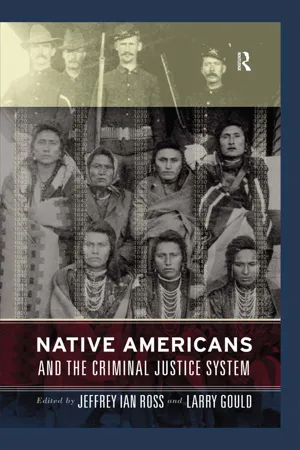
Native Americans and the Criminal Justice System
Theoretical and Policy Directions
- 290 pages
- English
- ePUB (mobile friendly)
- Available on iOS & Android
eBook - ePub
Native Americans and the Criminal Justice System
Theoretical and Policy Directions
About this book
'This collection presents significant summaries of past criminal behavior, and significant new cultural and political contextualizations that provide greater understanding of the complex effects of crime, sovereignty, culture, and colonization on crime and criminalization on Indian reservations.' Duane Champagne, UCLA (From the Foreword) Native Americans and the Criminal Justice System offers a comprehensive approach to explaining the causes, effects, and solutions for the presence and plight of Native Americans in the criminal justice system. Articles from scholars and experts in Native American issues examine the ways in which society's response to Native Americans is often socially constructed. The contributors work to dispel the myths surrounding the crimes committed by Native Americans and assertions about the role of criminal justice agencies that interact with Native Americans. In doing so, the contributors emphasize the historical, social, and cultural roots of Anglo European conflicts with Native peoples and how they are manifested in the criminal justice system. Selected chapters also consider the global and cross-national ramifications of Native Americans and crime. This book systematically analyzes the broad nature of the subject area, including unique and emerging problems, theoretical issues, and policy implications.
Trusted by 375,005 students
Access to over 1.5 million titles for a fair monthly price.
Study more efficiently using our study tools.
Information
Subtopic
Native American StudiesIndex
Social SciencesI
Introduction
1
Native Americans, Criminal
Justice, Criminological Theory,
and Policy Development
Jeffrey Ian Ross and Larry Gould
The study of law, justice, and criminal justice issues in Indian Country is complex and laden with cultural, economic, emotional, political, and social undertones that are bound in a deeply rooted historical context. In order to understand the relationship between the Native American and the U.S. criminal justice system (typically law enforcement, courts, corrections, and juvenile justice), it is necessary to appreciate the complexities of the European approach to deviance, justice, and social control. In short, the European system rests on punishment and retribution, whereas the Native American more often relies on cooperation and consensus building. One must also recognize the changing Native American responses to these processes, both before and after their contact with Europeans.
In their discussion of the fundamentally different concepts of sovereignty in European-based development and Native American tradition, Menno Boldt and J. Anthony Long (1984: 537–547) identify European-based concepts such as authority, hierarchy, and ruling entity as conflicting with the Native American concepts of spiritual compact, tribal will, and customary/traditional worldview. This systemic conflict sets the stage for both individual and organizational conflict, particularly among those native peoples who must work in both the native and European-based legal systems and cultures (Gould, 2002).
These conflicts are based on two very different ways of approaching these concepts and processes, which in their most basic characteristics are fundamentally at odds with each other. Even the briefest review of the literature suggests a constant attempt on the part of many Europeans to oppress, control, forcefully assimilate, and in many cases eliminate Native Americans through the creation and use of European-based laws (Boldt and Long, 1984: 537–547; Gould, 1998a; 1998b). The result, in most instances, was the criminalization of various native behaviors that were acceptable or controlled through different means prior to colonization along with the disruption of family structures and traditional tribal controls over individuals. Additionally, when Native Americans attempted to protect their rights and stand up for their traditional ways, this behavior was also criminalized.
The relationship between Native Americans and local, state/provincial, and federal branches of the criminal justice system is in a constant state of flux, often resulting in conflict and misunderstanding. This outcome has to do with the deeply rooted religious and spiritual underpinnings on which the various European and native cultures are based. Also in conflict is the two sides’ basic understanding of the nature of human beings and their relationship with one another. European culture is rooted in the predominant belief of the superiority of one people over another, with the winners of the conflict being able to force their superiority on the losers. The status of Native American tribes, in terms of the view the U.S. government has of them, seems to change constantly, varying from attempting to assimilate all native peoples to considering them as sovereign nations, from treatment of a geographic tribal area as one nation to requiring the allotment of land to individuals of the tribe. This treatment may result from a feeling of superiority that Europeans have long held over other cultures and societies. This attitude is directly traceable to and can account in large part for the relationship between the U.S. government and the various tribes, as well as the position of Native Americans in the criminal justice system. This includes the enactment of laws by the federal and state governments that negatively affect Native Americans, whose treatment of natives as noncitizens, incorrect interpretations of intent on both sides, racism, and differing and sometimes conflictual definitions of terms such as justice, sovereignty, spirituality, religion, and self-determination.
Many of the problems faced by Native Americans as they come into conflict with European-based justice—the basic foundation of U.S. justice—can be traced to the “Discovery Doctrine” (Jennings, 1975; and Washburn, 1988; Wilkins and Lomawaima, 2001; Williams, 1990; 1991). This approach, finding its origins in Aristotle’s Politics, was formalized in the late eleventh century and was based on “starkly prejudiced European religious and cultural biases, rather than on equitable or ‘just’ international laws” (Utter, 2001). Aristotle (384 to 322 B.C.) suggested that there are those who need to be ruled by their rational betters. This certainly seems to have been the philosophy and policy of early European colonists, as well as their descendants. Jack Utter (2001) provides a more comprehensive illustration of the “Discovery Doctrine,” but simply stated, it is the institutionalized superiority of one people over another. The doctrine practiced by Europeans from the moment of first contact was formalized in Johnson v. McIntosh (1823):
The United States, then, have unequivocally acceded to that great and broad rule by which its civilized inhabitants now hold this country. They hold, and assert in themselves, the title by which it was acquired. They maintain, as all others have maintained, that discovery gave an exclusive right to extinguish the Indian title of occupancy, either by purchase or by conquest: and gave also a right to such a degree of sovereignty [over Indians and their land], as the circumstances of the people [of the United States] would allow them to exercise. (Johnson v. McIntosh, 1823, 21 U.S. 543)
The Wheeler-Howard Indian Reorganization Bill (1934), which would have created separate Indian courts and self-governing communities that were empowered to make their own law and make contracts with the federal and state governments, was vehemently opposed by leading missionary groups and other advocates who favored assimilation by “civilizing” and “Christianizing” Native Americans. The missionaries were probably acting on their racist feelings of superiority based in their own religion and heritage. The halls of Congress and the Bureau of Indian Affairs have repeatedly resounded with debates over the protection of Native Americans’ civil rights, as well as debates over the restoration of traditional culture versus assimilation. Much of the conflict began to come to a head just prior to and after World War II, although native participation in the war presented its own set of problems.
During World War II there was much debate over the idea of Native Americans being drafted. The military needed cannon fodder, but to this point Native Americans had been denied many of the basic rights given to other peoples living within the continental United States. At that time most Native Americans could not vote, particularly those in New Mexico and Arizona. One young Paiute from Utah complained to the federal government in Washington, “The gent here is signing up all the young boys in the Army.… The young Indian boys aren’t citizens and they don’t buy whiskey.… We wanted to know if all of us Indian boys are going to fight for the white people.” A Mississippi Choctaw chief argued that his tribe “never vote or pay poll tax. The whites here say we not allowed to vote.… If we are not citizens, will it be right for Choctaws to go to war?” (Bernstein, 1991).
In another story—one that reflects the paternalistic ways in which those of European heritage have treated Native Americans—shared with one of the editors, a young Native American woman wanted to sell some of her calves. She had to apply to the secretary of the interior for permission to make the sale. The sale was approved after about three years, but by then the calves were cattle.
Even after the Indian Citizenship Act of 1924, a number of states continued to prohibit Native Americans from voting. The states’ legal arguments were (1) that Indians were “under guardianship” and therefore not competent to vote or (2) that Indians were not residents of the states in which they lived if they resided on reservations (Bernstein, 1991). The last states to fully extend voting rights to Indians were Arizona (1948), Maine (1954), Utah (1956), and New Mexico (1962) (Utter, 2001).
Another provocative issue in the relationship between Native Americans and the U.S. government, and one that relates to crime and the criminal justice system, involves the lingering effects of the boarding schools. If one assumes that stability in the family structure has a positive impact that serves to decrease criminality, boarding schools have had a particularly destructive influence on the children that attended and fostered increases in their criminality (Unger, 1977). Although the following quote from “Kid Catching” on the Navajo Reservation might not be directly related to the subject matter of this book, it does provide a poignant example of the attitude of the government and its representatives toward Native Americans.
I am making a brief statement of my experience with what I consider the greatest shame of the Indian Service (BIA)—the rounding up of Indian children to be sent away to government schools. … Stockmen, Indian police, and other mounted men are sent ahead [of the trucks] to round them up. The children are caught, often roped like cattle, and taken away from their parents, many times never to return. (in Unger, 1977, unnamed respondent)
There is little doubt that this type of treatment—the removal of a whole generation of people from their respective communities—has had a long-lasting impact on crime and criminality in Indian Country. As a result of this experience, many Native Americans developed institutionalized personalities, lost touch with family and their tribes, and were never prepared for life either on or off the reservation (Dumont, 1996a).
Yet another issue concerns sovereignty and its implementation and practice. At its most basic level, sovereignty means separateness. Any action by the county, state, or federal governments that threatens the autonomy of an Indian nation also impacts the sovereignty of the tribal government and thus the rights of Indian people. Common threats result from the suppression of culture, assimilative education, assimilative tribal government structures, destructive federal legislation, damaging state and federal court decisions, the loss of native language, and the acceptance of capitalism as the primary worldview to the exclusion of tribalism (Utter, 2001). Sovereignty also means the inherent right to or power of self-government. Indeed, sovereignty is a complex construct. Tribal sovereignty is closely related to tribal self-determination in terms of economic, political, legal, and cultural matters and not only guides how tribes interact with external systems but is also constrained by those systems.
Although each of the issues addressed above and many more not covered by scholars have had an impact on both the criminal justice system and the Native Americans who pass through or use it, the underlying causes of the conflicts are predominantly cultural. For example, something as seemingly simple as developing a common set of definitions for the discussion of native versus European systems of social control can set the stage for much debate and conflict. In their discussion of the fundamentally different concepts of sovereignty in European-based development and Native American tradition, Boldt and Long (1984: 537–547) identify European-based concepts such as authority, hierarchy, and ruling entity as conflicting with the Native American concepts of spiritual compact, tribal will, and customary/traditional worldview.
This systemic conflict sets the stage for both individual and organizational conflict (Gould, 2000; 2002) between two general types of legal systems: adjudicatory justice (in this case, the crime control model) and restorative justice. The European-based concepts of authority, hierarchy, and power differ fundamentally from the Native American concept of sovereignty or responsible and egalitarian government social control. The European system is most often based on the use of power and authority, involving adversarial methods of coercion and force to control the behavior of individuals (Yazzie, 1994), whereas the foundation for most native-based systems results from a healing process (Gould, 2000).
The specific points of conflict, according to Boldt and Long (1984), stem from the European concept of authority based on a belief in the inherent inequality of human beings. Adding to the conflict with Native American systems of justice and social control are the concepts of personal authority, hierarchical relationships, and a separate ruling entity, all based on European thought (Dumont, 1996b). In European-based societies, individual autonomy is regarded as the foundation for the successful acquisition of private property and achievement through competitive pursuits. Social control in terms of authority is deemed necessary to protect society against rampant individual self-interest; thus authoritative power is essential to maintain the integrity of a sovereign society. In this worldview, hierarchical power structures are necessary to ensure the distribution of privileges and the maintenance of order from the most authoritative to the most powerless (Brown, 1982; Dumont, 1993).
Furthermore, the adversarial approach to resolving issues on which the European system is based puts the different parties in a conflictual relationship. This is the kind of system that was imposed upon Indian nations toward the close of the nineteenth century. In traditional Native American society, self-interest is inextricably intertwined with tribal interest (Boldt and Long, 1984; Brown, 1982; Dumont, 1993). One of the strongest tenets of European-based forms of social control is the social contract, a concept of how authorities might more humanely exercise the right to govern others and devise egalitarian methods of extending authoritative rule from the ruler to the ruled (Rousseau, 1762/1998). In traditional native societies, it is believed that no human being rightfully has control over the life of another (Boldt and Long, 1984). According to native belief, social control has been viewed as a “spiritual compact, while the European-based means of social control derive from personal authority, hierarchical relationship and the concept of a separate ruling entity” (Boldt and Long, 1984; Dumont, 1993). As noted by James Dumont (1996b), European and native differences in the basic understanding of justice have had profound implications for the relationship of Native Americans to the justice system imposed upon them by European settlers and their descendants.
The impact of these numerous conflicts are evidenced in the simple fact that “native peoples are overrepresented in the criminal justice system statistics in the United States and Canada. … Native people, who make up 15.6 percent of the population of the state of Alaska … actually make up 31 percent of that state’s prison population” (U.S. Department of Justice, 1993). In other states, “the over-representation is less dramatic, being concentrated in specific categories such as substance abuse-related crime… . Furthermore, in some states, native offenders are not only overrepresented in terms of their numbers in prison but also receive longer sentences and serve more of their sentence than any other group… . This situation is even more pronounced in Canada, where native peoples are the largest minority group (about 4 percent of the total population). Native peoples make up about 8 percent of the federal prison population and make up an average of 20 percent of the provincial prison populations” (Nielsen, 1996: 12–13).
Additionally, “native societies are still in the process of adapting to the cataclysmic changes that colonization by Europeans produced. As part of this adaptation, native peoples are developing innovative criminal justice (and other) services from which the dominant society could learn a great deal” (Nielsen, 1996: 12). Since the 1980s, a number of experiments in native criminal justice have been introduced. Some appear helpful, whereas others simply replace old, traditional European values. After September 11, 2001, and the tightness of state budgets in law enforcement, it is difficult to determine what sort of effects the war on terror may have on or how it may trickle down to native communities. With recent decisions in several important Supreme Court cases (Chickasaw Nation v. United States (Docket No. 00–50) 534 U.S. 84 (2001), United States v. Navajo Nation (Docket No. 01–1375) 263 F.3d 1325 (2003), United States v. White Mountain Apache (Docket No. 01–1067) (2003), the law in Indian Country continues to evolve.
Although a considerable amount of research has been conducted on Native Americans and the criminal justice system, it is generally unintegrated with both the general criminology and criminal justice literature,...
Table of contents
- Cover
- Half Title
- Title Page
- Copyright Page
- Dedication
- Table of Contents
- Foreword
- Preface and Acknowledgments
- Part I Introduction
- Part II Theoretical Issues in the Area of Native Americans and Criminal Justice
- Part III Current Policy Issues Affecting Native Americans and Criminal Justice
- Part IV Conclusion
- Bibliography
- Index
- About the Editors and Contributors
Frequently asked questions
Yes, you can cancel anytime from the Subscription tab in your account settings on the Perlego website. Your subscription will stay active until the end of your current billing period. Learn how to cancel your subscription
No, books cannot be downloaded as external files, such as PDFs, for use outside of Perlego. However, you can download books within the Perlego app for offline reading on mobile or tablet. Learn how to download books offline
Perlego offers two plans: Essential and Complete
- Essential is ideal for learners and professionals who enjoy exploring a wide range of subjects. Access the Essential Library with 800,000+ trusted titles and best-sellers across business, personal growth, and the humanities. Includes unlimited reading time and Standard Read Aloud voice.
- Complete: Perfect for advanced learners and researchers needing full, unrestricted access. Unlock 1.5M+ books across hundreds of subjects, including academic and specialized titles. The Complete Plan also includes advanced features like Premium Read Aloud and Research Assistant.
We are an online textbook subscription service, where you can get access to an entire online library for less than the price of a single book per month. With over 1.5 million books across 990+ topics, we’ve got you covered! Learn about our mission
Look out for the read-aloud symbol on your next book to see if you can listen to it. The read-aloud tool reads text aloud for you, highlighting the text as it is being read. You can pause it, speed it up and slow it down. Learn more about Read Aloud
Yes! You can use the Perlego app on both iOS and Android devices to read anytime, anywhere — even offline. Perfect for commutes or when you’re on the go.
Please note we cannot support devices running on iOS 13 and Android 7 or earlier. Learn more about using the app
Please note we cannot support devices running on iOS 13 and Android 7 or earlier. Learn more about using the app
Yes, you can access Native Americans and the Criminal Justice System by Jeffrey Ian Ross,Larry Gould in PDF and/or ePUB format, as well as other popular books in Social Sciences & Native American Studies. We have over 1.5 million books available in our catalogue for you to explore.