- 226 pages
- English
- ePUB (mobile friendly)
- Available on iOS & Android
eBook - ePub
About this book
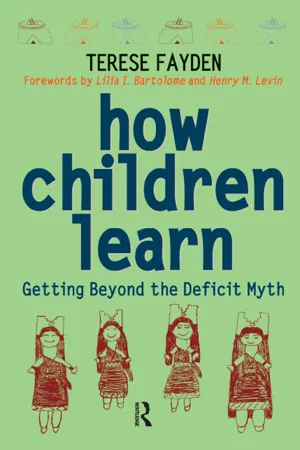
The inspirational stories of young learners in this book discredit assumptions behind recent educational reforms, including high stakes testing and No Child Left Behind policies. The experiences of the American Indian children and the author, a kindergarten teacher, challenge the widely held assumption that minority children enter school "at risk." Deficit theory assumes that minority children are responsible for their failure by cultural deficiency or family ineptitude. Fayden vividly shows how truly equitable treatment of minority children can improve students' inherent abilities to learn and can result in higher achievement for minority and all young children.
Trusted by 375,005 students
Access to over 1 million titles for a fair monthly price.
Study more efficiently using our study tools.
Information
Topic
EducationSubtopic
Education General1
Background
Studying the Children
I wanted to investigate how a group of four Pueblo Indian children enacted literacy during daily writing time. I was curious to see if the values of communal living that they experienced at home would be brought to school and how these values might be demonstrated. This undoubtedly would shed light on possible methods that could be implemented or discarded in order to avoid cultural conflicts and feelings of alienation and, hopefully, offer insight into ways to help children see their lives meaningfully represented in a school setting. Throughout the study, when I note values at home that are repeated in school, I do not intend to state causality. I want to make clear the similarities between the two. Although the names of those who were responsible for specific actions were specified, my intention was to portray the group as an aggregate and to account for the children’s actions as a whole (Gearing and Epstein 1982) so that the four individual children would merge, in essence, into an assemblage. In accordance with the children’s background of group living—by studying communal interactions I would be more able to uncover resemblances between shared communication in their Pueblo setting and their actions in the classroom. Thus, individual personalities were not dwelled upon. Rather, group actions were highlighted. I used multiple methods of data collection: (1) Roughly sixty hours of video-recording sessions; (2) Document review; (3) Photographs; (4) Observation; and (5) “Critical friend” (Anderson, Herr, and Nihlen 1994). I had the good fortune to have someone at the pueblo to help me understand life and values from the Indian perspective. She advised me on the indigenous comportment particular to that setting and shared the people’s general outlook with me, bolstering my understanding by referring to practices and lore. This helped me to understand Pueblo values and way of life and connect these views to my findings. Of course, I did not rely on her solely to gain my perspective of Native life. Working in a school for many years gave me a tacit understanding of the people and their perspectives. I also interacted with the people, including attending events in the villages such as rabbit hunts, foot races, dances, and “throws.” I lived with a family for frequent but brief times in the nearby pueblo. There, I participated in activities such as baking bread with the women, shopping for a feast, helping as families dressed for a dance, and other things one does with friends. The Pueblos value secrecy of their ways as a defense against first Spanish, then Anglo, encroachment. Outsiders must follow the primary rule of refraining from being inquisitive. Many years ago, during my first visit to a pueblo, I had dinner with a family and their friends. The governor of the village happened to be there. After listening to what must have been my incessant inquiries of Indian life, the governor gently told me, “Eat now. Ask questions later.” Later never came. Over the years, I have learned to repress my questioning bent and accept what I both see and hear as gifts from the people.
Practitioner Research
The research for this book was specifically practitioner research. I am a Kindergarten teacher and this study was conducted in my classroom. The research evolved out of thoughts and questions I had regarding classroom events. Because I was situated in my own particular place, I possessed implicit understandings that can only be gained by being an insider and by participating in the daily happenings of a school. Practitioner research is not a procedure for substantiating a particular proof but is a view of research that invites an unfolding of knowledge with the specific end of solving problems in order to improve practice and curriculum (Britton 1983). This gave me a practical advantage because new understandings gained could be readily investigated and implemented in my classroom. For example, originally I was concerned that my students were entering school “behind” middle-class white youngsters. Thankfully, I was also examining my own practices. My initial inquiries were not only “Why aren’t the Kindergartners investigating writing?” but also “Is there anything more I need to do to help the children attain literacy?” I examined this problem through a comprehensive understanding of a case-study group of four Kindergartners. By examining specific instances, I expected to bring light to a general problem common to teachers of underrepresented children: “Why don’t the students fare well in school?” As I discovered the richness of the children’s learning, I hoped to illuminate that literacy of diverse children need not be compared to that of their mainstream counterparts, but should be examined through the aggregation of experiences, actions, and values the children actually demonstrated. This included finding the pathways these particular children sought as their natural intelligence developed. This case focused on the particulars of the group studied. In coming to understand it thoroughly, refinement of an understanding may be gained. I hope that this petite generalization (Stake 1995) can be applied to those seeking understanding of underrepresented children and that the reader leaves this study with the conception that modifying traditional paradigms of literacy are helpful when one studies children of diverse cultures.
The study involved a group of four Keresan Pueblo Indian children (Keresan refers to a particular language grouping of Pueblo Indians), three of whom were ranked at risk, and the fourth, who was ranked between at risk and “normal” based on a standardized Kindergarten test that is given annually, shortly after the children enter our school district. Again, when I weighed their speaking, actions, and work, the children seemed to be intelligent and knowledgeable. This discrepancy fueled my study, and as I examined these children within their writing group, I attempted to develop a more accurate assessment of their literacy. This was achieved by expanding on concepts of intelligence which are commonly determined through established principles of verbal skills to those that included the many fashions through which the children actually communicated, such as gesturing, talking, drawing, creating artwork, dancing, chanting, singing, playing, and writing. When examining these modes, I intended to develop a concept of literacy that authenticated ways of thinking and creating knowledge.
Blaming the Victims
From the time I started teaching Kindergarten at Pueblo Elementary, a school made up of approximately 55 percent Pueblo Indian children and 45 percent Hispanic children, I had been told that the students were behind in basic skills and that they were lagging behind in language development. When discussing the children at staff meetings, the students were frequently spoken of as lacking the parental guidance similar to that of middle-class children. There were many conversations about how the children’s families didn’t read to them at home, that their parents didn’t participate in the parent-teacher organization (PTO) or help with homework, too much money was spent on toys (rather than on books), and so on. In short, it was heavily implied that the families’ values did not help children progress and were, in fact, averse to the advancement of their children in school. Deficit thinking was established as the faculty constantly compared our population and their families to mainstream communities, especially during testing, when our students invariably placed well below the norm.
The district administration had a sincere desire for the children to succeed. They implemented what they believed were strong reading and math programs and supported innovative ideas through the awarding of minigrants. Yet the test scores continued to reflect a low level of learning. This, of course, was due to the fact that the school was looking at its students as being of lower rank than middle-class whites. Even the most sophisticated methods of teaching will be rendered ineffective if educators believe their charges to be culturally disadvantaged and in need of modification (Trueba and Bartolome 1997). Operating through deficit assumption has had deleterious effects on minority children through pedagogical attitudes and watered-down curricula.
Literacy procedures for the poor are most often carried out through the “dipstick” method, in which the proverbial brain can be opened up and examined with an instrument (a dipstick) to determine the child’s literacy level. If there is not enough literacy inside, it is presumed that more can be added with supplementary formal instruction (Reder 1994). Astonishingly, shortly after I wrote this, a first-grade teacher told me: “If only we could open up their heads with a can opener, we could pour the information in.” No credit was given to the students for having a knowledge base or any type of literacy—their culture was completely discounted as irrelevant and unfavorable to the cultivation of academics. Most of the teachers, at one time or another, had voiced their concern as to why the children were not up to par and we continued to investigate methods that would remedy this situation. At school administration proceedings as well as school levels, meeting after meeting was devoted to what could be done to help the children advance, especially in reading and math, so that they could achieve the educational level of middle-class America and prove their worth with their test scores. Primary teachers were frequently told by administration that the children needed “more language” and these teachers frequently complained that the children came into our school already two or three years behind mainstream students. These ridiculous accusations were never challenged.
Cultural Deprivation
At the time, I didn’t realize that our particular educational institution was playing into the philosophy of cultural deprivation. This concept supposes that children’s upbringing and environment are responsible for their low entry test scores, inadequate language development, and continuing poor performance in school. The model charges the culture and the families with an inability, unwillingness, or ignorance of how to properly stimulate children’s cognitive growth, which, in turn, is responsible for their intellectual and linguistic delays. It accuses cultures and families of being unable to produce appropriate skills and attitudes that will help prepare their children for school. Current deficit thought is that poor children enter school “at risk of failure” because they lack the abilities and attitudes of middle-class children. The minority child
is blamed for his own miseducation. He is said to contain within himself the causes of his inability to read and write well. The shorthand phrase is “cultural deprivation,” which, to those in the know, conveys what they allege to be inside information: that the poor child carries a scanty pack of intellectual baggage as he enters school. He doesn’t know about books and magazines and newspapers, they say. (No books in the home: the mother fails to subscribe to Readers’ Digest.) They say that if he talks at all—an unlikely event because slum parents don’t talk to their children—he certainly doesn’t talk correctly…. If you can manage to get him to sit in a chair, they say, he squirms and looks out the window (impulsive ridden, these kids, motoric rather than verbal). In a word he is “disadvantaged” and “socially deprived” they say, and this, of course accounts for his failure (his failure, they say) to learn much in school. (Ryan 1971, 4)
Playing Catch-Up
Schools that serve students of diverse populations often create an atmosphere where teachers are placed in the position of helping their students “overcome” their “deprived” background so that they can move on to the intellectual level of their middle-class counterparts who are already proficient in basic skills. The incessant emphasis on catching up transmits the message of cultural shortcomings. Its zeal is as strong, pervasive and similar to the early missionaries who sought to “civilize” the Indians through making them in the image of the white man. The importance of Indian and other underrepresented children succeeding in school cannot be underestimated. However, creating a cultural gap where life and values are dissimilar and not as good as white life is not the way to accomplish it. The thrust of many of these schools is to concentrate on fundamental learning in order to bring up test scores (Bowman 1994) and is often done at the expense of individual motivations, interests, and activities that lead to higherorder thinking skills. This raises the question of access in education for minorities. While schools of diverse cultures are concentrating on the basics (Darling-Hammond 1995), other, more affluent schools are providing a different type of education for their students—one that is rich in problem solving and provides learning within varied curricula (Gay 1993). While helping diverse children to excel in elementary proficiency is certainly a necessary task, the concept of having them parrot other children’s performance reveals a subtle form of intolerance by implying that these cultures (usually African American, Hispanic, or Native American) are creating culturally and cognitively deficient children.
Historical Roots of Deficit Thinking
Menchaca described how the roots of deficit thinking applied to the Indians in the early seventeenth century (1997). The theft of Indian land became policy shortly after the arrival of the Pilgrims. Because the British economic appetite for land was insatiable, they would not recognize the Native people as having rightful ownership of their property. Thus, the solution was to relocate and exterminate the Indians. The insidiousness of Pilgrim thinking was that they justified this resettling and annihilation on religious grounds: rationalizing that they were God’s chosen people, fashioned to be a superior race. They felt their destiny was to own and populate America with Christians and rescue the Indians from paganism.
Menchaca referred to the work of Nott and Gliddon (1857) when she wrote: “American Indians were viewed to be savages, whose cultural environment had prevented them from cognitively developing in the same manner as Caucasians” (1997, 17). Thus the colonists deflected their unlawfulness by relegating the Indians to an inferior class whose culture, religion, and cognition were deemed defective and immoral. This set the stage for the schooling of Indians and the infamous attempts to estrange them from their own civilization based on the concept of cultural ineptitude.
When the Indian boarding schools were established in the latter part of the nineteenth century, the insinuation was that children raised on reservations were either morally or culturally lacking (Spring 1994). In many ways, this view of Indians has not diminished. Now, as before, this type of narrow-mindedness is evidenced in an appeal to help the children while negating their culture. The difference is that when the boarding schools were established the eradication of culture was an overt and deliberate act, whereas now it is done in an almost unconscious manner, under the guise of helping the children and their families mirror selected attributes of conventional American culture. It is accomplished through the attempted transmission of a myriad of middle-class attitudes such as required nightly storybook reading at home, helping with schoolwork, and attending parental functions. When these obligatory duties are not carried out by family members, their cultural values are blamed for the lack of children’s achievement in school.
Deficit Thinking in Various Guises
The communal lifestyle among the Pueblo may prevent families from fulfilling daily school requirements such as reading to their children or helping with homework. In Pueblo life, it is a strong priority to fulfill cooperative responsibility, whether it entails communally baking bread, practicing for a religious dance, attending a village rabbit hunt, or any number of the multitudinous religious and social activities that dominate their lives. The continuation of Pueblo life and their people is the main priority of Pueblo Indians—the way they survive is by participating in these events. The problem is that when we want disparate populations to “be like” those of the mainstream, we are ignoring and trivializing the children’s culture. Today, the belief that diverse children are “lacking” is widely accepted: The blame is put on the home life of these students, suggesting insufficiencies in the ways that families raise their children. According to the particular historical time, alleged failings of minorities were said to be inherited through inferior genes, low-rank culture, or incompetent familial socialization (Valencia 1997). Today, the cultural blame is placed on the families’ failing to prepare their children for success in school. A common statement that reverberates in the teacher’s lounge is: “If only the parents would help their children more (as is seen in many white middle-class families), their young students wouldn’t enter school “behind.” This belief is common among teachers of minority students who frequently view the home environment as inept and counterproductive to school efforts to educate the children (Miramontes and Commins 1991). For example, when homework tasks are not completed, teachers see the home environment of poor children as inadequate (Commins 1986). Recently, a first-grade teacher in my school complained that a certain child lacked fluency in reading. When I asked her to identify the cause, she replied, “Because the parents won’t read to her at home.” It would have been an easy task for the teacher to “make up” this need by reading to the child in school but it was even easier to blame the child’s family for the failure. As Bernstein sarcastically commented:
If only parents were interested in the goodies we offer; if only they were like middle-class parents, then we could do our job. Once the problem is seen implicitly in this way, then it becomes appropriate to coin the terms cultural deprivation, linguistic deprivation, etc. And then these labels do their own sad work. (1972, 137)
Popular in the 1960s, the cultural-deprivation theory held that because of families’ low intellectual standards, limited modes of child-rearing (Hess and Shipman 1965), and the visioning of life with restricted possibilities, minority groups thought concretely and were therefore unable to comprehend the abstract reasoning skills required of school subjects. An outstanding feature of cultural deprivation was lack of motivation; that unlike parents of middle-class children, poor parents failed to provide a provocative atmosphere for their children and didn’t spend time naming, clarifying, or providing activities that lent themselves to reflection (Deutsch 1967a). The conviction of paucity was also applied to speech and became the image for linguistic deprivation. Nott and Gliddon (1857 in Menchaca 1997) set the stage for the belief of “high-level” and “low-level” languages by stating that Caucasians spoke intricate languages which was the representation of their superior intellect whereas nonwhites expressed themselves in primitive languages which, in turn, reflected their simple minds. The thought of speaking in inferior styles is still firmly entrenched in the minds of teachers, both Anglo and Native alike. In a course that I attended, given by an illuminating Pueblo man, the professor expounded upon this view when telling the students how middle-class parents ask detailed questions about the child’s day while Pueblo parents merely give directives such as “You behave yourself.” He ignored the fact that during the forced boarding-school period, Pueblo parents had to be terrified of their children participating in a misdeed because of the severe punishments meted out. The Pueblo, who are keenly aware of their history, may be acting from this reference point. More importantly, however, is the fact that subjugated groups sometimes come to believe the philosophy of the dominant group as a means of survival. Anglo teachers have told the Pueblo for many years that they have deficits, especially linguistic shortcomings, and they have come to believe it. At parent conferences where the teacher is instructed to relay the test results to parents (or guardians), the teacher’s records are taken as facts about the student. Often taught that the teacher “know...
Table of contents
- Cover
- Half Title
- Title Page
- Copyright Page
- Dedication
- Table of Contents
- Foreword
- Foreword
- Acknowledgments
- Introduction
- 1 Background
- 2 A Short History of the People
- 3 The Social Construction of Knowledge
- 4 The Children’s Pre-History of Writing
- 5 The Emergence of Writing
- 6 Curriculum: Two Kinds of Literacy
- 7 Multiculturalism Enacted: An Equity Pedagogy
- References
- Index
- About the Author
Frequently asked questions
Yes, you can cancel anytime from the Subscription tab in your account settings on the Perlego website. Your subscription will stay active until the end of your current billing period. Learn how to cancel your subscription
No, books cannot be downloaded as external files, such as PDFs, for use outside of Perlego. However, you can download books within the Perlego app for offline reading on mobile or tablet. Learn how to download books offline
Perlego offers two plans: Essential and Complete
- Essential is ideal for learners and professionals who enjoy exploring a wide range of subjects. Access the Essential Library with 800,000+ trusted titles and best-sellers across business, personal growth, and the humanities. Includes unlimited reading time and Standard Read Aloud voice.
- Complete: Perfect for advanced learners and researchers needing full, unrestricted access. Unlock 1.4M+ books across hundreds of subjects, including academic and specialized titles. The Complete Plan also includes advanced features like Premium Read Aloud and Research Assistant.
We are an online textbook subscription service, where you can get access to an entire online library for less than the price of a single book per month. With over 1 million books across 990+ topics, we’ve got you covered! Learn about our mission
Look out for the read-aloud symbol on your next book to see if you can listen to it. The read-aloud tool reads text aloud for you, highlighting the text as it is being read. You can pause it, speed it up and slow it down. Learn more about Read Aloud
Yes! You can use the Perlego app on both iOS and Android devices to read anytime, anywhere — even offline. Perfect for commutes or when you’re on the go.
Please note we cannot support devices running on iOS 13 and Android 7 or earlier. Learn more about using the app
Please note we cannot support devices running on iOS 13 and Android 7 or earlier. Learn more about using the app
Yes, you can access How Children Learn by Terese Fayden in PDF and/or ePUB format, as well as other popular books in Education & Education General. We have over one million books available in our catalogue for you to explore.