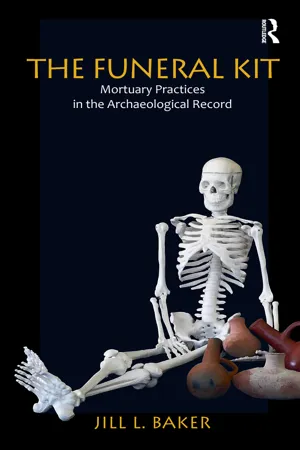
Studies of mortuary archaeology tend to focus on difference—how the researcher can identify age, gender, status, and ethnicity from the contents of a burial. Jill L. Baker's innovative approach begins from the opposite point: how can you recognize the commonalities of a culture from the "funeral kit" that occurs in all burials, irrespective of status differences? And what do those commonalities have to say about the world view and religious beliefs of that culture? Baker begins with the Middle and Late Bronze Age tombs in the southern Levant, then expands her scope in ever widening circles to create a general model of the funeral kit of use to archaeologists in a wide variety of cultures and settings. The volume will be of equal value to specialists in Near Eastern archaeology and those who study mortuary remains in ancient cultures worldwide.
Trusted by 375,005 students
Access to over 1.5 million titles for a fair monthly price.
In the course of reading published reports about excavated tombs, the interpretation of mortuary architecture, and associated grave goods, it occurred to me that while much has been learned about ancient mortuary practices, considerable gaps in our understanding remain. Until now, attention has tended to focus primarily on mortuary variability, the differences that occur among burials, which is an approach often used to identify cultural, social, and economic aspects of the tomb occupant(s). This approach assumes that cultural and socioeconomic factors such as the wealth, status, and the persona of individual community members determined the variations present among their interments. Such variations include grave type, tomb architecture, grave goods, gender, sex, and age. For example, tombs boasting elaborate architecture and decorative elements appear to have been owned by an individual or family of high socioeconomic standing, one that could afford to build and maintain such a structure. Additional factors include energy expenditure—how much (perceived) effort was invested in the construction of the tomb structure, the funerary ceremony, and the quality and quantity of the grave goods. It is assumed that a high measure of energy expenditure is indicative of the high socioeconomic standing of the occupant(s) within the community, either as an official, a leader, or a prosperous business person (Binford 1971; Parker-Pearson 2005; Richards 2005; Saxe 1970; Wason 2004)1. Other indicators of social standing may include health, diet, and skeletal markers of heavy physical labor. These variations and differences among burials have been the primary focus when defining and interpreting mortuary practices in Bronze Age Canaan. Determining the socioeconomic disparities of the deceased, however, seems to address only part of the ancient mortuary puzzle. The evidence of repetitive patterns found among contemporaneous Bronze Age burials in Canaan reveal similarities, which I propose should be viewed with equal significance. It is curious how the literature only briefly mentions and largely ignores mortuary uniformity and the commonalities among and between burials. These patterns of similarity deserve greater attention and may offer the missing pieces that will help complete the picture of the mortuary puzzle.
Accordingly, I have taken a different approach when interpreting tomb architecture, the use of interior space, and grave goods by focusing on patterns of similarity among interments in the chamber tombs (single and multiple interments) of Bronze Age Canaan. When comparing interments, both inter and intratomb, the patterns seen suggest that the information being conveyed was more than simply the social and economic conditions of the deceased. Certainly, a celebrated individual such as a king or high official may have received a tomb with more grandiose architecture and more elaborate grave goods than ordinary individuals; however, the vast majority of undistinguished burials, and even those of celebrated individuals, exhibit observable patterns that are specifically notable in the repetition of certain items among grave assemblages in Bronze Age Canaan. During the course of my research, it was the repetition of ceramic types, scarabs, and toggle pins in Canaanite burials that caused me to reconsider traditional interpretations of grave goods. This mortuary uniformity led me to believe that certain items reveal ritual and ceremony rather than socioeconomic rank and persona. Indeed, some items do reveal a person’s socioeconomic standing or profession, while others are of a more personal nature revealing individual qualities or gender. However, these objects are often unique to a particular individual and may not necessarily be repeated in exactly the same way for another person, attesting to that individual’s unique characteristics and distinguishing him/her from others.
Conversely, those items that were repeatedly deposited with each person regardless of rank within the community suggest routine practice, rite, ritual, and ceremony. The components of these relatively predictable assemblages fit into the category of essential grave goods, because they provided something essential to the well-being of the deceased and are referred to here as the funeral kit, which is the focus of this study. The funeral kit, then, is a relatively predictable set of grave goods—including ceramic and nonceramic items—that was repeatedly deposited with most contemporaneous burials. The presence of the funeral kit offers insight into the beliefs of the interred and those who performed the funeral ceremony and burial relative to the needs of the spirit and afterlife scenarios. Many ancient afterlife scenarios involved a perilous underworld in which beings and deities seek to impede the deceased’s journey to a happier, safer place in the eternal realm. In such cases, the family would outfit the deceased with the equipment necessary to sustain their wellbeing throughout their journey and upon arrival and beyond. The presence or absence of the funeral kit and the components that comprised it is the archaeological indicator for these developing beliefs and evolving afterlife scenarios.
It has long been held that the occupants of these multiple-burial, chamber tombs, owned by a kinship group, were probably members of the upper class. It has also been assumed that the placement of individuals in the tomb at the time of burial was dependent upon available space (save for high-ranking individuals). Older interments whose flesh had decayed either in part or in whole were often pushed aside to make room for new burials, making placement in the tomb seem random and contributing to the mix of skeletal remains and grave goods frequently found in them. In some instances, archaeologists have concluded that this seemingly chaotic jumble prevents the identification of the ownership of specific grave furniture, resulting in the majority of deposits being analyzed collectively rather than individually and so producing artifact tallies and statistics that reveal little useful data. Upon closer examination, it is possible in many cases to disentangle the intertwined mass and identify the final interment(s), clusters, and/or individual burials. Of particular interest are burial clusters, which are made up of multiple individuals irrespective of age or sex. This apparent clustering, together with textual references referring to the importance of being buried with one’s kin, caused me to re-examine the long-held belief that interments were deposited in the tomb on the basis of available space alone. It is more probable that these clusters were not indiscriminate and may represent the deliberate organization of the smaller family units within the larger clan who owned the tomb. Clusters appear to occur in specific zones within the chamber, and the additional assistance of architectural features such as niches, probably helped define that family’s space within the tomb.
The recognition of status, rank, privilege, gender, and so forth (mortuary variability) in the archaeological record, specifically in the mortuary setting, has become relatively straightforward and has contributed to a better understanding of social relationships and hierarchy in complex societies. In death, much as in life, one’s socioeconomic position is reflected by the tangible property that was deposited with the burial, such as personal possessions (grave goods) and house of eternity (tomb). Since personal possessions, and in some cases architecture, tended to be unique to individual burials (or groups), certain conclusions can be drawn. Luxury items, such as ceramics, receptacles for commodities, jewelry, and even clothing indicate not only the social and economic standing of the individual, but also the intracountry and international commerce and trade relationships of that community. The implication of long-distance trade suggests a certain amount of interaction between peoples of different nations and the exchange of ideas. Incorporating imported items in the mortuary setting suggests these items had become integrated into society and were highly valued commodities. The burials of celebrated individuals such as kings, officials, warriors, priests, and well-to-do merchants reveal the types of occupations that were highly revered. Those of prestigious occupation often received tombs with elaborate architecture, grave goods of a specific type (e.g., weaponry for a warrior—engendered items), greater quantity and quality, and probably a funeral ceremony that would include greater pageantry. Certainly the death of these high-ranking individuals would be felt not only within the family but also within the local and wider community too. The unique celebration of an individual’s life (mortuary variability) would not only honor the personal attributes of the deceased but also enable the surviving family members and the community to cope with their loss by providing a funeral, burial, and tomb commensurate with their position in life and their contribution to society.
Recognizing ceremony in the archaeological record, specifically in the mortuary setting, is as straightforward as recognizing status. Within the same context mentioned above, there are also tangible objects that accompany many if not all contemporaneous burials within a tomb, necropolis, community, or cultural group (mortuary uniformity); however, these objects do not speak to the unique status, occupation, or character of an individual(s). Instead multiple interments who receive the same (or very similar) object or set of objects suggest that something is shared, reflecting a degree of equality among the recipients. This sort of uniformity reveals repetition of action, which, in turn, reveals ceremonial behavior. Ceremony is inextricably intertwined with rite and ritual, which are tools that help to explain natural occurrences, maintain social order, provide a sense of belonging within a community, and transform a person or community from one state of being or understanding to another (C. Bell 1997; Turner 1969). Rites, rituals, and ceremonies are events that may be celebrated either publically or privately and may be social and/or religious occasions. They usually involve leaders, members, and aspirant(s) who participate and witness prescribed formulae that include liturgies and actions that are preformed in a similar fashion over and over again. Thus, a rite is the transformative social, moral, religious, or political concept that causes a person(s) or community to move from one state into another. Ritual is the mechanism—the prescribed formula—by which the transition occurs. While the ceremonial aspect is the public, outward expression of the rite and the mechanism by which the ritual is performed, it announces to the wider community that a transition has occurred. The funerary ceremony, then, is the outward expression of mortuary rite and ritual and the repeatedly deposited prescribed sets (essential grave goods) are the artifactual evidence of these invisible obsequies. The performance of these prescribed formulae is both consistent and unaffected by socioeconomic status, and it is this quality of “sameness” that contributes to the mortuary uniformity found in the archaeological record, even in the midst of mortuary variability. Therefore, the interpretation of burials is a two-tiered integration; it involves socioeconomic status intertwined with prescribed rite, ritual and ceremony, through which valuable information about the life of the deceased is revealed.
Recognizing this two-tiered integration is important not only for archaeologists who analyze Canaanite burials, but also for all archaeologists who excavate and interpret burials. It is important to acknowledge that in much of the ancient world, the secular (social, economic, and political), the ceremonial, and the spiritual (not necessarily in a religious sense) aspects of life were integrated and embraced on a daily basis. Although much of the modern world separates “church” and state, the ancients did not. The religious or spiritual world was just as real and immediate as politics and business. The secular aspects of life are better understood because there is more tangible proof of them: nation-states, palaces, houses, commodities, and texts. Conversely, the ceremonial aspects of life are less well understood because these are ethereal concepts, which the ancients understood but did not necessarily write down; however, they are tangibly represented by obscure objects such as figurines, vessels, paraphernalia, and architecture such as temples. To understand the ceremonial aspects of ancient life is to understand the glue that held society together as families, communities, cultural groups, and nations. It was the rites, rituals, and ceremonies that imposed and legitimized social order, providing a sense of belonging that bound the members of a community—society—to one another (C. Bell 1997; Moor and Myerhoff 1997). In the same way that secular laws impose order and bind the public aspects of society, so too do ceremonial traditions impose cultural, moral, and spiritual order, which bind a community in a deeper ethereal sense. Careful excavation and interpretation of burials can reveal both the secular aspects of life as well as its ceremonial dimensions.
Earlier reference has been made to the patterns that can be observed about grave goods when comparing Canaanite burials in a necropolis or within multiple-burial tombs; some objects are unique to each burial while others are deposited repeatedly, sometimes in quantity, with all or most burials. Those objects that are unique reveal information regarding the deceased’s persona and socioeconomic status. Those objects, or set of objects, that are common to most or all burials within a community or cultural group reflect rite, ritual, and ceremony. Careful examination of these sets, referred to as a funeral kit, identifies them as the tangible and artifactual evidence for ceremony in Canaan; however, similar sets and patterns may be observable in burials beyond Canaan. In Canaan and beyond, the funeral kit could consist of combinations of one or several vessels (ceramic, glass, wood, baskets), amulets (scarab, ankh, crystal, cross), garments, headdress, or implements (coin, mirror, or key). Vessels in the funeral kit may contain food and drink, representing either a portion or remnant of a meal, and commodities such as oils, perfumes, unguents, etc. Amulets often posses powers and qualities that protect the spirit itself or represent the protection of the spirit by a deity as it makes the journey into the next world and provides ongoing protection once it has arrived. Items such as coins may be necessary to pay ferrymen (Greek) or gate keepers and mirrors may ward off evil spirits (Etruscans).
By way of example, easily recognizable components of the funeral kit in Egypt are the canopic jars, which were often placed inside a canopic chest and deposited in the tomb of the deceased. During the mummification process, the stomach, intestines, lungs, and liver were removed and each placed into a separate jar. The stomach was placed into a jackal-headed jar, Duamutef a deity of protection who represented the east and protected the deceased from hunger and thirst. The intestines were placed into a falcon-headed jar, Qebehseneuf represented the west and was also a god of protection. The lungs were deposited into a baboon-headed jar, Hapi who represented the north and protected the throne of Osiris in the Underworld. The liver was put into a human-headed jar, Imseti who represented the south. All four were sons of Horus and considered to be protectors of the organs housed within their own jar, because the deceased would need these organs in the afterworld (Budge 1989; Ritner 1997). When found in the mortuary setting, this component of the Egyptian funeral kit represents customs and beliefs that were essential to the survival and well-being of the spirit and bound that community together as a cultural group. Essential grave goods that comprise the funeral kit are the tangible culmination of the ceremonies that expressed the rites, rituals, and beliefs behind them. All items in a funeral kit are considered to be in some way essential to the survival and well being of the spirit both for its journey into the next world and in the life beyond.
In as much as the funeral kit represents a specific moment in time, namely the invisible funerary ceremony, it also reflects culture-specific, afterlife scenarios. Each culture’s funeral kit reveals details that pertain to their afterlife scenario. The very presence of essential grave goods that are meant to provide sustenance, protection, payment for passage, and anything that has to do with the well being of the spirit, are indicative of what sort of supernatural care or peril awaits the deceased. For example, the Mesopotamians and Egyptians also provided food stuffs for the dead at the time of burial and during regular festivals, suggesting that the deceased required an ongoing supply of sustenance, that was not provided by an afterworld deity, and which may not necessarily have been cultivated by the deceased in the afterlife. As another example, the previously mentioned placement of vital organs in canopic jars in the Egyptians’ afterlife scenario suggests the expectation of bodily rebirth in the next world, wherein these vital organs would once again be necessary to a living body. In a third example, the placement of a coin with the deceased is consistent with texts and vase paintings that refer to the payment of Charon (Greece), the ferryman who provided passage for the deceased across the rivers Styx and Acheron as they journeyed into the underworld. As afterlife scenarios evolved, the quantity and type of grave goods reflected those changing details. For example, as Judaism embraced an afterlife wherein Yahweh cared for the dead, fewer, if any, grave goods were deposited with the deceased. Similarly, with the emergence of Christianity and an afterlife wherein God provided for all the needs of the dead, essential grave goods were reduced to one or more crucifixes and perhaps anointing oil. Thus, in the archaeological record, in the same way that some grave goods can identify chronological period, international trade relationships, and socioeconomic status, certain objects can also identify rite, ritual, ceremony, and afterlife scenarios, which were basic rights available to all irrespective of socioeconomic status. These concepts will be more fully developed and supported with detailed archaeological examples in the chapters that follow.
This work will focus primarily on Bronze Age Canaanite mortuary practices. Specific attention will be given to grave goods in general and essential equipment in particular. The focal point will be on mortuary uniformity, on that which binds rather than divides, as a reflection of rite, ritual, and ceremony. Additionally, related subjects, such as burial clusters, use of interior space, and afterlife scenarios will be explored so as to present a well-rounded understanding of the way(s) in which the ritualistic aspects mortuary practice bound families and communities together. The Canaanites did not live in a vacuum, nor were they the only ancient people to develop complex mortuary practices. This being the case, it is equally important to understand the mortuary traditions of the peoples with whom the Canaanites may have had contact, so as to compare and contrast customs and the exchange of ideas that contributed to the unique nature of the Canaanites mortuary traditions. To do so, the mortuary traditions of neighboring cultures, both contiguous and distant, from contemporaneous as well as earlier and later chronological periods, will be integrated and woven throughout the fabric of this work. The main focus of the extra-Canaanite mortuary practices will concentrate on tomb architecture and grave goods, specifically the essential equipment.
The first priority, however, is to establish a foundation from which to begin a discussion of the above-mentioned topics. The next chapter will present a summary of mortuary practices and analyses that have already been established by archaeologists, anthropologists, textual scholars, and historians. The observations and interpretations of these scholars have contributed greatly to our current understanding of mortuary practices in Canaan and in the surrounding ancient world. Consequently, it is essential to acknowledge and summarize the relevant portions of their work so as to formulate a launching point for furthering the mortuary discussion. Chapter three will discuss the identification of and model for the funeral kit, the essential equipment that provided for the well being of the deceased in Bronze Age Canaan and focus on a description of the methodology used to identify the funeral kit at the site where it was first observed and so establish a case for its use. The fourth chapter will take the funeral kit model out of its original setting and apply it to contemporaneous sites in wider Canaan. In doing so, the widespread use of the funeral kit as a well-established, Canaanite funerary tradition will be demonstrated, concurrently proving the model was not just a one-time phenomenon at a single site.
Thus far, the discussion of the funeral kit will have been based on a well-established tradition in the height of its popularity; however, its origin and termination will have yet to be discussed. Chapter five will attempt to answer those questions by identifying when the tradition began, track its development, explore when and why it fell into decline, became redundant, and finally disappeared. Although the funeral kit model was based on Canaanite tombs and traditions, in theory application of the funeral kit model should be universal. The sixth chapter will remove again the funeral kit model from its Canaanite context and apply it to other tombs and burials found in different geo-cultural locations where mortuary uniformity has been observed. In so doing, the universal nature of the funeral kit model can be tested. In chapter seven, I will integrate the theory with the data by reviewing the archaeological evidence presented in the preceding chapters. The chapter will also introduce some additional data and discuss the archaeological evidence as it relates to the various interpretations of status and the funeral kit theory previously described. The final chapter will weave together the multifaceted nature of tombs, burials, ceremonial customs, and afterlife scenarios to offer a coherent picture of the binding force of funerary practices in the ancient world.
Chapter2 The Archaeology of Death and Burial: Established Interpretations, Terminologies, and Definitions
The burial of the dead woul...
Table of contents
Cover
Half Title
Dedication
Title
Copyright
Contents
List of Illustrations
Acknowledgements
Chapter 1: Introduction
Chapter 2: The Archaeology of Death and Burial: Established Interpretations, Terminologies, and Definitions
Chapter 3: The Funeral Kit Model
Chapter 4: The Funeral Kit in Wider Canaan (MB IIB/C–LB II)
Chapter 5: The Genesis and Extinction of the Funeral Kit in Canaan
Chapter 6: Beyond Canaan: The Funeral Kit in a Wider Geographical and Chronological Context
Chapter 7: Evidence and Theory
Chapter 8: The Ties That Bind
Appendix A. Clustered and Nonclustered Burials in Tomb Chambers 5, 8, 11, 13, 14, 16 at Ashkelon
Appendix B. The Funeral Kit in Wider Canaan: Middle Bronze Age IIB (may also represent MB IIA/B transition)
Appendix C. Burial Clusters in Wider Bronze Age Canaan
Notes
Chronology
References
Index
About the Author
Frequently asked questions
Yes, you can cancel anytime from the Subscription tab in your account settings on the Perlego website. Your subscription will stay active until the end of your current billing period. Learn how to cancel your subscription
No, books cannot be downloaded as external files, such as PDFs, for use outside of Perlego. However, you can download books within the Perlego app for offline reading on mobile or tablet. Learn how to download books offline
Perlego offers two plans: Essential and Complete
Essential is ideal for learners and professionals who enjoy exploring a wide range of subjects. Access the Essential Library with 800,000+ trusted titles and best-sellers across business, personal growth, and the humanities. Includes unlimited reading time and Standard Read Aloud voice.
Complete: Perfect for advanced learners and researchers needing full, unrestricted access. Unlock 1.5M+ books across hundreds of subjects, including academic and specialized titles. The Complete Plan also includes advanced features like Premium Read Aloud and Research Assistant.
Both plans are available with monthly, semester, or annual billing cycles.
We are an online textbook subscription service, where you can get access to an entire online library for less than the price of a single book per month. With over 1.5 million books across 990+ topics, we’ve got you covered! Learn about our mission
Look out for the read-aloud symbol on your next book to see if you can listen to it. The read-aloud tool reads text aloud for you, highlighting the text as it is being read. You can pause it, speed it up and slow it down. Learn more about Read Aloud
Yes! You can use the Perlego app on both iOS and Android devices to read anytime, anywhere — even offline. Perfect for commutes or when you’re on the go. Please note we cannot support devices running on iOS 13 and Android 7 or earlier. Learn more about using the app
Yes, you can access The Funeral Kit by Jill L Baker in PDF and/or ePUB format, as well as other popular books in Social Sciences & Ancient History. We have over 1.5 million books available in our catalogue for you to explore.