- 400 pages
- English
- ePUB (mobile friendly)
- Available on iOS & Android
eBook - ePub
About this book
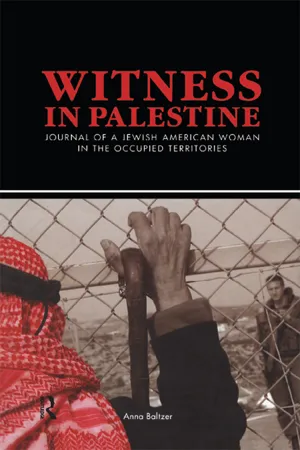
Anna Baltzer, a young Jewish American, went to the West Bank to discover the realities of daily life for Palestinians under the occupation. What she found would change her outlook on the conflict forever. She wrote this book to give voice to the stories of the people who welcomed her with open arms as their lives crumbled around them. For five months, Baltzer lived and worked with farmers, Palestinian and Israeli activists, and the families of political prisoners, traveling with them across endless checkpoints and roadblocks to reach hospitals, universities, and olive groves. Baltzer witnessed firsthand the environmental devastation brought on by expanding settlements and outposts and the destruction wrought by Israel's "Security Fence," which separates many families from each other, their communities, their land, and basic human services. What emerges from Baltzer's journal is not a sensationalist tale of suicide bombers and conspiracies, but a compelling and inspiring description of the trials of daily life under the occupation.
Trusted by 375,005 students
Access to over 1.5 million titles for a fair monthly price.
Study more efficiently using our study tools.
Information

Kate was deported on January 17, 2004. She is not the first IWPS peaceworker to be deported from Israel, and she probably won’t be the last. Although physically harming international volunteers could entail undesirable diplomatic repercussions, Israel is free to prevent internationals that admit to working with Palestinians from entering Palestine, since Israel controls all movement into, within, and out of Palestine. As a result, IWPS volunteer numbers are dwindling.
In the Fall of 20041 was informed that IWPS needed volunteers in early 2005, so in February I flew to Israel and crossed into the West Bank for three more months in Haris. The Wall had grown quite a bit during my absence despite the International Court of Justice’s ruling in July 2004 that Israel’s “Separation Barrier” is in breach of international law and a violation of the Palestinians’ human rights and right to self-determination. The court demanded that Israel cease construction of, dismantle, and make reparation for all damage caused by the Wall. Israel responded by rejecting the the court’s opinion and declaring its intentions to continue Wall contruction.
Nonviolent resistance continued all over Palestine throughout 2004, and much of it met with violence from the Army. In the twelve months or so that I was gone, about 110 Israelis were killed by Palestinians, along with more than 935 Palestinians killed by the Israeli Armed Forces and settlers.21 Before the rise in deaths, Israel cited the decrease in suicide bombings as proof of the Wall’s efficacy. When the death toll rose, Israel cited the deaths as justification for the Wall, and proof of Israel’s need to defend itself.
One promising piece of news: continuous nonviolent demonstrations in Budrus village succeeded in getting the Wall’s path near Budrus moved all the way to the Green Line, except for a dozen acres in one area that are still threatened with annexation. Villagers continue to demonstrate nonviolently for these last acres; their actions have included cutting through large chunks of the fence. In response, the Army is replacing the wire-fence Wall near the village with a concrete one.
Note
21 Middle East Policy Council, December 31, 2004. www.mepc.org/public_asp/resources/mrates.asp
Witness in Palestine
QBZ Boys’ School Under Attack
Monday, February 14, 2005:
It has been hard being back in Palestine. We are busy and freezing, and I have been fighting a cold for weeks. But I am filled with energy and excitement about being back here. The competing forces of war and peace-making all around make me feel awake and alive in a way that I never feel at home.
Palestine is even more beautiful than I remembered it. Every tree, grove, and field is so ancient, fertile, and cared for. I am surprised to feel a strong attachment to the land here unlike anything I’ve ever felt in my own country, even though I allege no biblical or hereditary claim to Palestine. Feeling an attachment to land for the first time in my life helps me to understand why people would fight so hard to take or keep it.
I spent last weekend in a village called Qarawat Bani Zeid (QBZ), where locals had asked for an international presence at a boy’s high school due to frequent incursions by Israeli soldiers. Two years ago, several soldiers entered the village on foot and opened fire on the school courtyard, killing two and injuring several others. The attack was retaliation for students throwing stones at Army jeeps in the village. There have been dozens of Palestinians killed in the village since then, with no justification given, no investigations carried out, and no one held responsible. The jeeps continue to drive around and the boys continue to throw stones.
My colleague Fatima and I were asked to sit at a bus stop on the main road next to the school on Saturday morning, the first day of the school week. The children gathered in the courtyard at eight o’clock to sing the school song and get organized for the day. Five minutes later, a jeep and a Humvee drove by and the students quickly picked up stones to throw. We were helpless, unable to prevent the Army from passing or the students from throwing stones. But we were visible in the road, watching. The Humvee drove away and the students went into the school, where they stay all morning except for one recess.
The Army returned precisely at recess. This time, the teachers had received a call from a nearby village warning them of the Army’s approach and managed to usher all the students in before the soldiers passed. As the jeep and Humvee drove by, a soldier threw a sound bomb into the empty schoolyard. Then they were gone.
It was miserable to watch this scene, knowing how determined each side was not to show fear and how much carnage was bound to come of that. We knew how it would be reported in the American press: “Angry Palestinians Shower Israeli Soldiers With Stones,” with no mention of the terror the village faces each time a jeep zooms through, not knowing what will come next. Two days ago a young man was arrested; two weeks before, two men were killed and one house destroyed.

Students hang around QBZ boys’ school, where soldiers opened fire in 2003, killing two.
The article would also not mention that the Army consistently drives by during the recess period, when the boys are outside. We interviewed the headmaster, who said that the pattern had become so obvious that the school changed its hours around to avoid confrontation. He said the Army now comes during the new break time hours with regularity that cannot be coincidental. We asked what it was like to teach under such circumstances, and he sighed. “We have to seize each day to teach them. Who knows if tomorrow we will have the chance?”
Sitting at the bus stop, we talked to passers-by about the situation, each one seeming less hopeful than the last. Some were students taking a break. One Hemingway fan asked me if I had read A Farewell to Arms. The school’s English teacher came out during his free hour to welcome me. He had heard that I was Jewish. He explained that the Jews are cousins of the Arabs and the neighbors of Palestinians. But he lamented the 30,000 homeless in Gaza and the innocent people killed every day. He said he no longer wondered how people could blow themselves up: “When you’ve lost everything and everyone, you want to do something to make yourself feel powerful again.”
One man waiting for the bus spoke excellent English and French. After shaking our hands, he said in the most respectful way possible, “Something has been troubling me.” He read aloud from the IWPS card we had given him and then commented: “‘We support nonviolent resistance to the military Occupation’… I welcome you to our country and I thank you for the work you’ve done, but tell me, why do you only support nonviolence? Violence has always been an acceptable means of fighting oppression in most countries in the world… Why not here? How can you expect us to be nonviolent when we are under attack? What else can we do?”
I explained that I believe the resolution to the problem must include international pressure on Israel to stop, as it did with apartheid in South Africa. I also believe that pressure might never be realized if people in other countries continue to view Palestinians as terrorists.
Fatima, who is from South Africa, pointed out that there was also a major armed resistance to apartheid that helped end the system. She said, “I believe nonviolent resistance was part of the struggle, but not all of it.” Our new friend asked what she would recommend, and she suggested boycotting Israeli products. He laughed.
Boycotting?! What can we boycott? Israel completely controls our imports and exports, so we have no choice but to buy from Israel or its trade partners, and both of those options contribute to the Israeli economy. The few products produced in Palestine, like milk and hummus, would never make a difference. Once we tried to boycott fruits and vegetables and Israel lowered its prices so low that farmers couldn’t keep up. Believe me, we’ve tried. But it doesn’t work. Your most important work is not boycotting; it’s telling your family and friends what you see here. And our work is to resist, and to never, ever lose hope. We are not leaving.
He’s half right. Most Palestinians are not leaving, despite the curfews, incursions, house demolitions, arrests, and killings. They are more determined than I could ever be, but I wish that their success matched their determination. It’s unclear what would be most effective, and as a result much of the resistance is chaotic and disorganized, with no principle strategy to guide and unify the movement. As it is now, most of their nonviolent sacrifices are forgotten.
Fatima and I took an arrest report in QBZ for a young man named Hassan. We visited his family in their modest home and they welcomed us graciously, feeding us copious amounts of food. On their wall hung a poster of another son, Hassan’s younger brother, who was killed at the age of sixteen for throwing a stone at a jeep. He smiled handsomely in the poster and in a framed picture that they kept on the sofa next to them, as if pretending he was in the room. They bragged about another son Rami who was a Palestinian policeman in Ramallah. I recognized Rami’s name from a witness statement I had read earlier that day describing the events of a military incursion in QBZ eighteen months earlier. Here is an excerpt from Rami’s statement:
Suddenly they started to fire in the air and I saw a child, Tamer Arrar (eleven years old) crying when he saw himself alone and all who were around him escaped. I approached him on the eastern hill, while down from us stood the three soldiers with [a tall] blond soldier directing his gun towards us. We both lay down on the ground. I told Tamer not to raise his head because I could see the tall soldier targeting us. But as soon as he raised his head, a bullet hit him in the head and I saw his head exploding. The soldiers were about 400 meters from us. We were not throwing stones at the soldiers and there were no clashes between them and the children….
[Then] some young boys and I threw stones at the patrol cars and ran away towards the fields and they followed us shooting and firing at us until I reached a dead end. The soldiers and I came face to face and were separated by only ten meters. The same tall and blond soldier and another one insulted us and the tall one shot at me. The bullet penetrated my right thigh, where it entered from the front and exited from the back. On the same day, my brother Rafat was injured in the stomach and my friend Ghassan was also injured in the right thigh.22
It was not the shooting of an unarmed child from ten meters that startled me most. It was the mention of a boy injured in the stomach: I had only been to QBZ once before, and I remembered clearly a striking young boy who came up to the window next to me and lifted his shirt to reveal a large stomach wound draining into a sack. I had forgotten about him until reading the above passage from Rami’s statement, and I almost passed out when he walked into the room where we were eating with Hassan’s family.
I told Rafat that I remembered him and he verified that he had a wound in his stomach. He was nonchalant about the injury, since his father and three older brothers have also been shot. His younger sister was also hit in the eye with a stone thrown by her older brother at a jeep.
Abu Hassan told me the story of his son’s arrest several days before. He said soldiers woke him up at five in the morning and asked him to identify his son, who was wanted for being a Hamas-supporter. Abu Hassan refused to go until they threatened him with force. He was taken to a nearby village, terrified the whole time that he would be forced to identify his son’s corpse. When he arrived he saw three Palestinian young men standing, including his son, whose arms had been tied to a jeep. Dozens of soldiers milled around. An Arabic-speaking officer pointed to each of the three men in succession, asking Abu Hassan each time whether the man was his son.

Rafat and his cousin Rabia play chess in the QBZ International House.

Mohammed’s room after the Army searched it because he...
Table of contents
- Cover
- Title Page
- Copyright Page
- Dedication
- Table of Contents
- Maps
- Introduction
- Acknowledgements
- 2003:
- 2004:
- 2005:
- Conclusion
- Appendix I: What You Can Do
- Appendix II: Resource Guide
- Appendix III: Brief History
- Appendix IV: Myths and Facts about Camp David II
- Glossary
- About the Author
Frequently asked questions
Yes, you can cancel anytime from the Subscription tab in your account settings on the Perlego website. Your subscription will stay active until the end of your current billing period. Learn how to cancel your subscription
No, books cannot be downloaded as external files, such as PDFs, for use outside of Perlego. However, you can download books within the Perlego app for offline reading on mobile or tablet. Learn how to download books offline
Perlego offers two plans: Essential and Complete
- Essential is ideal for learners and professionals who enjoy exploring a wide range of subjects. Access the Essential Library with 800,000+ trusted titles and best-sellers across business, personal growth, and the humanities. Includes unlimited reading time and Standard Read Aloud voice.
- Complete: Perfect for advanced learners and researchers needing full, unrestricted access. Unlock 1.5M+ books across hundreds of subjects, including academic and specialized titles. The Complete Plan also includes advanced features like Premium Read Aloud and Research Assistant.
We are an online textbook subscription service, where you can get access to an entire online library for less than the price of a single book per month. With over 1.5 million books across 990+ topics, we’ve got you covered! Learn about our mission
Look out for the read-aloud symbol on your next book to see if you can listen to it. The read-aloud tool reads text aloud for you, highlighting the text as it is being read. You can pause it, speed it up and slow it down. Learn more about Read Aloud
Yes! You can use the Perlego app on both iOS and Android devices to read anytime, anywhere — even offline. Perfect for commutes or when you’re on the go.
Please note we cannot support devices running on iOS 13 and Android 7 or earlier. Learn more about using the app
Please note we cannot support devices running on iOS 13 and Android 7 or earlier. Learn more about using the app
Yes, you can access Witness in Palestine by Anna Baltzer in PDF and/or ePUB format, as well as other popular books in Politics & International Relations & Middle Eastern Politics. We have over 1.5 million books available in our catalogue for you to explore.