eBook - ePub
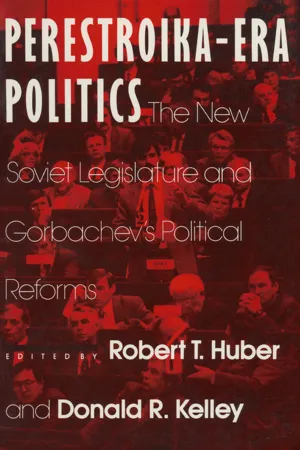
Perestroika Era Politics: The New Soviet Legislature and Gorbachev's Political Reforms
The New Soviet Legislature and Gorbachev's Political Reforms
- 256 pages
- English
- ePUB (mobile friendly)
- Available on iOS & Android
eBook - ePub
Perestroika Era Politics: The New Soviet Legislature and Gorbachev's Political Reforms
The New Soviet Legislature and Gorbachev's Political Reforms
About this book
This book is an evaluation of the new legislative politics in the Soviet Union. The contributors examine the uneven progress of electoral and constitutional reform, the composition, organisation, staffing and procedures of the Congress of People's Deputies and the Supreme Soviet, the development of factions, movements and parties on the left, on the right, and of the nationalist bent, the path of executive-legislative relations and case studies of the role of the legislature on domestic and foreign policy realms. This book should prove of interest to students of Soviet politics, political parties, and legislative politics, as well as for anyone interested in the struggle of political ideas, forces, and institutions in the USSR today.
Trusted by 375,005 students
Access to over 1.5 million titles for a fair monthly price.
Study more efficiently using our study tools.
Information
1
Introduction
The New Soviet Legislature: How Ideas and Institutions Matter
Robert T. Huber
Social scientists have long disagreed about the role ideas play in politics, particularly in times of transition or crisis. This disagreement has been evident in many cases where the struggle of ideas has clearly produced policy changes, but the role that can be assigned to new ideas as opposed to more settled institutional interests in effecting the changes is difficult to assess.1
To date, there has been no integrated effort to explore the role ideas have played in the systemic transition now under way in the Soviet Union. Why is such an effort important? Because the beliefs, values, and principles that are a part of glasnost', perestroika, demokratizatsiia, and "new thinking" in foreign policy, as well as transplanted conceptions of civil society and particularly the concept of separation of powers, have had an unmistakable impact on both individuals and institutions in the Soviet political system. Such an impact cannot be understood merely by regarding such ideas as the product of institutional interests or actors in place at the time of Mikhail Gorbachev's accession to power in 1985.
To argue that the ideas of the post-1985 period are simply "hooks" used by elites to advance their own interests is to lose much of the richness and context of today's Soviet politics and society. Such an approach was very popular in explaining Soviet politics of an earlier period. On the eve of Gorbachev's accession, no one would have suggested that the ideas we now accept as essential to understanding Soviet politics would develop in the years ahead.
Indeed, most scholars and policy makers were content to accept political outcomes in the Soviet Union as the product of entrenched individuals and institutions who preferred the status quo or only marginal change. Politics dominated by the Communist Party and tolerant of only a highly controlled pluralism of ideas was thought to explain adequately the political life of the country. Most observers had confidence in the party's ability to assimilate demands for modifications in policy within an existing political structure.
Studying only institutions and the policy-making process, as if the ideas and preferences of individuals were only the modeling clay of policy outcomes, produces a very distorted analysis. The stagnation of this approach produces either woeful unpreparedness for the dynamics of political change or after-the-fact explanations of policy changes that argue that institutions and individuals were really in favor of those changes all along.
To be sure, the debate about the role ideas play in politics and policy making has not been settled. The scholarly literature does, however, offer a number of hypotheses positing a role for ideas in the making of policy, hypotheses that will find both support and some counterevidence in the chapters that follow. Here are some of the hypotheses.
1. Ideas change the way actors define their worldviews and preferences by helping them to define meaning, to discern order and disorder, and to formulate beliefs, values, rules, and expectations.
2. Ideas are conditioned by and have impact on the way individuals, institutions, and their constituent interests are organized and deal with problems within their purview.
3. Ideas affect the structuring of policy-making agendas in both a limiting and a delimiting way, thereby suggesting tracks on which practical solutions will be channeled.
4. Ideas provide clues to a range of multiple equilibria in policy outcomes and the diversity of social, economic, and political forms present in those outcomes, as well as clues about their prevalence and enforcement or their failure to take root in the same or differing institutional settings.
5. During times of crisis or transition, ideas enable policy makers to reduce uncertainty and build consensus outcomes, or conversely, can restrain successful efforts to overcome uncertainty and instability.
6. Ideas frame the way policy makers signal commitments and structure strategies for reaching preferred outcomes.
7. Ideas enrich our understanding of outcomes, particularly since their implementation can be subject, for a variety of reasons, to lag times of long duration during which constraints to their acceptance are lowered.
8. Ideas are contested and their implementation can produce unexpected or unanticipated outcomes that in turn give purpose to differing ideas and policy-making preferences both within and across institutions.
The above hypotheses attest to the analytical richness the study of ideas can have for the conduct of research on political systems. But simply to posit a role for ideas is a rather modest scholarly objective. Many scholars can readily concede, whether they favor an ideational or a rational actor perspective, that in a general abstract sense both ideas and institutions matter. Far more useful is an effort to explore how they matter in concrete and disaggregated ways, what the ideas are and what led to their acceptance, how they are being practically implemented, the social context of implementation, and its effects on outcomes.
Moreover, it can be persuasively argued that ideas have played an important causal role in certain political outcomes, or at least helped make possible a range of outcomes. These ideas have also been a causal factor in the practical implementation of certain policies and in some instances the institutionalization of policy making generally.
The essays that follow seek to demonstrate not only the ways but the means by which the ideas of the Gorbachev period have had impact. The main focus of analysis is the major institutional changes under way since 1989 in the national legislature of the Soviet Union,2 the Congress of People's Deputies, but particularly the Supreme Soviet.
The functions and processes that legislatures undertake help us understand why they are often important institutions in their own right, particularly during times of systemic transition. Legislatures are a recruiting ground for emerging political elites. Legislators may serve as representatives of the public in dealing with unelected elites in the executive bureaucracy. The legislature can serve as an institution through which societal groups form coalitions and political parties to promote or frustrate social action and change, channel or harness dissent, and challenge or reinforce regime legitimation.
Finally, legislatures can often become the arena in which judgments are made about what functions governments will or will not carry out for the society. The legislature is, as Robert Sharlet points out in his chapter in this volume, part of "the value-rich environment of entwined supporting sociolegal networks ... underpinning a democratic system."
Thus, a legislature cannot be studied in a vacuum. Processes and institutions outside the legislature matter and deserve careful attention. In the Soviet context today, such issue areas as the direction of constitutional reform, the evolution of the electoral system, the legislative process, the emerging political parties and their interaction with the existing party-administrative structures, legislative-executive relations, the development of legislative power in specific issue areas, must be studied to understand credibly how the Soviet national legislature impacts and is impacted upon by perestroika-era politics.
The volume has chapters in all of the above issue areas. It is divided into a tripartite framework encompassing (1) the new legal framework that defines the legislature (the ongoing constitutional debate, electoral procedures and outcomes, and legislative organization and practice); (2) the formation of new parties and political groupings both within and outside the legislature (parties of the left, the right, and proto-partisan interest groups and national fronts); and (3) the functioning of the new Supreme Soviet (the state of legislative-executive relations, legislative oversight vis-à-vis the Soviet executive bureaucracy, and case studies of legislative action on both domestic and foreign policy issues).
A background theme in many of the chapters is the often competing rather than reinforcing development of politics and political institutions at other levels of the system. The volume also provides rich and heretofore unavailable taxonomic detail on the new political parties, and the rules of legislative debate, referral, amendment, and enactment.
As stated earlier, in addition to being a study of institutions, the volume seeks to explain the impact of ideas in the Gorbachev period and how those ideas have mattered for outcomes. The volume considers these ideas in the context of a series of hypotheses described earlier about the impact of ideas on policy making. For example, Sharlet's chapter on constitutional reform points out how the idea of movement toward a law-based state transforming society has changed the world views and preferences of policy makers, enabling and empowering new elites to declare autonomy for their regions and republics, and helping to create a new set of beliefs and values concerning sovereignty, regime legitimacy, private ownership, and the status of independent associational groups in policy making. The article also explores how changed conceptions of order and disorder as perceived by both the new elites and institutions and their established counterparts have affected the constitutional debate.
Viktor Danilenko's chapter on electoral reform demonstrates how ideas are conditioned by and have impact on the way problems are dealt with by policy makers and policy-making institutions. While as Danilenko points out, electoral legislation was designed to increase political participation, improve systemic responsiveness to public opinion, and change the composition and outlook of the previous national legislature, the impact of these ideas was diluted in various ways. Problems encountered in bringing about intended effects included a lack of political and legal experience in promoting institutional change, compromises in the law made necessary by the clash of reforming and reactive forces in the political system, and efforts to undermine the representativeness of nomination procedures.
Nonetheless, Danilenko argues firmly that the first contested national parliamentary elections since the early days of the Revolution did produce important results and impacted heavily on the approach of elites to political problems. In place of "the old talk about 'monolithic unity' ... a real, vital society emerged, full of different and sometimes conflicting interests."
Stuart Goldman's chapter on the legislative process shows how ideas change the way policy-making agendas are structured in both a limiting and a delimiting way. The proposals enunciated by Gorbachev in 1988 for the revitalization of the Soviet national legislature, in Goldman's view, had multiple objectives: establishing a more consensual legal foundation for promoting economic reform, increasing popular accountability for elite decision making, providing an alternative institutional structure for isolating opponents of reform within the Communist Party, and enforcing and giving greater meaning to the concept of "socialist legality."
The evolution of the legislature to date has resulted in at least partial achievement of these ideas. For example, the legislature has insisted on making final override votes on vetoed legislation, a two-thirds voting requirement for the imposition of a state of emergency, and the ability to reject the agenda for legislation proposed by the presidium of the Supreme Soviet. Nonetheless, ideas of legislative power have also been delimited by Gorbachev in terms of agenda setting and the arbitrary control of legislative power that he has exercised through the presidium.
Donald Kelley's chapter on the factionalization of Soviet politics demonstrates how ideas frame the way policy makers signal commitments and structure strategies for reaching preferred outcomes. The reduction of power located in the Communist Party that was a consequence of glasnost' and perestroika had a major impact in the decision to agree to the abolition of the constitutionally mandated leading societal role for the party. This decision led to the demise of the Communist Party as the ultimate aggregator of interests and signaler of political commitments in the Soviet political system.
In the process, a whole range of strategies for attaining favorable political outcomes have arisen, along with a staggering array of structures (60,000 informal public organizations, a myriad of political parties, popular front coalitions, splits within the Communist Party, and the formation of decentralized communist parties at the republic level). As Kelley points out, the structuring of strategies and signaling of commitments brought about by the ideas of the Gorbachev period have at least for the present created a situation in which elites in various new institutional structures "seem better able to articulate demands, spawn new political entities that zealously set themselves apart from others in the political spectrum, and press for solutions to real and imagined grievances than to generate mechanisms that produce political consensus, working coalitions within the legislature, and viable national leadership."
Joel Moses's chapter on the new right-wing political parties demonstrates how the implementation of ideas can be subject to lag times of long duration. Like Kelley, Moses points to the idea of removing the monopolization of formal political power by the Communist Party as being a pivotal event in political party formation. This idea in turn also made possible a whole range of ideas heretofore considered unsuitable for appropriate political discussion or implementation. Moses describes in detail a furious political debate now under way to define a symbolic "turning point" in Russian history, to establish a new "conventional wisdom" about the country's past and thus to legitimate a future path. As Moses points out, a debate about ideas has been spawned in perestroika-era. politics, centered around "the reasons for the crisis and the point at which things began to go wrong and a course of actions was taken that led to the present political crisis threatening the very survival of the nation."
Michael Urban's chapter on the new left-wing political parties shows that, particularly during times of crisis or transition, ideas enable policy makers either to build consensus outcomes or to restrain successful efforts in this direction. Urban argues persuasively that despite the presence among members of the Soviet democratic left of new ideas about the direction of economic activity and the political system that regulates it (constitutional democracy, social democracy, economic liberalism, regulated market economy, welfare-state capitalism, nonpartisan civil and military bureaucracy), these ideas to date have not contributed to an emerging societal consensus about political forms.
Rather, ideas about the future promulgated by new left-wing parties, in Urban's view, "are themselves expressions of the society in which they have emerged." Thus, the new parties are frustrated by the legacy of the past in representing interests and social forces, aggregating demands, and allocating resources. In many instances, even as they engage in tumultuous charges against each other concerning "collaboration" with the Communist Party, the tactics and strategies of the new opposition parties have often emulated the target of their scorn.
Emerging out of a political reality in which one party not only ruled society but sought to define its functions, new parties are torn between a need to extirpate one-party rule and the need to organize effectively against the remnants of that rule. The entrenched ideas characterized by stark pretensions of the old Communist Party to representation of all of society have frustrated the new political parties' ability to be candid about their desire to express and implement the policy preferences of social groups. This process has produced in turn a somewhat strange disassociation of parties from the social groups they purport to serve.
Eugene Huskey's chapter on legislative-executive relations demonstrates how ideas fare in institutional settings and how the diversity of differing social, economic, and political forms mitigates the effects of both ideas and outcomes. Inherent in the ideas of perestroika-era politics has been, as Huskey points out, "the struggle [by legislatures] over the centuries to influence and restrain the power of the executive."
The idea of restraining executive power through the approval of ministers and their accountability through public discussion found resonance in the revitalized Soviet parliament and gave meaning to its activities. Nonetheless, these ideas were not well received in the older and more adroit executive institutions, which found procedural means to resubmit ministerial appointments already rejected or remove those already approved.
Moreover, Huskey argues that efforts by the Supreme Soviet to use its law-making powers more extensively have been confronted by ministerial efforts to overwhelm statutes through the traditional practice of immersing Soviet society "in a sea of normative acts issued by the Council of Ministers and its constituent ministries." While this ocean of regulations, both written and unwritten, well known or little known, has been mitigated somewhat by legislative efforts at enhanced oversight and legal prohibitions on the recourse to regulation writing, Gorbachev's own method for dealing with ministerial interference has been to enhance the power of the office of the president through the issuance of decrees. Such a power clearly undermines legislative power, but not necessarily that of the executive bureaucracy.
Thomas Remington's and Robert Huber's chapters on the Supreme Soviet's legislative activities with respect to laws and oversight concerning the media and defense and foreign policy deal with the ways ideas become institutionalized, drawing on a comparative framework for evaluating institutionalization. Both chapters also show how ideas become implemented, are contested, produce unexpected outcomes, and generate differing policymaking preferences.
In Remi...
Table of contents
- Cover
- Half Title
- Title
- Copyright
- Contents
- Acknowledgments
- 1 Introduction The New Soviet Legislature: How Ideas and Institutions Matter
- The New Legal Framework
- The Formation of New Parties and Political Groupings
- The Functioning of the New Supreme Soviet
- Index
- About the Contributors
Frequently asked questions
Yes, you can cancel anytime from the Subscription tab in your account settings on the Perlego website. Your subscription will stay active until the end of your current billing period. Learn how to cancel your subscription
No, books cannot be downloaded as external files, such as PDFs, for use outside of Perlego. However, you can download books within the Perlego app for offline reading on mobile or tablet. Learn how to download books offline
Perlego offers two plans: Essential and Complete
- Essential is ideal for learners and professionals who enjoy exploring a wide range of subjects. Access the Essential Library with 800,000+ trusted titles and best-sellers across business, personal growth, and the humanities. Includes unlimited reading time and Standard Read Aloud voice.
- Complete: Perfect for advanced learners and researchers needing full, unrestricted access. Unlock 1.5M+ books across hundreds of subjects, including academic and specialized titles. The Complete Plan also includes advanced features like Premium Read Aloud and Research Assistant.
We are an online textbook subscription service, where you can get access to an entire online library for less than the price of a single book per month. With over 1.5 million books across 990+ topics, we’ve got you covered! Learn about our mission
Look out for the read-aloud symbol on your next book to see if you can listen to it. The read-aloud tool reads text aloud for you, highlighting the text as it is being read. You can pause it, speed it up and slow it down. Learn more about Read Aloud
Yes! You can use the Perlego app on both iOS and Android devices to read anytime, anywhere — even offline. Perfect for commutes or when you’re on the go.
Please note we cannot support devices running on iOS 13 and Android 7 or earlier. Learn more about using the app
Please note we cannot support devices running on iOS 13 and Android 7 or earlier. Learn more about using the app
Yes, you can access Perestroika Era Politics: The New Soviet Legislature and Gorbachev's Political Reforms by Robert T. Huber,Larry D Kelley in PDF and/or ePUB format, as well as other popular books in Politics & International Relations & Constitutions. We have over 1.5 million books available in our catalogue for you to explore.