eBook - ePub
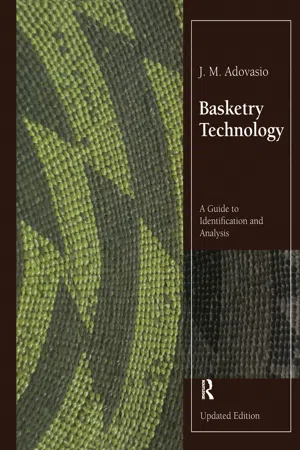
Basketry Technology
A Guide to Identification and Analysis, Updated Edition
- 182 pages
- English
- ePUB (mobile friendly)
- Available on iOS & Android
eBook - ePub
About this book
Basketry Technology, first published in 1977, is the only comprehensive guide for archaeologists, anthropologists, art historians, and collectors for identifying and analyzing ancient baskets and basket fragments. Long out of print, this volume is again available with an extensive new introduction by the original author that summarizes the extensive work done in this area over the past 35 years. The volume describes proper field and lab techniques for recovery of specimens and offers a systematic methodology for identifying and interpreting twined, coiled, and plaited basket samples. It then uses Canyon de Chelly as an example of how to process a large basketry assemblage properly. In addition to 200 illustrations, the book includes a variety of sample forms to use in describing and analyzing ancient baskets.
Trusted by 375,005 students
Access to over 1.5 million titles for a fair monthly price.
Study more efficiently using our study tools.
Information
Introduction
DOI: 10.4324/9781315433257-1
BASKETRY DEFINED
The production of basketry is one of the oldest non-lithic crafts represented on this earth. Its antiquity, known to extend back at least 11,000 years, is probably second only to cordage and netting among the perishable fiber arts. The term “basketry” applies to several different kinds of items; in addition to rigid and semi-rigid containers, matting, and bags, it embraces forms such as fish traps, hats, and cradles.
Matting consists of items that are essentially two dimensional or flat, whereas baskets and many of the other forms are three dimensional. Bags may be considered intermediate because they are two dimensional when empty and three dimensional when full. As Driver (1961:159) points out, these artifacts may be treated as a unit because the overall technique of manufacture is the same. Specifically, all forms of basketry are manually assembled or woven without a frame or loom. Being woven, they are technically a class or variety of textile. Usually, however, that term is restricted to “cloth” fabrics with continuous plane surfaces produced on or with the aid of some sort of auxiliary apparatus.
CLASSIFICATION
The classification of basketry may be likened to the taxonomy of living or extinct plants and animals. This operation consists of two basic steps. The basketry assemblage from any given site is first divided into major groups or sub-classes of weaves; then each sub-class is divided into technological types. The entire procedure reduces the assemblage to progressively smaller units of increasingly greater taxonomic resolution or precision.
It is generally accepted that basketry may be divided into three sub-classes of weaves that are mutually exclusive and taxonomically distinct: twining, coiling, and plaiting. The potential number of technological types within each sub-class is relatively great.
Assignment of specimens to sub-classes or types depends on the identification and quantification of shared attributes or clusters of attributes. Attributes may be defined as features of manufacture, the sum total of which is the individual specimen. Any attribute is the direct product of specific manipulatory techniques that are highly standardized or culturally prescribed within any basketmaking population. Further, each attribute reflects cultural and/or idiosyncratic (that is, individual) preferences.
A variety of attributes have been and can be employed to classify basketry. Such diverse criteria as shape of the object, rigidity or flexibility of the weave, and elements of decoration (to name but a few) have been used with widely varying degrees of success. I believe that sub-classes or types should be defined exclusively by attributes of wall construction.
For purposes of this discussion, any item of basketry is assumed to have several distinct parts, the most significant of which is the “wall” or main body of the specimen. In a container or basket proper, the wall is easily distinguished from other parts, such as the rim or selvage and the center or point of starting. However, in other forms, this distinction may become somewhat arbitrary. In mats and other flat or atypical forms, the wall is the principal or major portion of the item and subsumes virtually everything that is not clearly edge or center.
The wall or main body of a specimen of basketry can be constructed by only three basic manipulative procedures or weaves, which correspond to the three major sub-classes. Specifically, it can be twined, coiled, plaited, or some combination of these techniques. The procedures are so distinctive that even when all three are employed in the same specimen (and the incidence of this is practically nil), it is easy to detect where one ends and another begins.
THE DATA BASE
Prehistoric basketry, in contrast to lithic or ceramic artifacts, is recovered intact only under special conditions. More or less stable environments, which are extremely dry, extremely cold or extremely wet, retard the decay and disintegration of basketry and other perishables by the exclusion of intermittent moisture, oxygen, bacteria or a combination of these agents of destruction. Basketry may also be preserved if it is in direct contact with the corrosion products of certain metals, notably copper, which act as bacteriacides. Thoroughly charred or incinerated specimens are insulated from further decay and may also be preserved for long periods if undisturbed.
Basketry remains from North America (and from most other parts of the world) have been found almost exclusively in dry caves and rockshelters. Occasionally, however, extensive assemblages of carbonized remains have been recovered from exposed sites in the Americas, Europe, Africa, and Asia. Alaska, parts of Canada, and Eurasia have yielded basketry in permafrost contexts. Waterlogged specimens have been encountered in North and Middle America, as well as Europe, but this form of preservation is relatively rare.
The vast majority of prehistoric basketry has come from sites in the arid and semi-arid portions of western North America, including Mexico. Rockshelters and caves in Nevada, southern Oregon, Utah, Arizona, New Mexico, Colorado, western Texas, California, Arkansas, and the Mexican states of Coahuila, Chihuahua, Tamaulipas, Puebla, Oaxaca, Durango, Michoacán, and Guerrero have yielded tens of thousands of specimens, including many complete baskets, bags, mats, and other kinds of objects. By comparison, the inventory from the remainder of the world is relatively meager. Collections from scattered locations in arid stretches of South America, the Nile Valley, the Near East, and the Indian sub-continent rarely, if ever, approach the staggering mass obtained from the most productive North American sites. Similarly, waterlogged, incinerated, metal-preserved or permafrozen assemblages from a thousand-odd localities across the planet do not equal in sheer numbers the assemblages from sites in the North American west.
The differential distribution of prehistoric basketry remains directly reflects not only conditions of preservation, but also the intensity of archeological research and the methods of excavation and recovery. In many parts of North America (notably, most of the southeast, midwest, and northeast of the United States, as well as Canada), South America, Eurasia, Africa, Australia, and Oceania, the only evidence survives in the form of impressions on pottery or on floors of buildings. Where even these clues are lacking, the student of prehistoric basketry must either focus on indirect evidence, such as the presence of awls or other specialized tools that may have been used in the production of basketry, or he must draw inferences from ethnographic or ethnohistoric information.
In short, the extant inventory of prehistoric basketry from all parts of the world is a dim reflection of the incidence of manufacture. Furthermore, only in very limited and geographically circumscribed areas can the sample that has been collected be considered representative.
PREVIOUS PUBLICATIONS
Analytical and descriptive studies of prehistoric basketry are numerous, although no single work yet published covers any major continent. While it is neither practical nor necessary to review the development of this field here, several summary comments on its evolution in North America are warranted.
Some of the earliest studies of North American basketry appeared in the 1880’s and 1890’s. Although most publications of this time focused on ethnographic materials, notable and significant exceptions include Holmes (1884), Nordenskjold (1894), and Mindeleff (1896). Several works by Mason (1885, 1894) include discussions of prehistoric examples.
In the early 1900’s Mason published several articles (1900, 1901) that culminated in his monumental volume on aboriginal American basketry (1904). In this classic study, Mason discussed and illustrated many “types” of North American basketry distinguishable principally among ethnographic materials. He provided a glossary of descriptive terms and attempted to demonstrate how different sorts of basketry might be classified and what criteria might be employed.
Although now somewhat out of date, Mason’s work constitutes the first meaningful attempt at taxonomy, albeit on a regional basis; in addition, it provided much of the stimulus and orientation for further basketry analysis, notably in North America. It should be stressed that Mason’s study was an elaborate descriptive regional synthesis, not a tour de force in basketry systematics. Despite its taxonomic limitations, however, some portions of the text are still consulted and the bibliography contains nearly all the basketry studies published up to 1904.
Shortly before Mason completed his monograph, the first significant treatment of Basket maker-Anasazi basketry was published by Pepper (1902). Pepper described miscellaneous remains from San Juan County, Utah, and discussed various technical aspects of the assemblage. Between 1902 and the early 1930’s, a considerable body of literature was produced on materials from many parts of North America, but most of these “studies” are abbreviated portions of site reports and often consist of little more than a line or two commenting on the recovery of one or another kind of basket. As might be expected, most of these works deal with the American southwest.
A complete listing of the monographs and articles from this period is beyond the scope of this work (see Morris and Burgh 1941, Cressman 1942, Adovasio 1970 a for additional references), but mention should be made of Loud and Harrington’s report on Lovelock Cave (1929), which contains one of the first in-depth analyses of a large quantity of basketry from a single archeological site. It should also be noted that the German scholar, Lehman, produced the first major treatise on systematics and classification during the early part of this period (1907). Unfortunately, as Baumhoff (1957) and Balfet (1952) have pointed out, his taxonomic system was too cumbersome and difficult to be practical.
In 1930, Weltfish published a lengthy article that not only contained significant observations on basketry analysis, but also suggested a preliminary classification of prehistoric North American techniques. In her article, Weltfish attempted to trace the antecedents of ethnographic distributions — an endeavor that was hampered by the paucity of published data. Her later works treated various technical problems in basketry analysis (1932 a) and offered the first major attempt to systematize the vast diversity of prehistoric basketry from the American southwest (1932 b).
Despite the scarcity (at least at that time) of well preserved perishable materials from east of the Mississippi River, the role of textiles, including basketry, in the prehistory of the eastern United States was pointedly and correctly stressed by Miner in 1936. A year later, the first large-scale synthesis of prehistoric European basketry and textiles was published by Vogt (1937).
The appearance of Morris and Burgh’s study of Anasazi basketry (1941) was another milestone. Although restricted to materials ascribable to Basket maker II through Pueblo III contexts, their work remains one of the most thorough of its kind. In addition to employing precise descriptive terminology, the authors recognized that certain technological attributes are standardized and culturally determined. Moreover, they demonstrated that the systematic study of such features through space and time can be highly productive. The basic methodology they developed is still widely used and underlies my procedures for analyzing coiled and plaited basketry.
One year after publication of Morris and Burgh’s masterful synthesis, another significant study was included in Cressman’s summary of excavations in the northern Great Basin (1942). The chapter on basketry contains one of the best technical discussions of twining ever written and a limited comparative section that is still of value.
The year 1943 witnessed the appearance of the first comprehensive taxonomy since the pioneering effort by Lehman in 1907. Although its inclusion in a relatively widely circulated volume, L’Homme et la Matière by Leroi-Gourhan, made it readily available, the system was never generally adopted.
A number of site reports published in the late 1940’s and early 1950’s include analyses of large quantities of prehistoric basketry, again mostly although not exclusively from the western North American desert. Among the more important are Cosgrove (1947), Burgh and Scoggin (1948), Haury (1950), Martin et al (1952), Heizer and Krieger (1956), Rozaire (1957), and Price (1957). Concurrently, a number of articles appeared on archeological basketry and textile assemblages in the Old World. Of particular interest is Vogt (1947). In many instances, these analyses were technically competent, but their employment of diverse and occasionally imprecise descriptive terminology has hampered large-scale comparison. It is interesting that lack of systematization and taxonomic precision continued to characterize basketry research despite the publication of an updated version of Leroi-Gourhan’s classificatory scheme by Balfet in 1952.
During the 1960’s, descriptions of prehistoric basketry appeared with some frequency and often included excellent discussions of assemblages dated by radi...
Table of contents
- Cover Page
- Half-Title Page
- other
- Title Page
- Copyright Page
- Table of Contents page
- Figures
- Acknowledgments
- Preface
- Preface
- 1 Introduction
- 2 Recovery and Preparation
- 3 Analysis of Twined Basketry
- 4 Analysis of Coiled Basketry
- 5 Analysis of Plaited Basketry
- 6 Analysis of Miscellaneous Basketry Constructions
- 7 The Basketry from Antelope House, A Case Study in Description and Interpretation
- Literature Cited
- Acknowledgments
- Index
Frequently asked questions
Yes, you can cancel anytime from the Subscription tab in your account settings on the Perlego website. Your subscription will stay active until the end of your current billing period. Learn how to cancel your subscription
No, books cannot be downloaded as external files, such as PDFs, for use outside of Perlego. However, you can download books within the Perlego app for offline reading on mobile or tablet. Learn how to download books offline
Perlego offers two plans: Essential and Complete
- Essential is ideal for learners and professionals who enjoy exploring a wide range of subjects. Access the Essential Library with 800,000+ trusted titles and best-sellers across business, personal growth, and the humanities. Includes unlimited reading time and Standard Read Aloud voice.
- Complete: Perfect for advanced learners and researchers needing full, unrestricted access. Unlock 1.5M+ books across hundreds of subjects, including academic and specialized titles. The Complete Plan also includes advanced features like Premium Read Aloud and Research Assistant.
We are an online textbook subscription service, where you can get access to an entire online library for less than the price of a single book per month. With over 1.5 million books across 990+ topics, we’ve got you covered! Learn about our mission
Look out for the read-aloud symbol on your next book to see if you can listen to it. The read-aloud tool reads text aloud for you, highlighting the text as it is being read. You can pause it, speed it up and slow it down. Learn more about Read Aloud
Yes! You can use the Perlego app on both iOS and Android devices to read anytime, anywhere — even offline. Perfect for commutes or when you’re on the go.
Please note we cannot support devices running on iOS 13 and Android 7 or earlier. Learn more about using the app
Please note we cannot support devices running on iOS 13 and Android 7 or earlier. Learn more about using the app
Yes, you can access Basketry Technology by J. M. Adovasio in PDF and/or ePUB format, as well as other popular books in Social Sciences & Archaeology. We have over 1.5 million books available in our catalogue for you to explore.