- 168 pages
- English
- ePUB (mobile friendly)
- Available on iOS & Android
eBook - ePub
About this book
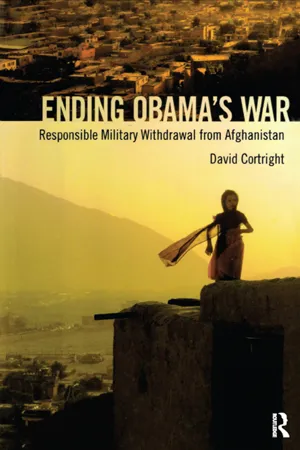
Now in its tenth year, the US-led military campaign in Afghanistan continues with no foreseeable end in sight. Ending Obama's War is intended to help and hold President Obama to his policy of beginning military withdrawals in July 2011 - and sooner if possible. Renowned peace scholar David Cortright offers realistic alternatives for ending the war whilst continuing to help the Afghan people, especially women, with development and human rights. Ending Obama's War outlines a responsible military disengagement strategy and links it to agreements on security cooperation, political power sharing, and a regional diplomatic compact. This is a timely, informed study which offers a way forward for one of the world's worst conflict zones.
Trusted by 375,005 students
Access to over 1.5 million titles for a fair monthly price.
Study more efficiently using our study tools.
Information
CHAPTER ONE

A “Good War”?
During his presidential campaign Barack Obama repeatedly criticized the Bush administration’s policy of invading and occupying Iraq, but he was equally firm in declaring his support for the U.S. military mission in Afghanistan. In his widely quoted speech at an antiwar rally in Chicago in October 2002 Obama declared, “I’m not opposed to all wars. I am opposed to dumb wars.” On the campaign trail in 2008 Obama vowed to end the war in Iraq but said he would expand military operations in Afghanistan. He criticized the Bush administration for neglecting Afghanistan and pledged to send additional U.S. forces to fight al Qaeda and the Taliban. It was thus no surprise that President Obama expanded the U. S. military commitment in March and December 2009.
Moral arguments are crucial to the political justification for war in Afghanistan. President Obama sent more troops to Afghanistan because he believes this is a just and necessary war and cannot be compared to the “dumb” policy of invading Iraq. The case for military escalation was made by journalist Peter Bergen in a 2009 article, “Winning the Good War.” Bergen wrote that Obama’s renewed and better-resourced war “will, in time, produce a relatively stable and prosperous” Afghanistan.1 Many experts are less sanguine about the outcome but share the belief in the necessity of the Afghan mission. Although doubts about the war have mounted, especially in recent years as military operations have dragged on inconclusively and casualties have mounted, political opposition has remained relatively muted. Afghanistan has not occasioned anything like the worldwide outcry that greeted George W. Bush’s attack on Iraq. Few see viable alternatives to continuing the current policy of military-led counterinsurgency.
Necessity and Choice
The characterization of Afghanistan as a “good war” dates back to the days immediately after 9/11. As the United States prepared to launch strikes in Afghanistan in October 2001, most commentators supported military action as a necessary and legitimate response. The decision to use force and attack the Taliban regime was “certainly a just one,” wrote the ethicist Michael Walzer. It was a classic “war of self defense.”2 The U.S. Conference of Catholic Bishops issued a pastoral message acknowledging “the right and duty of a nation and the international community to use military force if necessary to defend the common good by protecting the innocent against mass terrorism.”3 Scott Simon of National Public Radio wrote in the Wall Street Journal, “Even Pacifists Must Support This War.” In confronting the 9/11 attacks, Simon wrote, there is “no sane alternative now but to support war.”4
Not everyone was convinced at the time. Although few antiwar protests were mounted in opposition to military operations against the Taliban regime, many religious leaders and peace activists were troubled by the U.S. action. Countering al Qaeda and bringing the 9/11 perpetrators to justice were just purposes, all agreed, but bombing Afghanistan and overthrowing its government seemed questionable methods. Peace advocates argued for a counterterrorism strategy based on cooperative law enforcement rather than war. The proper response to the criminal attacks of al Qaeda was not military invasion, they asserted, but vigorous international police efforts to apprehend perpetrators and prevent future attacks. Reverends Jim Wallis of Sojourners and Bob Edgar of the National Council of Churches circulated a statement among religious leaders appealing for “sober restraint” and warning against indiscriminate retaliation that would cause more loss of innocent life. “Let us deny [the terrorists] their victory by refusing to submit to a world created in their image,” the declaration read. The statement was eventually signed by more than 4,000 people and was published in the New York Times on November 19, 2001.5
Some argued at the time that it was not necessary to overthrow the Taliban-led government, and that alternative diplomatic means were available for isolating al Qaeda and bringing its leaders to justice. An editorial in the Jesuit magazine America noted that, although the Afghan government did not accept the Bush administration’s ultimatum to turn over Osama bin Laden, Taliban leaders nonetheless offered (1) to negotiate, (2) to put him on trial in an Islamic court, and (3) to turn him over to a third country if the United States provided evidence of his guilt.6 Two years earlier, when the UN Security Council imposed sanctions against the Taliban regime in response to the bombing of U.S. embassies in Africa, officials in Kabul made similar gestures of diplomatic flexibility. In both instances the United States dismissed the offers as delaying tactics and rejected them as inadmissible legally and unacceptable politically. It is possible, however, that Taliban leaders may have been seeking ways to avoid military attack and distance themselves from bin Laden.7 In the fall of 1999, as sanctions were about to be enacted, bin Laden wrote a letter to Taliban leader Mullah Muhammad Omar offering to leave Afghanistan. After 9/11 a council of Islamic scholars met and requested that Mullah Omar persuade bin Laden to leave Afghanistan “voluntarily.”8 Some observers believe that Taliban leaders might have been willing to see bin Laden and his terrorist network depart if a graceful exit could have been arranged.9
The Bush administration never seriously considered an alternative to war in Afghanistan. According to a Los Angeles Times report at the time, “Bush advisors say the president decided from the start he wanted to launch a large-scale military response to the attacks.” The White House never veered from that determination and did not pursue diplomatic options for avoiding war. Asked whether Bush ever considered an alternative to military action, National Security Advisor Condoleezza Rice replied firmly, “No.”10 As Duane Shank, senior policy advisor for Sojourners, wrote in the church journal Mennonite Life, “Military force was the first resort, not the last.”11 The question of alternatives to military action remains relevant ten years later. In 2011 as in 2001, military means continue to be the primary response rather than a last resort.
Just War Criteria
The question of last resort is important because it is one of the core principles of just war theory. These principles provide a valuable moral framework for deciding when military force may be necessary (jus ad bellum) and how it should be used once hostilities are under way (jus in bello). They are intended to prevent war, not to make it more permissible. They are challenges to political realism, according to Walzer, and establish strict ethical criteria that must be met before the use of force can be justified.12 Just war doctrine is based on what the U.S. Catholic Bishops have termed a “presumption in favor of peace and against war” (emphasis in original). This principle recognizes that war itself is a grave injustice that victimizes the innocent. Overriding the presumption against war requires “extraordinarily strong reasons.”13 War may be a tragic necessity in extreme cases, but it can never be considered virtuous. Theologian Reinhold Niebuhr cautioned against any moral righteousness or attempt to invoke divine sanction for the use of armed force. Killing is always sinful, he argued, even if it is for a just purpose. Wars are conflicts between sinners, not between the righteous and the wicked. They are partly the consequence of our mistaken judgments and imperial policies.14 The use of force, even if it is deemed necessary, must be undertaken with a deep sense of regret.
Just war principles are often misunderstood and manipulated by powerful interests to justify uses of force that do not meet ethical standards. War is especially unjust when it is waged by powerful states against weak nations and non-state actors in the Global South. When foreign policy is heavily militarized, as in the United States, the use of armed force often becomes a primary response rather than a last resort.15 In such circumstances war does not meet ethical standards, and the appropriate approach is what philosopher John Rawls termed “contingent pacifism.” The possibility of just war is conceded in principle, but the greater likelihood is that war will be unjust.16
Self-Defense?
For war to be morally acceptable it must meet strict ethical criteria. Especially important in this case are the principles of just cause, probability of success, and proportionality. Self-defense is the most widely accepted just cause for the use of force. Most religious and moral teachings permit the resort to arms to defend against military aggression. The right of self-defense is acknowledged in many international legal agreements, including the UN Charter. Article 51 of the Charter recognizes the right of states to individual or collective self-defense if an armed attack occurs, but that right is not open ended and exists only “until the Security Council has taken measures necessary to maintain international peace and security.” Any military actions taken must be reported to the Security Council and “shall not affect the authority and responsibility of the Security Council” to maintain peace and security. The Charter allows a nation to take immediate action to defend itself but expects that states will then turn to the Security Council to adopt additional measures to ensure peace and security.
The United States did indeed go to the Security Council the day after the 9/11 attacks and received unanimous support for Resolution 1368. That resolution condemned the attacks, recognized the right of selfdefense, and expressed the Council’s “readiness to take all necessary steps to respond.” The Resolution did not authorize any form of military action, however, and was not taken under the authority of Chapter VII of the UN Charter, which is necessary to authorize the use of force. The Council subsequently adopted many resolutions to impose sanctions and other measures against al Qaeda, and to assist with reconstruction and stabilization in post-Taliban Afghanistan, but it never authorized the United States to take “necessary measures” to maintain international peace and security. Washington never requested such authority. It simply bypassed the Council and initiated military strikes unilaterally. It did not provide the required notice to the Security Council and never considered giving the Council responsibility for deciding appropriate security measures.
It is also worth noting that when the United States began military action in October 2001, no continuing terrorist attacks were under way. No evidence was presented or claimed of an imminent threat of additional attacks.17 This raises further questions about the strategy of using military force. The United States was certainly justified in taking security measures to prevent future terror strikes and bring to justice those responsible for the 9/11 attacks, but was it really necessary to overthrow the Afghan government—and to declare a global “war on terror”? These actions stretched the self-defense argument beyond recognition.
Just Cause
Whether the war in Afghanistan is a just cause depends on the goals of U.S. policy, and whether these can be achieved through military means. The core U.S. objective is defined in the 2010 U.S. National Security Strategy: to “defeat, dismantle, and disrupt” al Qaeda and its violent extremist affiliates in Afghanistan, Pakistan, and beyond. The U.S. Strategy describes Afghanistan and Pakistan as “the epicenter” of al Qaeda violent extremism. It asserts that military pressure is necessary to prevent terrorist attacks on the United States and its allies.18 Similar arguments were made in the March 2009 White Paper justifying Obama’s policy of military buildup. The priority U. S. goal is “disrupting terrorist networks in Afghanistan and especially Pakistan to degrade any ability they have to plan and launch international terrorist attacks.”19 The military mission aims to deny safe havens to al Qaeda and its affiliates and thereby prevent terrorist plots from developing.
The goal of apprehending those responsible for 9/11 and preventing future al Qaeda–related attacks is a just and widely supported cause. Nations have united with rare unanimity and political commitment in recent years to counter the continuing threat to international security posed by mass casualty terror attacks. The goal of preventing such strikes is a morally compelling mission that can be characterized as both self-defense and protection of the innocent. The key ethical and political question is not whether the mission is just, but rather how it can be achieved. It is a question of means rather than ends.
The mission to prevent global terrorist strikes leads to a related objective: building capable governments in Afghanistan and Pakistan that can meet the economic, social, and security needs of their people and provide long-term protection against the use of their territory for international terrorist activity. The administration’s White Paper speaks of promoting “a more capable, accountable, and effective government in Afghanistan.” It calls for developing “self-reliant Afghan security forces” and assuring a stable government and “vibrant economy” in Pakistan.20 Again, these are worthy objectives, logically linked to the core mission of preventing global terrorist strikes. The question is one of means rather than ends. Can these worthy goals be met through military means?
From the outset, U.S. military involvement in Afghanistan has been based on three fundamental strategic assumptions: (1) that war and military action are necessary and appropriate means of defeating al Qaeda and preventing global terrorist strikes, (2) that the Taliban is equivalent to al Qaeda and thus a legitimate target of military attack, and (3) that the United States and its allies must fight and win a counterinsurgency war against the Taliban and related jihadist groups. The first two assumptions determined policy decisions in the weeks after 9/11, and they have remained at the heart of U.S./NATO strategy ever since, continuing to shape the direction of military operations. The third assumption underlies the current long-term commitment to military action in the region. All of these assumptions are highly questionable strategically and pose serious dilemmas ethically.
A fourth strategic dimension has entered the equation in recent years—the extension of military operations to Pakistan. U.S. officials view Afghanistan and Pakistan as a single theater of war. Military strategists bemoan Pakistan’s role as strategic sanctuary for the insurgency in Afghanistan and worry about spreading Talibanization and armed violence in Pakistan itself. In response Washington has launched commando raids and drone bombing strikes into Pakistan as part of the military mission in Afghanistan. While the armed struggles are linked, the two countries are distinct sovereign entities and must be addressed separately. Whether the United States has legal authority to wage war in Afghanistan is at least arguable, but no such authority exists in the case of Pakistan. The self-defense argument does not apply, since Pakistan was in no way responsible for the 9/11 attacks. Pakistan is designated as a strategic ally of the United States, and its armed forces are engaged in combat operations against Taliban insurgents. Its government has not given formal public consent for U.S. military operations or bombing strikes into its territory. The military attacks into Pakistan have been counterproductive strategically and have dubious legal and ethical justification.
Countering al Qaeda
The al Qaeda threat that originally justified the U.S.-led intervention has changed globally and dwindled in Afghanistan. The al Qaeda brand has spread and been adopted by many Islamist extremist groups around the world, but the operational capability of the old central command in the Afghanistan/Pakistan (Af/Pak) border region has declined. Al Qaeda–related groups have lost ground politically and militarily in some countries, most spectacularly in Iraq, but also in Afghanistan. The al Qaeda movement as a military force has been widely discredited among Muslims around the world and has lost momentum.21 When an al Qaeda–related group attempted to establish a presence in Gaza it was crushed by Hamas. Al Qaeda’s decline has resulted from military and political competition with tribal power structures and revulsion in Muslim communities at the movement’s brutal methods and gruesome attacks against civilians. More innocent civilians have been killed by al Qaeda suicide attacks and bombings than by the...
Table of contents
- Cover
- Half Title
- Title Page
- Copyright Page
- Table of Contents
- Preface
- Introduction
- Chapter 1 A “Good War”?
- Chapter 2 An Unwinnable War
- Chapter 3 Gendered Intervention
- Chapter 4 Development and Security
- Chapter 5 Security Solutions
- Notes
- Index
- About the Author
Frequently asked questions
Yes, you can cancel anytime from the Subscription tab in your account settings on the Perlego website. Your subscription will stay active until the end of your current billing period. Learn how to cancel your subscription
No, books cannot be downloaded as external files, such as PDFs, for use outside of Perlego. However, you can download books within the Perlego app for offline reading on mobile or tablet. Learn how to download books offline
Perlego offers two plans: Essential and Complete
- Essential is ideal for learners and professionals who enjoy exploring a wide range of subjects. Access the Essential Library with 800,000+ trusted titles and best-sellers across business, personal growth, and the humanities. Includes unlimited reading time and Standard Read Aloud voice.
- Complete: Perfect for advanced learners and researchers needing full, unrestricted access. Unlock 1.5M+ books across hundreds of subjects, including academic and specialized titles. The Complete Plan also includes advanced features like Premium Read Aloud and Research Assistant.
We are an online textbook subscription service, where you can get access to an entire online library for less than the price of a single book per month. With over 1.5 million books across 990+ topics, we’ve got you covered! Learn about our mission
Look out for the read-aloud symbol on your next book to see if you can listen to it. The read-aloud tool reads text aloud for you, highlighting the text as it is being read. You can pause it, speed it up and slow it down. Learn more about Read Aloud
Yes! You can use the Perlego app on both iOS and Android devices to read anytime, anywhere — even offline. Perfect for commutes or when you’re on the go.
Please note we cannot support devices running on iOS 13 and Android 7 or earlier. Learn more about using the app
Please note we cannot support devices running on iOS 13 and Android 7 or earlier. Learn more about using the app
Yes, you can access Ending Obama's War by David Cortright in PDF and/or ePUB format, as well as other popular books in Politics & International Relations & Human Rights. We have over 1.5 million books available in our catalogue for you to explore.