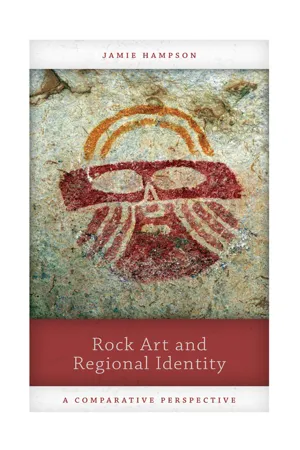
Why did the ancient artists create paintings and engravings? What did the images mean? This careful study of rock art motifs in the Trans-Pecos area of Texas and a small area in South Africa demonstrates that there are archaeological and anthropological ways of accessing the past in order to investigate and explain the significance of rock art motifs. Using two disparate regions shows the possibility of comparative rock art studies and highlights the importance of regional studies and regional variations. This is an ideal resource for students and researchers.
Trusted by 375,005 students
Access to over 1.5 million titles for a fair monthly price.
1 Setting the Scene: Rock Art and Regional Identity
Rock art speaks to us in a way that stones and pots and other archaeological objects do not: here is a picture of a deer, here are human figures on horseback (Figure 1.1), here is a strange half-man half-animal being (Figure 1.2). These images appear to be records that people made of their own—but, for us, alien—worlds. I say ‘appear’ because these pictures were much more than mere records; they were, as we shall see, powerful things in themselves. But why did the ancient artists create paintings (pictographs) and engravings (petroglyphs) in the first place?1 And—the really big question—what did the images mean?
Some researchers have argued that, without directly relevant records of the people’s beliefs and rituals, rock art merely inspires unwarranted confidence in our interpretations and understanding; how can we be certain that what we think we see today actually captures the meaning that was immanent in images when they were created? I reject this argument from ethnographic despair; many rock art researchers have shown repeatedly that there are ways, both archaeological and anthropological, of accessing the past in order to investigate and explain—at least in part—the significance as well as the meaning of rock art motifs. One topic left unexplored in this research, however, has been the importance of regional corpuses of art. This in turn has led to assumptions by some researchers that rock art interpretations are universal theories, or that these interpretations can or should be facilely transposed from one location to the next. I demonstrate that this is not the case.
My main goal in this book is to understand rock art regions. Given that we can explain at least some of the meanings and motivations behind the production and consumption of rock art by using ethnographic texts and analogy, how then should we interrogate previously held notions of rock art regions?
Trans-Pecos Texas and South Africa
At first glance, the Trans-Pecos area of Texas and a small area in South Africa that adjoins the famous Kruger National Park appear to have little in common. They are on different continents and in different hemispheres. The Trans-Pecos area is semidesert, whereas the southern African area is better watered and has denser vegetation. Yet there are commonalities. In both instances, the indigenous people who lived there and made rock art images are no longer extant. By the end of the 19th century, both areas had been taken over by European settlers and turned into wildlife parks. There seems to be no direct record of the beliefs and rituals of the people who lived there.
Figure 1.1 Detail from Meyers Springs site, Texas. Human figures on horseback are flanked by a bison and what we know from ethnography to be a Thunderbird (ca. 1.6 m wide). Most of the motifs at this spectacular site are in red pigment (see Figure 2.4 for more details). Drawing courtesy of Texas Archaeological Research Laboratory.
Figure 1.2 Therianthropic (half-man, half-animal) zigzag figure (ca. 18 cm tall) from Kruger National Park, South Africa. Black represents red pigment; stipple represents light red. Courtesy of C. de Rosner.
Nevertheless, I use these disparate areas to explore two key issues in current rock art research, the first theoretical, the second exemplary. Researchers often write of rock art regions without according the concept sufficient theoretical consideration. What are regions? Regions are not ‘given’. They are established by researchers who select criteria for their delineation. I argue, therefore, that rock art regions are more usefully defined by the presence and absence of ethnographically informed motifs than by formal aesthetics or ‘style’. This may seem a departure from a research tradition that has been prominent in the United States for many years: I see style as a starting point, not an end product of research. I support my argument by reference to the two understudied but fascinating rock art regions that I have mentioned: the Texas Trans-Pecos in the United States and Mpumalanga Province in South Africa.
The historical parallels between the two regions are also enlightening: both are cultural ‘crossroads’ with complex histories of migrations, group interactions, and colonial settlements (Biesele In press: 5). Both provide rich archaeological evidence of hunter-gatherer, herder, and farming peoples. Moreover, both regions are adjacent to other, better-known rock art corpuses that have been explicated by using ethnographic analogy and other anthropological approaches.
Using these tools, I explain some of the motivations and meanings behind the production and consumption of rock art in the Trans-Pecos and Mpumalanga. I argue that the most effective method for understanding the significance of the motifs—many of which are also found in the neighbouring regions—is to focus on ritual, embodiment, and belief in supernatural potency and a tiered cosmos. In Mpumalanga, I concentrate on images in 49 hunter-gatherer San (Bushman) rock art sites in and around Kruger National Park. In Texas I investigate interactions between indigenous hunter-gatherer groups and colonisers from Europe, from Mesoamerica, and from the Plains to the north; I focus on 44 rock art sites as manifestations of indigenous ideologies.
In addition to addressing the significance of rock art motifs and the nuances of rock art regions, my second goal is to augment rock art data sets for both these regions, especially in Trans-Pecos Texas. Although little has been published on the archaeological deposits or rock art of the Trans-Pecos or Mpumalanga, neighbouring areas are famous for their rich archaeology, impressive rock art corpuses, and academic publications. Mpumalanga is adjacent to well-known regions in which the rock art has been convincingly situated in an overarching, shamanistic framework; we know why many specific images were created, and by whom. In Texas, the Trans-Pecos is adjacent to several regions that also share many definitive characteristics through time and across space, including belief in a tiered cosmos.
Although many social scientists now wholeheartedly recognise religious symbolism in indigenous art, having overcome deep-rooted prejudices, there remains a need to raise the profile of rock art studies. Rock art is still an under-valued resource, and often, where rock art has been investigated alongside archaeological deposits, it is still expected to ‘fit’ the frameworks developed according to excavated archaeological data. Rock art is rarely studied in its own right.
This work is not an attempt to decipher one indigenous system of art and then explicate how it differs worldwide (cf. Dowson 2007, 2009). Nor is it an explicit comparison of South African and west Texas rock art motifs. Rather, it is a contribution to the broader field of rock art historiography and cultural identity, where the question of indigenous hunter-gatherer interaction with herder and farming groups is often treated simplistically and cursorily, and in a mode that is inconsistent with postcolonial studies (Blundell 2004). Throughout this book, I remain cognisant of postcolonial principles and ideals in the social sciences and stress that researchers should focus on the colonised rather than the colonisers. Awareness of concepts of creolisation and hybridity may help researchers avoid the pejorative implication that precolonial contact peoples were isolated or frozen in time. Moreover, following recent rock art studies in southern Africa (for example, Lewis-Williams 1981; Lewis-Williams & Dowson 1989; Ouzman 1995; Smith 1997; Blundell 2004; Hollmann 2005; Challis 2008) and in Texas (for instance, Turpin 1982, 2001, 2004; Boyd 2003), I focus on rock art and other manifestations of the ideologies of the colonised rather than on simple political economy or technologies of the past.
After outlining the historiography of rock art research in North America alongside enlightening examples from southern African research (this chapter), I introduce and describe rock art motifs at 44 sites in the Texas Trans-Pecos study area, with a view to investigating the significance of the rock art corpus; I then do the same for 49 sites in Mpumalanga (South Africa) in Chapter 3. Almost all the rock art data in these two chapters have not been published. I stress here that I do not argue by simple analogy from the United States to South Africa. Rather, I propose complementary hypotheses that can be evaluated independently. In both regions, I chose the rock art sites because of their heuristic potential.
Also in Chapter 3, I introduce a methodological framework for clarifying nuances within and between rock art regions and consider how motifs and ideologies change through time and across space as one moves away from a region’s centre toward its putative cultural boundaries.
Concentrating on the Trans-Pecos rock art corpus, I answer in Chapters 4 and 5 one of the key questions that permeates the entire work: given what is known through archaeological excavation and ethnographic analogy about the ideologies and lifeways of indigenous peoples in west Texas, what can we say about the significance of the region’s rock art? How useful are shamanistic anthropological frameworks and neuropsychological models as analytical tools to explicate the significance of regional rock art corpuses?
In Chapter 6, I employ elements of embodiment theory—another anthropological and sociological approach—to underscore these findings. Many of the motifs in the Texas Trans-Pecos feature somatic distortions or emphases that can be explained using embodiment theory within a shamanistic and ritualistic framework, where the process of creating the art was as important as the product. This further helps elucidate rock art regions.
I turn now to the historiography of rock art research in North America and beyond, in part to shed light on the goals of rock art researchers but also to show historiography as a tool to clarify what researchers mean when they talk about rock art regions.
‘Picture-Writing’ and the ‘Inspiration and Requirements of Religion’: North American Research from the 1880s–1920s
Histories of both North American and worldwide archaeology (for example, Willey & Sabloff 1974; Meltzer 1979; Fowler 1980; Trigger 1989; Fagan 1995; Kehoe 1998; Murray & Evans 2008) often imply that, until recently, there were no systematic studies of rock art. Some (such as Trigger 1989: 101, 351, 395; Kehoe 1998: 163, 202–03) devote two or three pages to rock art studies; others (Willey & Sabloff 1974) do not mention rock art at all. Implicit theoretical biases within the discipline of North American archaeology led to the privileging of stratigraphic excavation. Ironically echoing the famous notion that ‘American archaeology is anthropology or it is nothing’ (Willey & Phillips 1958: 2), the implication in these histories is that without stratigraphy, archaeology is nothing.
Rock art researchers have in fact successfully married data collection with theory for more than 100 years. Indeed, some researchers were pioneers in defining the intellectual concepts and frameworks that are still used in cognitive, heuristic, and problem-oriented archaeological research today (see, for example, Whitley 2001: 10–21; Whitley & Clottes 2005; Hampson 2011, 2013a). I do not suggest that there is a single factor that unites or united rock art researchers; nor do I claim that there is a neat evolutionary tale running through the history of rock art research. By outlining the aims and successes of some of the early North American studies, both chronologically and thematically, however, I demonstrate that rock art researchers helped to shape the discipline of archaeology—and I also show why this shaping of a discipline mattered and, indeed, why it still matters. Before considering why ancient artists created rock art, and what this art means, I situate the few studies that focus on the rock art of west Texas within the broader, continent-wide historiography, explaining how these studies have influenced my own research into rock art regionalism.
Born in 1831, Colonel Garrick Mallery was a pioneer in the field of North American rock art research. Working for the Bureau of Ethnology (founded in 1879, later renamed the Bureau of American Ethnology—hereafter referred to as BAE), Mallery collated thousands of observational data relating to North American ‘gesture-language’ or ‘picture-writing’—what we today call rock art. The primary goal of the 19th-century BAE was to ‘map’ the anthropology of the native peoples within the borders of the United States, just as earlier geographical expeditions had mapped the allegedly uninhabited western frontier. Mallery (1886, 1893) went beyond this primary goal, attempting to ‘ascertain the laws governing the direct visible expression of ideas between men’ (Mallery 1886: xxviii); he employed an epigraphic or philological approach to indigenous rock art, based on the assumption that the images were an early form of writing (Robinson 2006). Here was a stage of evolution where ‘primitive people’ conveyed their ideas through bodily movements, ‘gesture-language’, and then recreated those movements onto rock surfaces as ‘picture-writing’. Mallery was thus one of the first researchers to consider rock art as a form of embodiment, a theory not fully developed until advanced in the social sciences almost a century later. I consider this theoretical framework in more detail in Chapter 6.
Alongside this 19th-century unilinear evolutionary perspective, Mallery championed the fact that rock art interpretations should address issues of hunter-gatherer beliefs and lifeways—a key point that underscores my own research. Mallery (1893: 770) stressed the religious nature of the rock art: ‘A large proportion of the petroglyphs2 in America are legitimately connected with myths and the religious practices of the authors’. As Mallery makes clear, tribes such as the Zuni, Hopi, Navajo and Ojibwa
have kept up on the one hand their old religious practices and on the other that of picture writing…. The rites and ceremonies of these tribes are to some extent shown pictorially on the rocks, some of the characters of which have until lately been wholly meaningless,3 but are now identified as drawings of the paraphernalia used in or diagrams of the drama of their rituals. Unless those rituals with the creeds and cosmologies connected with them had been learned, the petroglyphs would never have been interpreted. (1893: 770; my emphasis)
Paradoxically, Mallery’s call for ethnographic analysis unwittingly led to the decision by archaeologists in the burgeoning academic discipline to ignore rock art on the grounds that it was an ethnological—rather than archaeological—topic. Indeed, as rock art researchers David Whitley and Jean Clottes (2005) have shown, despite anecdotal evidence within the archaeo-logical community to ...
Table of contents
Cover
Half Title
Dedication
Title
Copyright
Contents
List of Illustrations
Acknowledgements
1. Setting the Scene: Rock Art and Regional Identity
2. Trans-Pecos Texas as a Rock Art Region: Developing an Interpretive Framework
3. Rock Art Regions in Theory and in Practice: A Comparative Case Study from Mpumalanga Province, South Africa
4. An Ethnographic Approach to the Trans-Pecos Rock Art Region
5. Widely Distributed, Regional, or Rare? Six Diagnostic Trans-Pecos Motifs
6. Transformation and Embodiment in the Trans-Pecos Region
7. Reassessing the Rock Art Region: A Way Forward
Appendix Trans-Pecos People and Artefacts through Time: A Brief Overview
Notes
References
Index
About the Author
Frequently asked questions
Yes, you can cancel anytime from the Subscription tab in your account settings on the Perlego website. Your subscription will stay active until the end of your current billing period. Learn how to cancel your subscription
No, books cannot be downloaded as external files, such as PDFs, for use outside of Perlego. However, you can download books within the Perlego app for offline reading on mobile or tablet. Learn how to download books offline
Perlego offers two plans: Essential and Complete
Essential is ideal for learners and professionals who enjoy exploring a wide range of subjects. Access the Essential Library with 800,000+ trusted titles and best-sellers across business, personal growth, and the humanities. Includes unlimited reading time and Standard Read Aloud voice.
Complete: Perfect for advanced learners and researchers needing full, unrestricted access. Unlock 1.5M+ books across hundreds of subjects, including academic and specialized titles. The Complete Plan also includes advanced features like Premium Read Aloud and Research Assistant.
Both plans are available with monthly, semester, or annual billing cycles.
We are an online textbook subscription service, where you can get access to an entire online library for less than the price of a single book per month. With over 1.5 million books across 990+ topics, we’ve got you covered! Learn about our mission
Look out for the read-aloud symbol on your next book to see if you can listen to it. The read-aloud tool reads text aloud for you, highlighting the text as it is being read. You can pause it, speed it up and slow it down. Learn more about Read Aloud
Yes! You can use the Perlego app on both iOS and Android devices to read anytime, anywhere — even offline. Perfect for commutes or when you’re on the go. Please note we cannot support devices running on iOS 13 and Android 7 or earlier. Learn more about using the app
Yes, you can access Rock Art and Regional Identity by Jamie Hampson in PDF and/or ePUB format, as well as other popular books in Social Sciences & Anthropology. We have over 1.5 million books available in our catalogue for you to explore.