eBook - ePub
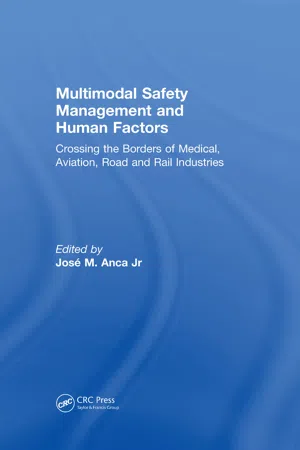
Multimodal Safety Management and Human Factors
Crossing the Borders of Medical, Aviation, Road and Rail Industries
- 356 pages
- English
- ePUB (mobile friendly)
- Available on iOS & Android
eBook - ePub
Multimodal Safety Management and Human Factors
Crossing the Borders of Medical, Aviation, Road and Rail Industries
About this book
Safety management and human factors disciplines are often regarded as subjective and nebulous. This perhaps stems from a variety of, sometimes disparate, activities in the realms of education, industry and research. Aviation is one of the safety-critical industries that has led the development of safety systems and human factors. However, in recent years, safety management and human factors are seen to be progressing well in the road, rail and the medical arena. Multimodal Safety Management and Human Factors is a wide-ranging compendium of contemporary approaches in the aviation, road, rail and medical domains. It brings together 28 chapters from both the academic and professional worlds that focus on applications, tools and strategies in safety management and human factors. It is a wellspring of the practical rather than the theoretical. Safety scientists, human factors industry practitioners, change management advocates, educators and students will find this book extremely relevant and challenging.
Trusted by 375,005 students
Access to over 1.5 million titles for a fair monthly price.
Study more efficiently using our study tools.
Information
Subtopic
Business GeneralPART 1
Multimodal Characteristics of Safety Management Systems
Part 1 contains insights on the systemic nature of safety management and how different industry modes (medical, rail, road and aviation) have introduced SMS in varying degrees of maturation. It will submit that the foundations of SMS are the same in these modes, however, its tools and applications vary because of the disparate contexts of these industries.
The Introduction will also highlight anecdotal findings from these different industries of the need for more tools rather than theories on SMS. Safety management systems will be defined in this chapter from the standpoint of equipping organizations with risk-resistant strategies.
Some examples of high-reliable organizations undergoing massive change will be discussed and both successes and pitfalls will be characterized in the process.
Chapter 1
Can Simply Correcting the Deficiencies Found through Incident Investigation Reduce Error?
Gerry Gibb
Safety Wise Solutions Pty Ltd
Safety Wise Solutions Pty Ltd
Safety wise solutions
ICAM (Incident Cause Analysis Method) is a holistic incident investigation method which aims to identify local factors and failures within an entire organization system (e.g. communication, training, procedures, incompatible goals, equipment, etc.) which contribute to an incident.
ICAM as a tool complements existing processes of error prevention, error containment and error mitigation. Applying ICAM allows the precursors to errors to be identified and corrected. ICAM provides the ability to identify what really went wrong and to make recommendations on what needs to be done to prevent recurrence. It is directed towards building error-tolerant defences against future incidents.
Can simply correcting the deficiencies found through incident investigation reduce error? This chapter will apply ICAM to review an aviation accident that occurred to determine whether the precursors to the accident could have been identified.
The chapter will also discuss whether the application of ICAM before the accident could have identified the precursors to the incident and thereby have prevented it.
Introduction
Our investigation and correction activities tend to be based on the amount of damage and injury – which is random. We don’t really have prevention programs; we have accidents correction programs (Wood, 1997).
Modern safety theory would suggest that relying on correcting deficiencies found though incident investigation as a means to reduce error is somewhat restrictive (Klietz, 1994; Wood, 1997; Reason, 2000; Wiegmann and Shappell, 2003). Significant factors leading to the accident and the subsequent actions necessary to prevent recurrence do not always emerge from the physical evidence of the case alone. Many accidents occur, not because they cannot be prevented, but because the organization did not appreciate the gaps in their safety systems, nor learn from – or perhaps did not retain the lessons from – past accidents within or outside their organization. The ‘best fit’ tool, identifying and resolving precursors to error and learning from past accidents, can assist the organization to gain an appreciation of the strengths and limitations of their safety systems and reduce errors that lead to incidents and accidents. It is necessary for organizations to select the ‘best fit’ investigative tool, to identify and resolve the precursors to error as well as focus on improving corporate memory to avoid potential accidents.
The selection of the investigative tool
The purpose of selecting a suitable investigative tool is to be able to manage exposure and risks across the organization – at both operational and strategic levels. Selecting the most appropriate tool will improve the likelihood for determining the precursors to a specific incident. An investigative tool provides a framework for data collection and organization and allows the investigation to follow a logical path. Each organization has a unique set of goals, constraints (e.g. budgets) and existing conditions (e.g. business structure), so will select a tool (or investigator) that suits them best. A comprehensive safety investigation not only looks at how an accident occurred, but also looks at why it occurred. Most importantly, the investigation recommends corrective action that can be taken across the organization to prevent such occurrences happening again.
There is no ‘one size fits all’ solution for designing and implementing an organization-wide safety management program. The principle objective of incident investigation is to prevent recurrence, reduce risk and advance health, safety and environmental performance. It is not for the purpose of apportioning blame or liability.
Organizational safety systems
Many models for accident causation have been used to propose ideas to minimize loss. The ‘systems’ approach was developed to manage safety. This approach promotes a balance between the assessment of people, behaviour and the infrastructure to support the operation. However, given the adoption of safety systems in many organizations, there are questions surrounding organizational incidents that remain unanswered by many of these systems.
- How can absent or failed defences be identified?
- What are the successful approaches to eliminating or altering the barriers to error management?
- What are the precursor tasks or environmental conditions that lead to incidents?
- What organizational factors predict success in prevention programs?
- What are the barriers to the acceptance of new error control strategies?
- What are the best techniques to encourage the implementation of recommendations?
- How can the effectiveness of implemented recommendations be evaluated?How can the retention of corporate learning be achieved?
Whilst this chapter will not answer all of these questions, it proposes that investigative tools can be used both pre-incident to answer the ‘why’ and post-accident to answer the ‘how’.
Standard investigative tools look at the physical evidence of a particular incident and where it is specifically relevant to the particular investigation; they also examine the pertinent organizational contributing factors. Whilst this should be effective at determining the causes of the incident and hopefully be effective at preventing the same incident from occurring again, these techniques are not focused on, and therefore not effective at making, safer organizations. To create safer organizations, a more holistic tool, which examines the full range of organizational elements in depth, is required. Importantly, if one wishes to reduce the pre-cursors to error within an organization, such a tool should be used proactively and not be limited just to post-incident application. A number of investigative tools are available to an assessor. This chapter will explore the Incident Cause Analysis Method (ICAM) tool for the purposes of discussion.
Incident Cause Analysis Method (ICAM)
Professor James Reason and his colleagues from the University of Manchester in the United Kingdom developed a conceptual and theoretical approach to the safety of large, complex, socio-technical systems. Drawing on the work of Reason, ICAM identifies the workplace factors that contribute to an incident and the organizational deficiencies within the system that act as its precursors.
ICAM allows the investigator to gather data, organize it and carry out an effective analysis by organizing causal factors into four manageable elements. These are:
- absent or failed defences;
- individual or team actions;
- task/environmental conditions; and
- organizational factors.
ICAM is designed to ensure that the investigation is not restricted to the errors and violations of operational personnel. It identifies the local factors that contributed to the incident and the latent hazards within the system and the organization (Gibb and DeLandre, 2002).
Before starting, the level of investigation required is determined, then the investigation team is assembled and, with the assistance of the client organization, the investigation commences.
Specific objectives of ICAM
The specific objectives of investigations using ICAM are:
- to establish all the relevant and material facts surrounding the event;
- to ensure the investigation is not restricted to the errors and violations of operational personnel;
- to identify underlying or latent causes of the event;
- to review the adequacy of existing controls and procedures;
- to recommend corrective actions which, when applied, can reduce risk, prevent recurrence and, by default, improve operational efficiency;
- to detect developing trends that can be analysed to identify specific or recurring problems;
- to ensure that it is not the purpose of the investigation to apportion blame or liability – where a criminal act or an act of wilful negligence is discovered, the information will be passed to the appropriate authority; and
- to meet relevant statutory requirements for incident investigation and reporting.
Once the data has been gathered, it is organized into a sequence of events, validated, and then analysed. From the analysis of findings, the facts can be classified and charted in the ICAM model for inclusion in the investigation report and for briefing management on the investigation findings.
The investigators work with clients to design and implement customized solutions based on their company strategies, structure and culture to enhance performance and optimize costs. A fundamental concept of ICAM is the acceptance of the inevitability of human error. As stated by Reason (2000), an organization cannot change the human condition, but they can change the conditions under which humans work, thereby making the system more error tolerant.
The investigation identifies recommendations for corrective actions to prevent recurrence, reduce risk and advance safety. The investigation report is presented to assist management to understand the factors contributing to the incident. The investigation team works with management to review the recommendations and develop corrective actions for system deficiencies and ineffective organizational processes. These should integrate with existing systems and time lines to achieve the expected outcomes of the organization’s business case. Actions and target dates need to be realistic and achievable to ensure follow-through and completion.
Applying ICAM as a predictive tool allows the organization to identify and retain information on causal factors, so the organization remembers that the accident occurred, what caused it, and why procedures were changed. R. Wood (1997) states: ‘Beyond question, the most difficult and troublesome aspect of aircraft accident investigation is the determination of cause.’
It is difficult to reduce the causes of an accident to a single sentence. To improve the methodology for cause determination, an appropriate investigative tool and reporting style will encourage the organization to look at precursors and causes the same way investigators do.
Case study: Learjet accident, Aberdeen, USA, 1999
Had an ICAM analysis occurred before the incident, could the precursors to error and the deficiencies in the safety system been identified, and thus prevented the accident? The precursors to error need to be identified and resolved, thereby breaking the chain of latent conditions and its effects. To conduct a complete ICAM analysis of a particular incident, a full investigation would need to be conducted by the investigation team as soon as possible after the incident had occurred.
It should be noted, however, that this case study analysis has been applied after the event and based on existing documentation and reports. Applying ICAM to the Payne Stewart Learjet accident in 1999 (Airsafe, 2005), it is possible, for illustrative purposes, to identify organizational factors and task/environmental factors contributing to the incident. This incident has been selected as it represents some of the difficulties in applying standard post-incident investigative techniques. The following is an excerpt from the National Transportation Safety Board (US NTSB) summary report on the Learjet incident.
Case study: summary
A Learjet crashed near Aberdeen and Mina, South Dakota on 25 October 1999. The aircraft, a Learjet model 35, registration number N47BA was operated by Sun Jet Aviation of Sanford, Florida. The aircraft flew from Sanford to Orlando, Florida on the morning of the accident, where it picked up its passengers. The flight departed Orlando with two pilots and four passengers, including professional golfer Payne Stewart, about 09.19 destined for ‘Love Field’ in Dallas, Texas. The planned flight time was two hours. The airplane had about four hours and forty-five minutes of fuel aboard.
Air traffic control lost radio contact with the flight at 09.44 Eastern Daylight Time, when the airplane was climbing through and located north-...
Table of contents
- Cover
- Half Title
- Title Page
- Copyright Page
- Dedication
- Table of Contents
- List of Figures
- List of Tables
- Foreword
- Preface
- Acknowledgements
- List of Abbreviations
- PART 1 MULTIMODAL CHARACTERISTICS OF SAFETY MANAGEMENT SYSTEMS
- PART 2 SAFETY MANAGEMENT METRICS, ANALYSIS AND REPORTING TOOLS
- PART 3 NORMAL OPERATIONS MONITORING AND SURVEILLANCE TOOLS
- PART 4 THE MODALITY OF HUMAN FACTORS: EXPLORING THE MANAGEMENT OF HUMAN ERROR
- Index
Frequently asked questions
Yes, you can cancel anytime from the Subscription tab in your account settings on the Perlego website. Your subscription will stay active until the end of your current billing period. Learn how to cancel your subscription
No, books cannot be downloaded as external files, such as PDFs, for use outside of Perlego. However, you can download books within the Perlego app for offline reading on mobile or tablet. Learn how to download books offline
Perlego offers two plans: Essential and Complete
- Essential is ideal for learners and professionals who enjoy exploring a wide range of subjects. Access the Essential Library with 800,000+ trusted titles and best-sellers across business, personal growth, and the humanities. Includes unlimited reading time and Standard Read Aloud voice.
- Complete: Perfect for advanced learners and researchers needing full, unrestricted access. Unlock 1.5M+ books across hundreds of subjects, including academic and specialized titles. The Complete Plan also includes advanced features like Premium Read Aloud and Research Assistant.
We are an online textbook subscription service, where you can get access to an entire online library for less than the price of a single book per month. With over 1.5 million books across 990+ topics, we’ve got you covered! Learn about our mission
Look out for the read-aloud symbol on your next book to see if you can listen to it. The read-aloud tool reads text aloud for you, highlighting the text as it is being read. You can pause it, speed it up and slow it down. Learn more about Read Aloud
Yes! You can use the Perlego app on both iOS and Android devices to read anytime, anywhere — even offline. Perfect for commutes or when you’re on the go.
Please note we cannot support devices running on iOS 13 and Android 7 or earlier. Learn more about using the app
Please note we cannot support devices running on iOS 13 and Android 7 or earlier. Learn more about using the app
Yes, you can access Multimodal Safety Management and Human Factors by José M. Anca Jr in PDF and/or ePUB format, as well as other popular books in Technology & Engineering & Business General. We have over 1.5 million books available in our catalogue for you to explore.