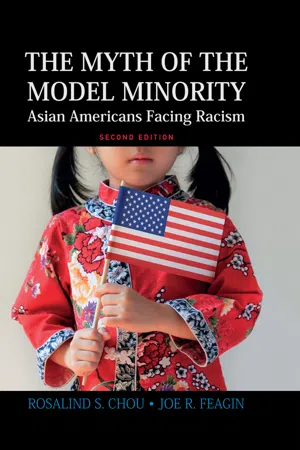
The second edition of this popular book adds important new research on how racial stereotyping is gendered and sexualized. New interviews show that Asian American men feel emasculated in America's male hierarchy. Women recount their experiences of being exoticized, subtly and otherwise, as sexual objects. The new data reveal how race, gender, and sexuality intersect in the lives of Asian Americans. The text retains all the features of the renowned first edition, which offered the first in-depth exploration of how Asian Americans experience and cope with everyday racism. The book depicts the "double consciousness" of many Asian Americans—experiencing racism but feeling the pressures to conform to popular images of their group as America's highly achieving "model minority."
eBook - ePub
Myth of the Model Minority
Asian Americans Facing Racism, Second Edition
- 274 pages
- English
- ePUB (mobile friendly)
- Available on iOS & Android
eBook - ePub
Myth of the Model Minority
Asian Americans Facing Racism, Second Edition
About this book
Information
CHAPTER 1
THE REALITY OF ASIAN AMERICAN OPPRESSION
I had a terrible, uneasy feeling in my stomach and I picked up the phone to hear panic in the voice on the other end of the line. “She jumped out the window. Farrah* jumped out of the window.” What I thought were irrational fears from the night before had, in fact, become a reality. In late March of 2013, I could not fall asleep. Something was off, something was sitting in my gut and it felt as if I was living out a sociological statistic in real life. It was just before going to bed and I, Rosalind S. Chou, could not get ahold of my friend Farrah. She was not returning any of my phone calls or text messages. She had always been timely in responding in the past few years that we had been friends, and it seemed a little out of character. I had spoken to her a couple days earlier and she just did not seem like herself. I tried my best not to panic, but to explain my nervousness to my partner with whom I shared numerous studies about Asian American women and their high rates of suicide and depression. For some reason, my inability to get in touch with Farrah triggered all the “what if” scenarios.
I slept terribly, and the next morning, I reached out to other friends to see if they had heard from her. I was nervous and anxious for hours. And then I got the phone call. When I answered, I got the news. Farrah had jumped out of a window that morning and was in a nearby hospital. I was stunned. In academia, we scholars are often taught to distance ourselves from our research, but this hit home. This was not a lecture in class where I discuss health disparities and how there is growing evidence that racism plays a role in disparate outcomes. This was someone close to me, in my inner circle.
I often encourage my students to feel when we learn about inequality, because oppression works in a way so that we no longer feel empathy for target groups. My community of friends faced shock and confusion and in the first edition of the book, Joe and I argue that, while it is very difficult to measure how much racism affects Asian Americans and people of color in general, the mental health statistics show that Asian American women are overrepresented in rates of suicide and depression.
In the first edition, we argued that it is a dangerous assumption that Asian Americans are free from racism. Their relatively high levels of educational attainment and household income, and their overrepresentation in professional occupations, make it seem as if they are doing better than other racial minorities or even some whites. However, the white-constructed label of “model minority” awarded to Asian Americans does not protect them from prejudice and racism.
The incident with my friend Farrah was not the first one I had experienced with Asian American women I know. In the fall of 2001, R. W., a young Chinese American, bludgeoned and strangled her mother. While her mother lay dead on the floor, she covered her and called the police, confessing her crime. This school valedictorian was an accomplished musician who had begun her education at a prestigious Ivy League school and graduated with honors from her southern university. Her crime received little local notice. Only one full-length newspaper article was published, and after her indictment she was barely mentioned. This tragic incident hit home for the first author because she is acquainted with the family, which was one of the few Chinese families in her hometown. The incident sent shockwaves through the Asian American community of which they were part. R. W.’s failure to stay at her first college program, an elite institution, may well have contributed to her several suicide attempts and eventually to the homicide. She may now live out her years in a mental institution, and family and friends are left stressed and wondering “why?”1
On the outside, R. W. appeared to be a model student at her historically white educational institutions. Her demeanor was quiet, which likely suggested to white outsiders only a stereotyped Asian passivity. Thus, even with numerous warning signs of mental illness, she was never seen as a concern. The white-created “successful model minority” stereotype made it difficult for non-Asians around her to see her illness and encouraged silence among the Asian Americans who knew her.
The 2007 shootings of students and staff at Virginia Tech University by Cho Seung-Hui suggest somewhat similar issues. A Korean American student at a historically white institution, Cho was viewed by outsiders as unusually quiet, and although he demonstrated warning signs of mental illness, he was mostly ignored, especially by those with the most authority to take action. Not much has been revealed about his life growing up in a Virginia suburb except that he was an “easy target” at school and endured substantial teasing from white children. When younger, he struggled to learn English, which made it difficult to adapt in his predominantly white environment. Cho seems to have lived as an outcast and in social isolation. Given his parents’ success in business and his sister’s success as a Princeton graduate, Cho and his family seem to outsiders like a proverbial model family that “lifted themselves up by their bootstraps” and thus are living the American dream.2 Yet, these stereotyped images and Cho’s own struggle to achieve may have worked against his mental health. As the interviews in this book reveal, this young Asian American’s struggle to make it in a predominantly white world was not unique in being both very invisible and excruciatingly tormented.
Our argument here is not that Asian Americans are distinctively prone to serious mental illness or violence. Rather, we accent in this book the institutionally racist situations in which Asian Americans find themselves—those highly pressured situations that create much stress and deeply felt pain. One major societal problem is that Asian Americans are typically viewed and labeled as “model minorities” by outsiders, especially by whites with power over them. This highly stereotyped labeling creates great pressure to conform to the white-dominated culture, usually in a one-way direction.
In books titled YELL-Oh Girls! and Asian American X, several hundred young Asian Americans discuss their often difficult lives. These young people recount recurring experiences with coercive pressures to assimilate into the prestigious white end of the prevailing U.S. racial status continuum—to white ways of dress, speech, goal attainment, thinking, and physical being. Most are torn between the culture of immigrant parents or grandparents, with its substantial respect for Asianness, and the burdensome pressures of a white-controlled society. As one young Korean American who grew up in a white community puts it, the dominance of whites explains the “thoughtless ways white Americans often inhabit a sense of entitlement and egocentric normality.”3 Like other Asian Americans, these young people report racialized mistreatment, ranging from subtle to covert to overt discrimination. The successful minority image does not protect them from the onslaughts of discriminatory whites.
Our research here attempts to give voice to numerous Asian Americans as they describe and assess their discriminatory and other life experiences. Using in-depth interviews, we collected accounts of Asian American experiences in everyday life, including incidents of racial hostility and discrimination, responses of assimilation and conformity, and ways that individuals, families, and communities cope with and resist white-imposed racism. Our interviews indicate that Asian Americans suffer from much discrimination, ranging from subtle to blatant, at the hands of whites. The interviews show that, even after Herculean efforts to conform to the dominant racial hierarchy and to the white framing of them—efforts seeking to achieve the fabled American dream—Asian Americans frequently feel stressed, embattled, isolated, and inadequate. Many passively accept that they must hide or abandon their home culture, values, and identity to prevent future mistreatment. Significant educational and economic achievements do not effectively shield them. Some analysts have argued that Asian Americans are “lucky” that they do not face the negative imagery that African Americans experience.4 This view of Asian Americans is incorrect. The Asian American experience with racial hostility and discrimination is also very negative and largely untold, and such an untold experience is indeed a very harmful invisibility.
The Reality of Systemic Racism
Traditional analytical approaches to immigrants and immigration to the United States mostly emphasize various assimilation orientations and processes. Some assimilation analysts have argued that all incoming immigrant groups will eventually be fully integrated into U.S. society, including the more distinctive ethnic and racial groups. Many social science researchers view the adaptation of Asian immigrants and their children to U.S. society since the 1960s through an assimilation lens, one similar to that used for assessing the adaptations of past and present European immigrants. Numerous assimilation analysts have argued that Asian American groups are on their way to full integration into the “core society,” by which they mean white middle-class society. For example, Paul Spickard has argued that by the 1980s whites no longer viewed Japanese Americans “as very different from themselves, and that fact is remarkable.”5 To make this case, these analysts usually focus on Asian American socioeconomic progress in areas such as educational and income achievements. However, this limited definition of success in adaptation in the United States is mostly white-generated and ignores other important areas of Asian American lives.
Indeed, the fact that Asian immigrants and their children are heavily pressured to conform to a white-imposed culture, racial frame, and racial hierarchy—and suffer from much racial hostility and discrimination—is usually left out of most assessments of Asian immigrants and their children and grandchildren. Here we go beyond the typical assimilation approach and accent a systemic racism perspective. Since at least the seventeenth century, European Americans have created a complex North American society with a foundation of racial oppression, one whose nooks and crannies are generally pervaded with racial discrimination and inequality. Near their beginning, the new European colonies in North America institutionalized white-on-Indian oppression (land theft and genocide) and white-on-black oppression (centuries of slavery), and by the mid-nineteenth century the Mexicans and the Chinese were incorporated as dispossessed landholders or exploited workers into the racial hierarchy and political-economic institutions of a relatively new United States. Our systemic approach views racial oppression as a foundational and persisting underpinning of this society. From the beginning, powerful whites have designed and maintained the country’s economic, political, and social institutions to benefit, disproportionately and substantially, their racial group. For centuries, unjust impoverishment of Americans of color has been linked to unjust enrichment of whites, thereby creating a central racial hierarchy and status continuum in which whites are generally the dominant and privileged group.6
Since the earliest period of colonization, moreover, European Americans have buttressed this hierarchical and entrenched system of unjust material enrichment and unjust material impoverishment with legal institutions and a strong white racial framing of this society. In the past and in the present, whites have combined within this pervasive white frame a good many racist stereotypes (the cognitive aspect), racist concepts (the deeper cognitive aspect), racist images (the visual aspect), racialized emotions (feelings), racist narratives (e.g., “manifest destiny”), and inclinations to take discriminatory action. This white racial frame is old, enduring, and oriented to assessing and relating to Americans of color in everyday situations. Operating with this racial frame firmly in mind, the dominant white group has used its power to place new non-European groups, such as Asian immigrants and their children, somewhere in the racial hierarchy whites firmly control—that is, on a white-to-black continuum of status and privilege with whites at the highly privileged end, blacks at the unprivileged end, and other racial groups typically placed by whites somewhere in between. This white racist framing of society is now a centuries-old rationalizing of the racism systemic in this society.
Our concept of systemic racism thus encompasses a broad range of racialized realities in this society: the all-encompassing white racial frame, extensive discriminatory habits and exploitative actions, and numerous racist institutions. This white-generated and white-maintained system entails much more than racial bigotry, for it has been from the beginning a material, structural, and ideological reality.
The Exploitation and Oppression of Asian Immigrants
In the classroom, our non-Asian students, regardless of their backgrounds, are often shocked to hear about Asian American oppression. These students have never been taught Asian American history, or been privy to significant events that have shaped these communities in the United States. Students often ask us why these things have been “left out” of their regular curriculum. Additionally, they start to make the important societal connections that Asian Americans do have with other groups—with African Americans, Native Americans, Latinos, working-class whites, and the list goes on. We encourage our students to relearn an accurate U.S. history—and to recognize that our common bonds may keep us from making the same mistakes of the past. Knowing our racial past is imperative to help us with our racial future.
While some Asian Americans today trace family histories back to nineteenth-century immigrants, most have a more recent immigration background. Older members of the families of R. W. and Cho are relatively recent immigrants, and thus these families are typical. Changes in U.S. immigration laws since 1965 have allowed a substantial increase in immigration from Asian and Pacific countries, and thus Asian/Pacific Islander Americans have become the fastest growing U.S. racial group. In 1940 they made up less than 1 percent of the population, but by 2012 their numbers had grown to more than 17.5 million, about 5.6 percent of the U.S. population. The largest Asian/Pacific Islander group is Chinese American. In numbers, Filipino Americans are not far behind, and Japanese, Korean, Asian Indian, and Vietnamese Americans constitute other large Asian-origin groups.
Much scholarship on Asians in North America has addressed Asian experiences with racial hostility and discrimination over a long history of immigration. Scholars have examined more than 150 years of Asian immigration and shown, to take one example, that Asian workers have regularly been pitted against white workers. The first major immigrant group was Chinese. Between the 1850s and 1880s, Chinese contract laborers migrated in large numbers to the West Coast to do low-wage work in construction and other economic sectors. The preference that white employers had for Chinese workers fueled tensions in the racial hierarchy, often pitting white workers against Asian workers. After whites’ racist agitation and exclusionary legislation stopped most Chinese immigration, Japanese immigrants were recruited by employers to fill the labor demand on white-run farms and construction projects. (By the late nineteenth century the Chinese were viewed by whites as the stereotyped “yellow peril.”) The racially motivated termination of Japanese immigration in 1907–1908 spurred white employers to recruit other Asians and Pacific Islanders (such as Filipinos) to fill labor needs on the U.S. mainland and in Hawaii. This employers’ strategy of using immigrant workers from Asia and the Pacific Islands to replace white and other native-born workers has continued in some U.S. workplaces to the present.7
In the nineteenth and early twentieth centuries, Asian and Pacific Islander immigrants and their children—mostly Chinese, Japanese, and Filipino—suffered extremely blatant and institutionalized racism. They were negatively positioned, and imaged, by whites as “black” or “near black” on the dominant socioracial continuum. Powerful whites imposed a strong racial framing on these subordinated immigrants, with barbed racist stereotypes and images. Reviewing the history, Robert Lee has commented on white constructions of hated “Orientals”: “Six images—the pollutant, the coolie, the deviant, the yellow peril, the model minority, and the gook—portray the Oriental as an alien body and a threat to the American national family.”...
Table of contents
- Cover
- Half Title
- Title
- Copyright
- Contents
- Preface and Acknowledgments
- 1 The Reality of Asian American Oppression
- 2 Everyday Racism: Anti-Asian Discrimination in Public Places
- 3 Everyday Racism: Anti-Asian Discrimination in Schools and Workplaces
- 4 The Many Costs of Anti-Asian Discrimination
- 5 Struggle and Conformity: The White Racial Frame
- 6 Acts of Resistance
- 7 Reprise and Conclusions
- Notes
- Index
- About the Authors
Trusted by 375,005 students
Access to over 1.5 million titles for a fair monthly price.
Study more efficiently using our study tools.
Frequently asked questions
Yes, you can cancel anytime from the Subscription tab in your account settings on the Perlego website. Your subscription will stay active until the end of your current billing period. Learn how to cancel your subscription
No, books cannot be downloaded as external files, such as PDFs, for use outside of Perlego. However, you can download books within the Perlego app for offline reading on mobile or tablet. Learn how to download books offline
Perlego offers two plans: Essential and Complete
- Essential is ideal for learners and professionals who enjoy exploring a wide range of subjects. Access the Essential Library with 800,000+ trusted titles and best-sellers across business, personal growth, and the humanities. Includes unlimited reading time and Standard Read Aloud voice.
- Complete: Perfect for advanced learners and researchers needing full, unrestricted access. Unlock 1.5M+ books across hundreds of subjects, including academic and specialized titles. The Complete Plan also includes advanced features like Premium Read Aloud and Research Assistant.
We are an online textbook subscription service, where you can get access to an entire online library for less than the price of a single book per month. With over 1.5 million books across 990+ topics, we’ve got you covered! Learn about our mission
Look out for the read-aloud symbol on your next book to see if you can listen to it. The read-aloud tool reads text aloud for you, highlighting the text as it is being read. You can pause it, speed it up and slow it down. Learn more about Read Aloud
Yes! You can use the Perlego app on both iOS and Android devices to read anytime, anywhere — even offline. Perfect for commutes or when you’re on the go.
Please note we cannot support devices running on iOS 13 and Android 7 or earlier. Learn more about using the app
Please note we cannot support devices running on iOS 13 and Android 7 or earlier. Learn more about using the app
Yes, you can access Myth of the Model Minority by Rosalind S. Chou,Joe R. Feagin in PDF and/or ePUB format, as well as other popular books in Social Sciences & Asian American Studies. We have over 1.5 million books available in our catalogue for you to explore.