eBook - ePub
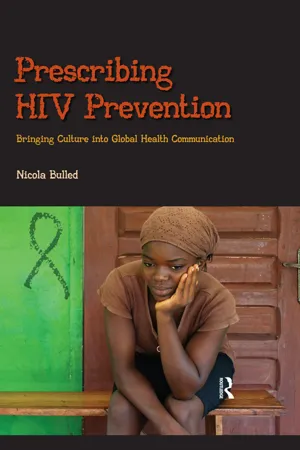
Prescribing HIV Prevention
Bringing Culture into Global Health Communication
- 273 pages
- English
- ePUB (mobile friendly)
- Available on iOS & Android
eBook - ePub
About this book
Critical health communication scholars point out that the acceptance of HIV risk prevention methods are bound inside inequitable structures of power and knowledge. Nicola Bulled's in-depth ethnographic account of how these messages are selected, transmitted and reacted to by young adults in the AIDS-torn population of Lesotho in southern Africa provides a crucial example of the importance of a culture-centered approach to health communication. She shows the clash between traditional western perceptions of how increased knowledge will increase compliance with western ideas of prevention, and mixed messages offered by local religious, educational, and media institutions. Bulled also demonstrates how structural and geographical forces prevent the delivery and acceptance of health messages, and how local communities shape their own knowledge of health, disease and illness. This volume will be of interest to medical anthropologists and sociologists, to those in health communication, and to researchers working on issues related to HIV.
Trusted by 375,005 students
Access to over 1.5 million titles for a fair monthly price.
Study more efficiently using our study tools.
Information
Topic
MedicineSubtopic
Anthropology1
The Prescription for HIV Prevention

While biomedicine and epidemiology have made possible an understanding of HIV pathology, these specialized fields of knowledge have been unable to prevent the persistent spread of HIV throughout the world.1 Since it was recognized over 40 years ago, 75 million people have become infected with HIV, more than 36 million people have died of AIDS, and 16 million children are considered AIDS orphans. At the end of 2012, 35.3 million people were estimated to be living with HIV/AIDS, and approximately 2.3 million new infections had occurred (UNAIDS 2012). It is by far the most dramatic epidemic since the Black Plague devastated Europe 500 years ago. Author and journalist Adam Hochschild describes the epidemic by saying, “If a war had killed 20 million soldiers, and left 28 million more dying of wounds, we’d call it the worst such tragedy since World War II. This is the scale of AIDS…the greatest health crisis of our time” (comment on Stephanie Nolen’s 28: Stories of AIDS in Africa, 2008).
Genetic tracing and social history place the beginnings of the human form of the immunodeficiency virus—HIV—in Central Africa in the 1920s (Pepin 2011). However, June 5, 1981 is generally referred to as the beginning of the HIV/AIDS pandemic. On this date, the U.S. Centers for Disease Control and Prevention (CDC) reported the first cases of rare pneumonia among a small group of young men in Los Angeles (Gottlieb et al. 1981). Since that moment, the extensive dedication devoted to understanding HIV has resulted in the building of knowledge and global awareness of the disease at a pace never before experienced.
Just one month after the Morbidity and Mortality Weekly Report(Gottlieb et al. 1981) publication of the observed disease cluster, the CDC reported a highly unusual occurrence of rare skin cancer, Kaposi’s sarcoma (CDC 1981). Both conditions were later determined to be AIDS-related. By 1982, the CDC formally established the term Acquired Immune Deficiency Syndrome (AIDS) and identified four primary disease ‘risk factors’: anal sex among men, intravenous drug abuse, Haitian origin, and hemophilia (Curran and Jaffe 2011). These risk categories were also crudely referred to as the “4H’s”—homosexuals, heroine users, Haitians and hemophiliacs—linking identity or disease condition to risk behaviors.
According to the timeline of AIDS put together by AIDS.gov (2012), an information collective managed by the U.S. Department of Health and Human Services, by 1986, the first cases of HIV had been reported in most African countries, China, Russia, and India. By 1988, UNAIDS reported that in sub-Saharan Africa the number of women living with HIV/AIDS outnumbered men. By 1992, AIDS had become the number one cause of death for U.S. men ages 25-44 years. In 1994 and 1995, AIDS became the leading cause of death for all Americans ages 25-44 years. AIDS remained the leading cause of death among African Americans within this age group in 1996. In 2002, AIDS was the leading cause of death worldwide among people aged 15-59 years. AIDS is currently the leading cause of death among women of reproductive age and remains the leading cause of death in Africa (UNAIDS 2012).
Since the 1980s, the global effort to stem the tide of HIV has moved through various phases of multilateral, bilateral, nongovernmental, voluntary, and private programs and initiatives. The World Health Organization (WHO) started the Global Programme on AIDS in 1987, the first global institutionalized effort to contain HIV. Realizing the complex nature of the pandemic, in 1994, UNAIDS, a joint body of six UN organizations, was formed to provide a more comprehensive, complete, and coordinated global response. Even so, for much of the first two decades of HIV, there was a general lack of cohesiveness and clarity in the direction of global planning. This failing has been attributed to difficulties in worldwide data collection, diverse cultural interpretations of HIV, complacency and lack of effective leadership in many countries, scarcity of funds for sustaining long-term programs, inordinate allocation of available funding to expensive drug treatment research, inter-organizational confusion about the scope of each unit’s work, an overall fuzzy picture of worldwide AIDS, and an inability or unwillingness to accept the sheer magnitude and spread of the disease (Christakis 1989; Mann, Tarantola, and Netter 1992; Mann, Tarantola, and Global AIDS Policy Coalition 1996).
Global and national policies reflect the disjointed responses to the epidemic. For example, in the US, the media and health professionals increasingly came to use the term GRID, or gay-related immune deficiency, relating sexuality to disease risk, as opposed to the specific risk behavior (male-anal sex), as initial fear and panic led to the identification of ‘risk groups’ rather than risk behaviors. Some countries implemented repressive policies to prevent the spread of disease such as Cuba’s segregating sidatorios(O’Connor 1991) and Russia’s and the US’ tight immigration controls (Kraft 1994). Resistance to the idea that HIV posed a significant global threat to human health took the form of governmental denial and lack of commitment towards policy development (Bonacci 1992).
In June 2001, the General Assembly of the United Nations held its first ever gathering aimed at discussing the future of the disease. Issues of fund allocation for treatment and prevention efforts, as well as issues of ‘culture,’ were the focus of attention. The meeting concluded on the note that any future global action needed to be respectful of the different cultural traditions in many parts of the world, which included the use of culturally appropriate language and culturally sensitive management of issues such as homosexuality, commercial sex work, intravenous drug use, and condom use. These directives did not suggest a need to engage with local cultural groups to define or develop effective interventions relative to the social, political, and economic context. Instead, the revised agenda continued to regard the established global interventions as generally applicable across the world, in a cohesive and universal structure to correct the fragmented approaches of the past. Slight modifications were expected at the community and country level to respond to the nuanced values and beliefs of particular social situations. Then Secretary General Kofi Annan endorsed a grassroots, culture-specific approach by emphasizing that women and nongovernmental organizations needed to be at the helm of the global preventive initiative (Harris 2001). In spite of this desire, the meeting solidified commitments from national governments to work with a global blueprint that set specific overarching policy and preventive action goals for the years 2003 and 2005, as opposed to unique plans generated by communities to take account of their distinct contexts.
Kofi Annan’s desires to develop a new approach to addressing the HIV pandemic led to the creation of the Global Fund to Fight AIDS, Tuberculosis, and Malaria. The Geneva-based multi-billion-dollar health agency was launched in 2002, shortly after the first UN General Assembly Special Session on AIDS. The Global Fund has been hailed as a transparent, efficient aid machine delivering the elements of the AIDS prevention and treatment package prescribed by the UN General Assembly, including HIV testing services, condoms, and antiretroviral drugs for AIDS treatment. It receives only voluntary contributions from governments and private philanthropists, billing itself as an “innovative approach to international health funding.” Funding is controlled by local actors, including officials from government and nongovernmental organizations. Countries implement their own programs based on their priorities, and the Global Fund provides financing on the condition that verifiable results are achieved. Despite this unique model of country ownership coupled with performance-based funding, which aims to avoid the inevitable politicization of bilateral programs like USAID and the bureaucracy of UN agencies, the Global Fund has been investigating allegations of corruption in many countries. This situation has resulted in the temporary suspension of payments to the fund from major government contributors (The Global Fund 2010, 2011).
In 2003, U.S. President G. W. Bush announced PEPFAR, the President’s Emergency Plan for AIDS Relief. PEPFAR was initially a five-year, 15 billion USD initiative to address HIV/AIDS, tuberculosis, and malaria primarily in the worst affected countries. Despite contributing funds to UNAIDS and the Global Fund, U.S. government administration officials in the early 2000s did not care for the focus of these organizations. They pressed the UN to spend most of the United States’ funding contributions on disease prevention rather than treatment. In an extreme attempt to justify this stance, the United States Agency for International Development (USAID) administrator, Andrew Natsios, argued that sending antiretroviral drugs to African countries would be ineffective due to the lack of trained doctors, limited infrastructure, and the inability of Africans to follow a complicated treatment regimen because of their insufficient knowledge of clocks and Western notions of time.2 The authorizing U.S. legislation stipulated that at least a third of all prevention funds of PEPFAR be spent to promote sexual abstinence and faithfulness, and that faith-based organizations should be allowed to reject strategies they considered objectionable, such as condom distribution. In spite of Natsios’ comments, treatment ultimately came to constitute roughly half of the PEPFAR budget.
In recent years there have been some promising movements in global HIV statistics as a direct result of the extensive government and private responses, and rapid advancements in HIV-related knowledge, biomedical technologies, and pharmacology. New infections have decreased by 33 percent since 2001, the number of children with new HIV infections has declined by 52 percent, and AIDS-related deaths have dropped by 30 percent since 2005. Even so, the fourth decade of HIV is faced with many challenges. Though oral antiretroviral drug therapy is considered “one of the most remarkable achievements in recent public health history” (UNAIDS 2012, 50),3 expensive antiretroviral drugs remain a distant dream for many infected with HIV. Under the 2013 WHO treatment guidelines, HIV treatment coverage in low- and middle-income countries represented only 34 percent of the 28.6 million people eligible (UNAIDS 2013). Furthermore, treatments are not cures, but rather ways of prolonging life. Recently there has been much enthusiasm regarding antiretroviral oral pharmaceuticals as a prevention strategy for people not infected, pre-exposure prophylactic (PrEP). However, structural limitations, acceptance, and ethical considerations pose significant barriers to the full implementation of such an approach in both high- and low-income countries (Kenworthy and Bulled 2013)4. Topical microbicide vaginal gels have so far proven to have mixed results in preventing HIV infection in women (Abdool Karim et al. 2010; Van Damme and Szpir 2012; VOICE [MTN-003] 2011; Ramjee et al. 2007). Similarly, voluntary medical male circumcision, though effective in randomized control trials in preventing HIV infection among men (Auvert et al. 2005; Bailey et al. 2007; Gray, Kigozi, et al. 2007), has not received the desired level of in-country scale-up (to 80 percent of male population) determined necessary for reductions in HIV prevalence (Gray, Li, et al. 2007; Kahn, Marseille, and Auvert 2006; Nagelkerke et al. 2007; Njeuhmeli et al. 2011). Last, countless complexities surround vaccine development as a biomedical prevention strategy (Nabel 2001, Stephenson 2001). Consequently, preventive behaviors remain the only known method for checking the spread of HIV.
HIV Communication
The goalposts have shifted. It is time for us to regroup and re-strategize. Our redirection must focus on two goals. First, leveraging the AIDS movement as a force for transformation in global health, development and environmental sustainability. Second…mobilizing a prevention revolution.
Michel Sidibé, Executive Director, UNAIDS (2009)
In December of 2009, Michel Sidibé called for the mobilization of a prevention revolution. He stressed that with adequate monetary investments today for educational and treatment-based prevention initiatives, the number of new infections could be halved by 2015, claiming “2.3 million new infections can be averted and 12.5 billion USD in treatment costs saved” (UNAIDS 2009a). The 2012 World AIDS Day events embraced Sidibé’s calls to action under the theme “Getting to Zero”—Zero new HIV infections. Zero discrimination. Zero AIDS-related deaths. The UNAIDS strategy for 2011–2015, adopted by the Programme Coordinating Board in December 2010 aims to advance global progress in achieving universal access to HIV prevention, treatment, care, and support (UNAIDS 2010a).
Global health programs have focused HIV prevention efforts on decreasing an individual’s risk for disease through surveillance, personal behavioral changes, and clinically driven care and treatment. This approach has developed out of a long history of knowledge-based health communication campaigns. In the 1960s and 1970s, health-promotion campaigns in developing countries emphasized the transmission of information on healthy lifestyles for the prevention of non-communicable diseases. In the 1970s, public health initiatives started to use the notion of empowerment and self-help to link unhealthy lifestyles to the development of preventable disease (WHO 1986). In the 1980s and 1990s, social marketing emerged as a new approach to health information dissemination, influencing social norms and behaviors (Andreasen 1995). Social marketing encourages creative marketing approaches to the analysis of issues and the development of programs to communicate information. However, some view these creative strategies as attempts by private firms, including U.S.-based foundations, government agencies, and international organizations, to adapt commercial marketing methods to promote neoliberal economic schemes of privatization and individual agency (Manoff 1985; Reid 2004).
By the 1990s, the term ‘health literacy’ emerged in the health scholarship, describing a patient’s ability to understand health care providers and the terminology of health care so as to be able to comply with prescribed therapeutic regimens (American Medical Association 1999; Kalichman and Rompa 2000; Kalichman et al. 2000). Functional health literacy is the ability to read, understand and act on health information, including comprehending prescription labels, interpreting appointment slips, completing health insurance forms, following instructions for diagnostic tests, and understanding other essential health-related materials required to adequately function as a patient of biomedicine (American Medical Association 1999; Baker 1995; Giorgianni 1998; Parker et al. 1995). Under the principle of health literacy, the focus of health care shifted from providing for the patient to one requiring patients to be able to advocate for their own health and independently navigate the health care system. The idea of individual agency in health care has been integrated into the WHO’s broader definition of health literacy as, “the cognitive and social skills which determine the motivation and ability of individuals to gain access to, understand and use health information in ways which promote and maintain good health” (WHO definition as cited in Nutbeam 2000). Under this definition, health literacy empowers people to effectively maintain and manage health and health care through improved access to health information and advancement of cognitive and social skills to utilize that information.
In studies conducted with HIV patients, psychologist Seth Kalichman and colleagues (2000, 2000) determined that poor health literacy not only creates barriers to fully understanding one’s health, illness, and treatments, but also has the potential to endanger others (i.e., through the generation of treatment-resistant strains of HIV due to improper treatment adherence). The studies found that patients with lower health literacy are significantly more likely to visit their doctors, thus overburdening the system, and less likely to view health providers as involving them in the treatment process. These findings suggest that persons with lower health literacy place a greater demand on the health care system and their health care providers, and do not feel like agents of their own wellbeing, independently making and imposing health-enhancing choices. Consequently, health literacy is a relatively economical strategy, particularly amid growing demands to lower the costs of health care delivery. This perception has a global reach today, often with unexpected and not necessarily healthy consequences.
Given the costs of treatment based HIV prevention initiatives, rational behavior change through knowledge transfer has remained (until quite recently) the central focus, as suggested in the UNAIDS policy document Intensifying HIV Prevention(2005a, 23), “(p)romot[ing] widespread knowledge and awareness of how HIV is transmitted and how infection can be averted.” The education for prevention strategy aims to elucidate the problem (what constitutes the virus and how it is transmitted) and then explain the solution (how transmission is avoided, including sex education) (Pigg 2001, 483). The message is very simple—a risk exists and here is the prescription for dealing with it.
The United Nations Children’s Fund (UNICEF) outlines its components of HIV prevention education as integrated within a larger Life Skills curriculum for youth (see unicef.org/programme/lifeskills). The UNICEF model stresses three components: knowledge, attitudes, and skills. Knowledge regarding transmission routes, means of prevention, personal risk, and prevalence of HIV form the foundations. Attitudes about social rights, gender, cultural norms, and discrimination are subsequently addressed. Skills relating to communication, value analysis, decision-making, and stress management are then developed. The effectiveness of such knowledge-based models is measured in terms of the acquisition of ‘sufficient knowledge’ (UNICEF 2002). Sufficient knowledge to protect one’s self from HIV is defined as knowing three major ways to help prevent transmission (abstain from sex, have one faithful uninfected sexual partner, and use a condom every time sexual intercourse takes place). It also entails correct identification of three major misconceptions about HIV transmission (AIDS is not transmitted by supernatural means, AIDS is not transmitted by mosquito bites, and a healthy looking person can be infected). In this regard, the ‘education for prevention’ model appears comprehensive, supplying factual biomedical information, addressing attitudes, and developing risk reduction skills. But has this model been effective in reducing engagement in risk behaviors?
The knowledge-based, rational-actor approach addresses risk behaviors as a secondary measure, assuming that rational action naturally follows from knowledge acquisition in line with many behavior change models that focus on the individual. Such a strategy also conforms to neoliberal concepts of good citizenship, whereby knowledgeable subjects are committed to the truth and value of being informed (Barry 2001) and acting on this knowledge in a rational way to reduce individual disease risk. In this light, HIV prevention is premised on having individuals transform what they know (condoms protect you) into disease prevention behaviors or acknowledge the difficult work they must do in order to know (recognizing risk, personalizing it, and understanding it as controllable) (Foucault 1991). This framing presupposes a relationship between the knower and known and assumes the transparency of self-knowledge—the idea that individuals can discover knowledge of personal risk merely through self-reflection and self-recognition because this knowledge is true, real, and waiting to be realized.
A multitude of factors at the levels of the interpersonal network, community, health system, and larger social structure influence individual behaviors, yet many behavior change models, including the UNAIDS model, target the individual as the element of change with explanations for differentials in HIV rates sought at the level of individual variation (Parker ...
Table of contents
- Cover
- Half Title
- Title
- Copyright
- CONTENTS
- List of Illustrations
- Preface
- 1 The Prescription for HIV Prevention
- 2 Surveillance
- 3 Knowledge Production
- 4 Knowledge Dissemination
- 5 Knowledge Acquisition
- 6 Rational Action
- 7 Biomedical Shift: Medical Male Circumcision
- 8 Bringing Culture to Global Health Communication
- Appendix
- Notes
- References
- Index
- About the Author
Frequently asked questions
Yes, you can cancel anytime from the Subscription tab in your account settings on the Perlego website. Your subscription will stay active until the end of your current billing period. Learn how to cancel your subscription
No, books cannot be downloaded as external files, such as PDFs, for use outside of Perlego. However, you can download books within the Perlego app for offline reading on mobile or tablet. Learn how to download books offline
Perlego offers two plans: Essential and Complete
- Essential is ideal for learners and professionals who enjoy exploring a wide range of subjects. Access the Essential Library with 800,000+ trusted titles and best-sellers across business, personal growth, and the humanities. Includes unlimited reading time and Standard Read Aloud voice.
- Complete: Perfect for advanced learners and researchers needing full, unrestricted access. Unlock 1.5M+ books across hundreds of subjects, including academic and specialized titles. The Complete Plan also includes advanced features like Premium Read Aloud and Research Assistant.
We are an online textbook subscription service, where you can get access to an entire online library for less than the price of a single book per month. With over 1.5 million books across 990+ topics, we’ve got you covered! Learn about our mission
Look out for the read-aloud symbol on your next book to see if you can listen to it. The read-aloud tool reads text aloud for you, highlighting the text as it is being read. You can pause it, speed it up and slow it down. Learn more about Read Aloud
Yes! You can use the Perlego app on both iOS and Android devices to read anytime, anywhere — even offline. Perfect for commutes or when you’re on the go.
Please note we cannot support devices running on iOS 13 and Android 7 or earlier. Learn more about using the app
Please note we cannot support devices running on iOS 13 and Android 7 or earlier. Learn more about using the app
Yes, you can access Prescribing HIV Prevention by Nicola Bulled in PDF and/or ePUB format, as well as other popular books in Medicine & Anthropology. We have over 1.5 million books available in our catalogue for you to explore.