- 229 pages
- English
- ePUB (mobile friendly)
- Available on iOS & Android
eBook - ePub
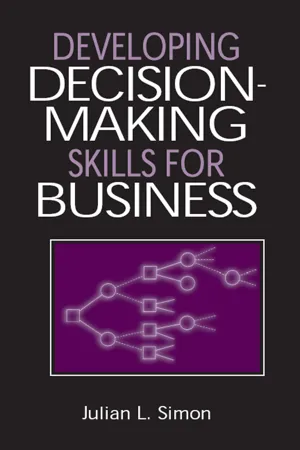
Developing Decision-Making Skills for Business
About this book
This practical resource shows business professionals how to improve their decision-making skills and enhance their ability to develop effective interpersonal relationships with co-workers and clients. The book covers a wide range of topics -- identifying tastes and preferences, personal skill assessment, cost-benefit analysis, risk and uncertainty, multi-tasking, human resource management, time constraints, data collection, and more. Designed to help busy professionals make the most effective use of time and energy, it will also be useful in the study of organizational behavior and business psychology.
PART I
WANTS, ABILITIES, AND GOALS
You must know your goals, and you must be able to specify your criteria of success in life, in order to make use of the machinery for evaluative analysis that helps you make decisions among various possible courses of conduct—the analytic system described in part II. But as we struggle with the toughest decisions in our personal and professional lives, we often find that we are unsure of our goals. Therefore, the next three chapters in part I tackle the difficult problem of selecting our goals and our criteria of success.
There are two main inputs for the process of selecting goals: (1) Our wants, the satisfaction of which pleases us and makes us feel good—call this satisfaction “benefits.” The most important and fundamental of these wants, apart from the needs of sheer subsistence, are the general desires that we call our values. (2) Our human and physical resources, which enable us to work toward satisfying our desires. We usually refer to the usage of these resources as “costs,” though using our talents may be a benefit as well as a cost; this interpenetration of work and play is one of the many interesting complications that pop up as we choose goals. These topics of benefit and cost are discussed in chapters 1 and 2, respectively. Chapter 3 discusses how to combine our values and our capacities in choosing our goals.
Chapter 1
Tastes, Preferences, Wants, and Values
Brief Outline
• What Do You Want?
• What Are We Talking About Here?
• The Basics of Understanding Desires
• Some Useful Tactics for Sorting Out Desires
• Tastes Are Tricky
• You May Wish to Increase Your Desires Rather Than Satisfy Them
• Analyzing the Aims of Organizations
• Summary
What Do You Want?
What you do want? Ask yourself what matters to you. Your family? Your car? The human species? Chocolate rather than vanilla? Lots of money? The environment? Religion? Quietness?
Our wants constitute one of the two elements of the life goals we set for ourselves. (Our capacities constitute the other element.) Satisfying one or more of our desires is the benefit part of cost-benefit analysis of alternatives. Therefore, in this chapter we turn to the task of clarifying our institutional and personal values, as well as our more ordinary needs and desires.
This is a very tough job, however. Our wants are slippery when we try to grasp and understand them. One reason that wants are elusive is that they change, and sometimes we change them by the very process of thinking about them. So we have hard work to do in this chapter.
What Are We Talking About Here?
Your desires are the sensible starting point for your efforts to think better and live well. But one’s desires are a very complex matter, perhaps the most complex matter in your life. It is simple enough to say “I want the French onion” when a waiter asks you to choose a soup. But especially when you are young, or at any other time when you face major choices, the question “What do I want?” can be unbearably difficult. It is such a difficult question that we often can hardly bear to ask it. Facing up to this question in a very explicit manner often is the crucial first step to resolving one’s confusion and making sound decisions.
Even Definitions and Distinctions Are Difficult to Come By
Even specifying and defining the subject of this chapter is a messy business. The word “want” can often be ambiguous, and sometimes it is just a single part of the overall issue you are grappling with. The economist and the psychologist can both agree that we should define “desire”—the rather vague word I’ve used so far—by the fact that you are willing to give up something else you desire in order to obtain the object of your desire and, even more so, by your actually behaving in such manner. Both the psychologist and the economist emphasize that talk is cheap with respect to wants; when someone acts in accordance with the talk, it is time to take the matter more seriously.
That is, a “good”—the object of a desire—is defined as something you are willing to pay for in effort, money, or the like. This can encompass the most noble of desires—which we may call values—as well as the most trivial of desires. Our desires include not only values but also tastes, preferences, and wants, with all those categories overlapping each other.
Values Compared to Other Wants
The difference between what are called “values” and our other desires is chiefly a difference in their importance to ourselves and to others, though people may also attach moral valences to their values. By values I mean the desires that are intertwined with our most basic beliefs, such as the belief that humanity should progress, or that children should grow up in decent homes rather than on the street. In contrast, tastes—say your taste for chocolate ice cream and your distaste for snake meat, or even your dislike of live snakes and your visceral reaction to the sight of blood—are not the products of deep thought but instead seem to stem from some combination of instinct and experience. This is not to say that these tastes are unimportant. Indeed, you might run away from an accident where there is blood even though you have a strong value to provide help in a disaster. Nevertheless you are not likely to say that avoiding the sight of blood is important to you.
We must also distinguish between values and goals, which will be discussed in part I, chapter 3. I recognize that I value having my children be healthy more highly than almost any other value. Then I think about ways to achieve this value, which is then a goal. That is, goals imply initiating actions whereas values imply setting priorities. The goals follow from the values, and from our capacity to achieve goals.
The Basics of Understanding Desires
The Conflicts Among Desires
Each of us has many desires that may conflict with each other. Rare indeed is the person who is so integrated that there is no pulling and tugging among her/his desires. We constantly want to eat the cake and stay thin, too. Indeed, such conflict is inevitable because we must satisfy our desires within limited lifetime budgets of time, strength, and material resources. Furthermore, if there were no conflict among desires, each desire would be unchecked and we would go careening without limit in one direction after another.
Conflict may arise because satisfying one desire means not satisfying the other, as the desire to smoke is incompatible with the desire to be fit. Or conflict may arise because the desires are inconsistent with each other, as the value for equal treatment of all people is inconsistent with the desire that your own ethnic group be given preference.
Conflicts Among Desires Appear Everywhere
Mutually inconsistent desires appear in all contexts. Abraham Lincoln agonized because he wanted peace and he also wanted to prevent the southern U.S. states from seceding, and then afterward he also wanted to free the slaves. Our desires differ in their immediacy. We want to eat and drink beyond moderation tonight, and we also want not to get fat or to be hungover tomorrow. This example, and even more so the example of drug and alcohol addiction, illustrates the perennial conflict between short-run versus long-run desires. Struggling with the conflicts helps you better understand your values, however. And responding to several values at once requires the sorts of techniques discussed in part II, chapter 9, on dealing with multiple goals.
Often we deal with conflicts in desires by not examining them closely, or by closing our eyes to the conflicts while we act. And, indeed, this may be the only practical way of getting on with your life. Demanding perfect clarity of yourself would lead you into an infinite regress with ever finer analysis of your desires but with ever worse paralysis of action. I once heard Herbert Simon (no relation, but a Nobel Prize-winning economist and psychologist), who knows as much about decision-making as any living person, refer to the ultimate decision-making tool—and then took a coin out of his pocket and flipped it.
Biological and Learned Wants
Our desires also differ in their different relationships to our biological needs. The need to void one’s bladder is more “primitive” and more urgent than the desire to arrange the greeting cards on the mantelpiece. We can think of our “higher” desires as being caused more by learning and less by instinct than our “lower” desires. And the higher desires come more into play as our skills and wealth enable us to satisfy our lower wants. Though the higher wants are built on the lower desires, they eventually develop existences of their own. In the words of Gordon Allport, the higher desires become “functionally autonomous” of the lower desires. Abraham Maslow formalized this idea into a hierarchy of wants, with the biological needs at the bottom and what he called the “self-actualization” desires for creative activity at the top. The place in the hierarchy corresponds to the distance from the purest biological needs of food, shelter, and so on, rather than to the importance of the needs.
Whether a given desire should best be considered learned or congenital is a murky matter, though genetic and social scientists are making rapid progress in this field. For example, for the first time, studies in the 1990s seemed to find solid evidence that a propensity for homosexual attraction derives from the genetic constitutions of at least some people, and that people differ greatly in their desires to eat large quantities of food. The strength of one’s curiosity—the desire to understand one’s world—may well derive from biological factors, too, though surely modified by experience. Research seems to trace ever more of our desires and behavior to congenital biology, as many great earlier scholars of human nature, such as David Hume, believed. The interactions between genetics and learning are so tangled, however, that it is exceedingly difficult to understand the roles of each.
There is further discussion in part II, chapter 9, of how to resolve the difficult matter of conflicting desires.
A Single Controlling Goal?
Despite the pyramidal, control-like image of a hierarchy, there is seldom a single goal atop the pyramid that rules the others uncontested. Trying to determine which is the emperor goal usually is a fruitless pursuit that can cause confusion and distress. The question “Who am I?” usually makes sense only if you translate it into “What do I want?” Looking for a single dominant want seems to follow from searching for the unique essence of “I.” I recommend that you do neither.
There are exceptions. Some people do discover a “life mission” for themselves—to create a medical clinic in a poor rural area (Albert Schweitzer), or renew a language thought to be dead (as in the case of Hebrew a century ago and the linguist Philip Lieberman). Such life missions can come to be life-saving and life-giving. Missions sometimes also can turn into monomanias that sow personal hardship for loved ones. But such callings are very rare, and when they happen, they are unmistakable. For most of the rest of us, going out looking for a calling can cause only confusion.
The Motive of “Honor”
Even though it seldom makes sense to think of a single overriding desire, many of our other desires can usefully be viewed as related to the enhancement of the sense of oneself—that is, to one’s own and others’ judgments about how “good” a person you are. An unusually strong desire for money often can be understood in this light. Why would a person want much more purchasing power than the person could conceivably use for almost any utilitarian purpose in his or her lifetime? Often a likely answer is: to show that one is successful and “good,” deserves honor for that success, and is better than other people. Why do people drive expensive cars and live in palatial houses? Unusually attractive aesthetics and creature comforts seldom are a convincing explanation.
Indeed, the very economists who are thought to view people as economically motivated—especially Adam Smith and before him Bernard Mandeville—knew that a person’s standing in the community was usually a deeper goal once the person satisfied the necessities. Mandeville put it this way:
The meanest wretch puts an inestimable value upon himself, and the highest wish of the ambitious man is to have all the world, as to that particular, of his opinion: so that the most insatiable thirst after fame that ever hero was inspired with was never more than an ungovernable greediness to engross the esteem and admiration of others in future ages as well as his own; and … the great recompense in view, for which the most exalted minds have with so much alacrity sacrificed their quiet, health, sensual pleasures, and every inch of themselves, has never been anything else but the breath of man, the aerial coin of praise.1
The desire for money is extraordinarily powerful simply because money is the means to obtain so many other goods, including honor (even titles of royalty and public office can often be bought) and power over other people.
Some Useful Tactics for Sorting Out Desires
Asking yourself the fundamental question “What do I want?” is an example of a suggestion that comes up in several apparently unrelated sections of this book.
Wise Tip #1: Ask “What Do I Want …?”
This is the first among the Wise Habits that will be flagged and labeled in the book.
When you don’t know which way to go, ask yourself a “What do I …?” question.
When you are working in scientific research and you feel stumped, ask, “What am I trying to find out?” When you are writing an essay or an advertis...
Table of contents
- Cover
- Half Title
- Title Page
- Copyright Page
- Table of Contents
- Preface
- Overview of Business Psychology
- Part I: Wants, Abilities, and Goals
- Part II: Introduction to Evaluative Thinking
- Part III: Getting Useful Ideas and Knowledge
- Part IV: Working With Information and Knowledge
- Index
- About the Author
Trusted by 375,005 students
Access to over 1.5 million titles for a fair monthly price.
Study more efficiently using our study tools.
Frequently asked questions
Yes, you can cancel anytime from the Subscription tab in your account settings on the Perlego website. Your subscription will stay active until the end of your current billing period. Learn how to cancel your subscription
No, books cannot be downloaded as external files, such as PDFs, for use outside of Perlego. However, you can download books within the Perlego app for offline reading on mobile or tablet. Learn how to download books offline
Perlego offers two plans: Essential and Complete
- Essential is ideal for learners and professionals who enjoy exploring a wide range of subjects. Access the Essential Library with 800,000+ trusted titles and best-sellers across business, personal growth, and the humanities. Includes unlimited reading time and Standard Read Aloud voice.
- Complete: Perfect for advanced learners and researchers needing full, unrestricted access. Unlock 1.5M+ books across hundreds of subjects, including academic and specialized titles. The Complete Plan also includes advanced features like Premium Read Aloud and Research Assistant.
We are an online textbook subscription service, where you can get access to an entire online library for less than the price of a single book per month. With over 1.5 million books across 990+ topics, we’ve got you covered! Learn about our mission
Look out for the read-aloud symbol on your next book to see if you can listen to it. The read-aloud tool reads text aloud for you, highlighting the text as it is being read. You can pause it, speed it up and slow it down. Learn more about Read Aloud
Yes! You can use the Perlego app on both iOS and Android devices to read anytime, anywhere — even offline. Perfect for commutes or when you’re on the go.
Please note we cannot support devices running on iOS 13 and Android 7 or earlier. Learn more about using the app
Please note we cannot support devices running on iOS 13 and Android 7 or earlier. Learn more about using the app
Yes, you can access Developing Decision-Making Skills for Business by Julian Lincoln Simon in PDF and/or ePUB format, as well as other popular books in Business & Business General. We have over 1.5 million books available in our catalogue for you to explore.