eBook - ePub
Where is Queer?
Museums & Social Issues 3:1 Thematic Issue
- 160 pages
- English
- ePUB (mobile friendly)
- Available on iOS & Android
eBook - ePub
Where is Queer?
Museums & Social Issues 3:1 Thematic Issue
About this book
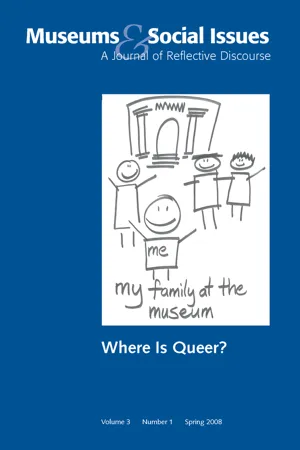
This is Volume 3, Number 1 Spring 2008 edition of Museums and Special Issues reflective discourse journal. The complexity and the power associated with language is evident in the many disciplines, books, courses and talk shows that focus on the disparate ways we use and interpret words. This edition looks at ' What is Queer?' and attempts to reframe the conversation, giving a chance to renegotiate how we talk about gender, sexuality, and identity as separate and vital concepts.
Information
Andrew Gorman-Murray
So, Where Is Queer?
A Critical Geography of Queer Exhibitions in Australia
Abstract This paper interrogates the geography of queer exhibitions in museums and galleries in Australia. The analysis draws on data from Museums Australia's database of queer exhibitions (1982-2005), which are cross-tabulated with geographical variables such as location, scale and state/territory population. The findings show an uneven geographical distribution of exhibitions, how geography also frames the themes of queer exhibitions, and an imbalanced geography, in which regional histories are few, national and state scale histories are prevalent, and minimal exhibitions occur outside metropolitan areas. This is problematic because queer identities, communities and histories vary across scales and between places. Appreciation of geography is thus useful for developing policies and practices that ensure the diversity of queer communities and histories is represented and communicated in exhibitions.
About the author Andrew Gorman-Murray, Ph.D., is a Research Fellow in Human Geography at the School of Earth and Environmental Sciences, University of Wollongong, Australia. His work focuses on geographies of sexuality and gender, particularly gay, lesbian, and queer appropriations of domestic, (sub)urban, and rural spaces.
Introduction: a Geography of Queer Exhibitions
The title of this special issue asks the provocative question, "Where is queer?" This is, quite literally, the issue addressed in this paper, which interrogates the geography of queer exhibitions held in museums and galleries in Australia. Space, place, and locality overtly frame the themes of queer exhibitions in Australia; queer exhibitions appear to be predicated on representing queer community histories across the national, state and regional scales. Yet, an uneven geography underpins the spatial distribution and thematic range of these exhibitions. On the one hand, there are notable biases in the geographical distribution of queer exhibitions in Australia, and this is troubling because it means that museums and galleries have been unable to reach and educate the widest possible audience about queer cultures, communities and histories. On the other hand, there are also significant omissions in the geographical themes of these exhibitions. This is problematic because queer identities, communities, and histories vary between places and across scales, and this geographical diversity is lacking in exhibitions, prompting concern about their inclusiveness. An appreciation of geography is thus crucial for generating policies and practices that ensure the diversity of queer communities and their histories is represented in and communicated through museums and galleries. Although this is an Australian case study, these implications are transferable.
In this paper the term "queer" is used in a pragmatic manner, as a generic term covering gay, lesbian, bisexual, and transgender forms of sexual identity and community. "Queer" also has a more critical application in academic work, where it signifies fluid, unfixed, and non-normative constellations of identities and practices (Jagose, 1996). Recognising this complexity, "queer" is deployed as a pragmatic umbrella-term in order to signify the diversity of lifestyles and identities within gay, lesbian, bisexual and transgender communities.
Rationale and Context: Museums Australia Policy and Queer Exhibitions
Established in 1993, Museums Australia is the peak professional body for museums and galleries in Australia and works to ensure that museum and gallery collections are representative of the diverse history and culture of Australia. As part of that mission, Museums Australia maintains a number of special interest groups, which develop policy and practice guidelines to achieve social and cultural inclusiveness in collections and exhibitions. One of these special interest groups is the Gay and Lesbian Alliance of Museums Australia (GLAMA), which seeks to ensure that a range of queer cultures, identities, histories and communities are represented in Australian museums and galleries.
To this end, in 1999 GLAMA produced the Gay arid Lesbian Policy Guidelines for Museum Programs and Practice, the key document which establishes policies and practices around queer collections and exhibitions, and encourages greater representation of Australian queer communities in museums and galleries. As part of this documented mission, GLAMA also points to the need to recognise and represent the cultural complexity and diversity within gay, lesbian, bisexual and transgender communities (Museums Australia, 1999).
There is no single gay and lesbian community. Like others in the community, gay men and lesbians may identify around common issues, without assuming a common identity Many of the differences are sensitive points of demarcation and should be managed carefully by the museum (pp. 5-6).
This includes "recognising the racial, cultural, social, economic and political diversity within these communities" (Museums Australia, 1999, p. 7).
What is omitted from this otherwise exemplary call is geographical diversity (Davison, 2006), which seems to be an increasingly important issue for Museums Australia. For instance, the Museums Australia National Conference 2006 was themed Exploring Dynamics: Cities, Cultural Spaces, Communities, and presentations drew attention to differences in communities, histories and exhibitions predicated on space and place. However, GLAMA's Guidelines, while invoking a host of differences within Australia's queer communities, do not consider how these communities might also differ across place and scale. Yet, as historians of queer communities have demonstrated, differences do exist. One obvious case is the varying histories of homosexual law reform across Australian states and territories, where consensual homosexual sex between men was legalised as early as 1973 in the Australian Capital Territory and 1975 in South Australia, but as late as 1997 in Tasmania. Likewise, differences exist between the histories of queer communities at the city scale, such as the early emergence of a notable "gay ghetto" in inner-city Sydney centred on Oxford Street, Darlinghurst, yet to be replicated elsewhere in Australia. A range of manuscripts has been written based upon these geographical differences, including distinct queer histories of Sydney, NSW (Faro and Wotherspoon, 2000; Wotherspoon, 1991), Darwin, NT (Hodge, 1993), Queensland (Moore, 2001) and Tasmania (Morris, 1995). Yet, representation of geographical diversity in queer exhibitions is not urged by GLAMA's Guidelines.
This absence at the policy level has led to uneven representation and omission of geographical diversity in museum and gallery practice. This imbalance, in turn, generates a range of implications relating to both the audience and content of queer exhibitions. Consequently, the critical consideration of the geography of queer exhibitions presented in this paper provides useful information for future policies and practices concerning the inclusion of queer communities in museums and galleries in both Australia and beyond.
Data and Methods
Drawing on a database of queer exhibitions maintained by GLAMA and research conducted on queer communities in rural Victoria, there is a record of 27 known queer exhibitions from 1982 to 2005 (Table 1). To analyse the geography of queer exhibitions, the data in Table 1 were cross-tabulated with a range of geographical variables, including the states, territories and cities in which they were held; the total population of each state/territory; and the estimated "queer" population of each state/territory. It was noted if the themes of the exhibitions were geographical, relating to queer histories, cultures and communities in specific places at particular scales, such as the nation, state or region. To assess the geographical diversity in these themes, data were subject to a content analysis, and exhibitions were collated into related spatial and scalar themes. These geographical themes were also cross-tabulated with the geographical distribution of the exhibitions to tease out further concerns about the geography of queer exhibitions.
The Geographical Distribution of Queer Exhibitions in Australia
Table 2 enumerates the geographical distribution of queer exhibitions by state or territory. What is apparent is that New South Wales (NSW) has dominated, hosting 44.4% of the queer exhibitions in Australian museums and galleries. This proportion is over twice that of Victoria and three times that of South Australia (SA), the second and third ranked states. What should be noted, though, is that NSW's dominance has declined since the end of the 1990s. Fourteen of the 27 exhibitions (52%) have been held since 2000, and only 5 (or 36%) of these have been in NSW (Table 2). The other notable figures in Table 2 are those that are absent, that is, the lack of exhibitions in Queensland and the Northern Territory (NT). The absence of exhibitions in Queensland is particularly noteworthy given it is Australia's third most populous state, with almos...
Table of contents
- Cover
- Half Title
- Copyright
- Contents
- Title
- Editor's Note
- Where Are We?
- The Museum's Silent Sexual Performance
- Secret Museums: Hidden Histories of Sex and Sexuality
- Theorizing the Queer Museum
- Embracing Our Erotic Intelligence
- So, Where Is Queer? A Critical Geography of Queer Exhibitions in Australia
- M or F? Gender, Identity and the Transformative Research Paradigm
- Gay and Lesbian Visitors and Cultural Institutions: Do They Come? Do They Care? A Pilot Study
- Nazi Persecution of Homosexuals: The Curator's View
- Queer Collections Appear
- Gay Ohio History Initiative as a Model for Collecting Institutions
- The National Museum of Lesbian, Gay, Bisexual & Transgender History
- Experiencing the Work of Jeff Wall
- National Constitution Center
- Resources for Where Is Queer?
Trusted by 375,005 students
Access to over 1.5 million titles for a fair monthly price.
Study more efficiently using our study tools.
Frequently asked questions
Yes, you can cancel anytime from the Subscription tab in your account settings on the Perlego website. Your subscription will stay active until the end of your current billing period. Learn how to cancel your subscription
No, books cannot be downloaded as external files, such as PDFs, for use outside of Perlego. However, you can download books within the Perlego app for offline reading on mobile or tablet. Learn how to download books offline
Perlego offers two plans: Essential and Complete
- Essential is ideal for learners and professionals who enjoy exploring a wide range of subjects. Access the Essential Library with 800,000+ trusted titles and best-sellers across business, personal growth, and the humanities. Includes unlimited reading time and Standard Read Aloud voice.
- Complete: Perfect for advanced learners and researchers needing full, unrestricted access. Unlock 1.5M+ books across hundreds of subjects, including academic and specialized titles. The Complete Plan also includes advanced features like Premium Read Aloud and Research Assistant.
We are an online textbook subscription service, where you can get access to an entire online library for less than the price of a single book per month. With over 1.5 million books across 990+ topics, we’ve got you covered! Learn about our mission
Look out for the read-aloud symbol on your next book to see if you can listen to it. The read-aloud tool reads text aloud for you, highlighting the text as it is being read. You can pause it, speed it up and slow it down. Learn more about Read Aloud
Yes! You can use the Perlego app on both iOS and Android devices to read anytime, anywhere — even offline. Perfect for commutes or when you’re on the go.
Please note we cannot support devices running on iOS 13 and Android 7 or earlier. Learn more about using the app
Please note we cannot support devices running on iOS 13 and Android 7 or earlier. Learn more about using the app
Yes, you can access Where is Queer? by John Fraser, Joe E Heimlich, John Fraser,Joe E Heimlich in PDF and/or ePUB format, as well as other popular books in Art & Museum Studies. We have over 1.5 million books available in our catalogue for you to explore.