- 160 pages
- English
- ePUB (mobile friendly)
- Available on iOS & Android
eBook - ePub
About this book
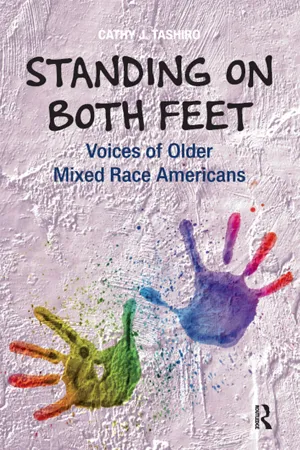
In the first book to focus on the experiences of older Americans of mixed race, Cathy J. Tashiro explores questions of identity and the significance of family experiences, aging and the life course, class, gender, and nationality. Including African American/White and Asian American/White individuals, the book highlights the poignant voices of people who embodied the transgression of the color line. Their very existence violated deep cultural beliefs in the distinctiveness of the races at the time. Based on extensive interviews, the book offers a unique perspective on the social construction of race and racism in America.Check out the website for "Standing on Both Feet" here!
Information
1
History Matters
Racial Rules for Blacks and Asians
We are all in the midst of history, but we generally aren’t aware of how the external context of the present moment is shaping our lives. Part of the problem may be that we tend to see history as being about major events, not the things that we can take for granted because of when and where we live. For example, I take for granted the fact that I, as a native-born mixed Asian American, can be an American citizen, own property, and live anywhere I can afford. Yet, none of these options would have been available to me a bit more than a century ago. I rarely think about this fact. Yet, my life has surely been shaped by the Supreme Court’s 1898 decision in United States v. Wong Kim Ark, which upheld the Fourteenth Amendment to the U.S. Constitution by ruling that all people born on U.S. soil have the right to citizenship (Odo 2002). There are laws that appear in history books, and there are the day-to-day experiences shaped by those laws. When I speak of the impact of history, I refer to the complex relationships between the law, significant historical events, and how these phenomena intertwined with and shaped the lives of the people I interviewed. For example, the fact that the parents of many of my respondents got together when it was illegal to do so in most states conveyed an aura of illegitimacy to their marriages, which profoundly affected the stability of their families.
Tracing relevant history for the lives of people of color to a great extent involves examining legal decisions. Work in the tradition of critical race theory shows the fluctuating nature of racial categories and the effects legal changes have had on the subsequent treatment of people of various ancestries (Crenshaw 1995; Haney Lopez 1996; Odo 2002; Hickman 2003; Gross 2003). Legal decisions have been extremely significant for the lives of both Asian and African Americans. They have made the difference in whether one could become a citizen, whether one could vote, where one could live and work, whom one could marry, and whether it was possible to establish a family. In other words, they influenced every aspect of life. Identity cannot be separated from such profoundly important facets of everyday life. In this chapter I present a brief summary of themes and events from African American and Asian American history that are relevant to interracial families and their offspring. I give some examples of how historical legacies affected the families of the people in my study.
African and Asian Americans: Some Commonalties of History
In Strangers from a Different Shore, Ronald Takaki (1989) tells the stories of Asian immigrants to the United States using archival sources to paint vivid portraits of the conditions they experienced. The first great wave of Asian immigration to the United States occurred in the territory of Hawaii in the 1870s. In his account, Takaki (1989, 25) quotes a memorandum to a plantation manager in Hawaii in 1890 acknowledging orders for
bonemeal
canvas
Japanese laborers
macaroni
Chinamen
When I read this list, I recalled a similar one I saw on a visit to South Carolina in 1997. During that visit, I went on a tour of Boone Plantation, picking it because it had the least offensive advertisements of the plantations near Charleston. As part of the tour of the main house, our guide brought us into the “gentlemen’s” smoking room. She called our attention to a piece of paper posted on the wall. It was a list of supplies to be purchased in town, something like a contemporary grocery list. Along with orders for several pounds of coffee, sugar, and flour appear the words “One negro girl” with a corresponding price.
Such mundane artifacts as these two lists tell us a great deal about how people of Asian and African descent were viewed in the United States. Being put on a grocery list implies that, like a sack of flour, one is a thing and therefore less than human. Being less than human, the labor of African and Asian Americans could be more vigorously exploited. It would not be exaggerating to say that these two groups would not have been tolerated in the United States were it not for the great need for their labor and its enormous profitability. Be it in sugar harvesting, cotton production, rice cultivation, mining, or the building of the railroads, much of this country’s wealth was accumulated through the labor of people of color. The histories of African and Asian Americans are inextricable from the basic economies of the United States.
In particular, the role of black slavery was integral to the history and economic development of the United States. Steven Steinberg (1981) points out how essential the cotton trade was to the development of the economies of both the North and the South, documenting in detail how cotton provided the United States with its first and most significant export staple. In addition to supplying British textile industries, cotton provided the basis for the growth of the textile industry in the U.S. North. The capital generated by these economic transactions formed the basis of the rapid economic growth of the United States as a whole at a key point in its development. And slave labor was the foundation on which the country’s economic development rested. An ideology was needed to justify this practice that was so profitable to the country as a whole. As Steinberg states, “It is facile to think that blacks were enslaved because they were defined as inferior; it would be closer to the truth to say that they were defined as inferior so that they might be enslaved” (1981, 30). He notes that the ideology of racial inequality that justified black enslavement would profoundly influence the treatment of others considered as racial and ethnic minorities.
Concomitant with the end of slavery achieved by the Civil War, expansion in the West and in Hawaii brought a mounting need for other sources of cheap labor (Okihiro 2001). This need, the particular conditions in the Asian countries of origin, and fluctuating quotas by and large accounted for the structure of Asian immigration in the nineteenth through the mid-twentieth centuries.
Steinberg correctly posits that the ideology justifying black slavery set the stage for the treatment of others viewed as not-white. While Asian immigrant workers were not slaves, they often labored under inhumane conditions and for wages that barely afforded subsistence. Many, such as the Chinese who built the western half of the Central Pacific Railroad, worked in the most hazardous conditions and died in much greater proportions than their white counterparts (Chan 1991). As members of contract labor gangs, they could essentially be sold and sent to work for the purchaser of their labor, having little choice in the matter. Many were kept in constant debt by company stores, thus unable to escape the prison of contract labor. Subhuman treatment was justified by the ideology of white supremacy, which was so well developed in the time of black enslavement.
The fact that both African and Asian Americans were valued solely for their labor and seen as inferior to whites influenced every aspect of their lives. However, these basic points of commonalty were translated differently for the two groups. Differences between the requirements of slavery versus contract labor, the status of the country of origin, and shifting definitions of racial group membership all played a part in the evolving histories of these groups and the treatment of their mixed offspring.
African American History, the Construction of Race, and Mixed Race
Some of the earliest people of African ancestry to arrive in what is now the United States were not slaves but indentured servants who arrived in Jamestown in 1619 (Franklin and Moss 1994). In the colonial world, racial boundaries and definitions were not immediately distinguished. Early interracial liaisons between blacks and whites commonly occurred between white indentured servants and blacks, both free and enslaved. The line between indentured servitude and enslavement was not so clearly drawn in the colonial world, and blacks and whites frequently worked in close proximity. The law treated the first people of mixed ancestry with some ambiguity for about the first fifty years in colonial Virginia. By 1662, the Virginia assembly had passed its first acts against miscegenation (Higginbotham and Kopytoff 2003; Feagin 2006). Mixed children of slave mothers were considered slaves, and consorting with “a negro man or woman” became a punishable act for any white person (Williamson 1995). However, liaisons between black men and white women aroused the most anxiety. Since the mothers were free, it was more difficult to make the argument that their mixed race children should not be. Severe penalties against white women who consorted with blacks and forced servitude of their mixed offspring were invoked as a disincentive to this type of interracial sex. At the same time, the more common unions between white slave masters and overseers and black female slaves were ignored and resulted in offspring who could be considered slaves (Fredrickson 1981).
The classification and treatment of mixed people of African ancestry was by no means uniform before 1850. Communities of free people of color existed in Louisiana and South Carolina (Dominguez 1994). However, there was never a third category that uniformly defined the position of people of mixed African ancestry throughout the United States.
In comparing the treatment of mixed offspring in the United States and in the West Indies and South Africa, where they occupied a third, intermediate stratum, George Fredrickson (1981) attributes the difference primarily to expedience. For example, in the West Indies, where small numbers of whites needed to control large slave populations, the creation of an intermediate stratum to carry out the overseer role was advantageous. In contrast, in the colonial South, there were enough free whites to play this role, and it was advantageous to elevate lower-class whites rather than mulattos to manage slaves. Promoting an ideology of racial inequality, which placed whites at the top of the hierarchy, thus counterbalanced potential class resentments by working-class whites toward the wealthier owners of slaves and property.
Though some relaxation of the racial divide occurred during the post–Civil War Reconstruction era, a resurgence of white supremacy in the late nineteenth century resulted in the reinstitution of antimiscegenation laws and a more rigorous definition of whiteness. Although slavery had ended, second-class citizenship for blacks had not. During Reconstruction, southern blacks had been able to vote and hold political office in most states. However, economic stability was not achieved for newly freed slaves. In addition, white supremacists began organizing almost immediately after the Civil War ended. The combination of continued economic domination and the proliferation of virulent white supremacist ideology allowed the rollback of the gains of Reconstruction state by state. With the removal of the last federal troops from the South in 1877, the stage was set for the triumph of white supremacy. State conventions systematically rewrote their constitutions to effectively disenfranchise blacks by a plethora of requirements such as poll taxes, tests based on the ability to read and understand documents like the U.S. Constitution (subject to the interpretation of the test administrator), and property ownership. With the 1896 Supreme Court ruling upholding segregation in Plessy v. Ferguson, strict segregation in all walks of life and rigid enforcement of the color line between black and white were institutionalized throughout the South (Franklin and Moss 1994). With the disenfranchisement of blacks, consolidation of control could proceed, and the American version of apartheid became institutionalized in the Jim Crow era (Feagin 2006).
The Delany sisters, two African American women aged 102 and 104 at the time their autobiography Having Our Say (1993) was published, remember their childhood before and after Jim Crow: “When we got to Pullen Park, we found changes there, too. The spring where you got water now had a big wooden sign across the middle. On one side, the word ‘white’ was painted, and on the other, the word ‘colored.’ Why, what in the world was all this about? We may have been little children but, honey, we got the message loud and clear. But when nobody was looking, Bessie took the dipper from the white side and drank from it” (Hearth, Delany, and Delany 1993, 95–96). The separate but equal doctrine was maintained in many states until the 1954 Supreme Court decision in Brown v. Board of Education of Topeka, which outlawed segregated public schools. The period of legal segregation also saw the flourishing of antimiscegenation laws (Pascoe 1996) and the most extreme hysteria about identifying who was “truly white” and who had “hidden blackness” in his or her family tree (Williamson 1995). Rigorous attention to racial classification was the mechanism for maintaining a social order built on racial hierarchy. By the beginning of the twentieth century, with the consolidation of Jim Crow, most southern states were using the one-drop rule of hypodescent, meaning that any African ancestry whatsoever resulted in a person’s being classified as black. A two-category system became codified, in which children of mixed black and white parentage were considered black (Feagin 2006).
As a result, according to Joel Williamson, the mulatto population (which included individuals mixed with any degree of African ancestry, by his definition) that had been moving in the direction of whiteness turned to blackness out of necessity. As Williamson states, “Because the great majority of American Negroes are in fact of mixed ancestry, and because mulattos and pure blacks came ultimately to fuse their cultural heritages, what begins in the colonial period as mulatto history and culture ends in the twentieth century as Negro history and culture” (1995, xii). Thus, a population with a variety of different ancestries became essentialized as black through the hegemony of the one-drop rule. The historical legacy of the rule of hypodescent with its extreme definition of blackness was still enormously significant for how the mixed African Americans I interviewed define themselves and were defined by others (Spencer 2006).
All of the mixed African Americans I interviewed talked about the presence of this legacy in their lives. For example Helen Wilson, a mixed African American woman born in 1932, spoke of the perceived normalcy of growing up in segregated Galveston as all she knew, something you didn’t question in her time. As she said, “In Texas the schools were segregated, and I went to a segregated grammar school. We knew that’s the way it was.” Although light skinned, with Caucasian and Native American ancestry, she and her family were subjected to the rigid definition of the color line, and “the family was so many different colors, from very, very fair to real dark, you know. But everybody just accepted that.”
Jim Crow was most entrenched in the South, and economic opportunities were slim there for African Americans. During and after World War I, the African American population became increasingly urbanized with large-scale migration to the cities in search of employment. World War II brought about new opportunities for African Americans. For example, President Franklin D. Roosevelt’s Fair Employment Executive Order of 1941 prohibited discrimination in employment in the defense industries. Along with other Americans seeking work, thousands of African Americans migrated to areas with defense jobs, such as the major California coastal ports. During wartime, the total black population of the San Francisco Bay Area expanded by over 227 percent (Johnson 1993). Many of the new black migrants to the area settled in the East Bay city of Oakland, where the parents of some of the people I interviewed sought economic opportunities. This pattern was not confined to African Americans. Sam Cole, a mixed African American born in 1944, recounts how his white mother and grandfather came to the Bay Area from Chicago. “They came out here, my mom and my grandpa at the end of 1942, to work at the Kaiser shipyards in Richmond. My mom was a welder in the ships. And like so many women, she made way better money than she had [before].”
There was much more freedom in California than in the South, where the majority of the new black population came from, and blacks and whites were thrown into much closer contact than would have been possible under segregation. However, as blacks replaced Asians as the largest racial minority, due in part to the relocation of the Japanese population during World War II, racial bias toward blacks grew (Johnson 1993, 55).
The 1950s and 1960s saw unprecedented organized resistance and action on the part of the black population and its allies, coupled with historically significant civil rights legislation. Some of the most memorable events included the Montgomery bus boycott of 1956 led by Reverend Martin Luther King Jr.; the desegregation of Central High School in Little Rock, Arkansas, in 1957, accomplished with the use of federal troops; the sit-in movement launched in 1960 in Greensboro, North Carolina; the freedom marches, culminating in the 1963 March on Washington for Jobs and Freedom; the Selma-to-Montgomery march of 1965; and the Poor People’s Campaign of 1968.
Though racially mixed, several of the people I interviewed took part in the struggle for racial justice. Sam Cole talks about being swept up in the civil rights movement in the Bay Area: “And then we were having the Mel’s drive-in sit-ins, ’cause Mel’s was a segregated place. People glorify this Mel’s stuff? Mel’s was a place that we hated. So I became active, and there was one at Hi’s drive-in here, where Carl’s Junior is right down the street, that was a segregated place. Montgomery Wards was still segregated. We picketed there. My brother, who’s the fairest skinned of us all with his big blue eyes, got spat on there, called a white-looking nigger.” Being fair skinned clearly offered no protection from racism for Sam and his brother. In fact, Gregory Williams, of a similar age to Sam, describes the particularly virulent treatment he received as a “black” man who could pass for white in Life on the Color Line (1996), which discusses his life before and after his placement on the wrong side of the color line in Indiana. During this period, the color line was still actively maintained, and special vigilance was exercised toward “white-looking” men in particular who could potentially pass for white, explored more in chapter 4.
The farthest-reaching legislative accomplishment of this period was the passage of the Civil Rights Act of 1964, which prohibited discrimination and segregation in voting rights, public accommodation, public facilities, public education, and federally assisted programs and extended the life of the Commission on Civil Rights. Title VII of the act established the Equal Employment Opportunity Commission and is still the cornerstone of fair employment law. In addition, Executive Order 11246 established affirmative action to eliminate historical patterns of discrimination in employment. The Voting Rights Act of 1965 further strengthened the fight to remove obstacles to black political participation by giving the attorney general the power to intervene in cases of discriminatory voting requirements. The Fair Housing Act of 1968 prohibited discrimination in the sale, rental, or financing of housing. Several of these laws gave greater rights not just to African Americans but to o...
Table of contents
- Cover
- Half Title
- Title Page
- Copyright Page
- Table of Contents
- Preface
- Acknowledgments
- Introduction
- 1 History Matters: Racial Rules for Blacks and Asians
- 2 Mixed Race: It’s a Family Affair
- 3 Mixed Race Identity: The Racial Chimera
- 4 Axes of Difference: Race and Intersections of Class and Gender
- 5 Eurasian or Bangus? Other Nations and Mixed Race
- 6 Aging and Identity: The Embodiment of History
- 7 Can We Stand on Both Feet?
- Appendix A: Dimensions of Identity
- References
- Index
- About the Author
Trusted by 375,005 students
Access to over 1.5 million titles for a fair monthly price.
Study more efficiently using our study tools.
Frequently asked questions
Yes, you can cancel anytime from the Subscription tab in your account settings on the Perlego website. Your subscription will stay active until the end of your current billing period. Learn how to cancel your subscription
No, books cannot be downloaded as external files, such as PDFs, for use outside of Perlego. However, you can download books within the Perlego app for offline reading on mobile or tablet. Learn how to download books offline
Perlego offers two plans: Essential and Complete
- Essential is ideal for learners and professionals who enjoy exploring a wide range of subjects. Access the Essential Library with 800,000+ trusted titles and best-sellers across business, personal growth, and the humanities. Includes unlimited reading time and Standard Read Aloud voice.
- Complete: Perfect for advanced learners and researchers needing full, unrestricted access. Unlock 1.5M+ books across hundreds of subjects, including academic and specialized titles. The Complete Plan also includes advanced features like Premium Read Aloud and Research Assistant.
We are an online textbook subscription service, where you can get access to an entire online library for less than the price of a single book per month. With over 1.5 million books across 990+ topics, we’ve got you covered! Learn about our mission
Look out for the read-aloud symbol on your next book to see if you can listen to it. The read-aloud tool reads text aloud for you, highlighting the text as it is being read. You can pause it, speed it up and slow it down. Learn more about Read Aloud
Yes! You can use the Perlego app on both iOS and Android devices to read anytime, anywhere — even offline. Perfect for commutes or when you’re on the go.
Please note we cannot support devices running on iOS 13 and Android 7 or earlier. Learn more about using the app
Please note we cannot support devices running on iOS 13 and Android 7 or earlier. Learn more about using the app
Yes, you can access Standing on Both Feet by Cathy J Tashiro in PDF and/or ePUB format, as well as other popular books in Social Sciences & Politics. We have over 1.5 million books available in our catalogue for you to explore.