eBook - ePub
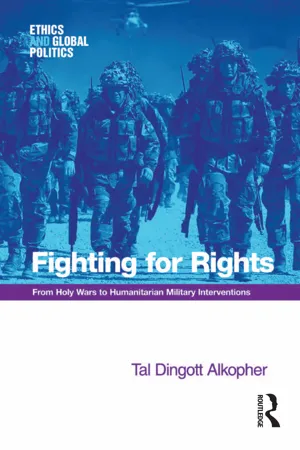
Fighting for Rights
From Holy Wars to Humanitarian Military Interventions
- 224 pages
- English
- ePUB (mobile friendly)
- Available on iOS & Android
eBook - ePub
About this book
In the light of NATO's humanitarian war in Kosovo is it possible to understand or explain wars as an outcome of perceptions of rights? How did rights, be they divine rights in the Middle Ages, territorial rights in the eighteenth century, or human rights today, become something that people are willing to fight and die for? To answer these questions, this book explores the linkage between concepts of rights and the practice of war in the international arena. Alkopher describes how normative structures of rights have shaped different practices of war from medieval to modern times, through the lens of social constructivism. From the eleventh to the thirteenth century, concepts of divine rights and institutionalized practices of the Crusades to the Holy Land fostered the prevailing ideas of international rights and war. In the eighteenth century, the institutionalization of states' rights and territorial wars shaped international conflict. This view held until the late twentieth century when the institutionalization of human rights coupled with the emerging practice of humanitarian war, particularly NATO's war in Kosovo, engendered new norms of international conduct. The author concludes that rights have the power to constitute an international order that will be either cooperative or conflictual and the choice of outcome is very much in our hands. This book will be essential reading for international relations and political science scholars and students but also philosophers, legal and sociological historians and international lawyers.
Trusted by 375,005 students
Access to over 1.5 million titles for a fair monthly price.
Study more efficiently using our study tools.
Information
1 The Role of Rights in Shaping International Wars
DOI: 10.4324/9781315582320-2
This chapter constructs a conceptual schema and coherent concept of rights as conceived from the constructivist standpoint. It also offers a general definition of rights containing an essentialist logical element that is relevant to any concept of rights, whether human rights, the rights of states, or divine rights. The schema also includes definitions and assumptions about rights, and connects and distinguishes between rights and other variables. It examines the implications of various ideas relating to rights and rights practices. The discussion will focus on constitutive connections, on different levels, between rights internationally defined and international wars. These connections are present at the social structures level, the social-emotional level, and the international-institutional level.
The Constructivist View of Rights
In the academic rights literature, there is no consensus regarding the definition of rights. In other words, no consensus over what we mean if we say that someone has a right to something. As Pierre Schlag writes, rights do not allow for “easy identification” (Schlag 1996 : 263–4). This chapter defines the general concept of rights as that which grants a right-holder positive power in the form of benefits and negative power in the form of a responsibility or obligation toward those from whom the right is claimed (Onuf 1998 : 68). Obligations and duties are of course only negative in the semantic sense as counter-correlatives of rights, and are not necessarily negative in the normative sense. For example duties can be positively perceived as the right to help others (Dagger 1989 : 303). The power of rights is mainly due to the entitlement associated with them, and although rights may differ, what they all share and what renders them unique is the idea of entitlement (McCloskey 1965 : 116, Martin and Nickel 1980 : 169–70, Kratochwil 1989 : 170).
The linkage of situation or attribute to a right or entitlement has a unique cognitive, affective, and discursive impact that separates this ideational variable from others. The cognitive 1 element of entitlement concerns the judgment that a person or category of people is entitled to certain outcomes because of who they are (Lerner 1991 : 13). Here the perception of rights relates to the deeper structure of identity 2 on which people’s rights are based, depending on who they think they are (Wenzel 2000 : 157). The converse can also be true, and perceptions of entitlement may involve processes of self-definition and identity (Kratochwil 1994 : 486, Wenzel 2000 : 159). In other words, although perceptions of rights strengthen social identities, when new conceptions of rights develop in a society they can engender new identities.
The Role of Rights in the Social Construction of Reality
This section will argue that the entitlement side of rights facilitates the construction of events in the world. This view is based on the constructivist conception of human reality generally and international relations in particular. According to the constructivist approach, reality, or at least certain aspects of it, depends on social agreement and acceptance. This is because the way that the material world shapes and is shaped by human action and human interaction is an outcome of people’s dynamic normative and epistemic interpretations of the material world (Adler 1997 : 322). People’s expectations of what they can and should do and of what they need are largely shaped by their ideas of rights. And it is those expectations that influence human action and constitute human reality (Hart 1954 : 48).
The formative influence of rights on expectations is extremely important since the structure of social expectations can change our dispositions. Expectations define the situations we encounter and in which our actions occur (Rummel 1975–81 : 22). Our perceptions of rights give rise to specific, concrete, and reasonable ideas about possible and essential behavioral options and outcomes: reasonable because behaviors that might otherwise seem arbitrary may be seen as reasonable when they seek to actualize rights (Waldron 1981 : 28); and essential because rights also construct perceptions of needs that people perceive as legitimate. In other words, our conception of rights shapes our perception of legitimate needs (Miller 1976 : 123).
But rights not only make a reality possible; they also limit possibilities. Indeed, the constitutive attribute of the ownership of rights obliges the Other to constrain himself and accept the powers of the right-holder (Wendt 1999 : 280). In other words, the ownership of rights gives the right-holder the power to determine how others act (Gewirth 1986 : 336, Steiner 1994 : 55). Sarat and Kearns explicitly discussed the constitutive effect of rights on human action: “Examining their [rights’] constitutive effects means inquiring into the way rights call into being, and enable, particular forms and expressions of personhood, as well as the way they disable others” (Sarat and Kearns 1995 : 3).
This leads to the conclusion that social relations are also based on definitions of rights (and duties) (Kratochwil 1994 : 500). It also means that rights facilitate and encourage the perceptions, norms, rules, institutions, and arrangements that we call “social” (Flathman 1976 : 5); in other words, they determine social order. In so far as rights involve the exclusion of some actions and the acceptance of others, they also involve the constraints that influence social choice (Jacobs 1993 : 35). Theories that explore the reciprocal relations between rights and duties highlight this idea and many studies on rights have argued for the correlative nature of rights and duties.3 Where these studies differ is in their understanding of how rights and duties are linked. Some believe that every duty necessarily entails a right, and every right a duty (Martin and Nickel 1980 : 166–7). Wesley Hohfeld makes the important point that every legal right is constructed by a complex bundle of freedoms, claims, powers, and immunities that he maintains are linked to legal duties because every legal right imposes one or more legal duties on one or more sides.4
A number of researchers have tried to prove that not every right has a correlative duty and vice versa. What is particularly relevant here is the argument found in all these studies that a right involves some sort of normative guidance of the behavior of others, not just right-holders (Martin and Nickel 1980 : 166–7). In that sense we could also say that, similar to rights, duties provide reasons for action (Montague 1988 : 363).
Finally, rights not only have a constitutive effect on our relations with others, they also constitute the actors themselves by promoting the power of some actors and negating that of others. Three sides are involved in questions of rights: the right-holder; the duty-holder from whom rights are claimed; and sometimes also a third party, which intervenes to assist the right-holder in realizing or defending their right. So, rights invite previously unknown actors into the international game (such as individual people and international organizations nowadays) while eliminating others (God, for example, nowadays) (Wellman 1985 : 192, 216).
As noted earlier, rights also have a unique affective and discursive impact which accounts for social and political behavior in general and wars in particular. Social theory, and especially international relations research, is based almost exclusively on the cognitive component of explanations. However, there is growing awareness recently that emotions have a constitutive role in constructing social reality. As Kratochwil sees it, by ignoring the emotions that lie behind thoughts—for example, sympathy, solidarity, as well as hatred—international relations research not only neglects a crucial aspect of human behavior, it also falls short in understanding of social reality. And Neta Crawford wishes us to consider that examining the impact of fear on the security dilemma is more interesting than analyzing the latter’s structural attributes or how the offense–defense balance affects it. She also suggests that fear and other emotions are not only the attributes of agents but also play a part in the structures and processes of international politics (Crawford 2000 : 119). Emotions may be internal, but the meanings and behaviors we ascribe to them and our awareness of others’ emotions are cognitively and socially structured (Crawford 2000 : 125). In other words, they are intersubjective. Emotions are generated by attitudes based on beliefs, judgments, and desires which do not arise on their own but are influenced by social belief, values, and morality. Emotions and their associated behaviors, such as aggression, are not natural but learned, and become more intense during social interaction (Crawford 2000 : 128). This shows a link between emotions and cognition. Cognitive activities like perceptions, obligations, and values cause emotional reactions. For example, the sense that justice or rights have been violated can generate anger and a desire for retribution/revenge. But, emotions also affect cognition. Humanitarian intervention, for example, shows how emotional responses affect the way people perceive, think, and act (the response to genocide for example) (Crawford 2000 : 152). Another example is entitlement, where feelings that certain actions and outcomes may be imperative or necessary, may be described in terms of entitlement. The affective element mainly arises in cases of a perceived violation of entitlement. Here the emotional reactions stem from perceiving these cases as unreasonable and objectionable and take the form of frustration or disappointment, which can develop into anger and aggression (Vermunt and Steensma 1991 : 16, Kriesberg 1998 : 67, Mikula, Scherer, and Athenstaedt 1998 : 769–70, Wenzel 2000 : 161).
Rights also have a unique discursive 5 effect. People use the language of rights, and claim entitlement to attract the attention of their target audience to what they believe they deserve, even though these perceptions have not been formally and legally recognized or approved. People argue for rights in different ways, using declaration, insistence, protest, justification, and explanation, which are all types of rights talk (Vincent 1992 : 254).
The views above point to a general awareness of the importance of discourse and language, which are not only regarded as epiphenomena of people’s activities but also as determinants in their activities. Stated most basically, a system of rules, perceptions, and meanings cannot exist without thoughts and must be linked to other words or signs; this is because the rules, perceptions, and so forth only exist due to collective agreements (Searle 1995 : 69). The expression of a claim in terms of rights by a party that is entitled to claim rights gives that claim more power—or, some would say, operative power. Actually, even if the claim does not lead to practical social measures, its entry into discourse has substantive implications in itself and symbolizes a deeper phenomenon. Moreover, Wittgenstein believed that even if someone uses the language of rights but is not involved in rights in a relevant way—in other words, even if they only use the language instrumentally—it does not mean they are completely outside the practice of rights (Tushnet 1989 : 416–18). Thus, the language of rights is important not only because of the fact that it is being used, but also because it testifies to a more general practice of rights and political behavior.
The Intersubjective Dimension of Rights
The Encyclopedia of Philosophy defines rights as “something that must be socially accepted, recognized, and protected … they are practices that are socially constructed” (Rex 1998 : 326–7). Coleman (1993) defines rights as rules that are socially created, and Wendt de...
Table of contents
- Cover
- Half Title Page
- Title Page
- Copyright Page
- Table of Contents
- Acknowledgments
- Introduction
- 1 The Role of Rights in Shaping International Wars
- 2 Divine Right and the Crusades
- 3 The Rights of States and the Territorial Wars of the Eighteenth Century
- 4 NATO’s Military Humanitarian Intervention in Kosovo
- Conclusions: Rights and Wars in the Twenty-First Century
- Bibliography
- Index
Frequently asked questions
Yes, you can cancel anytime from the Subscription tab in your account settings on the Perlego website. Your subscription will stay active until the end of your current billing period. Learn how to cancel your subscription
No, books cannot be downloaded as external files, such as PDFs, for use outside of Perlego. However, you can download books within the Perlego app for offline reading on mobile or tablet. Learn how to download books offline
Perlego offers two plans: Essential and Complete
- Essential is ideal for learners and professionals who enjoy exploring a wide range of subjects. Access the Essential Library with 800,000+ trusted titles and best-sellers across business, personal growth, and the humanities. Includes unlimited reading time and Standard Read Aloud voice.
- Complete: Perfect for advanced learners and researchers needing full, unrestricted access. Unlock 1.5M+ books across hundreds of subjects, including academic and specialized titles. The Complete Plan also includes advanced features like Premium Read Aloud and Research Assistant.
We are an online textbook subscription service, where you can get access to an entire online library for less than the price of a single book per month. With over 1.5 million books across 990+ topics, we’ve got you covered! Learn about our mission
Look out for the read-aloud symbol on your next book to see if you can listen to it. The read-aloud tool reads text aloud for you, highlighting the text as it is being read. You can pause it, speed it up and slow it down. Learn more about Read Aloud
Yes! You can use the Perlego app on both iOS and Android devices to read anytime, anywhere — even offline. Perfect for commutes or when you’re on the go.
Please note we cannot support devices running on iOS 13 and Android 7 or earlier. Learn more about using the app
Please note we cannot support devices running on iOS 13 and Android 7 or earlier. Learn more about using the app
Yes, you can access Fighting for Rights by Tal Dingott Alkopher in PDF and/or ePUB format, as well as other popular books in Politics & International Relations & Comparative Politics. We have over 1.5 million books available in our catalogue for you to explore.