eBook - ePub
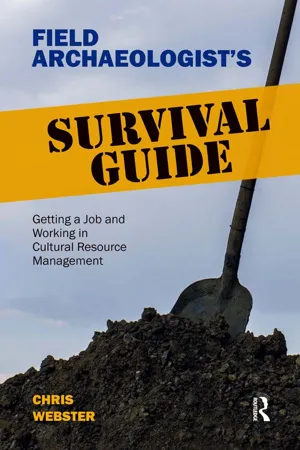
Field Archaeologist’s Survival Guide
Getting a Job and Working in Cultural Resource Management
- 157 pages
- English
- ePUB (mobile friendly)
- Available on iOS & Android
eBook - ePub
Field Archaeologist’s Survival Guide
Getting a Job and Working in Cultural Resource Management
About this book
Chris Webster's handy, informative guide outlines what it takes to become an archaeological technician, a field worker in cultural resource management (CRM) archaeology. Based on his popular blog feature, Shovelbums Guide, Webster offers young archaeologists useful advice about CRM work, including writing, cooking in hotel rooms, hand-mapping, surviving unemployment, life after archaeology, and more. It provides tools new CRM archaeologists need to get hired and to live life on the road in a fluctuating job market, as well as details on how to succeed as a field archaeologist. Appendices cover sample job hunting documents and checklists for fieldwork. If you will be pursuing a position in this dynamic, challenging field, this book is a must-read both before you apply for that first job and once you get one.
Information
SECTION 1
GETTING A JOB
You can’t start a career in cultural resource management (CRM) archaeology without jumping through a few hoops first. This isn’t like some jobs where you can work your way up from the mail room to project manager. There are certain requirements for each position, and you simply won’t get hired without them. There are people working today without some of these educational requirements, but they started in a time when that was possible. For the most part, that time has passed.
This section covers education, preparing a curriculum vitae (CV) or résumé, writing a cover letter, job hunting, and the interview process. There are a lot of resources on writing a CV, résumé, and cover letter, and on job hunting and interviewing. However, most of those resources are tailored for more traditional jobs and not for archaeology. The next few chapters, though, are designed to quickly and efficiently get you working in a region you want to work in. Check out William “Bill” White’s excellent eBook on résumé writing called Résumé-Writing For Archaeologists (2013).
1 EDUCATION
I transferred to the University of North Dakota (UND) as a commercial aviation major. Having come from what was basically a tech school for pilots, the liberal arts environment at UND was liberating and daunting. I couldn’t believe the number of classes that were available for me to take. Of course, I had to fulfill my general education requirements; so I filled them up with anthropology classes.
Since I was a little boy, I’d always wanted to be one of three things: an astronaut, an archaeologist (thanks, in large part, to Indiana Jones), or a pilot. Two out of three isn’t bad. I took as many anthropology classes as I could while I was pursuing my aviation degree. During that time, I was always excited to go to the anthropology classes. They helped engage my brain and kept me interested. The aviation classes, on the other hand, were all about memorization. I loved flying, but I didn’t know if I really wanted to do it for a living. I also didn’t know how to make archaeology a career without being on television or being a professor, neither of which seemed possible for me at the time. So, I continued with aviation. Eventually, I switched to anthropology, and through a round-about way, I became a cultural resource management (CRM) archaeologist.
The Basics
In order to work in CRM, you need a Bachelor of Arts or a Bachelor of Science degree and a field school. That’s it. The rest are details. Well, there are a lot of details and variations to obtaining those two requirements. Let’s talk about them. First, though, why take anthropology classes at all?
Why Study Anthropology or Archaeology?
Some would say that taking an anthropology class is an “easy A”—a quick way to get your general education requirements out of the way so you can move on to “more interesting” things. The easy part is mostly true. Why is it true? Because deep down, everyone wants to be an archaeologist. It’s true, not because the classes are easy, but because they are interesting and engaging.
A few people will attend their first archaeology or anthropology class with the intention of becoming the next Dr. Jones, complete with a tweed jacket and an office filled with artifacts (until they realize that he’s a grave robber and a criminal). A number of us, though, came to CRM in other ways. Some leisurely take classes without a clear objective in mind, and then, all of a sudden, they graduate and have no idea what to do next. Then, they find out about CRM and find their first job. Others, like myself, took archaeology and anthropology classes to fill in the general education requirements while pursuing another degree, but with a difference—I continued to take anthropology classes throughout my time in college.
The Author’s Story
After four years and changing majors twice, I found that there was one remaining constant in my life: anthropology. In fact, for every semester I was in college, I attended at least one anthropology related class. Over the summer before my last year, I decided to pursue an anthropology degree and formally declared my major. I don’t know whether the department head was thrilled or worried (I always asked a lot of questions and held up class, I’m sure). She was the best instructor I had though, and I’m sure she thought I was the best student ever! Anyway, I had taken so many anthropology classes already that only two semesters at 15 credits each of higher- level classes would complete my degree.

After a very tough year of papers and research, I received my shinny new Bachelor of Arts degree in Anthropology. To celebrate, I went straight to work as a day laborer for a home remodeling company. My degree really came in handy while I was making trash runs to the dump. I was able to interpret the stratigraphy in the piles of garbage, and I was able to understand the culture of the various people working in that fine establishment. Can you hear the bitterness and sarcasm? Wait a minute. We were talking about how to get a job in archaeology. I hate to be the one to tell you this, but sometimes the path is long and arduous. Archaeology, in all its forms, consists of a small sect of fiercely passionate academics (whether you work for a university or not, we are all academics), and it’s tough to break into this discipline. Eventually, I found out about the website Shovelbums.org in October of the following autumn, started my first job in early November, and never looked back.
What Classes to Take
The scope of this book isn’t large enough to go into the various programs in archaeology and anthropology at institutions across the country. What you should focus on at your university is on what you want to do after graduation. Take the classes that will help you achieve that goal.
In my experience, most people currently in anthropology programs imagine themselves in the field with the “natives” after they graduate and eventually landing a tenured job at a university somewhere. It’s probably not going to happen. There just aren’t enough opportunities in that sector. There are plenty of opportunities, however, in CRM archaeology. You just have to know where to look. What I’m getting at is that you decide the reality of your situation early so you can take classes that will benefit you later. If you decide to go into the field where most of the archaeology in the United States is accomplished (ahem … CRM), then take classes that will help you get there. Classes in theory and lab work are a big help. The theory classes give you the ability to speak somewhat intelligently about a subject and the lab classes get you introduced to the tedious nature of keeping meticulous records.
If you plan to stay in the region that your university is located in, then you should probably take as many regional courses as you can. Most universities have archaeology classes focused on the state or region in which they are situated. If your school has any preservation law classes over at the law school, you might want to see if you can get in on some of them. A working knowledge of the laws and regulations that make our jobs possible and necessary will put you one step ahead. If one is offered by your university, a CRM class would be even better than a law class. Such a class will focus on the laws and regulations directly related to the formation and practice of CRM.

figure 1.1: The total station.
Finally, operate as much equipment as you can (Figure 1.1). Force yourself into a position where you can work the equipment. Use Global Positioning Systems (GPSs), total stations, magnetometers, and whatever else you can find. If you get to your first job and no one gives you the time of day because you’re “green,” that will all change when you walk up to the total station and you and the crew chief are the only ones that know how to use it.
Field School
Every job posting I’ve ever seen has required attendance in a field school (Figure 1.2) along with a degree. What they don’t tell you is that most employers are only concerned with whether or not you went to field school, not what you learned there. Students tend to see this as a chance to either do something that will help them later in their careers, see other countries, or fulfill their dreams. I chose the last one, since I didn’t know what CRM archaeology was when I graduated. I wish I’d chosen a program that would help me later in my career.
UND offered a field school that was located in the south-central part of the state. There was an ongoing excavation at a Native American site near Bismarck. Honestly, I don’t remember any more about the project. I was so uninterested that I just didn’t care. My focus was on paleoanthropology. I did not want to know what people were doing 200 years ago—I wanted to know how people became people. So, I found a field school that would let me do that.
My field school was actually an Earthwatch Expedition (www.earthwatch.org) to Tanzania where we excavated in Olduvai Gorge. It doesn’t get more “paleoanthropological” than that. The Earthwatch trip wasn’t a traditional field school. Anyone can do it; there is no education requirement. I did, however, learn a lot about excavation and managing finds in a lab; I wouldn’t trade the experience for anything.

figure 1.2: Olduvai Gorge field school
As fun as it was, the Earthwatch field school did not prepare me for CRM archaeology the way the UND field school would have. If I’d known about CRM, I would have researched what part of the country I wanted to work in, and then found a university offering a field school that matched that interest. Field schools out here in the Great Basin do everything from excavation to standard pedestrian survey. I wish someone had told me to think about my choices a little more thoroughly so I could have better prepared myself for the future (e.g. learn about the total station in Figure 1.1).
The founder of Shovelbums.org, R. Joe Brandon, publishes a field school guide on the Shovelbums website every year in early spring. That gives you plenty of time to find a program and make plans to attend. You can choose to have one last fling with university archaeology, or you can prepare yourself for a life in the trenches with the real archaeologists. Choose wisely.
Summary
You have some big decisions to make. These are decisions that will carry you through y...
Table of contents
- Cover
- Half Title
- Title Page
- Copyright Page
- Dedication
- Table of Contents
- Preface
- Introduction
- Section 1: Getting a Job
- Section 2: Shovelbumming
- Section 3: Location, Location, Location
- Section 4: Good to Know
- Section 5: The End, for Now
- Appendix A: CVs and Résumés
- Appendix B: Cover Letter Examples
- Appendix C: Fieldwork Checklist
- Appendix D: Interview Questions
- Appendix E: Dimensional Lumber
- Appendix F: Winter Checklist
- Index
Trusted by 375,005 students
Access to over 1.5 million titles for a fair monthly price.
Study more efficiently using our study tools.
Frequently asked questions
Yes, you can cancel anytime from the Subscription tab in your account settings on the Perlego website. Your subscription will stay active until the end of your current billing period. Learn how to cancel your subscription
No, books cannot be downloaded as external files, such as PDFs, for use outside of Perlego. However, you can download books within the Perlego app for offline reading on mobile or tablet. Learn how to download books offline
Perlego offers two plans: Essential and Complete
- Essential is ideal for learners and professionals who enjoy exploring a wide range of subjects. Access the Essential Library with 800,000+ trusted titles and best-sellers across business, personal growth, and the humanities. Includes unlimited reading time and Standard Read Aloud voice.
- Complete: Perfect for advanced learners and researchers needing full, unrestricted access. Unlock 1.5M+ books across hundreds of subjects, including academic and specialized titles. The Complete Plan also includes advanced features like Premium Read Aloud and Research Assistant.
We are an online textbook subscription service, where you can get access to an entire online library for less than the price of a single book per month. With over 1.5 million books across 990+ topics, we’ve got you covered! Learn about our mission
Look out for the read-aloud symbol on your next book to see if you can listen to it. The read-aloud tool reads text aloud for you, highlighting the text as it is being read. You can pause it, speed it up and slow it down. Learn more about Read Aloud
Yes! You can use the Perlego app on both iOS and Android devices to read anytime, anywhere — even offline. Perfect for commutes or when you’re on the go.
Please note we cannot support devices running on iOS 13 and Android 7 or earlier. Learn more about using the app
Please note we cannot support devices running on iOS 13 and Android 7 or earlier. Learn more about using the app
Yes, you can access Field Archaeologist’s Survival Guide by Chris Webster in PDF and/or ePUB format, as well as other popular books in Social Sciences & Archaeology. We have over 1.5 million books available in our catalogue for you to explore.