eBook - ePub
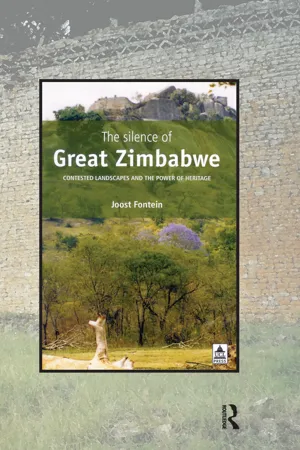
The Silence of Great Zimbabwe
Contested Landscapes and the Power of Heritage
- 264 pages
- English
- ePUB (mobile friendly)
- Available on iOS & Android
eBook - ePub
About this book
This book examines the politics of landscape and heritage by focusing on the example of Great Zimbabwe National Monument in southern Zimbabwe. The controversy that surrounded the site in the early part of the 20th century, between colonial antiquarians and professional archaeologists, is well reported in the published literature. Based on long term ethnographic field work around Great Zimbabwe, as well as archival research in NMMZ, in the National Archives of Zimbabwe, and several months of research at the World Heritage Centre in Paris, this new book represents an important step beyond that controversy over origins, to focus on the site's position in local contests between, and among individuals within, the Nemanwa, Charumbira and Mugabe clans over land, power and authority. To justify their claims, chiefs, spirit mediums and elders of each clan make appeals to different, but related, constructions of the past. Emphasising the disappearance of the 'Voice' that used to speak there, these narratives also describe the destruction, alienation and desecration of Great Zimbabwe that occurred, and continues, through the international and national, archaeological and heritage processes and practices by which Great Zimbabwe has become a national and world heritage site today.
Information
Chapter 1
The 'Zimbabwe Controversy': The Power of 'Fact' over 'Fiction'
Rumours of Gold, Sheba and the Land of Ophir
Today I dare to close this account with:
The Queen of Seba is the Queen of Simbaöe,
Psalm 72, 10 - The Seba mentioned there is Simbaöe,
Math. 2, 11 - Of the three kings the one was from here, the others from Arabia and India
The reported pot is possibly an Ark of the Covenant.
The ruins are copies of Salomo's temple and palace
Psalm 72, 10 - The Seba mentioned there is Simbaöe,
Math. 2, 11 - Of the three kings the one was from here, the others from Arabia and India
The reported pot is possibly an Ark of the Covenant.
The ruins are copies of Salomo's temple and palace
(Carl Mauch, Wednesday 6 March 1872, in Burke 1969: 191)
Carl Mauch, a German explorer, is often attributed with the 'discovery' of Great Zimbabwe in 1871, and whilst he was probably the first European to publish an account of visits there, it is clear from his published journals (Burke E. 1969 The Journals of Carl Mauch 1869-1872) that he did not stumble upon them, rather he was looking for them. His journal entry for Friday 1 September 1871 - four days before he first 'discovered' the ruins - makes this clear,1
Some more people were questioned about this pot and they, too, told curious stories about it. There was one among these people who came forth with still more important news, namely of the presence of quite large ruins which could never have been made by blacks. Could these be the ruins of the Banyai for which I've been looking?
(Carl Mauch Friday 1 Sept. 1871 in Burke 1969: 139)
Mauch already held faith in the fanciful theories of the ancient and white origins of the stone walls, even before hearing of the ruins themselves from locals. This would certainly explain his delight - evidenced in his journal entry for the previous day when 'natives' told him white people once lived in the country.
This most exciting news was that, according to the natives, white people had once lived in this country and that when they [ie the 'natives'] took possession of these parts (about 40-50 years ago), they had, now and again, picked up tools while working in their gardens; for instance, once a piece of iron which, according to their description, could have been a miner's pick. They affirmed with conviction that they would not have been able to make such things. Remnants of furnaces were still numerous and, as they do not keep it secret but, on the contrary, would like to see white people living here, the ancestors of whom once owned this country, I started early to look for traces on a higherlying terrace.
(C. Mauch Thursday 31 Aug. 1871 in Burke 1969:137)
The search for ruins of an 'ancient' and 'foreign', preferably white, civilisation were linked in the explorer's imagination to the search for gold - the discovery of which he was already credited with at what became known as the Hartley Hills, during previous explorations (Burke 1969: 3). Indeed, prior to this expedition, Carl Much had come under the influence of a certain Rev. A. Merensky of the Berlin Mission in the Transvaal, who 'was of the conviction that m the country Northeast and east of Mosilikatse the ancient Ophir of Solomon is to be found and that in the times of the Ptoleymies Egyptian trade penetrated to our coasts'2 (Burke 1969: 4). Garlake (1973: 62) has also emphasised the role of Rev. Merensky in the formation of Mauch's expectations of, and subsequent explanation for, the ruins. Describing Mauch as a 'young man of courage and great tenacity, but certainly no thinker', Garlake (1973: 62) suggested that,
In fact Mauch was, of course, not conducting an investigation but giving unquestioning acceptance to someone else's ideas. His opinions reflect nothing more than the sources, selected, channelled and coloured by Merensky, that had stimulated him. Thus Mauch, the first certain foreign visitor to the Ruins and the first person to describe them to the outside world set the final touches to Muslim tales that had reached the Portuguese over three centuries before.
(Garlake 1973: 64)
The 'Muslim tales' that Garlake referred to are detailed in a variety of Portuguese documents from the sixteenth century, alongside the Portuguese writers' own accounts of encounters with the kingdom of Mwene Mutapa, on the plateau of northern Mashonaland. While the Portuguese archives of their explorations between 1506 and 1890 are extensive, there are only a few references to stone buildings (Garlake 1973: 51; Beach 1998: 48). Some of these accounts refer to stone buildings within the 'Mwene Mutapa's own Karanga Kingdom' (Garlake 1973: 51) in the north of Zimbabwe, but one in particular (that of Joao de Barros published in the first decade of his Da Asia in 1552) seems to describe Great Zimbabwe's geographical position, surroundings and architectural features very closely (Garlake 1973: 51-52).
Garlake has argued convincingly that the ideas of Great Zimbabwe's 'foreign origins' that emerged in the Carl Mauch's descriptions, and later sparked the 'Zimbabwe Controversy', originated from the tales of Swahili traders and Portuguese writers who ignored 'the most obvious assumption ... that they were the work of the local people' (Garlake 1973: 54). In particular, he laid blame on the Portuguese writers De Barros and Dos Santos, who 'with a completely uncritical acceptance of Swahili tales and with generalisations based on incomplete knowledge, ruled out an indigenous origin for the stone buildings' (Garlake 1973: 54). He continues:
It is much more certain that the Swahili did not build the Ruins. De Barros 'Moorish merchants' admitted that they knew nothing of the builders and Dos Santos' 'aged Moors' were indicating much the same thing in naming Solomon or Sheba as the builders for these were popular figures in Muslim folklore and two names from the remote past with which every Muslim was familiar ....
Having thus eliminated the Karanga and Swahili, de Barros and dos Santos were left with no concrete evidence at all. They therefore drew from their own resources. They could scarcely conceive of any area of major human achievement that had gone completely un-recorded and recognised in the Bible as the most precise historical account of the Human past, elaborated perhaps by some classical authors. Their view of Africa was coloured by memories of the hopes once raised by the great lost Christian Kingdom of Prestor John, and by their faith, however much it was dwindling, in an enormous wealth in gold in the Sofalan interior. These diverse inspirations were reinforced by an awareness that Ethiopia contained definite ruins of Biblical kingdoms, coupled with a very hazy and exaggerated idea of how far Ethiopia extended. With these premises, it now looks nearly inevitable that they should have suggested Prestor John, Solomon and Sheba as the instigators of Mwene Mutapa's stone buildings.
(Garlake 1973: 54-5).
By the end of the nineteenth century, these accounts were feeding a frenzy of European imperial and capitalist discourses and activities in southern Africa. Mauch's 'discovery' of Great Zimbabwe 1871, and the almost inevitable comparison with Solomon's Temple, and the Queen of Sheba only fuelled a fire that was already burning with fury. Set in the context of what Pakenham (1991) described as 'the scramble for Africa', the effects of the reports that Carl Mauch had found the mythical ruins of the 'land of Ophir' were exponential. By 1890 'historical legend had inspired the colonisation of Zimbabwe' (Kuklick 1991:139).
The territory occupied by the British South Africa Company was, as Kuklick noted, the 'only British Colonial preserve acquired for the explicit purpose of exploiting its mineral resources' (1991: 138). Furthermore, 'Rhodes and his kind in southern Africa were accustomed to invoking their version of the history of the area to demonstrate that African polities had no stronger claim to land than they did' (1991: 138-39). Therefore the rumours of ancient civilisations, and the land of Ophir3 'helped fire his imagination and shape his policy' (Colquhoun 1914: 485). The link between Great Zimbabwe, rumours of gold and ancient mythical/biblical 'civilisations' was used to encourage early setters to join the British South Africa Company's (BSACo) 'pioneer column' in 1890. Beyond attracting colonial settlers with the lure of abundant and exploitable gold resources. Great Zimbabwe 'also quickly became a symbol of the essential rightness and justice of colonisation and gave the subservience of the Shona an age-old precedent if not Biblical sanction' (Garlake 1973: 65). When Cecil Rhodes came to visit for the first time, 'local Karanga chiefs were told that the "Great Master" had come to see the ancient temple which once upon a time belonged to white men' (Garlake 1973:66),
Clearly theories of 'ancient' and 'exotic origins for Great Zimbabwe were of great political use for the British South Africa Company, and particularly Cecil Rhodes. In 1891 he began financing a variety of research projects, including a search among European archives and libraries for descriptions of Zimbabwe by Alexander Wilrnot (1896). With the Royal Geographical Society and the British Association for the Advancement of Science, he commissioned an expedition to, and investigation of, the ruins led by an explorer called Theodore Bent, a man with 'antiquarian inclinations but no formal archaeological training' (Garlake 1973: 66). This was to be the first in a series of 'officially sanctioned' excavations at Great Zimbabwe which signalled the systematic, and institutionalised appropriation of both its past and the site itself.
In terms of artefacts, the process of appropriation had already begun when Carl Mauch took samples of what he thought was cedarwood4 from the lintel of the Great Enclosure's north entrance on Wednesday 6 March 1872 (Matenga 1998: 21). Much more significant than Mauch's splinters of wood, was Willie Posselt's dubious acquisition of one of the - soon to be famous - 'Zimbabwe Birds' in 1889, which was later sold to Cecil Rhodes (Matenga 1998: 22). While Great Zimbabwe was apparently spared from the relic hunting of the Ancient Ruins Company, authorised by the British South Africa Company in 1895 to 'plunder for profit in all the ruins save Great Zimbabwe' (Kuklick 1991: 142; see also Ndoro and Pwiti 2001: 23), it still fell victim to destruction and pillaging by unauthorised excavators. Most destructive of all were Richard Hall's vast clearances of the Great Enclosure between 1902 and 1904, done under the auspices of 'preservation work' (Garlake 1973: 72). Further destruction of archaeological deposits occurred under the authority of the Public Works department in the second decade of twentieth century, in a misguided attempt to prevent the collapse of the western wall of the Hill Complex (Ndoro 2001: 41). But the appropriation of the site did not only take the form of relic hunting, or the destruction of archaeological deposits. It also refers to the process by which local communities were increasingly distanced and alienated from the site. At the end of the nineteenth century members of the Mugabe clan occupied parts of the Hill Complex, and much of what is now the Great Zimbabwe estate was grazed by cattle, hunted on, and used for gathering fruits, and collecting thatching grass. More importantly perhaps, the site was considered sacred by different local communities who were deeply involved in a contest over the ownership of the site. Today a fence exists around the estate, access is tightly controlled, and entrance fees are charged. In short, Great Zimbabwe has become a heritage site, and a tourist destination.
Theodore Bent's excavations at Great Zimbabwe began in the Great Enclosure in June 1891. The site was already receiving a great deal of European visitors inspired by the rumours of King Solomon and the Queen of Sheba, that had been widely proliferated through popular novels such as Rider Haggard's King Solomon's Mines (1885). Bent was sceptical of these ideas.
The names of King Solomon and the Queen of Sheba were on everybody's lips, and have become so distasteful to us that we never expect to hear them again without an involuntary shudder.
(Bent 1896: 64)
Indeed, his excavations in the Great Enclosure came across very little that was not of much more recent, local African origin. Bent wrote, 'We found but little depth of soil, very little débris, and indications of a Kaffir occupation of the place up to a very recent date, and no remains like those we afterwards discovered in the Fortress' (Bent 1896: 118). As Garlake noted, Bent's guide, C.C. Meredith, said that 'on one occasion at this time Bent "looking rather depressed" and confided to him "I have not much faith in the antiquity of these ruins I think they are native .... Everything we have so far is native" ' (Garlake 1973: 66). But Bent's preconceived ideas of 'exotic', 'foreign' builders held strong and his finds indicating 'kaffir occupation' were ignored as failing 'to bring any definite records of the past' (Bent 1896: 121). Rather, he suggested that perhaps,
a spot situated on the shady side of the hill behind the great rock might possibly be free from Kaffir desecration; and the results of our excavations on this spot proved this to be the case, for here, and here only, did we come across relics of the past in our digging. In fact, the ancient builders seemed to have originally chosen the most shady spots for their buildings. Undoubtedly the oldest portions of the Zimbabwe ruins are those running along the sunless side of the hill fortress; on the other side, where now the Kaffir village is, we found hardly any trace of ancient structures. Our difficulty was to get the shivering Kaffirs to work there, for whenever our backs were turned they would hurry off to bask in the rays of their beloved sun.
(Bent 1896: 122)
It seems extraordinary that Bent would have used the reasoning that his African workers disliked the shade and preferred to work in the sun, as a basis upon which to choose a site 'free from Kaffir desecration', in order to 'come across relics of the past'. What he came across there were more material remains that seemed 'indistinguishable from contemporary Karanga articles', as well as a few less obviously dateable objects he never-the-less considered African, and some 'clearly identifiable and dateable ... pieces of Arabian, Persian and Chinese glass and ceramics ... no more than a few centuries old' (Garlake 1973: 67). These objects were of litde help to bolster his conviction that the ruins were of ancient and exotic origins. However, he did come across various soapstone objects, including four 'Zimbabwe birds' on carved monoliths, as well as other decorated monoliths, soapstone bowls, figurines and 'phalli'. Unlike anything else that had been found in sub-Saharan Africa before, these objects were 'assumed by Bent to be the only clues to the origins of the builders and he started to look for parallels' (Garlake 1973: 67...
Table of contents
- Cover Page
- Dedication
- Half Title page
- Title Page
- Copyright Page
- Contents
- List of Illusrations
- List of Acronyms
- Acknowledgements
- Some Notes on Fieldwork, Language and Sources
- Part I: The Silence of Unrepresented Pasts at Great Zimbabwe
- Part II: The Silence of Anger at Great Zimbabwe
- Bibliography
- Index
Trusted by 375,005 students
Access to over 1.5 million titles for a fair monthly price.
Study more efficiently using our study tools.
Frequently asked questions
Yes, you can cancel anytime from the Subscription tab in your account settings on the Perlego website. Your subscription will stay active until the end of your current billing period. Learn how to cancel your subscription
No, books cannot be downloaded as external files, such as PDFs, for use outside of Perlego. However, you can download books within the Perlego app for offline reading on mobile or tablet. Learn how to download books offline
Perlego offers two plans: Essential and Complete
- Essential is ideal for learners and professionals who enjoy exploring a wide range of subjects. Access the Essential Library with 800,000+ trusted titles and best-sellers across business, personal growth, and the humanities. Includes unlimited reading time and Standard Read Aloud voice.
- Complete: Perfect for advanced learners and researchers needing full, unrestricted access. Unlock 1.5M+ books across hundreds of subjects, including academic and specialized titles. The Complete Plan also includes advanced features like Premium Read Aloud and Research Assistant.
We are an online textbook subscription service, where you can get access to an entire online library for less than the price of a single book per month. With over 1.5 million books across 990+ topics, we’ve got you covered! Learn about our mission
Look out for the read-aloud symbol on your next book to see if you can listen to it. The read-aloud tool reads text aloud for you, highlighting the text as it is being read. You can pause it, speed it up and slow it down. Learn more about Read Aloud
Yes! You can use the Perlego app on both iOS and Android devices to read anytime, anywhere — even offline. Perfect for commutes or when you’re on the go.
Please note we cannot support devices running on iOS 13 and Android 7 or earlier. Learn more about using the app
Please note we cannot support devices running on iOS 13 and Android 7 or earlier. Learn more about using the app
Yes, you can access The Silence of Great Zimbabwe by Joost Fontein in PDF and/or ePUB format, as well as other popular books in Social Sciences & Archaeology. We have over 1.5 million books available in our catalogue for you to explore.