- 144 pages
- English
- ePUB (mobile friendly)
- Available on iOS & Android
eBook - ePub
About this book
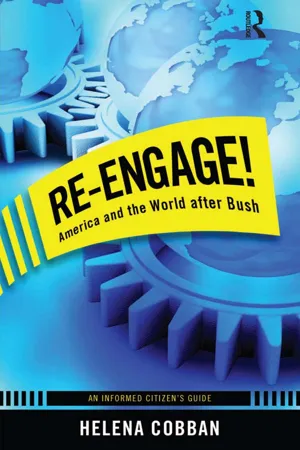
A veteran international journalist gives us a concise, readable guide that provides a new vision for the United States in the global community. Since 9/11, the United States has pursued a foreign policy some have called a "control paradigm"-a unilateral domination of world affairs through military means that tries to keep the lid on insecurity without addressing root causes or protecting human rights. The Bush administration's energetic use of this approach has ripped the fabric of America's relationship with the rest of the world. In this concise guide, veteran journalist Helena Cobban proposes moving the United States away from the control paradigm to a policy of global inclusion. Global inclusion seeks to repair the U.S. relationship with other countries, recommit the United States to effective participation in the United Nations and other multilateral institutions, and ground U.S. foreign policy firmly in the principle of human equality. It also involves moving away from the language of threats and fear to a language of challenge and possibility. This book outlines how a global inclusion policy would address key challenges faced not only by Americans but by the 95 percent of humanity who are not Americans: - Challenges of terrorism and weapons proliferation. - Growing global inequality. - Rights abuses worldwide. - Climate change. - Shifting international power balances. Cobban reminds readers we do not need to do any of these things alone. Since 9/11, she has traveled to 18 foreign countries on four continents. She has heard how deep the desire is among people in China, sub-Saharan Africa, the Muslim world, Europe, and elsewhere for the United States to rejoin the world community on a sound and cooperative basis. In heartfelt, accessible prose with highly readable tables, graphics, websites, and other resources, she shows how we can re-engage as neighbors, as a country, and as a trusted international partner.
Information
1
America and the World after Bush
America and the World after Bush
More than ever today Americans, like the rest of humanity, need a functioning global system through which the world’s peoples can face global challenges together.
—Kofi Annan, Former UN Secretary-General and Nobel Peace Laureate
Our country’s relationship with the rest of the world is damaged and is in dire need of healing. Even before the day in March 2003 when President George W. Bush launched the invasion of Iraq, there were already big problems in the relationship. But when he launched that invasion, without having obtained the backing of the United Nations and in open defiance of the preferences of most other countries, he set in motion a number of processes that have haunted our country and the world ever since.
Within Iraq, the U.S. military was easily able to topple a long-weakened Saddam Hussein. But the invasion also unleashed vast and unruly internal forces that made Iraq nearly ungovernable and kept the U.S. military stuck in the Iraqi quagmire for more than five years after March 2003. By the end of 2007 that engagement had cost the lives of more than 3,900 U.S. servicemembers and scores of thousands of Iraqis, most of them civilians. It consumed more than $450 billion of U.S. spending, financed largely by burdensome debt. It pummeled the reputation of the United States as a reliable, law-abiding player within the international community. It distracted considerable resources from the U.S.-led fight against Al-Qaeda in Afghanistan and Pakistan, and it stimulated the emergence of Al-Qaeda affiliates in many places where previously there had been none—including an extremely brutal affiliate in Iraq itself. Finally, the lengthy and draining U.S. engagement in Iraq distracted the attention of most Americans from other, deeper challenges in the international system, including shifts in the balance of global power, the challenge of climate change, and the mounting need for our country to strike a new kind of compact with the 6 billion of the world’s people who are not American citizens.
Now, however, the Bush presidency is winding down. Our country will have a new chance to set things right—with Iraq, and in our relationship with the rest of the world. The future course of events in Iraq and the rest of the Persian Gulf is hard to predict. Box 1.1 outlines some of the prospects.
But this book is only a little about Iraq. It is mainly about the world-defining relationship the planet’s 6 billion non-Americans have with our country, a land of just 300 million souls that for a decade after the fall of the Soviet Empire stood astride the world like a colossus but that now stands largely outside the global community like a distrusted stranger.
Box 1.1 Prospects in Iraq and the Gulf
A wide variety of scenarios look possible for Iraq, the Persian Gulf region, and the broader Middle East over the years ahead. The most troubling is the prospect of a U.S. or Israeli military attack on Iran. Such an attack would almost certainly provoke sharp Iranian counterattacks against U.S. targets in Iraq and the rest of the region, and unleash further instability throughout the Middle East.
Meanwhile, U.S. forces worldwide are now so thinly stretched that any acute security crisis in Pakistan or Afghanistan—or indeed, in Iraq itself—might force Washington to reduce U.S. troop levels in Iraq very swiftly indeed.
Whatever happens in 2008, Iraq itself will likely present Bush’s successor with tough choices. I have long argued for a U.S. troop withdrawal from Iraq that is total, speedy, orderly, and generous to the Iraqis, whom our country has harmed so grievously. A bilevel, UN-convened peace negotiation—with one level involving the major Iraqi political trends, and the other Iraq, its six neighbors, and the United States—probably offers the best chance that Iraqis can find a decent political agreement among themselves in the context of the U.S. pullout. The United States should participate constructively in a portion of these negotiations but let the United Nations actually run all of them.
Whether this is the course adopted, or the U.S. drawdown from Iraq is more gradual or less orderly, there will almost certainly be a significant reduction in the U.S. troop level there before 2010. And over the next decade, the United States will likely have to reduce further the role it has played since 1970 as the dominant military power in the oil-rich Gulf region. Few people have given much thought to what will replace the current situation. The Gulf’s coastal states—including, of course, Iran—share with the international community a strong interest in keeping the Gulf’s sea lanes open and secure. A collaborative regional arrangement for maritime policing seems like the best option.
We should understand, though, that the decision Bush took to invade Iraq in 2003 was very consequential. It was a big-stakes roll of the dice in a strategically crucial part of the world. The now evident failure of that gamble will have consequences for the U.S. position in the world as great as those encountered by other world powers after they met strategic failures of similar magnitude. We could look, for example, at the diminution of global power suffered by Britain and France after the strategic failure of their campaign against Suez in 1956, or that suffered by the Soviet Union after its failure in Afghanistan in the 1980s.
I grew up in a Britain that, back in the 1950s and 1960s, was rapidly decolonizing. Almost every week, it seemed, in some distant land a ceremony was held in which Britain’s Union Jack flag was brought down the flagpole and the insignia of a newly independent nation was raised. The new president or prime minister who took over the country was often a man who had previously been hounded or jailed on charges of “terrorism.” Some Britons felt upset and betrayed to see the rapid dissolution of the once proud British Empire. Most did not. Most welcomed the end of imperial responsibilities, and turned eagerly to building new kinds of relationships with the newly independent powers.
I graduated in 1973 from Oxford, where the sons and daughters of many of those postcolonial leaders were my classmates. Soon after, I went to Beirut, Lebanon, to build a career as a foreign correspondent. From 1976 through 1981, I was a regional correspondent for the Christian Science Monitor and London’s Sunday Times. I reported from prerevolutionary Iran and from the frontlines of both the Lebanese civil war and the big war that Saddam’s Iraq launched on Iran in 1980. I covered many twists and turns in the Palestinian-Israeli issue, and reported on big political, diplomatic, and social developments in Egypt, Jordan, Syria, and elsewhere.
In 1982 I came to the United States. I was divorced and raising two young children alone. Continuing to work as a foreign correspondent seemed impossible, so I focused on other forms of writing about international issues. For seventeen years I contributed a regular column on global affairs to the Christian Science Monitor. (Over the years, it has dealt with all of the issues covered in this book and then some.) The six books I have published in the United States include four on Middle East issues, one on postconflict policies in Africa, and one on the role of moral leadership in building world peace. I have been a U.S. citizen since 1987.
I have continued to travel widely in connection with my work—interviewing political leaders, rights activists, survivors of political violence, and policy analysts on five continents. I have done hands-on work in Israeli-Arab conflict resolution, participated in conferences in many countries, and spoken at events in most of the states of the union. I’m a long-standing member of both the London-based International Institute for Strategic Studies and the Middle East Advisory Committee of Human Rights Watch. In early 2003 I started writing a blog, JustWorldNews.org. It now has thousands of readers around the world, some of whom contribute their own distinct perspectives to its online discussions. Those discussions, and others like them in today’s blogosphere, can allow all of us to feel better connected with people around the world.
I have gone back to the United Kingdom at least once a year since I left as a young adult. I know that today, Britain is a self-confident and vibrant place. “Letting go” of the attempt to control distant others, as the United Kingdom did during my growing up years, can have very good effects for the country that does it reasonably well.
From “Control” to Global Inclusion
In recent years, and especially since the end of the Cold War, the United States has pursued a general approach toward many other nations that British authors Chris Abbott, Paul Roger, and John Sloboda have termed a Control Paradigm. In their book Beyond Terror: The Truth about the Real Threats to Our World, the authors described this approach as one of “attempting to maintain the status quo through military means and ‘keeping the lid on’ insecurity without addressing the root causes” (82).
The United States as a country never set out to create a globe-girdling empire. But it has had great influence on world affairs since 1945, when it established a unified set of rules—centered around the United Nations and two or three global financial institutions—to regulate international relations in the postwar world. Then, after the fall of the Soviet Union in the early 1990s, the United States and a few rich allies came easily to dominate the rule system created in 1945. The indirect form of control Washington thereby came to exercise over much of the world’s economy had a huge impact on people in other countries, even if most Americans never saw those impacts. Most Americans did not particularly seek for the United States to “control” other countries—but nonetheless, in many important respects, it did just that.
The control paradigm as described by Abbott et al. is not a new phenomenon. However, all the colonial powers that followed it prior to World War II discovered, in one way or another, that it did not provide a workable model for their behavior after 1945. The post-1945 era has, after all, always been centrally defined by those portions of the UN Charter and the Universal Declaration of Human Rights that state unequivocally that the world’s women and men are all endowed equally with human rights, including the rights to human dignity and self-governance.
When George W. Bush became president, he promised to adopt a “humble” posture in international affairs. But his administration’s actions were far from humble! He firmly turned away from many international agreements and generally chose not to address the root causes of other nations’ discontents. And he showed himself very ready to use military might to uphold U.S. power in the world.
Throughout most of his two terms in office Bush clung desperately to pursuit of the control paradigm in world affairs. But this choice did not help Americans to be safer or feel more “in control.” On the contrary, it made us more isolated from the rest of the world than ever before, and hence in many ways far less secure. It also left many Americans feeling much more fearful about the future.
There are other ways to think of our role in the world that do not involve a self-defeating attempt to exercise control over most of it. Some Americans—in the post-Iraq period, as earlier—may be tempted to think that our country can manage best by turning inward and forgetting about the world outside. But in the twenty-first century, that is not a realistic option. Our country is so closely tied to the rest of the world through economic and personal links that dissolving those ties now seems quite undoable. Instead of isolationism, we need to find a way to stay in good and productive touch with the rest of the world—but one that is clearly different from a futile, continued pursuit of the control paradigm.
The best approach I can suggest is one I call Global Inclusion. This kind of inclusion would operate at a number of different levels, as described in Box 1.2.
A foreign policy of global inclusion would involve intelligent embrace of, rather than fear of, the currently shifting balances of global power. It would refocus our nation’s energies on building global institutions able to meet the needs of both Americans and non-Americans. And it would unlock the tremendous new capabilities unleashed when human individuals or groups decide to work together on common problems rather than against each other.
Global Inclusion is an approach that reflects the way most of us would hope that a well-run community would operate—but at the global level. In our own neighborhoods, if something threatening arises, such as reports of a burglar or rapist lurking in a strip of wooded parkland, few of us would respond by picking up a gun and going out alone to kill the miscreant. If everyone in the neighborhood felt entitled to do that, the casualty level could be huge! Instead, nearly all of us would feel a lot safer if we could rely on a capable community police force, operating within the framework of the law and answerable to the whole community, to deal with the threat.
Box 1.2 What Would a Foreign Policy of Global Inclusion Involve?
1. Repairing our country’s relationships with the other peoples and governments of the world.
2. Recommitting Washington to effective participation in the United Nations and the other international institutions from which it has become estranged.
3. Restating the historical U.S. commitment to the principle of human equality, and pursuing a foreign policy built on it.
4. Reaffirming our country’s support of the principle of war avoidance, as spelled out in the UN Charter, and shifting our taxpayer dollars significantly away from instruments of war toward instruments of peace-building.
5. Joining the global movement that looks at strategic affairs through the people-centered lens of “human security” (see Box 2.2) rather than the traditional, government-centered lens of “national interest.”
6. Working proactively to include in international decision-making those voices and views currently marginalized from it.
That is the approach global inclusion urges as all of the people in today’s world, Americans and non-Americans, deal with the matters of even greater concern and danger that face us at the international level. Rather than seeing the world as a fearsome and mystifying place populated mainly by groups and individuals who wish us harm, global includers would see it as a single broad community that our country is fully a part of, a community in which responsibilities are equitably shared and community members all hold themselves accountable to each other. In response to a serious crisis like that of 9/11, global includers would focus not on ill-considered and unilateral m...
Table of contents
- Cover
- Title Page
- Copyright Page
- Table of Contents
- Preface
- 1 America and the World after Bush
- 2 Traditional Security Challenges
- 3 Global Inequality
- 4 Strengthening Human Rights
- 5 Climate Change
- 6 Global Power Shifts
- 7 Rejoining the Rest of the World
- Resources for Global Re-Engagement: Action and Topics Toolkits
- Notes
- Index
- About the Author
Trusted by 375,005 students
Access to over 1.5 million titles for a fair monthly price.
Study more efficiently using our study tools.
Frequently asked questions
Yes, you can cancel anytime from the Subscription tab in your account settings on the Perlego website. Your subscription will stay active until the end of your current billing period. Learn how to cancel your subscription
No, books cannot be downloaded as external files, such as PDFs, for use outside of Perlego. However, you can download books within the Perlego app for offline reading on mobile or tablet. Learn how to download books offline
Perlego offers two plans: Essential and Complete
- Essential is ideal for learners and professionals who enjoy exploring a wide range of subjects. Access the Essential Library with 800,000+ trusted titles and best-sellers across business, personal growth, and the humanities. Includes unlimited reading time and Standard Read Aloud voice.
- Complete: Perfect for advanced learners and researchers needing full, unrestricted access. Unlock 1.5M+ books across hundreds of subjects, including academic and specialized titles. The Complete Plan also includes advanced features like Premium Read Aloud and Research Assistant.
We are an online textbook subscription service, where you can get access to an entire online library for less than the price of a single book per month. With over 1.5 million books across 990+ topics, we’ve got you covered! Learn about our mission
Look out for the read-aloud symbol on your next book to see if you can listen to it. The read-aloud tool reads text aloud for you, highlighting the text as it is being read. You can pause it, speed it up and slow it down. Learn more about Read Aloud
Yes! You can use the Perlego app on both iOS and Android devices to read anytime, anywhere — even offline. Perfect for commutes or when you’re on the go.
Please note we cannot support devices running on iOS 13 and Android 7 or earlier. Learn more about using the app
Please note we cannot support devices running on iOS 13 and Android 7 or earlier. Learn more about using the app
Yes, you can access Re-engage! by Helena Cobban in PDF and/or ePUB format, as well as other popular books in Politics & International Relations & Diplomacy & Treaties. We have over 1.5 million books available in our catalogue for you to explore.