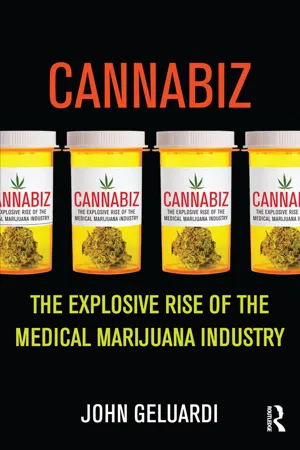
<i>Cannabiz</i> tells one the most important political and business stories of our generation: the transformation of a counterculture movement into a growth industry with staggering potential. Charting the rise of medical marijuana in California and 14 other states, award-winning journalist John Geluardi vividly recounts the movement's early activism, its legal challenges and victories, and its emergence as a commercial and political force.
<br>
<br>Tracing the history of marijuana in the United States, <i>Cannabiz</i> also reports on the industry's key players, political allies and opponents, internal strife, and audacious aspirations—including a 2010 ballot initiative to legalize the adult use of marijuana in California. Along the way, Geluardi describes local efforts to regulate dispensaries, ranging from workable ordinances in some cities to bureaucratic paralysis in Los Angeles, where dispensaries came to outnumber McDonalds franchises. He also reports on efforts in Humboldt County, the heartland of marijuana cultivation, to keep pot illegal—and prices high.
<br>
<br>Adroitly profiling this unique industry, <i>Cannabiz</i> tells a distinctively American story—one whose colorful characters and fascinating details evoke Prohibition and the Gold Rush.
<br>
<br>
- 202 pages
- English
- ePUB (mobile friendly)
- Available on iOS & Android
eBook - ePub
About this book
CHAPTER 1
Out of the Shadows
Councilman Jim Rogers had an idea to end the late-night bickering. The city council of Richmond, California, had pushed its meeting past midnight to discuss the sudden appearance of four medical marijuana dispensaries. The city’s seven council members, bleary eyed and short tempered, had been discussing the issue for more than an hour. No one seemed to know where the dispensaries had come from or how to handle them. The council and city administrators were completely lost as though they were hearing for the first time that medical marijuana dispensaries had existed in California for 13 years. Constituents had been complaining to council members, who attempted to shift the blame onto department heads, who passed it around like a hot potato. The assistant police chief asked the council to recommend a course of action; the council asked for direction from the planning director, who passed it to the city attorney, who threw the whole thing back at the city council.
Then Rogers suggested his idea: why not simply ban the dispensaries? A ban would end the problem once and for all. The police would be pleased, parents would be relieved, and marijuana distributors and users wouldn’t come out of the shadows to com-plain. The other council members agreed. They scheduled a vote on the proposed ban for the next meeting two weeks later.
Richmond sits on the northern end of the San Francisco Bay, which is ringed by some of the most progressive cities in the country. Berkeley and Oakland lie a few miles south; San Francisco and affluent Marin County are just across the bay. But Richmond’s culture does not reflect its close proximity to those left-leaning cities. Although solidly Democratic, Richmond’s working-class political culture tends to regard Berkeley’s progressives as overedu-cated parlor liberals with too much time on their hands.
One example of this is the “operable” windows controversy. In 2007 Richmond’s mayor, Gayle McLaughlin, proposed changing the permanently closed windows in the city’s Civic Center to high-tech opening windows that were energy efficient and created a more pleasant and healthy working environment. These “operable” windows had been installed in civic buildings in Berkeley, Oakland, and San Francisco. UC Berkeley mechanical engineering professor Gail Brager made a presentation to the council citing numerous studies that verified the operable windows lowered energy costs, improved worker health, and increased productivity.1 Nonetheless, the council majority shot down the idea. “This business about more productivity is hogwash,” scoffed one councilman. “People are going to work or they aren’t. Just because a window is open, all of a sudden you’re going to have better performance? I don’t buy it.”2
Richmond’s self-imposed isolation from its progressive neighbors may have been one reason the four dispensaries caught the city off guard. Berkeley had hammered out an effective policy a decade earlier, limiting the number of dispensaries to four and later creating a commission to oversee their operation and manage any unforeseen effects. Marin County and other Bay Area cities, including San Francisco and Oakland, had similar success governing the establishment and operation of medical marijuana dispensaries.
Richmond’s next city council meeting had a long agenda, and it was past one a.m. when the council addressed the dispensary ban. By that hour, council members were usually tired from wrangling over bureaucratic details, and the public had long since gone home. But on this night, the council looked out at a sea of people who had waited hours to discuss the ban. They included medical marijuana patients, dispensary owners, attorneys, advocates, and community members. And they were spoiling to be heard.
Councilman Rogers noted the late hour and suggested the discussion be postponed until the next meeting. A loud rumbling rose up from the chamber gallery. One man’s voice was clear above the others. “Go ahead and postpone it,” he said. “We’ll come back stronger.”3 The council decided to take up the issue.
A parade of speakers came to the lectern to argue in favor of the dispensaries and espouse the medical value of marijuana. Nearly all of them were better informed than the council members or city staff. They included representatives of Americans for Safe Access (ASA), the National Organization for the Reform of Marijuana Laws (NORML), and the newly formed Medical Cannabis Safety Council. Many of the speakers had watched the previous council meeting on video and pointed out the misconceptions, inaccuracies, and falsehoods that had been bandied about. In an orderly fashion, they accused the council of being “blatantly misleading” and “cavalier with people’s medicine.” They produced statistics showing that areas around dispensaries had less crime because of security patrols, surveillance cameras, and increased foot traffic. One speaker pointed out that 13 years earlier, Councilman Rogers—then a county supervisor—had endorsed Proposition 215, the statewide measure that legalized medical marijuana. Each time the speakers concluded their remarks, the gallery erupted in raucous applause.
Of the 30 speakers who appeared, only one favored the ban on dispensaries. The hard-line attitudes the council exhibited at the previous meeting were replaced by a more open-minded approach. One of the council’s most conservative members, a retired probation officer, was intrigued by the possibility of increasing the city’s tax base and creating jobs. Rogers withdrew his ban proposal, and the council voted unanimously to research the advantages of allowing dispensaries to operate in Richmond. The vote produced a loud predawn cheer.
The Richmond City Council discovered that night a new and startling reality. The medical marijuana industry was not only out of the shadows, but it had become a powerful political force with savvy leadership, dedicated allies, and impressive resources.
The resources flowed from the sheer demand for the product. In California alone, the State Board of Equalization estimated the marijuana crop generated $14 billion each year, making it the state’s largest cash crop—and four times bigger than the state’s storied wine industry.4 If those numbers were accurate, a fully legalized cannabis industry could contribute $1.3 billion a year in tax revenue to California’s woeful coffers.5
Growers and dispensary owners were not the only ones making money. Ancillary businesses had also prospered. Hundreds of attorneys were counseling dispensary owners on regulatory issues, real estate law, tax strategies, business plans, and employee policies. Hundreds of doctors specialized in marijuana recommendations,6 and insurance companies were writing policies to protect grow-ers from crop failures. Public relations firms helped organize and design political campaigns, and lobbyists negotiated dispensary permits with local governments and advised dispensaries on community relations. While mainstream newspapers and magazines struggled to stay afloat, dozens of marijuana-based publications were thriving on advertisements for dispensaries, cultivation equipment, how-to books, and medical and legal services. Many city and county governments required dispensaries to provide comprehensive security, which had produced thousands of new low-skill jobs.
Perhaps no place demonstrates that dynamic more clearly than the commercial district in Oakland known as Oaksterdam, a play on the drug-friendly Dutch capital. Oaksterdam University, the first trade school for the medical marijuana industry, is based there. The neighborhood also has two dispensaries, a marijuana novelty and gift shop, two medical offices that specialize in marijuana recommendations, a marijuana advertising agency, law offices that specialize in marijuana issues, and a cannabis cultivation supply store. Before the marijuana industry revitalized the area, it was marked by empty storefronts, crime, and general urban decay. Now a variety of small businesses cater to students and dispensary customers, and the area has developed a hip, youthful cachet.
Faced with the industry’s impressive growth, elected officials who might not have supported medical cannabis a decade ago were softening their positions. In fact, local politicians who voted to ban dispensaries not only risked losing the job growth and tax revenues that accompanied them, but also the wrath of a public that increasingly supported the medical use of marijuana and the full legalization of adult use.
Surveys have shown that a majority of every living American generation thinks medical marijuana should be legal. A 2004 poll commissioned by American Association of Retired People (AARP) discovered 72 percent of Americans 45 and older agree that adults should be allowed to legally use marijuana for medical purposes.7 In the general population, that number was even higher. A 2010 ABC News/Washington Post poll showed 81 percent of Americans support marijuana for medical use, up from 69 percent in 1997.8 And support for legalization of adult use was growing. A 2009 Gallup Poll showed 44 percent of Americans supported full legalization; nine years earlier, only 31 percent did so. In western states, a majority (54 percent) supported full legalization.9
Why the increased support after four decades of the war on drugs? One factor was demographic. Baby boomers, who grew up in an age of drug experimentation, are now running the country. Legislators and Supreme Court justices have admitted to trying marijuana, and at least three presidents have lit up. Bill Clinton famously said he tried marijuana but didn’t inhale. Barack Obama said he not only inhaled in his youth, but he also did so frequently because “that was the whole point.”10 Nobody asked California governor Arnold Schwarzenegger whether or not he had smoked marijuana; anyone who has seen Pumping Iron (1977) knows the answer to that. Having won yet another bodybuilding title, Schwarzenegger was filmed puffing a joint at a small celebration. Medical marijuana had even been strongly endorsed by beloved national figures like PBS’s travel guru Rick Steves, who somehow, with his itemized packing lists and carefully planned sightseeing schedules, seems a little more adult than most of us.
As boomers became parents, executives, managers, teachers, community leaders, and business owners, they found it difficult to argue with conviction that marijuana was the dangerous drug it was made out to be in previous decades. The philosophy student who read Jack Kerouac and listened to Charlie Parker while smoking pot is now a university regent. The high school jock who spent a year selling just enough weed so he could follow a Grateful Dead tour is now a city councilman. And the surly high school student who dyed her hair purple, strung paper-clip chains from her nose piercings, and got high while listening to Social Distortion is now a senior partner at a prestigious law firm.
As attitudes changed, so did the marijuana movement. The days of long-haired hippie advocates are over. The new cannabis advocate is clean-cut, wears a suit and tie, and often has an advanced degree or years of experience in the corporate sector. This new breed has become extraordinarily effective both in court and in shaping public opinion.
Recent court decisions in favor of the marijuana industry would have stunned the public only a decade ago. In 2008, for example, the California Department of Motor Vehicles (DMV) revoked the license of 53-year-old Rose Johnson because she had a recommendation for medical marijuana to treat a chronic back problem. Americans for Safe Access (ASA), the largest medical marijuana advocacy group in the nation, filed a suit on behalf of Johnson, who had an excellent driving record for more than 35 years. The DMV relented and reinstated Johnson’s license before the case went to trial. Nonetheless, a superior court judge ordered the DMV to update its employee manual so that medical marijuana would be treated like any prescription drug. The court also required the DMV to pay $69,400 to ASA for legal fees.11
The courts have ordered police departments to return confiscated marijuana, provided it could be shown that the plants were cultivated for medical purposes. In 2007, a Sonoma County judge ordered the Santa Rosa Police Department to return 18 pounds of marijuana to sanctioned grower Shashon Jenkins along with about $5,000 of growing equipment. In 2008, the California Highway Patrol (CHP) stopped a driver on Highway 101 in Los Angeles and discovered 60 pounds of marijuana wrapped in one-pound bricks. When the driver’s attorney showed his client was transporting the marijuana to a dispensary, the judge ordered the CHP to return it all.
The industry’s political advances were even more remarkable than its court victories. Some state and local officials became unabashed champions of medical marijuana. As a result, they were able to tap prosperous donors and motivated volunteers eager to work phone banks and walk precincts for the cause. But not all local governments were so accommodating. By 2010, more than 129 California cities and counties had banned dispensaries altogether. Such bans may have been politically popular, but few believed they stopped marijuana commerce. Rather, they reinforced the old status quo, in which the marijuana trade took place on the black market. City leaders had essentially given up any chance of controlling marijuana, and the idea that law enforcement could prevent—or even significantly reduce—illegal marijuana distribution was no longer remotely viable.
Opposition to medical marijuana came from most of the expected sources: law enforcement agencies, prison guard unions, churches, and family-based organizations such as Mothers Against Drunk Driving. In cities that had allowed dispensaries with strong ordinances, police departments seemed to have accepted their presence. But in other areas, law enforcement was highly skeptical. The California Police Chiefs Association, for example, maintained a running tally of marijuana-related crimes.12 The list included home robberies—a major problem with indoor growers—as well as property damage caused by indoor cultiva-tion. The list also provided a record of environmental damage on private property and in state and national parks where growers dumped garbage, spilled diesel from generators, and contaminated groundwater and creeks with pesticides and herbicides. Finally, the association kept track of any murder, assault, or robbery in which marijuana was present.
Not all of these offenses were connected to medical marijuana, but a great deal of crime, environmental damage, and health and safety violations have routinely accompanied marijuana cultivation. In 2009, Los Angeles district attorney Steve Cooley tested cannabis confiscated in a dispensary raid and discovered it was laced with a pesticide used to kill Mexican fire ants.13 In general, however, law enforcement has struggled to overcome a credibility problem created by decades of misinformation and fear tactics designed to discourage marijuana use. One California police officer admitted to me that government scare tactics have complicated meaningful debate about the issue. “I just want to discuss these issues in a real way,” he said.
The opposition also included religious leaders, who argued medical marijuana advanced the interests of drug dealers. One outspoken opponent was Bishop Ron Allen, who founded the International Faith-Based Coalition. Allen said legalizing marijuana would have a devastating effect on young people and l...
Table of contents
- Cover
- Half Title
- Title Page
- Copyright Page
- Dedication
- Table of Contents
- Introduction
- 1 Out of the Shadows
- 2 Damnation
- 3 Redemption
- 4 An Industry Takes Shape
- 5 Growing Pains
- 6 The New Professionals
- 7 The New Politicians
- 8 Legalization
- 9 Heartland
- Notes
- Index
- About the Author
Trusted by 375,005 students
Access to over 1.5 million titles for a fair monthly price.
Study more efficiently using our study tools.
Frequently asked questions
Yes, you can cancel anytime from the Subscription tab in your account settings on the Perlego website. Your subscription will stay active until the end of your current billing period. Learn how to cancel your subscription
No, books cannot be downloaded as external files, such as PDFs, for use outside of Perlego. However, you can download books within the Perlego app for offline reading on mobile or tablet. Learn how to download books offline
Perlego offers two plans: Essential and Complete
- Essential is ideal for learners and professionals who enjoy exploring a wide range of subjects. Access the Essential Library with 800,000+ trusted titles and best-sellers across business, personal growth, and the humanities. Includes unlimited reading time and Standard Read Aloud voice.
- Complete: Perfect for advanced learners and researchers needing full, unrestricted access. Unlock 1.5M+ books across hundreds of subjects, including academic and specialized titles. The Complete Plan also includes advanced features like Premium Read Aloud and Research Assistant.
We are an online textbook subscription service, where you can get access to an entire online library for less than the price of a single book per month. With over 1.5 million books across 990+ topics, we’ve got you covered! Learn about our mission
Look out for the read-aloud symbol on your next book to see if you can listen to it. The read-aloud tool reads text aloud for you, highlighting the text as it is being read. You can pause it, speed it up and slow it down. Learn more about Read Aloud
Yes! You can use the Perlego app on both iOS and Android devices to read anytime, anywhere — even offline. Perfect for commutes or when you’re on the go.
Please note we cannot support devices running on iOS 13 and Android 7 or earlier. Learn more about using the app
Please note we cannot support devices running on iOS 13 and Android 7 or earlier. Learn more about using the app
Yes, you can access Cannabiz by John Geluardi in PDF and/or ePUB format, as well as other popular books in Business & Business History. We have over 1.5 million books available in our catalogue for you to explore.