- 228 pages
- English
- ePUB (mobile friendly)
- Available on iOS & Android
eBook - ePub
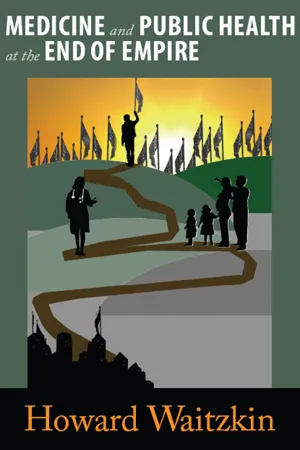
Medicine and Public Health at the End of Empire
About this book
The recent financial meltdown has brought notable changes to the global practice of health care changes that have often escaped the American news media. Although Western managed-care corporations previously had strengthened their influence abroad, now many countries are considering new approaches to health care for their citizens.The untold story of how corporations have influenced global health care and the impacts now in America as the system rapidly shifts is Dr. Waitzkin s subject in his provocative new book. We now live in a new era in which the prospects for more humane approaches to health care are taking root. Strengthening access and improving public health are at the heart of the many previously little-noted struggles and actions by individuals, groups, and whole nations to put control back in the hands of patients and practitioners, as Americans of many political stripes seem to universally seek. The impacts of these changes in the United States are considerable, and they are amply illustrated by Dr. Waitzkin as the United States attempts to reorient its own system of care.Selected as the 2012 winner of the Freidson Outstanding Publication Award by the American Sociological Association for its "bold and timely analysis of the global political economy of contemporary crises in health and medical care. By presenting the lessons learned from social medicine (past and present), [it] outlines a macro-sociologically informed response to these crises.""
Information
PART ONE
EMPIRE PAST

CHAPTER 1
EMPIRE’S HISTORICAL HEALTH COMPONENT
Although it is a complex, multifaceted phenomenon, I define “empire” in simple terms as expansion of economic activities—especially investment, sales, extraction of raw materials, and use of labor to produce commodities and services—beyond national boundaries, as well as the social, political, and economic effects of this expansion. Empire achieved many advantages for economically dominant countries. During the 1500s, a “world system” emerged in which a core group of nations came to control a worldwide network of economic exchange relationships.1 For centuries, empire included military conquest and the maintenance of colonies under direct political control. The decline of colonialism in the twentieth century led to the emergence of political and economic “neocolonialism,” by which poorer countries provided similar advantages to richer countries as they had under the earlier, more formal versions of colonialism.
Public health and health services played important roles in several phases of empire past. The connections among empire, public health, and health services operated through specific institutions, including philanthropic foundations, international financial institutions, organizations enforcing trade agreements, and international health organizations. Now I turn to each of these institutions and focus mainly on their early histories. Later in the book, I consider their more recent operations.
Philanthropic Foundations
Although notions about beneficent contributions by wealthy people to the needy date back in Western civilization to the Greek practice of “philanthropy,” modern practices that included the formation of foundations with their own legal status began in the early twentieth century, largely through the efforts of Andrew Carnegie. After he amassed a fortune in the steel industry and initiated philanthropic ventures such as the Carnegie Libraries in towns throughout the United States, Carnegie offered his opinions about the social responsibilities of wealth in writings such as The Gospel of Wealth, published in 1901.2
Carnegie’s book developed the principle that contributing to the needs of society was consistent with good business practices, partly to achieve favorable popular opinion about capitalist enterprises and individual entrepreneurs. By contributing intelligently to address social needs rather than squandering one’s wealth, Carnegie argued, the businessperson also could ensure personal entry into the heavenly realm (thus, the framework of “gospel”). Among the book’s other notable features, Carnegie distinguished between “imperialism” and the more virtuous “Americanism”: “Imperialism implies naval and military force behind. Moral force, education, civilization are not the backbone of Imperialism. These are the moral forces which make for the higher civilization, for Americanism.”3 By creating interconnected philanthropic foundations, Carnegie acted to ensure that his beliefs achieved the fruits he preferred in the disposal of his earthly wealth and in his own heavenly future.
The most cogent early extension of philanthropic foundations to public health and health services involved John D. Rockefeller and the Rockefeller Foundation. With his fortune based in oil, Rockefeller emulated Carnegie’s philanthropic activities, despite their conflicts in the realm of monopolistic business practices. However, Rockefeller and his associates moved more specifically to support public health activities and health services that would benefit the economic interests of Rockefeller-controlled corporations throughout the world.
In particular, the Rockefeller Foundation initiated international campaigns against infectious diseases such as hookworm, malaria, and yellow fever. Between 1913, the year of its founding, and 1920, the foundation supported the development of research institutes and disease eradication programs on every continent except Antarctica. Infectious diseases proved inconvenient for expanding capitalist enterprises due to several reasons, which became clear from the writings of Rockefeller and the managers of the Rockefeller Foundation.4 First, these infections reduced the productivity of labor by diminishing the effort that workers could devote to the job (thus the designation of hookworm, for instance, as the “lazy disease”). Second, endemic infections in areas of the world designated for such efforts as mining, oil extraction, agriculture, and the opening of new markets for the sale of commodities made those areas unattractive for investors and for managerial personnel. Third, to the extent that corporations assumed responsibility for the care of workers, especially when workers were in short supply within remote geographical areas, the costs of care escalated when infectious diseases could not be prevented or easily treated.
To address these three problems—labor productivity, safety for investors and managers, and the costs of care—the Rockefeller Foundation’s massive campaigns throughout the world fostered research and efficient delivery of services. These programs took on certain characteristics that persist to this day in some of Rockefeller’s activities as well as in those of other foundations, international health organizations, and nongovernmental organizations. Rather than organizing “horizontal” programs to provide a full spectrum of preventive and curative health services, the foundation emphasized “vertical” programs initiated by the donor that focused on a small number of specific diseases, such as hookworm or malaria. In addition, rather than broad public health initiatives to improve economic and health conditions of disadvantaged populations, the foundation favored the development of vaccines and medications that could prevent and treat the infectious diseases designated as most problematic—an approach some referred to as the “magic bullet.” Later in the book, I show how these orientations have persisted in even the most recent, large-scale efforts by foundations to address public health problems in less developed countries.5
International Financial Institutions and Trade Agreements
Although trade across nations and continents dates back centuries, the framework for modern international financial institutions and trade agreements began after World War II with the Bretton Woods accords. These accords, which gradually emerged as an important mechanism to protect the political-economic empires of the United States and Western European countries, grew from meetings in Bretton Woods, New Hampshire, that involved representatives of countries victorious in World War II. The agreements initially focused on the economic reconstruction of Europe. Between 1944 and 1947, the Bretton Woods negotiations led to the creation of the International Monetary Fund (IMF) and the World Bank, as well as the establishment of the General Agreement on Tariffs and Trade (GATT).6
By the 1960s, after the recovery of Europe, these institutions and agreements gradually expanded their focus to the less developed countries. The World Bank, for instance, adopted as its vision statement “our dream—a world without poverty.”7 However, because the IMF and World Bank provided most of their assistance through loans rather than grants, the debt burden of the poorer countries increased rapidly. By 1980, many less developed countries, including the poorest in the world, were spending on average about half their economic productivity, as measured by gross domestic product, on payment of their debts to international financial institutions, even though these institutions’ goals usually emphasized the reduction of poverty. These international financial institutions during the early 1980s embraced a set of economic policies known as “the Washington consensus.” Advocated primarily by the United States and the United Kingdom, these policies involved deregulation and privatization of public services, which added to the debt crisis by constraining even further the public health efforts and health services that less developed countries could provide.8
GATT initially aimed to reduce tariffs and quotas for trade among its twentythree member nations. Its fairly simple principles included “most favored nation treatment” (according to which the same trade rules were applied to all participating nations) and “national treatment” (which required no discrimination in taxes and regulations between domestic and foreign goods).9 GATT also established ongoing rounds of negotiations concerning trade agreements.
From their modest origins in GATT, international trade agreements eventually morphed into a massive structure of trade rules that would exert profound effects on public health and health services worldwide.10 Although I consider recent trade agreements further in Chapter 6, the contours of the transition from GATT to what followed proved quite dramatic. As the pace of international economic transactions intensified, facilitated by technological advances in communications and transportation, the World Trade Organization (WTO) in 1994 replaced the loose collection of agreements subsumed under GATT. The WTO and regional trade agreements have sought to remove both tariff and nontariff barriers to trade.
Growing from the narrow scope of GATT, whose focus involved tariff barriers alone, the burgeoning array of international trade agreements encompassed under WTO expanded the purview of trade rules far beyond tariff barriers. Instead, the new trade agreements interpreted a variety of public health measures, such as environmental protection, occupational safety and health regulations, quality assurance for foods and drugs, intellectual property pertaining to patented medications and equipment, and even health services themselves as potential nontariff barriers to trade. As I argue later, this perspective in trade agreements transformed the sovereignty of governments to regulate public health and to provide health services.
International Health Organizations
The first approach to international public health organization evolved in Europe during the Middle Ages. At that time, some governments established local, national, and international cordons sanitaires—guarded boundaries that blocked people from leaving or entering geographical areas affected by epidemics of infectious diseases. In addition, governments imposed maritime quarantines that prevented ships from entering ports after visiting regions where epidemics were occurring. “Sanitary” authorities arose mostly on an ad hoc basis and remained active mainly when epidemics were present or anticipated.11
During the late nineteenth and early twentieth centuries, the rise of export economies and the expansion of economic interests worldwide triggered the demise of conventional maritime public health. Instead, the motivation for international cooperation in public health emerged largely from concerns about infectious diseases as detrimental to trade among nations that were participating in the expanding reach of capitalist enterprise. The need to protect ports, investments, and landholdings such as plantations from infectious diseases provided incentives for redesigning international public health.
The first formal international health organization arose in the Americas. Founded in Washington, D.C., during 1902, explicitly as a mechanism to protect trade and investments from the burden of disease, the International Sanitary Bureau focused on the prevention and control of epidemics.12 Mosquito eradication campaigns and the implementation of a vaccine against yellow fever occupied public health professionals in this organization throughout the early twentieth century. During that period, plans proceeded for the construction of the Panama Canal, the development of agricultural enterprises in the “banana republics” of Central America and northern South America, and the extraction of mineral resources as raw materials for industrial production from such areas as southern Mexico, Venezuela, Colombia, and Brazil. Work in the tropics demanded public health initiatives against mosquito-borne diseases like yellow fever and malaria, parasitic illnesses like hookworm, and the more common viral and bacterial illnesses like endemic diarrhea.
As the first modern international health organization, the International Sanitary Bureau devoted much of its early activities to infectious disease surveillance, prevention, and treatment, largely to protect trade and economic activities throughout the Americas. Later, during the 1950s, the International Sanitary Bureau became the Regional Office for the Americas of the World Health Organization (WHO) and in 1958 changed its name to the Pan American Health Organization (PAHO). Subsequently, PAHO’s public health mission broadened.13 However, PAHO retained a focus on the protection of trade through the present day, and in general it supported the provisions of international trade agreements.
WHO emerged in 1948 as one of the component suborganizations of the United Nations (UN). Although prevention and control of infectious disease epidemics remained a key objective throughout its history, WHO did not frame its purpose in controlling infectious diseases as a way to protect trade and international economic transactions—as PAHO had done during its early history. Instead, during the 1970s, WHO prioritized the improved distribution of health services, especially primary health care. This orientation culminated in the famous WHO declaration on primary health care, issued at an international conference at Alma-Ata, USSR, in 1978, which provided guidelines for subsequent actions by WHO and its affiliated organizations.14 As the principle of universal entitlement to primary care services throughout the world became one of WHO’s priorities, the organization took a strong position of advocacy on behalf of programs to improve access to care, especially in the poorest countries.
During the late 1970s and early 1980s, however, WHO entered a chronic financial crisis produced largely because of the fragile financing provided for WHO’s parent organization, the UN. Because of ideological opposition to several programs operated by component organizations of the UN, especially those of the United Nations Educational, Scientific, and Cultural Organization (UNESCO), the Reagan administration withheld from the UN large portions of the United States’ annual dues. As a result, the UN began to experience increasing budgetary shortfalls, which it passed on to its component organizations, including WHO. Into this financial vacuum moved the World Bank, which began to contribute a large part of WHO’s budget. (The precise proportion of WHO’s budget dependent on the World Bank’s financing remained shielded from public scrutiny.) As its financial base shifted more toward the World Bank and away from the UN, WHO’s policies also transformed to an orientation that more closely resembled those of international financial institutions and trade agreements. The financial crisis that originated in the nonpayment of dues by the United States eventually led within WHO to a policy perspective regarding international trade that proved similar to PAHO’s earlier orientation.
In these ways, the history of international health organizations manifested an ongoing collaboration with institutions that sought to protect commerce and trade. Constituted in the interest of trade, the organizational predecessor of PAHO devoted half a century of public health initiatives largely to the prevention and control of infections that threatened the viability of trade and investment. PAHO and eventually WHO sought improved health conditions in poor countries partly as a means to strengthen the economic positions of rich countries by facilitating activities that extracted raw materials and that opened new markets. The efforts of international health organizations on behalf of empire came to compose a major focus of the public health enterprise that these organizations fostered.
A Countervailing Viewpoint
I return to the above themes in Part 2, where I delve into the recent connections among empire, public health, and health services in more detail. How these more recent connections evolved, however, refle...
Table of contents
- Cover Page
- Title Page
- Dedication
- Copyright Page
- Table of Contents
- Preface
- Part One: Empire Past
- Part Two: Empire Present
- Part Three: Empire Future
- Notes
- Index
- About the Author
Trusted by 375,005 students
Access to over 1.5 million titles for a fair monthly price.
Study more efficiently using our study tools.
Frequently asked questions
Yes, you can cancel anytime from the Subscription tab in your account settings on the Perlego website. Your subscription will stay active until the end of your current billing period. Learn how to cancel your subscription
No, books cannot be downloaded as external files, such as PDFs, for use outside of Perlego. However, you can download books within the Perlego app for offline reading on mobile or tablet. Learn how to download books offline
Perlego offers two plans: Essential and Complete
- Essential is ideal for learners and professionals who enjoy exploring a wide range of subjects. Access the Essential Library with 800,000+ trusted titles and best-sellers across business, personal growth, and the humanities. Includes unlimited reading time and Standard Read Aloud voice.
- Complete: Perfect for advanced learners and researchers needing full, unrestricted access. Unlock 1.5M+ books across hundreds of subjects, including academic and specialized titles. The Complete Plan also includes advanced features like Premium Read Aloud and Research Assistant.
We are an online textbook subscription service, where you can get access to an entire online library for less than the price of a single book per month. With over 1.5 million books across 990+ topics, we’ve got you covered! Learn about our mission
Look out for the read-aloud symbol on your next book to see if you can listen to it. The read-aloud tool reads text aloud for you, highlighting the text as it is being read. You can pause it, speed it up and slow it down. Learn more about Read Aloud
Yes! You can use the Perlego app on both iOS and Android devices to read anytime, anywhere — even offline. Perfect for commutes or when you’re on the go.
Please note we cannot support devices running on iOS 13 and Android 7 or earlier. Learn more about using the app
Please note we cannot support devices running on iOS 13 and Android 7 or earlier. Learn more about using the app
Yes, you can access Medicine and Public Health at the End of Empire by Howard Waitzkin in PDF and/or ePUB format, as well as other popular books in Medicine & Health Care Delivery. We have over 1.5 million books available in our catalogue for you to explore.