eBook - ePub
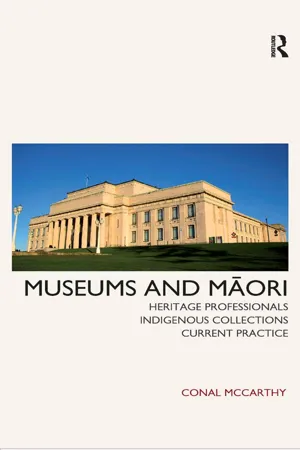
Museums and Maori
Heritage Professionals, Indigenous Collections, Current Practice
- 334 pages
- English
- ePUB (mobile friendly)
- Available on iOS & Android
eBook - ePub
About this book
This groundbreaking book explores the revolution in New Zealand museums that is influencing the care and exhibition of indigenous objects worldwide. Drawing on practical examples and research in all kinds of institutions, Conal McCarthy explores the history of relations between museums and indigenous peoples, innovative exhibition practices, community engagement, and curation. He lifts the lid on current practice, showing how museum professionals deal with the indigenous objects in their care, engage with tribal communities, and meet the needs of visitors. The first critical study of its kind, Museums and Maori is an indispensible resource for professionals working with indigenous objects, indigenous communities and cultural centers, and for researchers and students in museology and indigenous studies programs.
Information
Part One
From monoculturalism to biculturalism
1
Before Te Maori
The Auckland War Memorial Museum Tāmaki Paenga Hira, founded in 1851, is one of the oldest cultural institutions in New Zealand and holds a significant collection of Māori material culture.1 For much of its history the museum collected and displayed Māori objects without consultation with Māori or regard for their values, and until recently it appears not to have attracted many Māori visitors. However, we do know about one visitor, and his memories of and contacts with the museum parallel the extraordinary changes New Zealand museums have undergone in the last few decades.
Māori academic, writer and commentator Ranginui Walker was born among the Whakatōhea people near Ōpōtiki in the eastern Bay of Plenty.2 In 1937, when he was a child, his parents visited Auckland to watch a rugby game between New Zealand and South Africa. Walker remembers his parents telling him that they went to the Auckland Museum and were horrified to see dried and tattooed human heads, or mokamokai, on display there.
In 1946, when he was thirteen years old, Walker was a student at St Peter’s Māori College in Northcote on Auckland’s North Shore. From school he could see the Auckland Museum across the harbour. One day he took the ferry to town and instead of going shopping with his schoolmates walked across the Domain with its beautiful gardens to the neoclassical edifice on the hill. ‘There in the Māori court I feasted my eyes on the taonga (treasures) of my ancestors,’ he wrote later. But when he turned a corner and came across a mokamokai he was ‘flabbergasted’ and could not help thinking of his mother’s reaction. ‘I was both disappointed and outraged at the cultural insensitivity.’3 Later, in the 1940s, a relation from Whakatōhea pressed the museum to remove the heads from display.
By 1951, when Walker went back to the museum as an adult, the mokamokai were gone. He was then a trainee teacher doing a ‘section’ or placement with the museum’s education department, which was experimenting with tactile objects and group work in lessons for schoolchildren held in the museum’s galleries. He returned the following year for another section, along with his friend and classmate Paki Harrison, who later became a famous carver. Like Harrison, Walker relished the opportunity to ‘look at and learn from the glory of the culture of our ancestors’.4
Over the next 20 years, Walker was busy with his career as a schoolteacher and academic, and became heavily involved in politics through the Auckland District Māori Council. He thinks that in the 1960s New Zealand was a very repressive society, and that even as late as the 1970s the state was ‘arrogantly monocultural’. Walker became involved with a new generation of young urban radicals, Nga Tama Toa, who vigorously protested injustices of the past and challenged the Pakeha majority to recognise their rights as indigenous people. In 1971, Walker visited the museum again when activist Hana Jackson organised a Māori fashion parade there, which included traditional cloaks as well as the latest designer clothes. This ‘stunning event’ was a huge step in ‘humanising’ the museum, which had previously seemed to him a ‘cold, dead place’.
In 1987 Walker saw the Te Māori exhibition at the Auckland City Art Gallery and was delighted by the international recognition of Māori art and the pride that it engendered. The exhibition accelerated the gradual process of change already under way at the Auckland Museum, where aspects of collections, conservation and display had seen a quiet revolution with more attention being paid to Māori perspectives of their heritage. Walker became involved with the museum directly in the 1990s in an advisory capacity and observed changes in Māori staff and the evolution from a monocultural institution to one in which there was a much greater Māori presence. He thinks that despite the inevitable issues, biculturalism ‘had to be’. Walker enjoyed visiting the new displays, which he felt worked much better for Māori audiences. ‘When Māori connect with those things they are connecting in a spiritual way, they come alive again,’ he says. ‘That’s part of the present revivification of Māori culture too. We’ve seen a tremendous effervescence of Māori culture in the past ten to fifteen years…’

Figure 4: The Auckland War Memorial Museum building was erected in 1929 on a prominent hilltop site in the Auckland Domain. It houses one of the largest collections of taonga Māori in New Zealand.
Working at the Waitangi Tribunal, Walker was part of the settlement of Treaty claims that he calls the ‘remaking’ of New Zealand society. He firmly believes that Māori self-determination is ‘a force that cannot be resisted’. In his lifetime, New Zealand society, and the museums that are firmly embedded within it, has undergone tremendous change, and there is little doubt that before long iwi-led initiatives, such as cultural centres, will usher in the next stage of development. The Auckland Museum’s remarkable transformation in the last few decades has been over 150 years in the making.
Colonial museums in a British world 1850–90
The evolution of museums in New Zealand unfolded within a network of colonial museums in Britain and throughout the British Empire. This is not a case of ideas spreading out from the metropolitan centre to the colonial periphery, nor is it a straightforward matter of the imperial discourses of power/knowledge being inscribed onto distant peoples and artifacts, with collections and display somehow acting as tools of empire. Museums in the British Empire were relatively independent and diverse institutions, which were as much a product of local actors and circumstances as they were of colonial policy in London.5
The history of public museums in the British world is closely connected to the development of exhibitions that spurred public interest and developed new technologies of collecting and display. The Great Exhibition of 1851 in London, which contained a few objects from New Zealand including Māori carvings, led to a whole series of ‘world’s fairs’ or international exhibitions over the next 50 years. There were New Zealand Courts at international exhibitions in Melbourne in 1867, Sydney in 1879, and again in Melbourne in 1880 and 1888. In New Zealand, the first such exhibition was held in Dunedin in 1865, then in Christchurch in 1882, Wellington in 1885, and Dunedin again in 1889 to 1890.6
Museums and art galleries in the col...
Table of contents
- Cover
- Half Title
- Title Page
- Copyright Page
- Table of Contents
- List of illustrations
- A note on the Māori language
- Map of New Zealand
- Simplified iwi map
- He mihi
- Preface
- Acknowledgements
- Introduction: Museums and indigenous people
- Part one: From monoculturalism to biculturalism
- Part Two: Biculturalism in practice
- Part three: Beyond biculturalism?
- Conclusion: The future behind us
- Afterword: Pacific voices in the bicultural museum
- Appendix
- Glossary
- Bibliography
- Index
Trusted by 375,005 students
Access to over 1.5 million titles for a fair monthly price.
Study more efficiently using our study tools.
Frequently asked questions
Yes, you can cancel anytime from the Subscription tab in your account settings on the Perlego website. Your subscription will stay active until the end of your current billing period. Learn how to cancel your subscription
No, books cannot be downloaded as external files, such as PDFs, for use outside of Perlego. However, you can download books within the Perlego app for offline reading on mobile or tablet. Learn how to download books offline
Perlego offers two plans: Essential and Complete
- Essential is ideal for learners and professionals who enjoy exploring a wide range of subjects. Access the Essential Library with 800,000+ trusted titles and best-sellers across business, personal growth, and the humanities. Includes unlimited reading time and Standard Read Aloud voice.
- Complete: Perfect for advanced learners and researchers needing full, unrestricted access. Unlock 1.5M+ books across hundreds of subjects, including academic and specialized titles. The Complete Plan also includes advanced features like Premium Read Aloud and Research Assistant.
We are an online textbook subscription service, where you can get access to an entire online library for less than the price of a single book per month. With over 1.5 million books across 990+ topics, we’ve got you covered! Learn about our mission
Look out for the read-aloud symbol on your next book to see if you can listen to it. The read-aloud tool reads text aloud for you, highlighting the text as it is being read. You can pause it, speed it up and slow it down. Learn more about Read Aloud
Yes! You can use the Perlego app on both iOS and Android devices to read anytime, anywhere — even offline. Perfect for commutes or when you’re on the go.
Please note we cannot support devices running on iOS 13 and Android 7 or earlier. Learn more about using the app
Please note we cannot support devices running on iOS 13 and Android 7 or earlier. Learn more about using the app
Yes, you can access Museums and Maori by Conal McCarthy in PDF and/or ePUB format, as well as other popular books in Art & Museum Studies. We have over 1.5 million books available in our catalogue for you to explore.