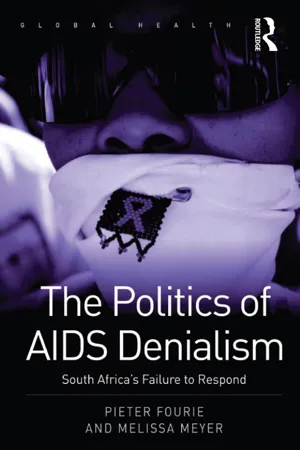
eBook - ePub
The Politics of AIDS Denialism
South Africa's Failure to Respond
- 252 pages
- English
- ePUB (mobile friendly)
- Available on iOS & Android
eBook - ePub
About this book
Successive South African governments have had controversial views on HIV and AIDS which have led to allegations that South Africa is in a state of denial about the AIDS epidemic. This book attempts to determine the validity of such claims of government denial by formulating and testing a denial hypothesis.The hypothesis is contextualized with an overview of the South African epidemic as well as a review of allegations of government denial. It reveals possible political factors that may motivate policy-makers to resort to official denial and tentatively concludes with a confirmation of the allegations contained in the denial hypothesis. However, this is done within the broader notion that denial is inherently vague and couched in language (rarely in writing) and therefore difficult to test with certainty and as such this book's real value lies in the insights gained into the complex politics of denial. By exploring the dynamics of denial and denialism and applying this to the South African AIDS epidemic, this study provides a comprehensive analysis.
Information
Chapter 1
Introduction
Thabo Mbeki’s controversial views on AIDS and his two governments’ objections to, and foot dragging on, treatment rollout have rendered him infamous amongst the local and global AIDS community, scientists and most of South African civil society. Amidst all the media and public relations furore, the blame for the severity of South Africa’s AIDS epidemic has almost exclusively been allocated to Mbeki, his Health Minister, Manto Tshabalala-Msimang, and their denialist attitude.
But matters of blame and denial are not that easily resolved when relating to the AIDS epidemic. Firstly, this has to do with the long-wave nature of the epidemic. Its slow, creeping onset means that HIV and AIDS have become a living reality, unlike most other disasters that tend to strike suddenly, elicit shock and necessitate urgent action. Secondly, the delay between HIV infection and AIDS illness and death has implications for both the perceived severity and urgency of the epidemic as well as accountability for infections and treatment. It can take up to two Presidential terms for HIV infections to unfold into full-blown AIDS illness. The unique nature of the epidemic has serious implications for how leaders perceive their accountability and responsibility to act.
Whilst Mbeki has become a convenient scapegoat, this drawn-out nature of the epidemic necessitates a closer investigation of government response – including that of Mbeki’s predecessors. Thabo Mbeki may have been at the helm of a government that refused to make lifesaving treatment available to AIDS suffers, but those who were ill and dying during Mbeki’s tenure contracted HIV quite some time before he took up office. That AIDS deaths surged during this time would suggest that long before Mbeki’s notorious handling of the epidemic, South African officials failed to avert the spread of HIV.
In this light the popularly held view that Mbeki’s government was in a state of denial requires careful reconsideration. Taking the long-wave nature of the epidemic into account, this book argues that accusations of government denial should be reformulated to consider not only recent government (in)action, but also that of former governments that were as responsible for not adequately facing up to the realities of AIDS in South Africa.
A short history of the epidemic
The developed world’s version of the story of HIV and AIDS typically begins in the early 1980s when Western doctors observed an increase in certain opportunistic illnesses amongst urban homosexual men. The pathology suggested that these patients’ immune systems were compromised. In 1981 doctors in New York noted an increase in a particularly aggressive form of Kaposi’s Sarcoma (KS) amongst young gay men (KS is a form of cancer that until then had been relatively benign and largely limited to older people).1 That same year a number of cases of a rare lung infection, pneumocystis carinii pneumonia (PCP), were treated in California and New York.2 Again these instances were confined to homosexual men. PCP is a condition that is common to animals like dogs, rats and sheep. Humans often carry the infection latently without falling ill. The manifestation of PCP into life-threatening pneumonia suggested to doctors that ‘something was seriously wrong’ (Whiteside 2006: 30).
These initial findings led to the medical community naming this new disease Gay-Related Immune Deficiency Syndrome (GRID). However, cases were soon discovered amongst haemophiliacs, Haitians and intravenous drug users (IDUs). It was not long before the name GRID was rendered redundant (Avert 2009). Thus the acronym AIDS (Acquired Immunodeficiency Syndrome) was formulated. The name ‘AIDS’ was first used on 27 July 1982 at a meeting in Washington, DC (Kher 2003).
Awareness and knowledge of AIDS grew rapidly. Already by 1982 a number of voluntary organisations were established in the United States (Avert 2009). By this time cases of AIDS were appearing in all developed countries (Whiteside 2006: 31). In 1983, incidents of AIDS in women suggested that the disease could be spread through heterosexual as well as homosexual intercourse.3 That same year a team of scientists from the Institut Pasteur in Paris (led by French scientist Luc Monagnier) identified the cause of AIDS – the Human Immunodeficiency Virus that later became known as HIV-1.4 A second HI virus was identified two years later, known as HIV-2. This is a much less aggressive virus that is harder to transmit, slower acting and less virulent (Whiteside 2006: 31).
By 1985 the first needle exchange programmes had been introduced to prevent HIV transmission during drug use (Avert 2009). Also in 1985, the first test for HIV was developed (Pear 1985). The following year, around 38,000 cases of AIDS had been reported to the World Health Organisation (WHO). By now developed countries were responding strongly with awareness campaigns. In February 1986 the UK held its first ‘AIDS week’. That same year ACT UP (the AIDS Coalition to Unleash Power) was founded. US President Ronald Reagan also made his first major speech on AIDS and the WHO’s Global Programme on AIDS (GPA) developed a Global AIDS Strategy. That same year, work on treatment for HIV and AIDS had yielded the first anti-retroviral drug, azidothymidine (AZT).5 On 1 December 1988 the first World AIDS Day was held and the US launched a wide-reaching HIV and AIDS education campaign (Avert 2009).

Figure 1.1 A global view of HIV infection: 2007
Source: UNAIDS (2008).
The resources invested in the search for treatment continued to yield promising results into the mid-1990s. In 1994, AZT was proven to limit the risk of mother-to-child transmission (MTCT) of HIV (Connor et al. 1994). As a result infant mortality rates in developing countries declined sharply. In 1996 the first non-nucleoside reverse transcriptase inhibitor (a new treatment for HIV, Viramune, also known as Nevirapine) was released. Around that time, researchers also established the heightened efficacy of combination anti-retroviral treatment (Priority Press 1995). Consequently AIDS death tolls in the developed world declined sharply (Brown 1997).
This relatively rapid response coupled with good access to treatment have meant that in the developed world HIV and AIDS have become manageable conditions (often compared to lifestyle diseases like diabetes). As a result the epidemic in North America, Western Europe, Australia and other developed countries is quite contained, with national prevalence rates well below one per cent of the populations.
As demonstrated in Figure 1.1, by comparison, the national prevalence levels in Sub-Saharan Africa are often well in excess of five, ten or even 15 per cent (UNAIDS 2008). The total number of people living with HIV in North America, Western and Central Europe (2 million) is nearly equal to the amount of new infections in 2007 alone in Sub-Saharan Africa (1.9 million). It follows that for the developing world (and Africa in particular) the story of HIV and AIDS has been a very different one.
A ten-year study completed in 2005 provided conclusive evidence that HIV originated in Africa.6 The first transfer of HIV-1 to humans is thought to have occurred around 1930.7 Experts estimate that by the 1960s, 2,000 people in Africa were already infected. The first epidemic most likely broke out in Kinshasa in the 1970s. However, a lack of awareness of HIV and AIDS at the time led to the labelling of the illness as ‘slim disease’. Unlike in developed countries, in Africa the virus was and is mostly spread heterosexually (Avert 2009).
From Kinshasa (which is often called the epicentre of the epidemic) the virus spread to Eastern Africa in the 1980s. Transmission was rapid due to a number of factors, including the migrant labour system, the low status of women, a high ratio of men in urban areas, a lack of circumcision and the prevalence of sexually transmitted infections (STIs) (Avert 2009). Around this time Uganda experienced a sudden surge in deaths caused by ‘slim disease’. By the mid-1980s associations were made between slim disease and the newly discovered HI virus (Serwadda et al. 1985).
Lack of knowledge of the disease, limited access to resources and a widespread sense of fear against the backdrop of economic concerns and political instability led to an overall paralysis amongst African governments in the early stages of the epidemic. The developed world was also slow to intervene. The WHO initially argued that there were more immediate health concerns in Africa that took preference, like malaria (Avert 2009).
By the end of the 1980s, HIV and AIDS had made its way to Southern Africa. Ten years later, just as the epidemic began burgeoning in Southern Africa, prevalence rates in East Africa were slowing (Avert 2009).8 Whilst governments as well as the international community have since been responding to the epidemic, HIV and AIDS is still worst in Africa – where it originated. Statistics from the Joint United Nations Programme on AIDS (UNAIDS) suggest that in 2007 over three quarters of the world’s AIDS deaths (1.5 million) have taken place in Sub-Saharan Africa (SSA) and that over two thirds of the world’s HIV cases are in SSA (22 million) (UNAIDS 2008).
In spite of the epidemic’s concentration in SSA, cases of HIV and AIDS have been reported in every country, making it a global health issue. Around 33 million people were thought to be living with HIV in 2007 (UNAIDS 2008). Given its global reach this can rightfully be called a pandemic (Whiteside 2006: 28).
HIV and AIDS in South Africa
The South African story of HIV and AIDS resounds both with the story of developed countries as well as with Africa’s. The apartheid governments’ rule meant that racially white areas resembled isolated strongholds of modernity in which people enjoyed the living standards, health care and technology of the developed world. Beyond the white cities and suburbs, however, poverty was rife and conditions were ideal for the rapid spread of a heterosexual epidemic. And so, in South Africa, HIV and AIDS made its onslaught on two fronts.
In 1982 two South African air stewards died of opportunistic infections associated with AIDS. Like the first cases in the US both men were homosexuals (Ras et al. 1983: 140). Soon after, HIV surfaced amongst haemophiliacs, drug users and commercial sex workers. In 1988 an increase in HIV amongst the black population was observed and it was speculated that an ‘African type’ heterosexual epidemic might follow (Sher 1989: 317).
It is likely that given the skewed nature of the health system under apartheid, a heterosexual epidemic was already brewing amongst the black population but that the white medical institutions were largely isolated from it. Four years later, in 1992, whilst official statistics reported only 26 AIDS deaths in the whole of South Africa, one hospital in the rural Kwa-Zulu Natal homeland alone recorded 153 AIDS deaths in the first nine months of that year (Furlong and Ball 2005: 133). Having been severely neglected under the apartheid system, the South African epidemic soon began mirroring the ‘African pattern’ as it evolved into a largely heterosexual epidemic.
In its severity, however, South Africa’s story of HIV and AIDS is unique (see Figure 1.2). It remains the country with the largest AIDS epidemic in the world. South Africa is home to the greatest number of HIV-positive people in the world, totalling over 5.7 million in 2007 (UNAIDS 2008: 40). According to an actuarial study conducted in 2006 by Dorrington et al. (2006: 10) prevalence amongst South African men aged 30 to 34 was as high as 26.5 per cent and reached a maximum of 32.5 per cent amongst women aged 25 to 29. This means that if left untreated, at least a quarter of the backbone of South African society will fall ill and die prematurely.
In August 2009, the eminent medical journal The Lancet (2009) stated that, since 1994, average life expectancy in South Africa has dropped by almost 20 years, mainly because of the rise in HIV-related mortality. Average life expectancy at birth is only 50 years for men and 54 years for women, and according to the South African Institute of Race Relations’ annual survey (SAIRR 2009), by 2011 life expectancy will fall to 48 years for men and 51 years for women. The Lancet study points out that South Africa has 0.7 per cent of the world’s population, but carries 17 per cent of the global HIV burden.
The implications that an epidemic of such magnitude has for South African society are immense. AIDS deaths leave both the elderly and the young without caregivers and in so doing negate the intergenerational contract that holds parents accountable for the wellbeing of their children and in turn requires children to take care of their parents in their old age (Barnett and Whiteside 2006: 210). Without this familial welfare system, society and the state are left to bear the burden.9 In the absence of effective national health care the brunt of this burden of care most often falls to the women in affected communities.

Figure 1.2 The South African AIDS epidemic
Source: Data compiled from Dorrington et al. (2006).
The gender implications of HIV and AIDS go well beyond that. In impoverished circumstances, women’s disadvantaged positions mean that they often experience the epidemic with greater intensity. With limited rights and means of support women may resort to bartering or selling sex to ensure their wellbeing. Women are also biologically more at risk, being twice as likely to acquire HIV during intercourse than heterosexual men (UNAIDS 2009). In many communities women are also perceived to be the carriers of disease as they are the first to notice their illness when they fall pregnant and visit clinics (Marais 2005: 15). Moreover, in the case of pregnancy, women are the ones who are required to deal with the added burden and responsibility of protecting their unborn child from becoming infected.
AIDS has also made itself deeply felt in South Africa’s economy. These effects can be assessed on two levels: first there are the direct costs associated with ill-health and premature death like spending on health care, funerals and the costs incurred as a result of increased sick leave and diminished overall productivity. Secondly, the consequences resulting from a changed demographic structure like a smaller working class, more dependents and fewer consumers need to be considered (De Waal 2003: 6). In a preliminary report, Arndt and Lewis (2000) have suggested that by 2015 the...
Table of contents
- Cover Page
- Title Page
- Copyright Page
- Contents
- List of Figures
- List of Tables
- Foreword by Mary Crewe
- Preface
- List of Abbreviations
- 1 Introduction
- 2 The South African AIDS Epidemic
- 3 Developing a Theory of Government AIDS Denial
- PART I A HISTORY OF THE OFFICIAL RESPONSE
- PART II MAKING SENSE OF OFFICIAL AIDS DENIAL
- Bibliography
- Index
Trusted by 375,005 students
Access to over 1.5 million titles for a fair monthly price.
Study more efficiently using our study tools.
Frequently asked questions
Yes, you can cancel anytime from the Subscription tab in your account settings on the Perlego website. Your subscription will stay active until the end of your current billing period. Learn how to cancel your subscription
No, books cannot be downloaded as external files, such as PDFs, for use outside of Perlego. However, you can download books within the Perlego app for offline reading on mobile or tablet. Learn how to download books offline
Perlego offers two plans: Essential and Complete
- Essential is ideal for learners and professionals who enjoy exploring a wide range of subjects. Access the Essential Library with 800,000+ trusted titles and best-sellers across business, personal growth, and the humanities. Includes unlimited reading time and Standard Read Aloud voice.
- Complete: Perfect for advanced learners and researchers needing full, unrestricted access. Unlock 1.5M+ books across hundreds of subjects, including academic and specialized titles. The Complete Plan also includes advanced features like Premium Read Aloud and Research Assistant.
We are an online textbook subscription service, where you can get access to an entire online library for less than the price of a single book per month. With over 1.5 million books across 990+ topics, we’ve got you covered! Learn about our mission
Look out for the read-aloud symbol on your next book to see if you can listen to it. The read-aloud tool reads text aloud for you, highlighting the text as it is being read. You can pause it, speed it up and slow it down. Learn more about Read Aloud
Yes! You can use the Perlego app on both iOS and Android devices to read anytime, anywhere — even offline. Perfect for commutes or when you’re on the go.
Please note we cannot support devices running on iOS 13 and Android 7 or earlier. Learn more about using the app
Please note we cannot support devices running on iOS 13 and Android 7 or earlier. Learn more about using the app
Yes, you can access The Politics of AIDS Denialism by Pieter Fourie,Melissa Meyer in PDF and/or ePUB format, as well as other popular books in Politica e relazioni internazionali & Politica. We have over 1.5 million books available in our catalogue for you to explore.