- 248 pages
- English
- ePUB (mobile friendly)
- Available on iOS & Android
eBook - ePub
About this book
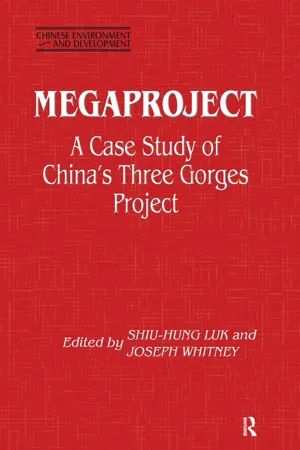
This volume translates crucial Chinese documents on a debate currently raging in China on a proposed project that has enormous implications for its environmental, economic, and social impact - the Three Gorges (Sanxia) Project on the Yangtze River. The most massive water resource project ever planned in China and one of the largest in the world, the Three Gorges Project would cost $1.1 billion to build, would necessitate the relocation of 1.1 million people, would flood a 375-mile-long area and thus destroy some of China's - indeed the world's - most beautiful scenery, and would threaten the extinction of a rare river porpoise. The editors seek to place the arguments in a clear and scholarly perspective that helps to make this book a valuable source of information.
Information
Subtopic
Business General1
A Review of the Work during the Early Stages of the Three Gorges Project
Hong Qingyu
1. Introduction
THE KEY to the Three Gorges Water Conservancy Project (TGP) is in the Xiling Gorge along the Three Gorges section on the main channel of the Changjiang (Yangtze) River. The proposed dam site is located at Sandouping, in the municipality of Yichang in Hubei province, 47 km upstream of the city of Yichang. The proposed dam will control a drainage area of about one million km2, approximately 56 percent of the Changjiang River's total drainage area of 1.8 million km2. At the dam site, the average annual flow is 450 billion m3, approximately one-half of the river's total amount of 960 billion m3.
The idea of constructing the TGP was first enunciated in Sun Yat-sen's plans for industrial and commercial development. During the 1930s, the Construction Committee of the Nationalist government investigated the Three Gorges and proposed the building of a low dam. In the 1940s, the Resources Committee of the Nationalist government signed an agreement with the U.S. Bureau of Reclamation to conduct further study of the proposal.
Since 1949, to control and develop the Changjiang River, large-scale surveying, planning, design, and scientific research in preparation for the project have been carried out. Planning for the comprehensive utilization of the Changjiang basin began in 1955. By 1958, the "Report on the Main Design Features of the TGP" had been completed. The report dealt with the overall planning of the Changjiang River and demonstrated that the project was of pivotal importance among the steps to be taken to control and develop the river. It showed the potentially significant impact of the project in preventing the threat of floods along the middle and lower reaches of the river, harnessing its water resources, and improving navigation in the river and its tributaries. In March 1958, at its meeting in Chengdu, the party's Central Committee discussed the TGP and the planning of the Changjiang River. In its resolution, the Central Committee pointed out that "from the points of view of long-term economic development, and of the technical capability of the country, the TGP is needed and can be constructed.... From now on, active preparation and sufficiently reliable policies must be adopted to facilitate all necessary work to construct the project." The resolution also stipulated that "all preliminary design work is to be submitted by 1962-63." The meeting was immediately followed by systematic surveys, design, and scientific research. The Central Committee's original thinking was to commence construction of the project in the early 1960s. But due to temporary economic difficulties and an unfavorable international situation, the project was later postponed. Nevertheless, following the spirit of Premier Zhou's instruction at the time to maintain determination and strengthen scientific investigation, all preparatory work was actively continued.
During the more than twenty years since, with the cooperation of the work units concerned, the Planning Office of the Changjiang River Basin (POCRB) has collected, organized, and analyzed a large amount of basic information. It has repeatedly carried out experiments on a number of major technical problems. The hundreds of work units associated with the project have written a large number of reconnaissance, survey, design, and research reports. They have organized numerous large-scale discussions and reviews by experts on major technical issues. In 1970, the Central Committee decided to commence construction of the Gezhouba (Gezhou Dam) "as a preparation for the actual battle at the Three Gorges." The construction of the Gezhouba allowed for the accumulation of rich experience needed for the building of the Three Gorges Dam. In 1983, after long years of investigation and comparative study of possible alternatives, and taking account of the socioeconomic conditions of the time, the POCRB completed a feasibility study report on a dam to store water to a normal depth of 150 m. In May 1983, the State Planning Commission examined the report, which was accepted in principle a year later by the State Council. The State Council instructed that a preliminary design be formulated for a dam to reach a height of 175 m and to store water to a normal depth of 150 m. However, differences of opinion still exist among the various groups involved. Taking account of the fact that the TGP is attracting world attention and is bound to have a major impact on China's four modernizations, the party's Central Committee and the State Council insisted that though much preparatory work had been done, valuable information obtained, and many experts consulted, there were still a number of problems and new proposals that should be evaluated from economic and technical points of view. The country's leaders recommended that based on a positive and prudent approach, and to achieve greater precision, reliability, and certainty, additional work on the feasibility of the project should be conducted. This work is currently being organized by the Ministry of Water Conservancy and Electric Power (MWCEP).
2. Major phases of strategic decisions affecting the TGP
2.1. Early study
The earliest reference to the plan to develop the Three Gorges may be found in the section on "Improvement of Navigable Rivers and Canals" in Sun Yat-sen's 1919 "Plan to Develop Industry." Sun proposed "to build a dam to store the water, so that ships can sail upstream against the flow of the river, and the river can be harnessed for electric power" at the Three Gorges. In 1924, in a speech on "People's Livelihood," he referred to the Three Gorges as "capable of providing more than 30 million horsepower of electric power." In the winter of 1932, under the sponsorship of the Nationalist Construction Committee, the National Defense Planning Commission organized a field reconnaissance of the hydropower potential of the upper reaches of the Changjiang River. Exploration and surveys were carried out in the Three Gorges area for approximately two months, and a report entitled "Reconnaissance Report on the Hydropower Generation in the Upper Reaches of the Changjiang River" was completed. The report proposed the construction of two low dams at Gezhouba and Huanglingmiao to produce 320,000 and 500,000 kW of hydropower, respectively. It is obvious that the improvement of the navigation channel along the Three Gorges and development of the water power resources of the Three Gorges have received people's attention for a long time.
In 1936, Bai Lang Du [transliteration; original name unknown—ed.], an Austrian adviser to the Yangtze River Water Resources Commission, also studied the problems of improving navigation and harnessing water power. His conclusion, however, was that "because of the depressed socioeconomic conditions, it would be especially difficult to carry out such a large project."
In April 1944, Pan Sun [transliteration], an American adviser to the Wartime Production Bureau of the Nationalist government, wrote a report dealing with the "utilization of American loans to construct a hydroelectric station and the repayment of such loans." He recommended the construction of a hydroelectric generating station at the Three Gorges to produce chemical fertilizers. Part of them would be used to repay the American loans, which would finance the purchase of necessary equipment.
In May 1944, John L. Savage, chief design engineer of the U.S. Bureau of Reclamation, was invited by the Nationalist government's Resources Committee to visit China on his way to India. After being briefed on the conditions at the Three Gorges and on the report drafted by Pan Sui, Savage decided to make a personal visit to the Three Gorges. In September, on his return from the trip, at the hydropower project office at Longxi River, Changshou county, in the vicinity of Chongqing, he drafted the "Preliminary Report on the Yangtze River Three Gorges Plan," formally presenting a concrete plan to construct the Three Gorges dam. The report marked the beginning of a series of proposals for the development of the Three Gorges. It was followed by numerous negotiation sessions between the Resources Committee and the Bureau of Reclamation on technical assistance, leading to the signing of an agreement in 1946. In June, the Bureau of Reclamation officially began work on the design of the Three Gorges dam. The Chinese side also sent technical personnel to participate in the work. Altogether fifty-four people were sent, but only a small amount of exploration, survey, economic study, and design work was carried out. In May 1947, the Nationalist government decided to terminate the design work of the project. The predominant thinking during this phase was to develop the Three Gorges section of the Changjiang River to improve navigation and harness water power. There was not much actual work done, and that work did not have much impact on the decision to carry on with the project later on. Nevertheless, it served as the first revelation of the enormous potential benefits of the project to improve navigation and develop water power.
2.2. Formulation of strategic steps for flood control on the Changjiang River and the TGP
The Changjiang River is subject to floods from excessive rain. Potential flooding areas are very widespread, but the most frequent and serious floods occur in the plains of the middle and lower valley, where approximately 90 million mu of farmland, more than 75 million people, and the country's major industrial and cotton and grain production bases are located. Within this area, generally speaking, elevation is below the flood level of the Changjiang River. Protection from floods is provided by the building of embankments, which cannot completely remove the threat of flooding. Before Liberation, in certain plain and lake regions, floods were a regular occurrence. The Hubei folk ballad that mentions the frequent floods destroying crops in Mianyang in the central part of the province is a true depiction of the hazards of regular flooding in these regions. According to historical records, in the more than two thousand years from early Han to late Qing (between 185 B.C. and A.D. 1911) over two hundred floods occurred, averaging one flood per decade. As the population in these regions grew, and as the environment became further modified, the frequency of flooding increased. Between 1921 and 1949 there were seven major floods, with the destruction caused by the floods of 1931 and 1935 being especially serious. Affected were 50.9 and 22.64 million mu of farmland and 28.55 and 10.03 million people, respectively. In each flood, more than 100,000 people lost their lives. The 1949 flood was also a major one, and the population along the river had to be mobilized to struggle against the threat. There were significant losses.
The threat of flooding in the middle and lower valley is particularly severe along the section called Jingjiang (that is, the Changjiang main channel between Zhicheng and Chenglingji). The north bank of Jingjiang, known as Yunmengze in previous times, has now evolved into the Jianghan Plain. Dongting Lake on the south bank has shrunk in size. The embankments protecting the valley from flooding have had to be raised continuously, Although deemed to be somewhat unstable, the Jingjiang embankments along the north bank have reached an average height of 12 m and a maximum height of 16 m. In the event of a breach of the embankments, the death toll could reach 100,000, or even a million, and the security of Wuhan could also be threatened. This is the most pressing problem related to the prevention of floods on the Changjiang River. The problem attracted immediate attention after 1949 and led to the proposal of the Jingjiang Flood Diversion Project by the former Changjiang River Water Conservancy Commission in 1951. The proposal very quickly received the approval of the Central Committee and Chairman Mao, and construction began in 1952. The project was completed in seventy-five days after an intensive effort by 300,000 soldiers and civilians. It made an important contribution to the struggle against the major flood of 1954.
Based upon studies of the characteristics of the river, the Changjiang River Water Conservancy Commission put forward in the 1950s a three-phase improvement proposal which emphasized flood prevention. The first phase was to strengthen the embankments; the second, to reduce the scale of flooding by creating retention basins on the plains and in the lake region for flood water that could not be held back by the embankments; and the third, to construct dams in upstream mountain valleys for flood regulation and to develop water resources for multiple use. These three phases were not distinct but rather overlapped with each other.
The above proposal made the following points: (1) The primary and most urgent task in the improvement and development of the Changjiang River is the prevention of floods along the middle and lower reaches, especially the Jingjiang section. (2) Embankments are an effective means of flood prevention along the middle and lower reaches, and therefore as the first priority, they should be strengthened to give them better defensive capability. But because flood peaks on the Changjiang River are enormous, it is not realistic to combat floods by simply raising the height of embankments; furthermore, the higher the embankments, the greater the threat of floods. That the Jingjiang area is experiencing increasing threats of flooding is the result of poor flood prevention methods. Prevention of floods in the middle and lower reaches of the Changjiang River should be achieved through a combination of retention and discharge measures. (3) Controlling the lakes and depressions along the middle and lower reaches to store flood water is a relatively simple but effective measure. Every time flood water is stored, however, considerable damage is inflicted. The amount of damage will increase with the development of agriculture and industry in the area. It is therefore important to increase flood prevention capability upstream by building dams in mountain valleys. This will gradually replace flood retention in the plains or reduce the frequency of flood diversion.
Based on the three-phase plan, not only were the embankments strengthened and flood water storage on the plains provided, studies of the comprehensive utilization of the dams on the main channel and tributaries were also conducted. After comparative studies of various potential dam sites on the main channel and the tributaries, it was concluded that the most suitable site for the effective control of flooding in the middle and lower reaches was at the Three Gorges. The site was thought to possess the irreplaceable capability of preventing disastrous flooding in the Jingjiang area. In February 1953, after being briefed on the proposals to improve and develop the Changjiang River, Chairman Mao remarked: "If so much effort is needed to construct dams on the tributaries, and still it is not enough to achieve the objective of flood control, why don't we just concentrate on the Three Gorges and stop the floods there?"
During this period, flood prevention was clearly designated as the primary objective of the work to control and develop the Changjiang River. In studying flood prevention in the middle and lower reaches, especially along the Jingjiang section, the strategic position of the TGP was realized. The TGP is not only a hydropower generating station of enormous size, but also a multiple-use project that has a major role to play in flood prevention along the middle and lower reaches of the Changjiang River.
2.3. Formulation of the Changjiang River Basin plan and the 1958 Central Committee meeting in Chengdu
Flood prevention through the construction of dams in upstream mountain valleys involves the problem of multiple use of the water resources of the river and requires comprehensive planning for the river valley. In early 1953, the Changjiang River Commission established the Changjiang and Hanjiang River Planning Committee to begin plans for the two rivers. In 1954, the biggest flood of the last one hundred years occurred along the middle and lower reaches of the Changjiang River. Although the strengthening of the embankments and the completion of the flood diversion project along the Jingjiang following Liberation saved the Jingjiang embankments, the cities of Wuhan and Nanjing, and other key areas downstream, destruction was still very severe. Fifty million mu of farmland were inundated, and twenty million people were affected by the floods, with thirty thousand killed. This catastrophe revealed once again the seriousness of flooding along the middle and lower reaches and made people even more aware of the urgent need for establishing flood prevention as the primary objective of the plan to develop the Changjiang River. It also confirmed that the proposed three-phase development concept conformed to the real situation in the river, and that the final solution to flooding along the middle and lower reaches depended upon the construction of dams in mountain valleys upstream. The party's Central Committee immediately decided to commence planning, and Premier Zhou Enlai personally wrote to Premier Bulganin of the Soviet Union requesting that experts be sent to China to provide assistance. Soviet experts began to arrive in June 1955, and along with personnel from more than thirty Chinese work units, they began a program of systematic surveying, design, and study of the Three Gorges.
During the earlier period of planning, there were differences in opinion on locating the strategic key project. The Soviet experts were inclined to consider Maoer Gorge as the suitable location of the key project. Although a combination of projects at Maoer Gorge, Wentang Gorge on the Jialing River, and several other sites could solve the flooding problem along the middle and lower reaches, the inundated areas caused by the dams at these two gorges are much too large. We therefore favored the Three Gorges as the strategic key to the control of the Changjiang River. At the end of 1955, after listening to the different viewpoints, Premier Zhou took the first step to define the Three Gorges as the principal part of the project for the whole Changjiang River Basin. The decision was based on the premise that the dam at Maoer Gorge would create an excessively large reservoir, while the Three Gorges "can regulate and store water for upstream, and provide compensation for downstream." Following this, more than a year was spent in further planning and study to demonstrate Chairman Mao's concept of "stopping the floods at the Three Gorges" and Premier Zhou's statement on the unique position of the Three Gorges in flood prevention along the middle and lower reaches.
In 1956, based on the preliminary results of the planning activities, Comrade Lin Yishan of the POCRB published a paper entitled "Discussion of Certain Problems Related to the Planning of the Changjiang River Basin" in the journal Zhongguo shuili (China water conservancy) (1956, nos. 5 and 6). He expounded the principles of multiple use in the development of the Changjiang River Basin, the major objectives, and the various developmental concepts and in particular discussed the role and effect of the TGP on the control and development of the Changjiang River. In September of the same year, Comrade Li Rui and others wrote in Shuili fadian (Hydroelectric generation) (1956, no. 9) a number of papers expressing disagreement with the view that attached such importance and urgency to the TGP in flood control on the middle and lower reaches of the Changjiang River, and doubts about the technical feasibility and applicability of the TGP. They recommended substituting Wuqiangxi along the Yuanshui River for the Three Gorges as the location of the key project.
In January 1958 in Naming, during the Central Committee meeting, Chairman Mao, Premier Zhou, and other leading comrades listened to the different views of comrades Lin Yishan and Li Rui on the development of the Changjiang River. Chairman Mao stated that construction of the TGP should be based on the principle of "enthusiastic preparation and complete reliability." He appointed Premier Zhou to take personal charge of the planning of the Changjiang River Basin and the TGP. Accordingly, between February 26 and March 5 of the same year, Premier Zhou led a group of more than a hundred people, including leading comrades in the central and local governments and Chinese and foreign experts, on an expedition to the Jingjiang embankments and the Three Gorges. He was briefed on the progress of the project and listened to views from different sides. At Chongqing, he presided over the meeting "to prepare enthusiastically for the construction of the Three Gorges Key Project," where more than twenty leading comrades and experts from different central ministries and commissions, provinces, and cities presented their views. Comrade Li Rui also participated in the expedition, and he spoke at the Chongqing meeting. He stated: "In terms of comprehensive benefits, the Three Gorges is ideal and very good. Although there are many technical difficulties, it must be said that it is feasible. In terms of meeting economic [efficiency] criteria, especially on a per unit input basis, the TGP also scores highly. There is no doubt that the TGP can solve the flooding problem on the Changjiang River and help in the development of water resources." He considered the controversy during the preceding two years as "mainly o...
Table of contents
- Cover
- Half Title
- Title
- Copyright
- Contents
- Acknowledgments
- Introduction
- 1. A Review of the Work during the Early Stages of the Three Gorges Project
- 2. The Features of the Three Gorges Reservoir
- 3. Comprehensive Assessment of the Ecological and Environmental Impact of the Three Gorges Project
- 4. The Three Gorges Project Should Not Go Ahead in the Short Term
- 5. Some Aspects of Sedimentation at the Three Gorges Project
- 6. The Flood Prevention Function of the Three Gorges Project—Disadvantages Outweigh Advantages
- 7. Resettlement Problem of the Three Gorges Project
- 8. Population Resettlement and Economic Development in the Three Gorges Reservoir Area
- 9. How Much Investment Is Required by the Three Gorges Project?
- 10. Assessing the Three Gorges Project from Three Macrostrategic Aspects
- Appendix 1. The Changjiang River and the Three Gorges Project
- Appendix 2. Site of the Three Gorges Project
- Appendix 3. Construction Data on the Three Gorges Dam
- Appendix 4. Hydrologic and Flood Prevention Data on the Three Gorges and Changjiang River
- Bibliography of Publications in English
- Index
Trusted by 375,005 students
Access to over 1.5 million titles for a fair monthly price.
Study more efficiently using our study tools.
Frequently asked questions
Yes, you can cancel anytime from the Subscription tab in your account settings on the Perlego website. Your subscription will stay active until the end of your current billing period. Learn how to cancel your subscription
No, books cannot be downloaded as external files, such as PDFs, for use outside of Perlego. However, you can download books within the Perlego app for offline reading on mobile or tablet. Learn how to download books offline
Perlego offers two plans: Essential and Complete
- Essential is ideal for learners and professionals who enjoy exploring a wide range of subjects. Access the Essential Library with 800,000+ trusted titles and best-sellers across business, personal growth, and the humanities. Includes unlimited reading time and Standard Read Aloud voice.
- Complete: Perfect for advanced learners and researchers needing full, unrestricted access. Unlock 1.5M+ books across hundreds of subjects, including academic and specialized titles. The Complete Plan also includes advanced features like Premium Read Aloud and Research Assistant.
We are an online textbook subscription service, where you can get access to an entire online library for less than the price of a single book per month. With over 1.5 million books across 990+ topics, we’ve got you covered! Learn about our mission
Look out for the read-aloud symbol on your next book to see if you can listen to it. The read-aloud tool reads text aloud for you, highlighting the text as it is being read. You can pause it, speed it up and slow it down. Learn more about Read Aloud
Yes! You can use the Perlego app on both iOS and Android devices to read anytime, anywhere — even offline. Perfect for commutes or when you’re on the go.
Please note we cannot support devices running on iOS 13 and Android 7 or earlier. Learn more about using the app
Please note we cannot support devices running on iOS 13 and Android 7 or earlier. Learn more about using the app
Yes, you can access Megaproject by Shiu-hung Luk,Joseph Whitney in PDF and/or ePUB format, as well as other popular books in Technology & Engineering & Business General. We have over 1.5 million books available in our catalogue for you to explore.