eBook - ePub
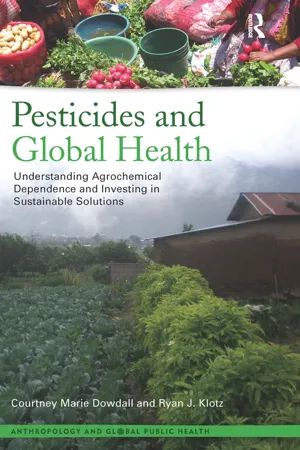
Pesticides and Global Health
Understanding Agrochemical Dependence and Investing in Sustainable Solutions
- 148 pages
- English
- ePUB (mobile friendly)
- Available on iOS & Android
eBook - ePub
Pesticides and Global Health
Understanding Agrochemical Dependence and Investing in Sustainable Solutions
About this book
This concise, accessible introduction to understanding agricultural chemicals and public health combines a broad synthesis on a global scale with rich ethnographic narratives on a human scale. Drawing on epidemiology, policy analysis, and social science research on the global commodity chain, the authors describe the system of global agrochemical dependence that constitutes a major threat to human health. Then they draw readers into the lush mountainsides of highland Guatemala, telling personal stories of farmers, their experiences with public health programs, their struggles against agrichemical dependence, and their innovations in sustainable agriculture. Finally, they show how this kind of qualitative, multi-level analysis holds practical lessons for public health. This engaging, brief text is an ideal supplement for courses in global health, introducing students to key concepts with broad coverage and engrossing ethnographic detail.
Information
Chapter 1
Global Agricultural Markets and Standardization

Over the past several decades, the production and circulation of agricultural goods has undergone a process of heightening integration on a global scale. From the planting and cultivation of export crops by farmers around the world, to the placement of farm products on the shelves of major supermarkets across the United States and other developed nations, global agriculture is a mammoth industry that employs over 22 percent of the world’s population (Smith et al. 2008: 167). In recent years, the agricultural sector has progressively come under the tight control of a few multinational actors. More and more, each step in the chain from farm to table must be managed in the interest of meeting the needs of global markets.
This chapter focuses on how the pressures of the global market condition the activities of large-scale distributors of agricultural goods. The need for profitability in the coffee and vegetable trades gives rise to specific forms of organization, standards for quality, and relations of power in their respective distribution chains. These forms of trade structure the ways in which agricultural production changes to meet industrial needs. This chapter demonstrates how large-scale actors like coffee roasters and supermarket chains struggle to secure predictability, standardization, and the minimization of risks in agriculture—an activity that is inherently unpredictable and risky.
Efforts to standardize agrarian commodity production have contributed to the rise of a multibillion dollar industry (Buccini 2004: 8) that attempts to realize this goal by modernizing agriculture through technology and chemical-based farming. During the post-war era of the 1940s and 1950s, agrochemical pesticides, high-yielding hybrid seeds, and other agro-technologies were widely seen as the solution to the problems of agricultural production and even world hunger. Consequently, an agrochemical industry has developed, primarily in the United States and Europe, to supply growing global demand. The use and circulation of pesticides has seen staggering jumps since the mid-twentieth century. According to some estimates, sales of registered pesticides doubled every ten years between 1945 and 1985 (WHO/UNEP 1990 cited in Dich et al. 1997: 422). By the early 1990s, over two million metric tons of chemical pesticides were sold worldwide with a total value of nearly 26 billion dollars (Dich et al. 1997: 423). Despite some signs of diminished growth, pesticide sales continued in much the same fashion throughout the early 2000s. Approximately 1.7 billion pounds of pesticides were exported from U.S. ports alone between 2001 and 2003 (Smith et al. 2008: 167). Total global exports, however, are much higher, as this figure does not include agrochemicals shipped from other major exporters, including Germany and Switzerland. Overall, current use of pesticides totals about 2.3 million tons dispersed annually around the world (Harris and McCartor 2011: 27); total sales of pesticides have grown from 30 billion dollars in 1999 to over 40 billion in 2008 (Pesticide Action Network (PAN) 2010: 3). According to World Bank estimates, global production of agrochemicals is expected to exceed 1995 production levels by approximately 85 percent by 2020, with greater proportions of chemicals being produced by, and exported to, the developing world (Buccini 2004: 10).
In recent years, many agrochemicals have come under increasing scrutiny for their observed and potential effects on human and environmental health. The risks have not escaped the attention of international organizations and regulators. In light of mounting evidence linking human exposure to certain agrochemicals with the prevalence of cancer, respiratory illnesses, neurological disease, and other health risks, institutions such as the WHO and the FAO have developed several key international agreements to stem or severely restrict the spread of these chemical compounds (see Buccini 2004).
Despite the best efforts of these organizations and widespread acceptance of international bans and participation in regulatory agreements, however, the health and environmental threats posed by the global circulation of agrochemicals persist. According to WHO estimates, over 3 million cases of acute pesticide poisoning occur annually, while long-term exposure to pesticides is thought to be responsible for more than 700,000 cases of chronic illness per year (PAN 2010: 6). The vast majority of these cases are concentrated among populations in the developing world.
In this chapter, we argue that agrochemicals remain a prime threat to the health and environmental well-being of farmers in the developing world because of a set of interrelated processes occurring at the international, national, and local levels. Cochrane’s agricultural treadmill does much to explain why farmers and their families continue to be exposed to toxic agrochemicals. However, to develop a full understanding of the persistence of the agrochemical threat, the treadmill concept must be applied more broadly to numerous sociocultural and economic processes that condition farmer decisions concerning agrochemical use, a topic explored in later chapters.
The forces driving global agricultural chains
Agriculture has become a global activity. Recent advances in telecommunication and transportation technologies make it possible for consumers to go into most supermarkets around the world and choose from a variety of farm products that have recently arrived from any given country. Supermarket chains and big-box stores in Canada, the United States, Europe, or Japan are able to arrange large purchases of agricultural goods, issue packaging specifications for their products, pay for express shipping, and receive their products in less than twenty-four hours. Along with these advances in export and communication technologies, a demand for coordination across borders and strategic management of complex agricultural systems has arisen to meet the requirements of globally competitive businesses.
The need for tight integration of every step in the process, from the planting of seeds to the sales of foods to final consumers, has led numerous observers of agricultural commodities to refer to these interlocking stages of production and distribution as “global value chains” (Bair 2005, Gereffi et al. 2005, Kaplinsky 2004). Using this metaphor, researchers show how different forms of organization and transactions take shape at each “link” in a product’s chain. Research on global value chains has demonstrated how the requirements for circulating different commodities give rise to distinct sets of relationships between actors and the systems by which products, profits, and power are distributed. Further, global value chain research has also shown how the logistical needs of global circulation require specific kinds of organization and divisions of tasks. These organizational strategies must be adequately efficient and routinized to function in an increasingly competitive world market for agricultural goods (Dolan and Humphrey 2000).
Agricultural value chains are distinct from those of numerous other commodities because they are “buyer-driven” systems (Kaplinsky 2004, Ponte 2002, Dolan and Humphrey 2000). They diverge from “producer-driven” chains for specialized goods, in which producers have a fair amount of power because they possess machinery and expertise that is not easily copied. By contrast, agricultural chains are dominated by large buyers whose power has been fortified by recent consolidations in the industry for agricultural goods.
In both coffee (Ponte 2002, Pendergrast 1999) and fresh vegetable (Konefal et al. 2007, Dolan and Humphrey 2000) circulation chains, the past two decades have been characterized by a rapid cornering of the industries by a handful of multinational firms operating in the global north. At the same time, the number of suppliers—exporters and farmers—has remained constant or increased. As a result, while producers were once able to choose the best terms of trade among a variety of interested purchasers, they now sell the majority of their produce to only one or two large-scale supermarket chains or coffee roasters. For this reason, it is far easier for these “lead firm” (Gereffi 1994) purchasers to switch suppliers of a product than it is for suppliers to find new purchasers (Dolan and Humphrey 2000). In effect, this situation creates a power imbalance wherein large buyers have the freedom to manipulate the other links in the chain to suit their own needs for capital accumulation. These buyers’ specifications for product quality, volume, and supply “drive” the modes of production and shape the distribution of agricultural products by other stakeholders in their respective chains. Suppliers are left with the choice either to conform to such specifications or to risk losing out on a contract with an increasingly short list of purchasers.
Quality and production standards of supermarket chains
Although large supermarket chains, coffee roasters, and other purchasers of global agricultural goods are able to harness a great deal of power in their dealings with farmers, exporters, and other suppliers, they continue to struggle with a special set of challenges and barriers to generating a profit. Overall, large-scale buyers of agricultural commodities must minimize unpredictability in their products and supply chains. This drive is in constant tension with the fundamental natural forces upon which agricultural production is based. Agriculture is inherently tied to changes in the weather and a host of highly varied social and environmental circumstances in the producing countries where cultivation takes place. The development of a hurricane that destroys a coffee crop in a Central American nation, for example, can lead to shortages and price spikes for the crop in the global market. Changes in growing conditions can affect product quality or supply, introducing an element of uncertainty that must be mitigated in the interests of securing a successful value chain and business model.
Because the success of retailers like supermarkets and coffee roasters depends heavily on their reputation among their consumers, sourced produce that fails to meet prevailing standards for quality in agricultural markets can create a number of problems. In order to remain competitive, it is essential that retailers ensure a normal and predictable supply of products in sufficient volumes that meet the quality expectations of markets and consumers around the world. The inability to provide products of a consistent quality can be devastating for farmers, especially in the increasingly competitive global markets where a few retailers compete for a fixed consumer base (Dolan and Humphrey 2000, Pendergrast 1999). Establishing and maintaining the reputation of their brands in terms of quality is essential to retailer success. For this reason, supermarkets or coffee roasters seek to keep consumers from switching to a competitor’s product by offering agricultural goods that are consistent in supply, appearance, taste, and other markers of quality. As a result, most lead firms in buyer-driven value chains such as those for coffee and vegetables maintain specific minimum standards to which the goods they purchase must conform. This system of passing product quality and production standards down the entire value chain, called “value-chain governance,” places the burden of assuring quality on exporters and farmers, who now bear the risk of growing a product that purchasers may be unwilling to buy at harvest time (Jaffee 2007, Fischer and Benson 2006, Mutersbaugh 2002).
In sum, lead-firm retailers attempt to minimize risks to the profitability of their ventures through value chain governance and the development and enforcement of minimum standards for agricultural goods. These mechanisms constitute an effort on the part of retailers to develop an edge over competitors by sourcing a steady and predictable supply of products of an acceptable quality. However, try as they might, maintaining rigid quality standards is a complicated task for farmers of coffee and fresh vegetables, as we will demonstrate in the following sections. Beyond these basic generalizations of global agricultural chains, stakeholders in the fresh vegetables and coffee industries face distinct sets of challenges that nevertheless result in similar approaches to securing the right conditions for profitability and capital accumulation. A brief breakdown of each of these chains illustrates the specific processes and barriers confronted by purchasers and how the use of modern agricultural technologies, specifically agrochemicals, becomes the solution. Though the value chains in which coffee and vegetable farmers participate vary in several key ways, the need to continue supplying produce according to the rigid specifications of retailers can lead farmers of both products to practice similar farming strategies that have the potential to pose serious threats to public health.
Aesthetic standards of consumers
Even among the largest supermarket retailers competition remains fierce. The biggest companies often secure their market shares at the expense of smaller players. For example, in the United States in the early 1980s, the top five national supermarkets controlled just over a quarter of the total countrywide supermarket sales in fresh produce. This figure changed dramatically by 2004, with the top five controlling more than 48 percent of all sales (McTaggart and Heller 2005: 50, cited in Konefal et al. 2007). With the elimination of many small and specialty food retailers from the market, large chains now engage in heated competition for smaller pieces of the consumer market. According to observers (Konefal et al. 2007, Dolan and Humphrey 2000), the rapid consolidation of the fresh fruit and vegetable trade has had far-reaching impacts for the industry in terms of competition, supply procurement, and value chain governance.
The rules of competition in fresh vegetables now center on consumer demands in terms of eye appeal, year-round availability, and uniformity. For this reason, supermarkets have developed specific aims for their sourcing activities, standards for produce, and overall governance of their value chains. In order to ensure a reliable stream of farm produce from exporting countries, supermarket chains contract with a few large exporters who are responsible for aggregating the contracted amount of produce from local farms. In both European (Dolan and Humphrey 2000) and North American (Fischer and Benson 2006) supply chains, supermarket buyers hold these intermediary firms responsible for enforcing standards to ensure that contracted produce meets quality and safety qualifications before hitting the grocers’ shelves.
With varying degrees of involvement on the part of their northern purchasers, exporters have become increasingly involved in changing the production process of their supplying farmers to meet these quality standards. To maintain positive working relationships with sourcing retailers, local suppliers and exporters strive to secure sufficient volumes of large, uniform, blemish-free produce that is free from evidence of disease or chemical contamination. Critically, they transfer the responsibility and cost of meeting these supermarket standards to farmers by inserting them directly into contracts with contracted farmers (Fischer and Benson 2006), making on-site visits to the fields of contracted farmers (Conroy et al. 1996), and conducting inspections of submitted produce. Any violations of the standards for product quality or production can lead to outright rejection of a farmer’s entire harvest.
This arrangement clearly places a large part of the burden of ensuring product quality on the shoulders of farmers. According to many of the farmers we encountered in our research, purchasers do in fact routinely reject contracted produce that does not conform to specific quality standards. In the mid-1990s in Guatemala, for example, farmers reported that at least 25 percent of their produce was rejected at the packaging shed for failure to meet contracted standards (Conroy et al. 1996). More recent data show Guatemalan exporters reject approximately 15 percent of all broccoli harvests submitted by farmers based on appearance alone (Fischer and Benson 2006: 29).
Competition between individual farmers to meet standards for quality and volume in the fresh produce value chain parallels the competition among large supermarket chains. Farmers desperate to sell a perishable crop like fresh snow peas will do whatever it takes to ensure that their harvests meet contract specifications concerning quantity, volume, and cosmetic, sanitary, and chemical standards. If they fail to meet these specifications or attempt to work outside contractual agreements with large suppliers, farmers are left to fend for themselves in the local open markets, where prices are wildly unpredictable and subject to even greater competitive pressures.
Supply standards of international commodity brokers
Coffee has a much longer history as a global commodity than do fresh vegetables. However, the contemporary coffee market transformed considerably following the fall of the International Coffee Agreement (ICA) in 1989 (Bacon 2005, Taylor 2005, Ponte 2002). Forged in the early 1960s at a UN Coffee Conference in New York, the ICA aimed to create a stable coffee price for exporting farmers and producing countries. This agreement between buying and producing nations attempted to set stable global coffee prices and regulate the trade through national marketing boards who controlled the amounts of coffee supplied to the global market. The ICA, in an attempt both to secure minimum prices for producing farmers and to curb the frequent boom and bust cycle of world coffee supplies that followed sudden changes in weather patterns in producing countries (Ponte 2002). Under the ICA, state-sponsored marketing boards in exporting nations were able to withhold purchased coffee stock in times of surplus, participate in minimum price-setting agreements with outside actors, and provide quality control and processing support to domestic farmers (Kaplinsky 2004). Before its demise, the ICA and coffee boards were the principal sources of “aggregated producer power” (Kaplinsky 2004: 11) in the coffee value chain (Fridell 2007, Jaffee 2007).
When the United States withdrew from the ICA in 1989, several processes were set in motion that shaped the development of the coffee market into its current form. Coffee supplies were deregulated, marketing boards were eliminated, and coffee production was decentralized: producers who formerly aggregated their harvests through the boards now sold directly to global purchasers. The elimination of the ICA paved the way for the rise of large coffee roasting firms as the principal overseers of the “buyer-driven” value chain for coffee. Even during the ICA, the top roasters in the global coffee market had already begun consolidating control over this lucrative market through mergers and buyouts of smaller firms. For example, as early as 1960, the top four coffee roasters controlled 40 percent of all coffee sales (Pendergrast 1999: 261). The 1970s and 1980s saw similar trends; for example, the purchasing giant General Foods, owner of the Maxwell House brand, accounted for over a third of all U.S. coffee sales throughout the early part of the 1970s (Pendergrast 1999: 314).
The fall of the ICA allowed this consolidation to accelerate. By 1991, Kraft General Foods held 33 percent of the ground roasted coffee market in the United States; Procter & Gamble was close behind at 32.7 percent (Pendergrast 1999: 364). Despite the rise of gourmet coffee roasters such as Starbucks beginning in the 1990s, the vast majority of the coffee market continues to be controlled by these major roasters (Taylor 2005). By 1998, the top two international roasters controlled 49 percent of the world market share for roasted and instant coffee and the top five controlled 69 percent (Van Dijk et al. 1998 cited in Ponte 2002). By the end of the 1990s, the behemoth Nestlé controlled half of the world market for instant coffees. Once Philip Morris acquired the Maxwell House brand, it became the world’s leader in roasted and ground coffees, controlling 14 percent of the entire world coffee market and 20 percent of the soluble coffee market (Pendergrast 1999: 422).
As a result of this consolidation, the contemporary international coffee trade, like that of fresh vegetables, is dominated by a few large buyers who compete with one another for small percentages of market share through careful governance of all steps in their production and supply chains. These major roasting firms in non-specialty, conventional coffee markets face a set of challenges to profit generation that are somewhat different from those in the fresh vegetable value chain. For this reason they take a different approach to supply chain governance and enforce distinct standards for coffee purchased from farmers or exporters.
Coffee is characterized by inelastic demand (Topik 2003). This means that coffee drinkers typically have a habit of daily consumption, so it is difficult for consumers to alter their purchasing pattern in reaction to price hikes or discounts. As as long ago as the postwar 1940s, spikes in coffee prices have been met with public outcry and often catch the attention of policymakers. At the same time, in the absence of ICA regulations it is increasingly difficult for roasters to maintain consistently low domestic prices for conventional coffee. Price fluctuations are much greater, subject not only to short-run changes in supplies but also to investor speculation on coffee futures (Jaffee 2007, Bacon 2005, Topik 2003). Roasters’ desire to ensure cheap, ready supplies for their consumers in the face of unpredictable world pricing has led to their strategy of amassing large volumes of undifferentiated coffee beans that are regular enough to be easily substituted in and out of coffee blends without significant changes in flavor (Pendergrast 1999). For this reas...
Table of contents
- Cover
- Half Title
- Title Page
- Copyright Page
- Contents
- Preface
- Introduction
- Chapter 1 Global Agricultural Markets and Standardization
- Chapter 2 Public Health and Vulnerable Populations
- Chapter 3 A Community Torn: Struggling to Rectify Agrochemical Hazards and the Immediate Needs Treadmill
- Chapter 4 Change Comes to the Valley: Confronting Agrochemical Use with Local Organic Food Systems
- Chapter 5 Conclusion: Program Recommendations and the Application of Ethnographic Research in Public Health Initiatives
- References
- Index
Trusted by 375,005 students
Access to over 1.5 million titles for a fair monthly price.
Study more efficiently using our study tools.
Frequently asked questions
Yes, you can cancel anytime from the Subscription tab in your account settings on the Perlego website. Your subscription will stay active until the end of your current billing period. Learn how to cancel your subscription
No, books cannot be downloaded as external files, such as PDFs, for use outside of Perlego. However, you can download books within the Perlego app for offline reading on mobile or tablet. Learn how to download books offline
Perlego offers two plans: Essential and Complete
- Essential is ideal for learners and professionals who enjoy exploring a wide range of subjects. Access the Essential Library with 800,000+ trusted titles and best-sellers across business, personal growth, and the humanities. Includes unlimited reading time and Standard Read Aloud voice.
- Complete: Perfect for advanced learners and researchers needing full, unrestricted access. Unlock 1.5M+ books across hundreds of subjects, including academic and specialized titles. The Complete Plan also includes advanced features like Premium Read Aloud and Research Assistant.
We are an online textbook subscription service, where you can get access to an entire online library for less than the price of a single book per month. With over 1.5 million books across 990+ topics, we’ve got you covered! Learn about our mission
Look out for the read-aloud symbol on your next book to see if you can listen to it. The read-aloud tool reads text aloud for you, highlighting the text as it is being read. You can pause it, speed it up and slow it down. Learn more about Read Aloud
Yes! You can use the Perlego app on both iOS and Android devices to read anytime, anywhere — even offline. Perfect for commutes or when you’re on the go.
Please note we cannot support devices running on iOS 13 and Android 7 or earlier. Learn more about using the app
Please note we cannot support devices running on iOS 13 and Android 7 or earlier. Learn more about using the app
Yes, you can access Pesticides and Global Health by Courtney Marie Dowdall,Ryan J Klotz in PDF and/or ePUB format, as well as other popular books in Medicine & Agribusiness. We have over 1.5 million books available in our catalogue for you to explore.