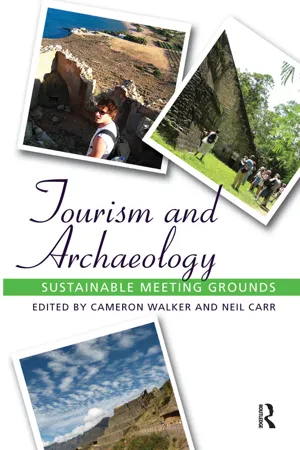
eBook - ePub
Tourism and Archaeology
Sustainable Meeting Grounds
- 301 pages
- English
- ePUB (mobile friendly)
- Available on iOS & Android
eBook - ePub
Tourism and Archaeology
Sustainable Meeting Grounds
About this book
The global popularity and lucrative potential of tourism has made sustainability a major concern for archaeologists, site managers, politicians, local communities, tourism officials, and other stakeholders. This book establishes new, interdisciplinary ground for tourism and archaeology that will foster a new generation of sustainable thinking and practice. First, three teams of co-authors from both disciplines tackle key conceptual dilemmas: exploration vs. exploitation, education vs. entertainment, and cultural sensitivity vs. embeddedness. Then, international case studies examine site development, marketing, community relations, and other on-the-ground examples of heritage work. The volume launches an important new era of collaboration in this growing field.
Information
Part ONE

Concepts
Chapter 1
Tourism and Archaeology: An Introduction
The study of tourism, and the management of it, demands that it be seen as an extended field of relationships not readily disentangled from one another, not easily sorted . . . into clear-cut and exclusive, opposing categories: host and visitor, local and global, we and they, here and there. (Geertz 1997:20)
Introduction
For many, the appeal of anthropology lies in the tradition of looking at the world as a complex, interconnected system. Rather than looking at human culture as isolated blocks of information, it is in the myriad ways that certain bits of information are associated with other bits of information that makes human beings and their cultures so enormously fascinating. To better understand various aspects of human behavior, it is necessary for the academic world to sort them into subcategories that, in the context of this book, have to do with tourism, heritage, archaeology, and sustainable conservation as the focus of research, analysis, and discussion. Unfortunately, focusing on separate subcategories actually takes the spotlight away from the systemic connections. With this approach, scholars often spend their careers analyzing similar subjects from different perspectives, and then they publish their conclusions as separate collections of information.
To get around this academic compartmentalization, this book has brought together assorted scholars from many different parts of the world and from various areas of scholarship to discuss topics that are of mutual concern. For many of us, this book marks the first time there is a sharing of knowledge and perspectives, which serves to deepen our overall understanding. This dialog also allows us to look for solutions to mutual concerns that make sense in the present and are sustainable into the future. For scholars interested in the issues of anthropological archaeology, those interests inevitably shift toward the complexities involved with opening an archaeological site for tourism. Those interests include relationships with local communities, the surrounding ecosystem, the myriad sociopolitical scenarios, and the need to provide interpretation for visitors.
In the late 1990s, archaeologists were just beginning to write about the subject of archaeological tourism; so it was necessary to turn to tourism literature as a way to expand into theory, methods, and other perspectives. It is still somewhat unusual for an article on archaeological tourism to be intended for an interdisciplinary audience or for the literature to incorporate other fields. Increased communication between the disciplines of archaeology and tourism studies seem to benefit both disciplines; so the idea for collaboration led to a partnership between Cameron Walker, an anthropological archaeologist based in California, and Neil Carr, a prolific tourism scholar in New Zealand. The plan for this book gradually developed a format that includes three conceptual chapters which address some of the more crucial issues that challenge archaeologists and tourism scholars. In order to produce a meaningful dialogue on each of these three concepts, we partnered an archaeologist or anthropologist with a tourism scholar whose experience included archaeological tourism. We asked the three teams to discuss their individual perspectives and, in particular, we asked each team to discuss one of the following issues: exploration versus exploitation; education versus infotainment; and cultural sensitivity versus embeddedness. To round out the book and provide a variety of on-the-ground, applied viewpoints, we also sought out a variety of case study experiences with archaeological tourism.
Perhaps unsurprisingly, the result was quite a complicated endeavor because, as it turned out, we had launched several multinational and multidisciplinary dialogues that became ever more complex as different perspectives were voiced. We had expected an intricate exchange of ideas, of course, but there were other additional hurdles from within the disciplines of archaeology and tourism studies, as well as from the many different national perspectives.
Ultimately, we have produced a book with more than 20 internationally diverse authors discussing their own experiences with archaeological tourism along with the challenges and lessons learned. In order to place the book within the realm of contemporary scholarship, we begin with a description of the world of archaeological tourism as it straddles the parallel academic arenas of archaeology and tourism studies.
Tourism and Heritage
Tourism is an immensely popular global social phenomenon, and it appears to be growing despite the otherwise daunting factors of global economic and political instability that are so much a feature of the early 21st century. As a topic, tourism has been separated into many different subtypes, many of which overlap one another. Our discussion of tourism sticks close to the theme of tourism at archaeological sites; although, the topic is also discussed in broader terms of heritage tourism, cultural tourism, ecotourism, and volunteer tourism, to name only a few examples.
Timothy (2011:341) provides one example of the overlap between many types of tourism:
Much of the world’s knowledge of the human past has come to light through the labors of amateur archaeologists or of volunteers undertaking archaeology experiences during their vacations, especially in the early years of archaeological exploration.
While recognizing the broader settings of archaeology and tourism, this discussion focuses on tourism of archaeological sites and adopts a definition of tourism that says it is part of “human exploratory behavior” that serves as a diversion from the ordinary and helps to make life more interesting and “worth living” (Berlyne 1962; Graburn 1989:21–22).1
Clearly, archaeological remains (artifacts and sites), and archaelogy as an academic discipline, can be situated within the broader field of heritage. At the same time, archaeology and heritage are not the same thing; so while debates about heritage and heritage tourism can and should inform our understanding of archaeological tourism, they should not be used as a substitute for focusing more specifically on the phenomenon of tourism of archaeological sites. The significant amount of work that has been published on heritage tourism has in general been implicit, and on occasion, explicit, when discussing issues associated with archaeology. This has certainly helped to inform much of the work thrashed out in this book; and while the focus of the book is on archaeological tourism, it is clear that any implications that are highlighted here will also have relevance for the fields of heritage studies and heritage management. Therefore, it is hoped that by putting archaeology in the spotlight, this book will also add to the literature on heritage studies and heritage tourism.
Archaeology is a fascinating, sometimes misinterpreted, discipline that is often romanticized in fictional (e.g., Indiana Jones and Lara Croft) and documentary media (e.g., the British TV program Time Team; Holtorf 2007; Walker 2009). Actually, the earliest archaeologists were themselves tourists (Russell 2006) who had the gumption and wherewithal to search for mysterious cities and lost artifacts. Archaeology remains a romantic pursuit for the public; although, it has also become an academic discipline that adheres to the rigors of scientific and humanistic scholarship. Archaeologists do not work in isolation, and an archaeological site is not merely a pile of ruins or a collection of ancient things. Rather, there is a more complex setting that includes the present-day ecosystem, local communities, and the sociopolitical networks that must also be considered.
By its very nature, archaeology is a destructive process, so it is necessary to predetermine how to protect a site after it has been excavated. Where will the excavated artifacts be placed? Who will study them? Will the analysis be published? What are the potential effects of excavation research on local communities and the surrounding environment? If the site entices the interest of tourists, what are the ramifications for bringing visitors into and out of the area? What are the presumed benefits of tourism, and what can be done to insure that negative impacts are mitigated? Which practices are sustainable, and how do we project them into the future? These are only a few of the many important considerations that are connected with tourism of archaeological sites, and no one, not even the tourists, are spared responsibility for their choices and their actions.
Tourism and heritage scholars are well aware of the detrimental effects of poorly planned tourism and have offered up recommendations that include the responsibilities of tourists. In the 8th Draft of the International Cultural Tourism Charter, Managing Tourism at Places of Heritage Significance, as adopted by ICOMOS (International Council on Monuments and Sites) at the 12th General Assembly in Mexico in October, 1999, tourism responsibilities were made explicit:
Tourism should bring benefits to host communities and provide an important means and motivation for them to care for and maintain their heritage and cultural practices. The involvement and co-operation of local and/or indigenous community representatives, conservationists, tourism operators, property owners, policy makers, those preparing national development plans and site managers is necessary to achieve a sustainable tourism industry and enhance the protection of heritage resources for future generations. (http://www.icomos.org/tourism/charter.html)
While tourism and archaeology are, without a doubt separate disciplines, they share a significant number of interests, such as the educational and financial responsibilities of archaeologists and those who manage archaeological sites and museums. The archaeological tourism market, as a vital part of a larger heritage tourism market, involves the interaction of archaeologists, tourism experts, and heritage site managers throughout the world. A growing trend highlights publishing articles about archaeological tourism in such widely varied disciplines as the National Association for the Practice of Anthropology (NAPA), World Archaeology, The International Journal of Tourism Research, Sustainable Development, and Conservation and Management of Archaeological Sites. Additionally, related articles can be found in such diverse academic publications as Museum Management, Heritage and Society, Journal of Tourism Studies, Pasos, and the Journal of Interpretation Research. In concurrence with the premise of this book, The Journal of Heritage Tourism has this to say about the need for particular scholarly collaborations:
During the past 20 years, the study of tourism has become highly fragmented and specialized into various theme areas, or concentrations. Within this context, heritage tourism is one of the most commonly investigated forms of tourism, and hundreds of scholars and industry workers are involved in researching its dynamics and concepts. This academic attention has resulted in the publication of hundreds of refereed articles in various scholarly media, yet, until now there has been no journal devoted specifically to heritage tourism; Journal of Heritage Tourism was launched to fill this gap. (http://www.tandfonline.com/action/aboutThisJournal?show=aimsScopeandjournalCode=rjht20)
This book aims to establish another type of forum for promoting the discussion of at least some of the issues that are so critical to archaeologists, anthropologists, and tourism scholars. Prior to this book, it has been relatively rare for articles and books on tourism to cross over into the realm of archaeological research, site management, and the public interpretation at archaeological sites; just as the perspectives of site managers, anthropologists, and archaeologists have had little influence on tourism scholars.
The discussion of issues at the core of archaeological tourism has been framed within a social, cultural, environmental, and economic ideal of sustainable development. The needs of archaeologists, tourists, local communities, the tourism industry, and the wider society must be recognized and considered while ensuring the viability of archaeological sites for the benefit of future generations. Ultimately, this book emphasizes specific areas where the demands of managing archaeological sites within a sustainable framework have become explicit to those who are involved at both the scholarly and entrepreneurial levels. In this way, the book represents an intellectual, yet applied, “reach across the gap” for tourism and archaeological literature.
Where Does Heritage Fit In?
Ashworth (1997) has described heritage as almost anything inherited from the past or destined for the future. Another perspective is provided by Harrison (2005) and Herbert (1995b:14), who suggest that “heritage” is a concept that “encapsulates notions of history, politics and identity,” which are often wrapped around historical artifacts and sites. This view of heritage is taken further by Franquesa and Morell (2007:171), who have noted that heritage and heritage-making is “inseparable from questions of influence, politics, interests, and authority – in short, power.”
According to the International Tourism Charter, adopted by ICOMOS in 1989:
Heritage is a broad concept and includes the natural as well as the cultural environment. It encompasses landscapes, historic places, sites and built environments, as well as biodiversity, collections, past and continuing cultural practices, knowledge and living experiences. It records and expresses the long processes of historic development, forming the essence of diverse national, regional, indigenous and local identities and is an integral part of modern life. It is a dynamic reference point and positive instrument for growth and change. The particular heritage and collective memory of each locality or community is irreplaceable and an important foundation for development, both now and into the future. (http://www.icomos.org)
The “meaning” given to an archaeological site or an artifact does not simply derive from what it is, but from those who present it to the public (Beeho and Prentice 1997). It is, therefore, essential to recognize that heritage is not merely a passive presentation of history, but an active agent in the formulation of how information is presented to the public. Given the interpretative nature of heritage, its meaning is not fixed either temporally or geographically but is employed to service a diverse global population (Ashworth 1997; Hodder 1991).
It must also be noted that heritage is often a flexible economic tool, which is separate from the ideological dilemmas discussed in the tourism and heritage literature (McMorran 2008). A multivocal approach is a key component of Ian Hodder’s archaeological excavation project at Catalhoyuk, Turkey, where they employ an ongoing and reflexive research plan. Their work demonstrates that it is both possible and necessary to collaborate with all of the stakeholder groups in a manner that determines which questions, answers, and interpretations will eventually emerge (Hodder 2003:180).
The recognition by humankind of the fundamental obligation to preserve heritage sites has been demonstrated by the presence of such influential institutions as UNESCO (United Nations Educational, Scientific, and Cultural Organization), which maintains lists of sites that have been deemed to be of critical importance to the world’s heritage. Some of the designated sites are natural, others are cultural, and a few are recognized because they embody both cultural and natural components. The lists comprise sites that are considered to be unique and significant to the world – including underwater sites – and the need to protect them and to prevent the illicit traffic of antiquities is made explicit. The World Monuments Fund and ICOMOS function as international, non-governmental organizations dedicated to the conservation of monuments and sites around the world (www.icomos.org; www.wmf.org).
Even more specific to archaeology are organizations such as ICAHM (International Scientific Committee on Archaeological Heritage Management), which advises ICOMOS and the World Heritage Sites Committee on matters that relate to the management of archaeological sites and landscapes, including formulating standards and best practices for archaeological research and cultural resource management (http://www.icomos.org).
A more recent plan initiated by the Archaeological Institute of America involves the SPI (Sustainable Preservation Initiative). The plan offers funding and advisory expertise “to save and preserve some of the world’s cultural heritage by providing transformative and sustainable economic opportunities” for communities adjacent to cultural heritage sites. The SPI motto, “Saving Sites by Transforming Lives,” is demonstrated by providing funding and guidance for communities near archaeological sites in such diverse locations as Peru, Easter Island, and Jordan (http://www.archaeological.org/sitepreservation/spi).
Individual archaeologists working in the field have also been instrumental to site preservation. A number of applied examples come from archaeologists working in Mexico and Central America, where for example, Anabel Ford of the University of California at Santa Barbara has received acclaim for her years of work at El Pilar in Belize (Bawaya 2005; Ford 1999). With funding sources from the Ford and MacArthur Foundations, among others, Dr. Ford has built a cultural center, a caretaker house, organized a women’s collective to sell crafts, and fostered an annual festival to cultivate community involvement and celebrate local cultural traditions (Bawaya 2005).
According to archaeologist Arthur Demarest of Vanderbilt University, “archaeology transforms a region,” and the days of excavating a site, then leaving it without further regard for the site or the local community are long gone. To avert destruction of the site of Cancuen, Guatemala, by looters and other human activities, Demarest and his team have enlisted the cooperation of local communities who have come to see it as part of their cultural heritage and are prepared to act as on-the-ground stewards. Over the last few years, Demarest has helped to establish a visitor center, an inn, a guide service, and a campground for the site, which is now a national park. Three nearby villages collaborate to manage the operations, and their profits now pay for the water systems, school expansions, and medical supplies (Bawaya 2005).
While the concept of heritage certainly includes material sites and objects, it also encompasses a wider range of less tangible aspects such as literature, music, and art and can exist across broad landscapes, as well as at specific sites (Beeho and Prentice 1997). Such a clear link between heritage and culture helps to explain why political parties and movements have a history of using heritage sites and artifacts to create and/or reinforce images of nationality that fit their own agendas (Rowan and Baram 2004). It is important, therefore, to recognize that archaeological sites and artifacts are often presented to the public through lenses other than those of the excavating archaeologists.
Clearly, archaeology...
Table of contents
- Cover
- Title Page
- Copyright Page
- Contents
- Illustrations
- Part One: Concepts
- Part Two: Case Studies
- References
- Index
- About the Authors
Trusted by 375,005 students
Access to over 1.5 million titles for a fair monthly price.
Study more efficiently using our study tools.
Frequently asked questions
Yes, you can cancel anytime from the Subscription tab in your account settings on the Perlego website. Your subscription will stay active until the end of your current billing period. Learn how to cancel your subscription
No, books cannot be downloaded as external files, such as PDFs, for use outside of Perlego. However, you can download books within the Perlego app for offline reading on mobile or tablet. Learn how to download books offline
Perlego offers two plans: Essential and Complete
- Essential is ideal for learners and professionals who enjoy exploring a wide range of subjects. Access the Essential Library with 800,000+ trusted titles and best-sellers across business, personal growth, and the humanities. Includes unlimited reading time and Standard Read Aloud voice.
- Complete: Perfect for advanced learners and researchers needing full, unrestricted access. Unlock 1.5M+ books across hundreds of subjects, including academic and specialized titles. The Complete Plan also includes advanced features like Premium Read Aloud and Research Assistant.
We are an online textbook subscription service, where you can get access to an entire online library for less than the price of a single book per month. With over 1.5 million books across 990+ topics, we’ve got you covered! Learn about our mission
Look out for the read-aloud symbol on your next book to see if you can listen to it. The read-aloud tool reads text aloud for you, highlighting the text as it is being read. You can pause it, speed it up and slow it down. Learn more about Read Aloud
Yes! You can use the Perlego app on both iOS and Android devices to read anytime, anywhere — even offline. Perfect for commutes or when you’re on the go.
Please note we cannot support devices running on iOS 13 and Android 7 or earlier. Learn more about using the app
Please note we cannot support devices running on iOS 13 and Android 7 or earlier. Learn more about using the app
Yes, you can access Tourism and Archaeology by Cameron Walker, Neil Carr, Cameron Walker,Neil Carr in PDF and/or ePUB format, as well as other popular books in Social Sciences & Hospitality, Travel & Tourism Industry. We have over 1.5 million books available in our catalogue for you to explore.