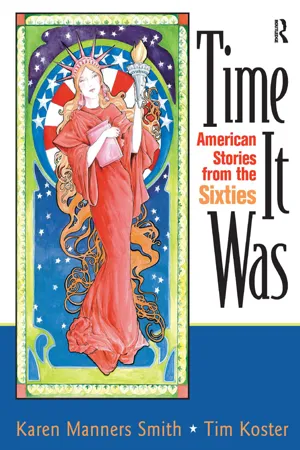
What was it like to live through the Sixties? The writers of these 27 memoirs offer the essence of life and youth in the period. In first-person narratives that range from poignant reminiscences to dramatic adventures, the writers convey what it felt like to land a helicopter in the middle of a firefight in Vietnam, to be beaten and jailed for trying to integrate restaurants in the American South, to run for cover when soldiers opened fire on a campus peace rally in Ohio. Other stories describe the writers' experiences organizing farm workers with Cesar Chavez, campaigning to elect Barry Goldwater, striking for Free Speech at Berkeley, living in a commune, joining the women's liberation movement, becoming caught up in a religious cult, or camping in the rain at Woodstock.
For the United States, the Vietnam War (1961–1975) was the single most devastating episode of the larger Cold War, the near half-century of political and ideological tensions between the East and the West that reverberated around the globe from 1945 to 1991. It has also been said that the Vietnam War was the most divisive event in U.S. history since the Civil War, pitting Americans on the home front against each other in support of the war or in angry opposition to it. Along with the Civil Rights Movement, the war in Vietnam—and responses to it—shaped much of what we have come to think of as the history of the 1960s. The Vietnam War is still fresh in many minds; its validity and meaning are still contested and still politically sensitive. Veterans, survivors, and their families in both the United States and Vietnam still live with the after-effects.
The stories in this section illustrate multiple aspects of the war and its long aftermath. Two are written by American combat soldiers, one by a Red Cross volunteer, and another by a draft resister who became a conscientious objector. The author of the final story is a former Vietnamese national, forced to flee his own country, who came to the United States as a refugee in the late 1970s.
In the Vietnam War, more than 58,000 Americans were killed or classified as missing in action and more than 153,000 were wounded. Nearly two million Vietnamese soldiers and civilians on both sides of the conflict lost their lives. Hundreds of thousands more were injured and maimed. There were also casualties among American allies from South Korea, Australia, New Zealand, and the Philippines. Agent Orange defoliated vast tracts of Vietnam and much of the country’s environment was poisoned by toxins used during the war. Both the Americans and the North Vietnamese planted mines throughout the landscape and along the coastal waters. In the end, the United States removed its military from South Vietnam, and the victorious North Vietnamese Army forcibly unified the country under Communist leaders. Thousands of war refugees fled Vietnam, seeking asylum throughout the world but mostly in the United States.
The United States first became involved in the life and politics of Vietnam in the 1950s, while trying to help the French sustain their colonial empire in Southeast Asia. After a disastrous defeat at Dien Bien Phu in 1954, the French withdrew, leaving a revolutionary Communist-leaning government on the north side of a Demilitarized Zone (DMZ). Vietnam was divided pending reunification elections but those elections never occurred. From 1954 onward, U.S. presidents sent civilian and military “advisors” to help train South Vietnamese soldiers; all U.S. policy decisions were based on the perceived need to maintain a Western presence in Vietnam to halt the spread of Communism throughout Southeast Asia. However, insurgent Communists formed a “National Liberation Front” in South Vietnam in 1960. The insurgents, later known by the name “Viet Cong,” waged guerilla warfare throughout the south in support of the efforts of the North Vietnamese Army and the Communist government of North Vietnam.
In late 1963, the government of South Vietnamese premier Ngo Dinh Diem was toppled in a coup that had the covert support of the U.S. government (U.S. leaders felt Diem’s government was ineffectual in halting the spread of Communism). The following August, North Vietnamese torpedo boats allegedly attacked U.S. destroyers in the Gulf of Tonkin, an event which precipitated President Johnson’s order for retaliatory air strikes against North Vietnam. Passing the Gulf of Tonkin Resolution in 1964, Congress gave Johnson full authority to “take all necessary measures to repel any armed attack against forces of the United States and to prevent further aggression.” From this point on, the war expanded, drawing more and more American military into what turned out to be a quagmire, a war of attrition in which neither side gained territory and the only assessments of progress were body counts. The U.S. Congress never officially declared war.
Lyndon Johnson had committed the country to a war it could neither win nor withdraw from without—as he saw it—appearing weak and defeated to the rest of the world. Johnson’s presidency foundered as the Vietnam War grew increasingly unpopular at home and abroad. By 1968, the year of the Tet Offensive, the My Lai Massacre, and massive anti-war demonstrations in the United States, nearly half a million American men were in Vietnam and Republican presidential candidate Richard Nixon was promising the electorate that he would bring peace with honor.
During Nixon’s first term, gradual troop withdrawals began. Nixon’s stated program was to remove all the Americans and turn the fighting entirely over to the South Vietnamese. But in 1970, Nixon ordered the invasion of Cambodia and made incursions into Laos. Protests erupted on campuses all across the United States and unarmed student demonstrators were shot and killed by National Guard units and police at Kent State and Jackson State Universities.
At the Paris Peace Talks in 1973, both sides agreed to a cease-fire and the last American troops departed in March. But the war in Vietnam dragged on until the South Vietnamese government surrendered to North Vietnam. In April 1975, the last Americans—embassy staff, marine guards, civilian workers, and their dependents—along with South Vietnamese loyalists, were hastily evacuated by plane and helicopter. The Provisional Revolutionary Government took control on June 6, 1975. Vietnam and the United States did not normalize diplomatic relationships until the 1990s.
Vietnam left a bitter memory in the minds of most Americans. People had lost friends and family members; veterans returned scarred and traumatized. Other young men had fled the country, never (they assumed) to return. There were no gains from the Vietnam War, only losses. Had it been worthwhile, Americans asked each other, or had it been a terrible mistake? Did the government ever tell us the truth about what was actually going on in Vietnam? The questions are still being asked. Issues connected with Vietnam continue to affect presidential elections and policy-making to this day. Like so many people whose lives were touched in some way by the Vietnam War, the contributors to this section feel that the war influenced who they became and who they are today.
Brothers Wayne and Paul Coe were born in the late 1940s to a devout Mormon family living in California. Their father was a career Naval officer who had served in World War II. Wayne, the older brother, went directly from high school graduation into an Army flight school, where he earned the rank of Warrant Officer and learned to fly helicopters, fulfilling an ambition that had been growing since his childhood.
In 1967, when Wayne Coe’s story begins, the price of that ambition was a year’s service in Vietnam. Assigned to the Blackhawks, the 187th Assault Helicopter Company based in Tay Ninh, Coe became an aircraft commander with the call sign “Blackhawk 54.” He flew supply and medical evacuation (Medevac) missions from Tay Ninh and other American bases of operation. Frequently under fire, especially when extracting wounded soldiers from live battlefields, Coe was shot down seven times, sustained several injuries, but managed to survive the war. Versions of the stories he tells here first appeared on the Blackhawks’ Vietnam veterans website, where Coe crafted narratives from memories, good and bad, that continue to haunt him more than three decades after the war.
Like most American soldiers in Vietnam, Coe only occasionally interacted with the Vietnamese themselves. Like most soldiers, he trusted individual leaders while remaining skeptical about the military command as a whole, and he decided to interpret the meaning of the conflict for himself. Like many of the young men sent to fight a baffling and perhaps unwinnable war, he focused his heart and his energies on his friends and on saving the lives of his brothers in arms.
Wayne Coe was decorated for his helicopter rescues, but he left the Army as soon as he could after his tour in Vietnam and spent a number of years as a commercial pilot. Now retired, he stays connected with his former comrades in the Blackhawks and commits much of his time to helping other Vietnam veterans find the services they need to cope with war-related illnesses and post-traumatic stress disorder (PTSD).
Unlike his father and his brother, Paul Coe had no military ambitions. A bright and lighthearted California teenager, Paul decided on college and attended the University of California at Berkeley. He sympathized with the antiwar protestors he met at college, even though his brother was serving in Vietnam. As a practicing Mormon, Paul did not drink, smoke, or take drugs. However, after attending a fraternity party where the campus police found some marijuana seeds, he and several other students were expelled from the university. Paul lost his student deferment. In April of 1969, he found himself drafted into the U.S. Army. His letters home from boot camp reveal a gentle, ironic sense of humor, a strong religious faith, and a powerful sense of duty. They also reveal his deep internal conflict about being trained to kill.
Because desertion was not in his character, even though he thought about it, Paul Coe decided to stick with the Army. Following a brief interlude of leave, during which he married his college sweetheart, he was sent to Vietnam. Initially assigned to an office job, Paul grew impatient with the Army’s wartime bureaucracy and infuriated by the incompetence and complacency of the “lifers.” He requested a field posting to an instant reconnaissance team.
There is no accurate count of the number of American women who worked in Vietnam during the conflict, but estimates exceed 7,000. In that period, decades before women could be assigned to combat units, they were able to participate in a variety of ways. Women served in all branches of the military as professional nurses and physical and occupational therapists. There were women air traffic controllers, intelligence and language specialists, and administrators. Civilian women worked in Vietnam in the Red Cross, the U.S. Agency for International Development (USAID), and the U.S. Health Service, as well as in other government agencies. There were also American women journalists in Vietnam, as well as a number of women who volunteered to work as missionaries and social service workers with churches and humanitarian organizations.
Fresh out of college, Leah O’Leary decided that she wanted to see for herself what the war in Vietnam was about. She was also looking for an adventure. In 1968 she joined the Red Cross’s Supplemental Recreation Activities Overseas (SRAO) program and became a “Donut Dollie,” a nickname she explains in her story.
Donut Dollies wore light blue cotton uniforms with knee-length skirts and black loafers or light blue sneakers. They ran recreation centers on bases, but they also visited groups of soldiers anywhere they were standing down or providing support services to troops in the field. Donut Dollies worked 10- to 12-hour days, usually six days a week, and traveled long distances by helicopter or in military vehicles over mined roads. Sometimes they lived in tents, and, even in places where they had plumbing, they most often had to use outhouses. Surrounded in a strange land by people with whom they could not speak and with whom they had little direct contact, heavily protected by military guards, hedged in by strict rules governing their conduct, and aware that danger was always nearby, Donut Dollies nevertheless found ways to make their jobs in Vietnam meaningful to themselves and to the young enlisted men they were assigned to entertain.
Initially skeptical about the utility of conducting recreation programs in a war zone, O’Leary later saw value in her low-key, friendly interaction with young American men sent halfway around the world to fight in a war that terrified and threatened to dehumanize them. Although O’Leary’s story minimizes the heat and the hard work of wartime service in Vietnam, she does not hesitate to discuss her feelings of cultural isolation or her emotionally charged encounters with young men living constantly on the edge of death. Donut Dollies were kept away from combat areas; they did not nurse or even visit with casualties right off the field. Yet, as O’Leary tells us, they felt and understood what was going on all around them. Donut Dollies suffered from PTSD in the years following their tours in Vietnam, as did soldiers and nurses. Today, Leah O’Leary continues to process her memories and to dedicate her life to international service. She runs A Red Thread Adoption Services, Inc., an agency specializing in foreign adoptions.
While Wayne Coe and Leah O’Leary chose to go to Vietnam, and Paul Coe went because he was drafted, there were others whose hatred of war, and particularly the war in Vietnam, led them to resist the draft in a variety of ways. Tim Koster, born in the Midwest, a former high school football player, had just turned 20 and was attending Boston University. However, before starting college he had worked in a warehouse to earn money for tuition, so he was not enrolled in enough total hours to maintain his student deferment. He was reclassified I-A, becoming eligible for service just before the first draft lottery drawing in December 1969. Koster’s story tells about his journey from youthful naiveté to political awareness through his educational and social encounters in Boston—a national center of the anti-war and draft resistance movements during the 1960s and 1970s—and his surprising and creative response to being drafted to fight in a war he could not support.
The United States has used the system of a draft—the enforced conscription of able-bodied men to fight the country’s wars—off and on since the nineteenth century. In 1940, the Selective Training and Service Act created the country’s first peacetime draft and made the Selective Service System an independent federal agency. During World War II, the agency used a lottery system, and after the war, whether the United States was at peace or at war, all men between 18 and 26 had to register for the draft and any number could be called up to fill vacancies in the armed forces that had not been filled through voluntary enlistments. Draft deferments in the 1960s were available to full-time students, men involved in occupations considered vital to the country, those physically unable to serve, and those with serious hardships, prior service, or any one of several other classifications. The draft-eligible were classed I-A, full-time students were II-S, conscientious objectors, I-AO, I-O, or I-W, and those physically unable to serve were IV-F.
The first draft lottery of the Vietnam War was held on December 1, 1969. All the dates of the year, enclosed in blue plastic capsules in a giant glass bowl, were drawn one by one and matched to lottery numbers 1 to 366. The first date picked was September 14 and the last was June 8. That meant that all men born on September 14 in any year between 1944 and 1950, if not otherwise exempt, would be the first to be drafted for the year 1970. It was generally considered that if your birth date fell among the first 100 to 120 numbers drawn, you were headed for military service. If you were born on June 8 (lottery number 366), you could relax. The active draft ended in 1973, though draft registration is still in place.
In 1969, when Tim Koster’s number came up, his life and all his plans were transformed beyond anything he could have foreseen. He was confronted with a set of unappealing choices: he could join one of the military services or be drafted into the Army; he could refuse the draft and go to prison; he could leave the country, never able to return, and eventually sacrifice his American citizenship. He could file for status as a conscientious objector—an official pacifist—although it was almost impossible to be classified as a CO because many draft boards required the applicant to demonstrate a lifetime of religious or ethical commitment to pacifism. If, however, a young man were to be reclassified CO, he could either work as a medic in the Army or be assigned in the United States to a service job that contributed to the national safety, welfare, or health. One thing Koster could not do was continue with the life he had planned. He decided to seek the advice of draft counselors and make himself familiar with the activities of the draft resistance movement being organized by his peers. When he received his draft notice, he left the country to give himself more time to plan his response.
Most draft resisters, contrary to some historical accounts, were highly principled young men who opposed the war in Vietnam and refused to participate in it. They organized protests, picketed draft boards, and published pamphlets and newsletters. They counseled each other on ways to avoid the draft by deliberately failing the physical exam, or finding exempt employment, or leaving the country, most often for Canada, which had no legal provisions for extraditing young men seeking immigrant status simply because they were draft-eligible in their cou...
Table of contents
Cover
Half Title
Title Page
Copyright Page
Dedication
Table of Contents
Preface
Acknowledgments
Introduction
1 Vietnam
2 Struggles for Social Justice
3 Pathways
4 Conservative Currents
5 Landmark Events
6 Speaking Out
The Contributors
Trusted by 375,005 students
Access to over 1.5 million titles for a fair monthly price.
Study more efficiently using our study tools.
Frequently asked questions
Yes, you can cancel anytime from the Subscription tab in your account settings on the Perlego website. Your subscription will stay active until the end of your current billing period. Learn how to cancel your subscription
No, books cannot be downloaded as external files, such as PDFs, for use outside of Perlego. However, you can download books within the Perlego app for offline reading on mobile or tablet. Learn how to download books offline
Perlego offers two plans: Essential and Complete
Essential is ideal for learners and professionals who enjoy exploring a wide range of subjects. Access the Essential Library with 800,000+ trusted titles and best-sellers across business, personal growth, and the humanities. Includes unlimited reading time and Standard Read Aloud voice.
Complete: Perfect for advanced learners and researchers needing full, unrestricted access. Unlock 1.5M+ books across hundreds of subjects, including academic and specialized titles. The Complete Plan also includes advanced features like Premium Read Aloud and Research Assistant.
Both plans are available with monthly, semester, or annual billing cycles.
We are an online textbook subscription service, where you can get access to an entire online library for less than the price of a single book per month. With over 1.5 million books across 990+ topics, we’ve got you covered! Learn about our mission
Look out for the read-aloud symbol on your next book to see if you can listen to it. The read-aloud tool reads text aloud for you, highlighting the text as it is being read. You can pause it, speed it up and slow it down. Learn more about Read Aloud
Yes! You can use the Perlego app on both iOS and Android devices to read anytime, anywhere — even offline. Perfect for commutes or when you’re on the go. Please note we cannot support devices running on iOS 13 and Android 7 or earlier. Learn more about using the app
Yes, you can access Time It Was by Karen Manners Smith,Tim Koster in PDF and/or ePUB format, as well as other popular books in History & North American History. We have over 1.5 million books available in our catalogue for you to explore.