eBook - ePub
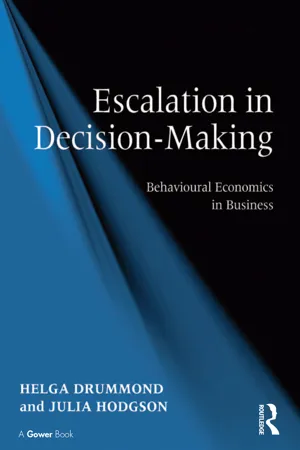
Escalation in Decision-Making
Behavioural Economics in Business
- 180 pages
- English
- ePUB (mobile friendly)
- Available on iOS & Android
eBook - ePub
About this book
When a venture seems to be faltering, do you persist and hope that things will get better or do you cut your losses? This may be one of the most important decisions business or project owners may ever have to make. Persistence involves the risk of throwing good money (or resources) after bad, but owners may feel they have too much invested to quit now. Escalation in Decision-Making reveals why social scientists believe that owners may not respond rationally to such predicaments. Instead of exiting when the odds are clearly stacked against them, they re-invest and end up compounding their losses - a phenomenon known as escalation of commitment. The authors, Helga Drummond and Julia Hodgson, also introduce the concept of entrapment, a variation whereby decision-makers passively drift towards insolvency as the cost of changing direction becomes too high. So: · what drives escalation? · why do some owners quit whilst others persist until the bailiffs arrive? · what can we learn from owners' mistakes? · what makes newcomers believe they can succeed where others are conspicuously failing? These questions of behavioural economics are answered using a narrative that analyses decisions made by market traders facing economic extinction. Many highly successful entrepreneurs started their careers in markets - it was once an almost guaranteed route to prosperity - now market traders are struggling to survive. Although the market traders featured are small entrepreneurs, the ubiquitous phenomenon of escalation at the heart of these stories is widely relevant to practitioners such as project managers in large organizations and to those responsible for managing risk in many situations. Rich in case studies involving real business decisions and dilemmas, Escalation in Decision-Making provides an accessible introduction to the application of theory against a background of growing interest in behavioural economics, now being researched and taught in univ
CHAPTER 1
If at First You Don’t Succeed – Then What? Introduction to Escalation Theory
If at first you don’t succeed, try, try again. Then quit.
No use being a damn fool about it.
No use being a damn fool about it.
(W.C. Fields)
Introduction
In 1961 something remarkable happened in the Libyan Desert. Eight years earlier in 1953 an obscure entrepreneur named Bunker Hunt applied for a drilling licence. The prospects were exciting, as geologists advised Hunt that an oilfield recently discovered in Algeria would almost certainly extend into Libya. Unfortunately for Hunt the so-called ‘Seven Sisters’ (multi-national oil companies) were already drilling in the best sites. The only concession available to Hunt was so far remote from the Algerian border offering such miserable prospects that even the customary bribe to local officials was waived:
The story could have ended there … except for Bunker’s instinct. As a gambling man, he believed that the more cards he could draw on, the better his chances would be, even if the cards were those no one else thought worth picking up. (Fay 1982: 5)
Indeed Hunt drilled for years and found nothing. Moreover, despite their markedly better chances, the ‘Seven Sisters’ did no better drilling near Algeria. Eventually, one of the ‘Sisters’ – British Petroleum (BP) – gave up and went into partnership with Hunt:
The deal did not at first change Bunker’s luck. In 1961 BP’s experienced drilling teams struck out into the desert and drilled one well in Block 65. They reported that it was dry. So was the second well, and the third. (Fay 1982: 6)
The rig superintendent was instructed by BP to stop drilling and return home. It was the final shattering blow for Hunt who had invested all his money in the venture:
Then, just for luck, the rig superintendent drilled another ten feet into the sand before withdrawing the bit from the third hole, and, in doing so, uncovered Bunker’s ace. That ten feet was enough to pierce the cap of one of the world’s largest oil fields. (Fay 1982: 7)
How Decisions Should Be Made
Any decision involving uncertainty runs the risk of failing. When it becomes apparent that a venture is not turning out as expected, decision-makers may face a dilemma. Do they cut their losses or risk ‘throwing good money after bad’? We will probably never know what made the foreman decide to drill drown another 10 feet. Yet supposing that the decision had proved abortive – then what? It is not difficult to imagine the foreman drilling down another 10 feet, and then another 10 feet and so on.
Economics teaches that such futile persistence is wrong. To be more precise, decision theory assumes that decision-makers aim to maximize future outcomes. In order to attain that goal, decision-makers should invest resources only after careful and objective assessment of all available options. Assessment, moreover, should reflect future costs and future revenues and/or other benefits – not hunches or wishful thinking.
Why Decisions Are Not Always Made as They Should Be Made
Research by behavioural scientists suggests that decision-makers may not always behave so rationally. That is, instead of ending unsuccessful ventures, decision-makers may be tempted to reinvest resources in them, hoping of pull matters round but usually only to make things worse – a phenomenon known as escalation of commitment.
More precisely, escalation means persistence with a course of action beyond a rationally defensible point. In other words, beyond the point where feedback reliably indicates that expectations are unlikely to be met. For example, if marginal costs are consistently higher than marginal revenues. A typical escalation scenario is thus one where:
1. Resources are invested in anticipation of results.
2. Feedback progressively worsens until eventually it becomes clear that expectations are unlikely to be met.
3. There is an opportunity to quit or continue.
4. The precise consequences of quitting and continuing are unknown.
Almost any risky investment decision can result in escalation. For example, whether to remain ‘on hold’ on the telephone, whether to continue an unrewarding personal relationship, whether to repair a car that is in danger of becoming a liability or abandon a multi-million pound infra-structure project like Amsterdam’s controversial metro system or the UK’s multi-billion-pound faltering NHS electronic patient record system. The defining feature of escalation scenarios is that they involve a continuing cycle of active reinvestment in response to negative feedback (for example, Staw 1981, Ross and Staw 1986, Staw and Ross 1987a,b, 1989, Staw 1997).
What Causes Escalation?
Why should anyone want to ‘throw good money after bad’? It seems bizarre. There are four main schools of thought about what drives escalation, namely:
1. Self-enhancement – needing to look good.
2. Emotional attachment to sunk costs.
3. Risk-seeking behaviour.
4. Uncertainty.
Each of these theoretical perspectives is explained in turn as follows.
Needing to Look Good: The Self-Enhancement Motive
Theories of self-enhancement suggest that escalation is primarily driven by the pursuit of self-esteem, that is, our innate desire, as human beings, to look good in our own eyes and in the eyes of significant others (for reviews of the literature see Pfeffer and Fong 2005, Staw 1997, 1981, Brockner 1992, Zhang and Baumeister 2006 and Crocker and Park 1974).
When it comes to decision-making, self-esteem means we need to be proved right. For example, in a consumer behaviour experiment, two groups received a sample of paint, ‘try before you buy’ as it were. One group paid a small amount for the sample. The other group got it free. When researchers compared levels of satisfaction, between the two groups they found paying customers were more satisfied with the paint than non-payers (experiment cited in Salancik 1977). Likewise, individuals who are free to choose from a variety of job offers subsequently reported higher levels of satisfaction and were less likely to leave than job applicants with less freedom of choice (O’Reilly and Caldwell 1981). Supervisors typically give higher performance appraisal ratings to staff they have personally selected than staff they did not appoint. It is as if supervisors unconsciously say to themselves, ‘I chose them therefore they must be good’ (Schoorman 1988; see also Bazerman, Beekun and Schoorman 1982).
PERSONAL RESPONSIBILITY FOR FAILURE
The risks of escalation may be heightened if decision-makers are liable to be held personally responsible for failure. In a seminal paper entitled ‘Knee-Deep in the Big Muddy’ (Staw 1976) observed:
It is often possible for the decision-maker to greatly enlarge the commitment of resources and undergo the risk of additional negative outcomes in order to justify prior behaviour or demonstrate the ultimate rationality of an original course of action. (Staw 1976: 29)
The argument is that once resources are invested in anticipation of results, decision-makers tend to feel the need to justify their investment. What better way to signal that the decision was the correct one than by reinvesting in it? Staw seems to have had in mind US embroilment in Vietnam. In 1965 George Ball, former Undersecretary of State, warned President Lyndon Johnson to think carefully before scaling-up US military deployments:
Once large numbers of U.S. troops are committed to direct combat, they will begin to take heavy casualties in a war they are ill-equipped to fight in a non-cooperative if not downright hostile countryside. Once we suffer large casualties, we will have started a well-nigh irreversible process. Our involvement will be so great that we cannot – without national humiliation – stop short of achieving our complete objectives. Of the two possibilities, I think humiliation would be the more likely than the achievement of our objectives – even after we have paid terrible costs. (Memo from George Ball to President Lyndon Johnson, July 1965; source The Pentagon Papers 1971; cited in Staw 1976: 29)
This communication proved prescient. Three years later on 4 March 1968 a presidential meeting in the White House noted that even with the addition of another quarter of a million men the war might continue without accomplishing its purpose and with no end in sight.
The conflict in Vietnam overshadowed Johnson’s presidency, eclipsing his achievements and, as we now know, driving Johnson to heavy drinking and depression as he found himself locked in to an unwinnable war. Likewise, to exit empty-handed from the military conflict in Afghanistan is tantamount to saying that troops have died for nothing.
Staw (1976) conducted an experiment to test responsibility theory. Two groups of undergraduates studied a scenario describing a company that had experienced a decade of decline due to problems in the research and development (R&D) department. Group 1 were given $10 million to invest in R&D and asked to decide which of the two major divisions to support, that is, consumer or industrial products. The group was asked to justify their decision in writing.
Notice what happens here. A clear volitional choice is made. It is a decision with potentially far-reaching consequences and is difficult to reverse. Moreover, responsibility for the decision is clearly pinned to individuals. Participants then received feedback. They learn that, five years on, the company now believes an even greater investment in R&D is required and therefore $20 million are now available. This time, however, instead of making an ‘either/or’ decision, participants can divide the money between the two divisions as they see fit. Again, written justification is required. Half of Group 1 subsequently learns that the divisions are now profitable. The other half of Group 1 learns that profits have fallen and that their decision has failed.
In contrast, Group 2 only participated in the second allocation decision. Group 2 did not decide which division to support initially, but were told that decision had been made by someone else. Both Groups, that is, those ‘responsible’ for previous decisions and those in the ‘not responsible’ category, again decided how much money to allocate. As expected, Staw found that participants responsible for an initially unsuccessful decision tended to direct more money to support ailing divisions than those who merely inherited the problem.
Research can never prove a theory. It merely fails to disprove it (Popper 1959). Subsequent tests of responsibility theory have produced mixed results. Whilst some studies have replicated the effect (for example, Conlon and Parks 1987, Kirby and Davis 1998, Schoorman et al. 1994, Whyte 1991a), other studies, including other Staw’s own work, have found no effect for responsibility (for example, Staw and Fox 1977, Conlon and Garland 1993, Karlsson et al. 2002) – even when repeating Staw’s original experiment (Armstrong, Coviello and Safranek 1993).
Two mathematical field experiments require special mention, however. Staw and Hoang (1995) found that team managers who paid large sums of money to recruit star players tended to use them more frequently than their goal-scoring record would warrant. Likewise, Staw, Barsade and Koput (1997) found that bank managers are more likely to perpetuate problem loans if they loaned the money in the first place than if they merely inherit someone else’s bad-loan book. These two studies are important because whereas aforementioned laboratory experiments merely required respondents to give hypothetical answers to hypothetical questions, in these two quantitative field studies, researchers actually observed how decision-makers behaved in practice so they provide more powerful support for responsibility theory than laboratory-based studies.
LAPSING INTO DENIAL
Clearly, few people would reinvest in a venture if they knew for certain that it was doomed to fail. The trouble is, decision-makers may not realize how bad things are because when negative feedback arrives, they lapse into denial. Beleaguered decision-makers typically narrow down the range of information that they consider, paying more attention to feedback that supports their preconceived views whilst downplaying or even ignoring disconfirming (for example, Nisbett and Ross 1980, Kahneman, Slovic and Tversky 1982, Staw, Sandelands and Dutton 1981). Alternatively, or additionally, they may distort the magnitude of a setback, seeing it perhaps as a minor hiccup, or even a blessing in disguise (Staw and Ross 1978). Moreover, if decision-makers can blame failure on factors beyond their control such as the business cycle, currency fluctuations or even the weather they may feel justified in escalating their commitment (Staw and Ross 1978). Since these processes are thought to occur unconsciously, the decision-maker may genuinely believe that the problems are temporary, that success is close and so forth, and reinvest accordingly.
OBSESSION WITH THE PAST
Recall that optimal decision-making means maximizing future outcomes. Yet when a venture begins to unravel, decision-makers may be more interested in defending past actions than optimizing future possibilities (for example, Beeler and Hunton 1997). For instance, they may spend hours and hours going over previous decisions again and again, at the expense of addressing immediate problems and opportunities. In extreme circumstances, decision-makers may lose touch with reality altogether – just like Hitler who eventually retreated to his bunker to command armies and an air force that no longer existed.
Such obsession with defending past actions may be helpful psychologically because it enables decision-makers to reduce the dissonance created by the gap between prior expectations and actual results. Dissonance theory (Festinger 1957) predicts that we strive for consistency between what we believe and how we behave. For example, if an entrepreneur buys a pub knowing that all owners over the previous 10 years have gone bankrupt they may experience dissonance. Clearly it is nonsense to invest money in a business that is almost certain to fail. Dissonance theory suggests that the entrepreneur may persuade themselves that previous tenants lacked the requisite skills and experience to run the pub successfully, or that they underinvested in the business. Such self-serving attributions reduce the dissonance created by buying the pub. When the pub subsequently proves unprofitable, another way of reducing the dissonance created by the gap between expectations and results is to reinvest in it (Staw 1981 also discusses the impact of dissonance on escalation).
AUDIENCE EFFECTS
Admitting failure privately is hard enough. Admitting it publicly may be even harder – so the presence of an audience is potentially powerfully conducive to escalation. Socially instilled norms – to be consistent, to fulfil our promises, to be resolute in the face of difficulties, to finish what we have started – can also make it hard to reverse unsuccessful decisions (for example, Drummond 2001, Ross and Staw 1986, 1991). For example, Margaret Thatcher became so locked in to her ‘not for turning’ persona and so personally identified with ‘Thatcherism’ that she could not change direction even when her political survival was at stake.
Escalation may be driven by the simple desire to show off. For example, Tata Steel’s questionable £6.7 billion bid for Corus in 2007 may have been driven more by hubris, a desire to become a global player in the steel industry and above all to impress rivals like Mittal Steel, rather than by economic logic.
The evidence for audience effects is not just anecdotal. In an experiment, two groups of participants were invited to set limits on their involvement in an investment decision before committing funds and before receiving feedback. One group set limits in public; the other group were allowed to set limits in private. Those who set limits in public stopped investing when those limits were reached even though their economic data said ‘continue’. Asked why they behaved in such an economically irrational manner, participants said they thought it would ‘look good’ to be seen to adhere firmly to their publicly stated intentions (Brockner, Rubin and Lang 1981). Similarly, a study by Beeler and Hunton (1997) found that decision-makers who announced new ventures with a fanfare were more prone to escalation that those who did not.
The Royal Institution of Chartered Surveyors estimates that the cost of pursuing a boundary dispute involving a parcel of land worth £700 it is likely to exceed £70,000; that is, at least a hundred times more than the land is worth. Yet there is never any shortage of litigants. Behavioural scientists might say that such seemingly irrational litigation is pursued because although the land is worth very little, dispossession poses a threat to owners. Certainly empirical evidence suggests that people are more likely to perpetuate an ineffective course of action if failure either threatens their identity or reflects badly upon them – for instance, if failure could be seen as implying that they lack the necessary skills for a job (Brockner et al. 1986, Zhang and Baumeister 2006).
Competition is thought to be powerfully conducive to escalation. Imagine being invited to bid for a £1 coin. There is no reserve price so, in theory, the coin may be had for as little as one penny. There is only one snag: the second highest bidder must also pay the bid price and they receive nothing (Teger 1980, Shubik 1971). Would you bid?
When we run the experiment with large groups of undergraduates it is never difficult to attract bidders. Most students bid for fun and soon drop out. Yet inevitably two bidders become trapped in a mutually destructive spiral as the hammer price of the coin soars well above its face value – £4.15p at the last attempt. Bid prices tend to be even higher with MBA students as they have more money than undergraduates. The auction shows how decision-makers can become caught up in escalatory spirals almost by accident. Interestingly, when bidders are debriefed it is apparent that bidding is partly driven by unwillingness to lose face in front of an audience and desire for revenge. The experiment is a metaphor for potentially suicidal price wars between airlin...
Table of contents
- Cover Page
- Title Page
- Copyright Page
- Contents
- List of Tables
- Acknowledgements
- About the Authors
- Introduction
- A Note on Method
- Chapter 1 If at First You Don’t Succeed – Then What? Introduction to Escalation Theory
- Chapter 2 Shutters Up: A Walk Round the Market
- Chapter 3 ‘Maybe We Can Make A Go Of It’: How Does Escalation Start?
- Chapter 4 Missing the Boat or Sinking the Boat? The Realities of Escalation
- Chapter 5 ‘You Think It’s Going to Turn Round’: Escalation
- Chapter 6 Five Past Midnight: Introduction to Entrapment Theory
- Chapter 7 Entrapment in Practice
- Chapter 8 ‘I’m Getting Out’: Escalation and Entrapment Avoided
- Chapter 9 Escalation and Entrapment Theories Revisited
- Chapter 10 Beyond Magic Thinking: Making Better Decisions – 10 Lessons For Practice
- Epilogue
- Appendix
- References
- Index
Trusted by 375,005 students
Access to over 1.5 million titles for a fair monthly price.
Study more efficiently using our study tools.
Frequently asked questions
Yes, you can cancel anytime from the Subscription tab in your account settings on the Perlego website. Your subscription will stay active until the end of your current billing period. Learn how to cancel your subscription
No, books cannot be downloaded as external files, such as PDFs, for use outside of Perlego. However, you can download books within the Perlego app for offline reading on mobile or tablet. Learn how to download books offline
Perlego offers two plans: Essential and Complete
- Essential is ideal for learners and professionals who enjoy exploring a wide range of subjects. Access the Essential Library with 800,000+ trusted titles and best-sellers across business, personal growth, and the humanities. Includes unlimited reading time and Standard Read Aloud voice.
- Complete: Perfect for advanced learners and researchers needing full, unrestricted access. Unlock 1.5M+ books across hundreds of subjects, including academic and specialized titles. The Complete Plan also includes advanced features like Premium Read Aloud and Research Assistant.
We are an online textbook subscription service, where you can get access to an entire online library for less than the price of a single book per month. With over 1.5 million books across 990+ topics, we’ve got you covered! Learn about our mission
Look out for the read-aloud symbol on your next book to see if you can listen to it. The read-aloud tool reads text aloud for you, highlighting the text as it is being read. You can pause it, speed it up and slow it down. Learn more about Read Aloud
Yes! You can use the Perlego app on both iOS and Android devices to read anytime, anywhere — even offline. Perfect for commutes or when you’re on the go.
Please note we cannot support devices running on iOS 13 and Android 7 or earlier. Learn more about using the app
Please note we cannot support devices running on iOS 13 and Android 7 or earlier. Learn more about using the app
Yes, you can access Escalation in Decision-Making by Helga Drummond,Julia Hodgson in PDF and/or ePUB format, as well as other popular books in Business & Business General. We have over 1.5 million books available in our catalogue for you to explore.