eBook - ePub
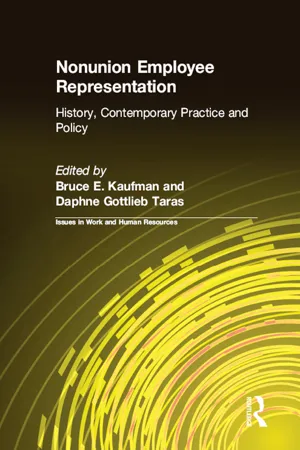
Nonunion Employee Representation
History, Contemporary Practice and Policy
- 590 pages
- English
- ePUB (mobile friendly)
- Available on iOS & Android
eBook - ePub
Nonunion Employee Representation
History, Contemporary Practice and Policy
About this book
Examines the history, contemporary practice, and policy issues of non-union employee representation in the USA and Canada. The text encompasses many organizational devices that are organized for the purposes of representing employees on a range of production, quality, and employment issues.
1
Introduction
The subject of this volume, nonunion employee representation (NER), until recently has languished in relative obscurity and neglect, particularly in Canada and the United States. Indeed, we are unaware of any book published in several decades in either country that deals explicitly with NER, while journal articles in business and the social sciences on this topic are sparse in number, nearly all historical in nature, and usually focused on the American experience with “company unions” of the 1915–35 period. When the National Labor Relations Act (NLRA, or Wagner Act) banned company unions and most other forms of NER in the United States in 1935, the subject abruptly passed from a major issue of contemporary research and policy debate to a peripheral topic in the field of labor history.
NER has returned as an important and contentious issue in both academic and policymaking circles. Four trends and developments of recent years have infused new life into the subject. The first is the marked long-term decline in the organized labor movement in the United States and, to a lesser degree, Canada and most other industrialized nations in the world. Certainly in the U.S.–Canada context, independent trade unions have for five decades or more been established by law and public policy as the principal and even preferred organizational form for representation of employee interests. When one-third or more of U.S. private-sector workers in the 1940s and 1950s belonged to unions, and an even larger proportion in Canada, making unions the primary or even sole agency for collective employee representation did not seem unduly narrow or restrictive. But in the late 1990s only slightly more than 10 percent of private-sector employees in the United States are union members, and the Canadian private-sector figures have declined to fewer than 22 percent. Concern is growing over the large and apparently widening gap between the substantial proportion of the workforce that desires representation at work and the dwindling proportion that has such representation through membership in independent labor unions (Freeman and Rogers 1993). There are two main proposed public policy responses to this “representation gap” (Commission on the Future of Worker-Management Relations 1994). The first is to bolster the membership and coverage of unions, both by changing the laws to make organization swifter and surer and by devising more effective union organizing strategies; the second is encouragement of alternative, nonunion forms of representation in the workplace. This second option, such as joint industrial councils, peer-review dispute-resolution panels, joint labor-management safety committees, European-style works councils, and nonunion professional employee associations, is the subject of this volume.
A second trend having much the same effect is the popularization of new forms of management and work organization, variously referred to as participative management, employee involvement, and the “high performance” workplace (Lawler 1986; Lawler, Albers, and Ledford 1992; Levine 1995). In years past, management tended to organize work in a top-down, “command-and-control” system. At the top of the organizational pyramid were high-level executives who designed strategy and established broad company policy directives. In the middle of the pyramid were gradations of staff and management who executed policy, supervised shop floor employees, and reported operational results and problems back up the chain of command. At the bottom were the mass of employees who followed orders and produced goods and services.
Although popular with managers and economically successful for a number of decades, this traditional form of organization increasingly is regarded as anachronistic in an era of heightened global and domestic competition, information and skill-intensive production systems, shortened product and technology life cycles, and greater employee expectation of involvement and satisfaction at work. As a result, leading companies have been developing and implementing new work systems, often called high-performance workplaces. The traditional command-and-control system has given way to decentralized decision making, team forms of production, and enhanced opportunities for employee involvement and participation. In most medium- to large-size work situations, this participation necessarily must be representational in nature for reasons of cost and efficiency. Traditional collective bargaining provides one mechanism for such representation and involvement, but many business executives have neither the basic inclination nor economic incentives to recognize and bargain with trade unions, nor do the majority of workers express a desire for union representation. As a consequence, interest in and experimentation with alternative nonunion representational structures has proliferated in recent years among both management advocates of employee involvement and labor advocates of industrial democracy. By promoting greater opportunities for employee voice in nonunion situations, these representational groups not only serve management interests in improved productivity and communication, but also ensure that employee interests in equitable terms and conditions of employment are factored into management decision making.
A third, and uniquely American, development that has given much greater saliency to the subject of nonunion representation is the ongoing political debate over reform of the NLRA (Estreicher 1994; LeRoy 1996). The Wagner Act contains statutory restrictions that have had the effect of banning most forms of nonunion employee representation. As stated in the NLRA, it is an unfair labor practice for management to participate in, dominate, or interfere with a labor organization. Forbidden forms of labor organization include various committees, teams, and councils that are of a representational nature and are created, financed, or operated by the employer and involve bilateral discussions about the terms and conditions of employment. Table 1.1 includes the relevant sections of the Wagner Act that pertain to NER. For comparison purposes, Table 1.1 also contains the provisions relating to NER from the U.S. Railway Labor Act (RLA), and an amalgam of twelve Canadian statutes, blended for convenience into what we term “the Canadian approach.”
Critics of the NLRA (and, to a lesser degree, the RLA) claim that its strictures inhibit the ability of American companies to form and operate employee involvement and participation programs in nonunion workplaces and thereby harm both national competitiveness and cooperative employer-employee relations. For several years running, a coalition of Republican and conservative Democrats in Congress have sought to enact legislation, popularly known as the “TEAM Act,” that would weaken significantly the NLRA’s Section 8(a)(2) restrictions on “dominated” labor organizations. TEAM Act legislation was passed by both houses of Congress in 1996, was vetoed by President Clinton, and was reintroduced by its congressional supporters. The ongoing debate engendered by this proposed legislation, as well as that precipitated by the hearings and final report of the Clinton-appointed Commission on the Future of Worker-Management Relations (Dunlop Commission), have put the subject of NER squarely on the front burner of the American labor policy debate.
Table 1.1
Statutory Treatments of Nonunion Representation in the United States and Canada
Statute | Definition | Prohibition |
National Labor Relations Act (Wagner Act, 1935) | Section 2(5). A labor organization is “any organization of any kind, or any agency or employee representation committee or plan in which employees participate and which exists for the purpose, in whole or in part, of deal-ing with employers concerning griev-ances, labor disputes, wages, rates of pay, hours of employment, or conditions of work.” | Section 8(a)(2). It is an unfair labor practice for an employer “to dominate or interfere with the formation or administration of any labor organization or contribute financial or other support to it.” |
Railway Labor Act (1926) | Section 1. “Representatives” means only persons or entities “designated either by a carrier or group of carriers or by its or their employees to act for it or them.” | Section 2(2). Representatives for both management and labor “shall be designated by the respective parties and without interference, influence, or coercion by either party over the designation of representatives of the other; and neither party shall in any way interfere with, influence, or coerce the other in its choice of representatives.” |
Section 3(4). It shall be unlawful for any carrier to interfere in any way with the organization of its employees, or to use the funds of the carrier in maintaining or assisting or contributing to any labor organization, labor representative, or other agency of collective bargaining. | ||
Canadian Approach (blending 12 statutes: federal, public service, and 10 provincial labor codes) | Definitions Sections: “Trade union,” “bargaining agent,” “union,” “association of employees,” or “labor organization” means an entity that has as one of its purposes the regulation of relations between employers and employees through collective bargaining. | Unfair Labor Practice Sections: It is an unfair labor practice for any employer or employer representative to participate in or interfere with the formation or administration of a trade union, or representation of employees in a trade union. |
Prohibitions against Certification Sections. Labor boards (or in Quebec, the commissioner-general) shall not certify a trade union if it is employer dominated. |
Proponents of the law claim Sections 2(5) and 8(a)(2) are crucial to protecting employee free choice in matters of union representation by preventing employers from manipulating and coercing workers through “sham” company unions. There also are those who agree that the NLRA treatment is problematic, but are gravely concerned that a movement to change the NLRA with respect to nonunion representation will merely allow management to lawfully employ new techniques to defeat unions. Another group would consider a change to the NLRA only if it was accompanied by more sweeping reform to the act in ways that would facilitate an easier transition to unionization where it is desired by employees.
By contrast, Canadians are not engaged in a similar debate. Canadian legislation, which observers would consider similar in most respects to the Wagner Act, diverged in its treatment of nonunion representation. NER is legal in Canada provided it is not designed to thwart union organizing. In Table 1.1, we blended a variety of Canadian statutes to demonstrate the Canadian approach. At first glance, it appears that the Canadian treatment is quite similar to the American. In Canada, it also is an unfair labor practice for management to participate in, dominate, or interfere with a union. A union that has been influenced by management cannot be certified as a bona fide bargaining agent and will not enjoy the protections of any collective bargaining statutes. Where Canada deviates from the Wagner Act is in the definition of a labor organization. A labor organization means a union, or at the least, a collective entity whose purpose includes regulation of relations through collective bargaining. Management must not interfere with a union, but management may deal openly with groups of nonunion employees on any issue of concern, including the terms and conditions of employment. It is not an unfair labor practice to run a NER plan because Canadian labor boards do not have the reach given to the U.S. National Labor Relations Board by the wording of NLRA Section 2(5). The critical distinction between Canada and the United States rests in the definitions sections of the statutes and not in any departure from the American Section 8(a)(2).
Aside from the contribution the Canadian approach can make in identifying an alternative wording to the NLRA, the Canadian-American divergence has provided scholars with a unique “natural experiment” that hitherto has remained unexploited. Here we have neighboring countries—in broad strokes similar in social, political, and economic institutions and labor policy approaches—that diverged greatly on NER within the corpus of similar labor laws. We think this provides a remarkable opportunity to shed considerable light on issues that otherwise would remain only topics of speculation. For example, what would have happened to the U.S. nonunion employee representation movement if the Wagner Act ban had not been enacted, and would union membership today be higher or lower?
Finally, a fourth trend that has worked to raise interest in NER is the important role that such representation plays in the industrial relations systems of other major industrial countries outside North America (Rogers and Streeck 1995; Wever 1995). Of most relevance in this regard is the European system of works councils, which are found in countries such as Germany, the Netherlands, Italy, and Norway. These councils typically are mandated or highly encouraged by law. They are plant- or establishment-level bodies of elected worker representatives that exist to promote dialogue and negotiation between management and employees, and formally are independent of trade unions (although the two often have a close relationship). Less well known, but also of interest for a North American audience, are the several forms of NER found in Japanese companies.
Although works councils and various forms of NER have existed in these countries for many years, they have captured noticeably greater attention in North America in the past decade. Certainly a major impetus is the widespread conviction that an important determinant of competitive success in the global economy is each nation’s system of industrial relations practices and institutions, a perception that has fueled interest in learning more about alternative systems of employee representation and their impact on important economic and social outcomes. Also important is the Works Council Directive issued in 1996 by the policymaking body of the European Union, which mandates that all member countries establish joint management-labor consultative bodies in large enterprises. In 1997 the Labor government in Britain accepted these accords, requiring implementation within British firms by the end of the century (Younson 1998).
Thus, the “representation gap,” new managerial practices, American public policy debate, and developments abroad have led to a convergence of interest in NER.
Employee Representation: Union and Nonunion Alternatives
This book is about collective representation. We use the term representation to mean that employees have the ability and venue to make their collective needs and opinions known to management. One or more persons must act in an agency function for other employees and communicate, negotiate and/or bargain with company managers over workplace issues of mutual interest and concern. Many companies—even those with high-performance worksites—have no form of employee representation, either because they choose not to as a matter of company policy or because they have not been organized by a labor union.
Employee representation in North America takes one of two basic forms: union or nonunion. The two systems diverge dramatically in a number of key respects.
In a union setting, employees are represented by an independent labor organization, typically a local affiliate of a national or international trade union. In the United States and Canada, the union becomes the exclusive, legally-recognized representational agent of the employees only after it has demonstrated that a majority of the employees desire that it serve this function. In the United States, this typically occurs when a union wins a majority vote of the employees in the designated bargaining unit in a representation election supervised by the National Labor Relations Board (or National Mediation Board in the transportation industries covered under the Railway Labor Act). The Canadian picture is complicated by the decentralization of labor law in the form of separate provincial and federal government statues. In all Canadian jurisdictions, unions may gain legal recognition through board-supervised votes, and in some jurisdictions, it is possible for unions to become certified to represent the bargaining unit after demonstration of a majority of authorization cards signed by the workers.
Nonunion forms of employee representation, by contrast, usually are created, structured, and operated by the employer. They are not independent labor organizations but, instead, are one part of a firm’s larger system of personnel/human resource management practices. They can be established and terminated at the employer’s discretion and in the United States and Canada require neither formal employee approval in a government-supervised representation election nor a grant of recognition by a labor board. In the prohibitions section of Table 1.1, it is clear that public policymakers in Canada never contemplated that nonunion representation would exist within the statutory framework accorded to relations between unions and management.
Labor unions and employer-created representational bodies also fundamentally differ in their structure, operation, and methods. Local union affiliates, for example, usually are chartered and governed by a national or international labor organization. They have written constitutions, elected officers, elected or appointed shop stewards, membership dues, and an independent treasury. They engage in bargaining with employers over wages, hours, and other terms and conditions of employment. They negotiate and sign often lengthy written contracts with employers. Unless expressly forbidden by law, they may strike to win their demands. They also have a formal grievance process that culminates in binding arbitration of disputes arising during the term of the collective agreement.
Nonunion forms of representation in North America are quite different, although some of the more formal arrangements mirror in a number of respects features of bona fide labor unions. Most often, employer-created representational grou...
Table of contents
- Cover Page
- Half Title page
- Issues in Work and Human Resources
- Title Page
- Copyright Page
- Dedication
- Contents
- List of Tables and Figures
- Foreword
- Original Half Title page
- 1 Introduction
- History: The United States and Canada
- Theory
- Contemporary Practice
- International Perspectives
- Practitioner Commentary: Employers
- Practitioner Commentary: Employees
- Practitioner Commentary: Labor Attorney
- Practitioner Commentary: Organized Labor
- Policymaker Commentary
- Conclusion
- Index
- About the Contributors
Trusted by 375,005 students
Access to over 1.5 million titles for a fair monthly price.
Study more efficiently using our study tools.
Frequently asked questions
Yes, you can cancel anytime from the Subscription tab in your account settings on the Perlego website. Your subscription will stay active until the end of your current billing period. Learn how to cancel your subscription
No, books cannot be downloaded as external files, such as PDFs, for use outside of Perlego. However, you can download books within the Perlego app for offline reading on mobile or tablet. Learn how to download books offline
Perlego offers two plans: Essential and Complete
- Essential is ideal for learners and professionals who enjoy exploring a wide range of subjects. Access the Essential Library with 800,000+ trusted titles and best-sellers across business, personal growth, and the humanities. Includes unlimited reading time and Standard Read Aloud voice.
- Complete: Perfect for advanced learners and researchers needing full, unrestricted access. Unlock 1.5M+ books across hundreds of subjects, including academic and specialized titles. The Complete Plan also includes advanced features like Premium Read Aloud and Research Assistant.
We are an online textbook subscription service, where you can get access to an entire online library for less than the price of a single book per month. With over 1.5 million books across 990+ topics, we’ve got you covered! Learn about our mission
Look out for the read-aloud symbol on your next book to see if you can listen to it. The read-aloud tool reads text aloud for you, highlighting the text as it is being read. You can pause it, speed it up and slow it down. Learn more about Read Aloud
Yes! You can use the Perlego app on both iOS and Android devices to read anytime, anywhere — even offline. Perfect for commutes or when you’re on the go.
Please note we cannot support devices running on iOS 13 and Android 7 or earlier. Learn more about using the app
Please note we cannot support devices running on iOS 13 and Android 7 or earlier. Learn more about using the app
Yes, you can access Nonunion Employee Representation by Bruce E. Kaufman,Daphne Gottlieb Taras in PDF and/or ePUB format, as well as other popular books in Economics & Business General. We have over 1.5 million books available in our catalogue for you to explore.