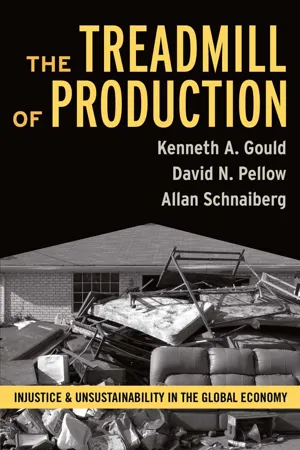
eBook - ePub
Treadmill of Production
Injustice and Unsustainability in the Global Economy
- 160 pages
- English
- ePUB (mobile friendly)
- Available on iOS & Android
eBook - ePub
Treadmill of Production
Injustice and Unsustainability in the Global Economy
About this book
Schnaiberg's concept of the treadmill of production is arguably the most visible and enduring theory to emerge in three decades of environmental sociology. Elaborated and tested, it has been found to be an accurate predictor of political-economic changes in the global economy. In the global South, it has figures prominently in the work of structural environmental analysts and has been used by many political-economic movements. Building new extensions and applications of the treadmill theory, this new book shows how and why northern analysts and governments have failed to protect our environment and secure our future. Using an empirically based political-economic perspective, the authors outline the causes of environmental degradation, the limits of environmental protection policies, and the failures of institutional decision-makers to protect human well-being.
Information
PART I
Origins of the Treadmill Theory
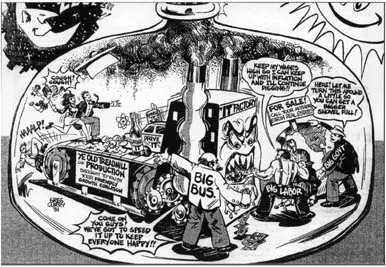
An early illustration of the Treadmill of Production by Greg Curry, 1981. (Courtesy of Greg Curry)
CHAPTER 1
The Treadmill of Production as an Outcome of Scientific Methods
The Development of the Treadmill Theory
DURING THE LATE 1970s, much of the commentary about the causes of environmental problems was provided by natural scientists. There were a small number of social scientists beginning to work in this area, most of whom had originally worked in other sociological subspecialties: demography, agricultural development, or sociology of science, among others. The writings of this aggregation of commentators provided a wide array of competing arguments about the origins of environmental degradation. Among them were rising population levels, “runaway” technology, consumer greed, and/or new “research and development” by corporate and government scientists and technologists.
Schnaiberg (1980) attempted to incorporate this array of arguments into a single work. Rather than just proposing some other single “cause” of environmental decay, he used the existing literature to begin a search for a grounded theory (Glaser and Strauss 1967) of ecological destruction in modern industrial society. This theory essentially involved an application of a scientific method to a complex set of changes in the society-environment relationship. A key component involved the incorporation of each of the existing arguments and an attempt to discern whether historical and contemporary facts were consistent with a causal statement about the origins of an environmental problem.
As with may persistent social issues that C. Wright Mills (1959) explored, the complex history of environmental degradation afforded many puzzles that no single theory could explain. Some pollution problems of mining, for example, had been noted in the sixteenth century (Mumford 1963). Yet there was little doubt that both the intensity and extensity of ecosystem disruptions had greatly accelerated during the middle of the twentieth century (Melosi 2001). From the timing and nature of this shift, Schnaiberg (1980: 5) constructed a theory that he felt was both plausible (i.e., consistent with historical observations) and compelling (i.e., one that seemed to track historical changes with a better fit than any of the existing arguments).
Myopia exists when social scientists concentrate only on the environmental movement, not on the social context from which it arises. Abstractions about our anti-ecological culture are not much help in addressing the problem. Schnaiberg’s approach was to seek an explanation of the social roots of expanded production through an analysis of social institutions involved in the creation and allocation of social surplus. What social forces induce ever-higher levels of industrialization and extraction of resources? (Schnaiberg 1980: 4)
The Development of Environmental Social Movements
During the 1960s and 1970s, the United States experienced the rise of the modern environmental movement. While it emerged in a period in which many new mass social movements appeared, the early history of these social organizations showed that they did not overlap much with the environmental movement. Bell’s (1962) controversial argument that traditional political alignments were disappearing by the 1950s was somewhat validated by the emergence of new antipoverty, antiwar, antiracist, and profeminist movements. Yet a careful analysis of the membership of national environmental movement organizations in the late 1970s showed little overlap by “environmentalists” with any of these other societal concerns (Mitchell 1980).
One of the factors that led Schnaiberg to construct analytically a new theory of environmental change was actually the extraordinary diversity of “environmental movements.” His early work (1973) outlined at least four categories of such movements: cosmetologists, meliorists, reformers, and radicals. While other social movements also entailed an array of activists, Schnaiberg’s analysis outlined important differences. Yet applying this insight to his newly constructed theory, he was somewhat chagrined to realize that the treadmill of production theory was likely to find only a limited audience (which the later analyses in this book confirm). Indeed, he already stated (1980: 5) that the problem was not that people wanted to “save the environment”: “the question must always be asked: for whom, and from whom has it been protected?” [italics ours]
Studying Consciousness Raising and Lowering about the Environmental Impacts of the Treadmill
In a recent work, Szasz (2007) has raised a provocative question about why many Americans have chosen to make private provisions for their health and welfare. In doing so, they have avoided offering strong support for government regulation of the treadmill’s impact on the environment, including its impacts on human health. In Mills’s (1959) framework, they have chosen to treat only those private troubles generated by the treadmill and largely have ignored most of the greater social issues that make such troubles so common. One example Szasz offers is the private use of bottled water, rather than the emergence of collective political demand for safe water systems in communities. He offers arguments about why this private path has been followed and the public path largely ignored. Other examples abound, including the purchasing of “Green” consumer products without seeking deeper changes in production processes and industrial organizations.
Schnaiberg (1980: 4) had earlier puzzled openly about that:
How does our social organization obscure the realities of resulting environmental degradation? In what ways do productive and governmental organizations treat environmental critics and their claims? How does this explain discrepancies between public complacency regarding environmental problems and the growing concerns of many policy analysts?
It should be noted that since this statement in 1980, current assessments of the environmental movement have indicated that its potency exists far more in the European Union than in the United States. Nowhere is this clearer than on the issue of global warming, where the U.S. government (and even some environmental organizations) has chosen to treat the issue as scientifically “unproven,” as well as insolvable (Begley 2007). And most of those organizations and elected officials who have embraced the cause of challenging global warming are unwilling to argue for the transformative (i.e., massive) changes required to achieve such a goal. Clearly, within the European context, the increasing disjuncture between the functioning of social systems and ecosystems has been imagined far more sociologically than it has within the context of the United States. This should not be surprising since the United States is ideologically more prone to locating both the causes of troubles and the remedies for troubles at the level of the individual (i.e., contrasociologically).
This concern about the consciousness of citizens and movement groups and their capacity to frame environmental issues sociologically drove us to focus on many of these problems, both in this work and in earlier ones. The treadmill is not just grounded in causal space; its reception by social leaders directly contributes to whether it is amenable to social change.
Individual Responses to the Treadmill, and Its Institutional Grounding: Consciousness Construction and Destruction
In an earlier analysis, Schnaiberg (1993) outlined the modal positions of individuals and groups opposing the treadmill’s antienvironmental outcomes. While doing so, he laid out a synthesis of much of the existing literature outlining both what environmental movements faced in attempting to act as well as what environmentally conscious individuals were exposed to. The items in Table 1, drawn from a diversity of literature, are organized to make the resistance by treadmill proponents clearer to the reader. While there is no guarantee that this represents a scientific sample of such conflicts, it resonated with the experiences we have all had in supporting and working with environmental movement organizations (Gould 1991, 1992, 1993, 1994; Pellow 1999; Tsoukalas and Gould 1997).
From this perspective, it becomes clearer that “saving the environment” in the face of structurally imbedded opposing institutional interests is a much more problematic and challenging action for citizens to take (St. Clair 2007).
Components of the Theory
Schnaiberg introduced the treadmill of production theory to address why U.S. environmental degradation had increased so rapidly after World War II. He argued that a growing level of capital available for investments and its changing investment allocation together produced a substantial increase in demand for natural resources. Essentially, the major change outlined in the theory was that more capital was accumulating in Western economies and it was being applied to replacing production labor with new technologies to increase profits. These new technologies required far more energy and/or chemicals to replace earlier, more labor-intensive processes, thus producing deeper levels of ecological disorganization than ever before. New technologies emerged from the organization of scientific and technological research in universities and research institutes as well as from the new “research and development” departments of large firms. Moreover, unlike the prior use of labor, the new technologies represented forms of sunk capital. To further increase profits, managers needed to increase and sustain production levels (because worker inputs could be cut back more readily, as opposed to the fixed costs of machine operations).
| Environmentalist claim | Producer counterclaim | |
| Problem severity issues | ||
| 1. | Ecological disorganization is being produced | No ecological disorganization being produced |
| 2. | Major ecological disruption is “known”: we do not need to postpone action for future research | Some ecological disruption already is occurring, but it is minor; we need costly ecological and community research to establish any “problem” |
| Causal issues | ||
| 3. | The disorganization is socially produced, not “naturally occurring” | There is some disorganization, but it is not really socially produced |
| 4. | Mechanisms exist to reduce or eliminate this disorganization without stopping or slowing societal growth | The ecological disorganization is socially produced, but it is an inevitable by-product of societal |
| Benefit-cost issues | ||
| 5. | Technologically feasible ways exist to control the disorganization already available or near at hand | We are currently unable to control this disorganization and need costly production and ecological research before any production options can be weighed |
| 6. | We can easily afford to implement the corrective technologies through implementation of regulatory rules, including fines for producers who violate them | Some corrective options are possible, but they are costly to use, and producers need some incentives to make them feasible |
| 7. | Social benefits from environmental protection are far greater than the relatively modest costs of implementing them | The costs of correcting these ecological problems really exceed any benefits of melioration |
| Cost-benefit issues* | ||
| 8. | Social and ecological benefits of recycling [reuse] are greater than economic costs | Economic and ecological benefits of recycling [remanufacturing] are greater than economic costs |
| 9. | Social and ecological benefits of energy conservation [reduced use] outweigh economic costs | Economic and ecological benefits of energy conservation [increased efficiency] outweigh economic costs |
| *Issue arena of relatively low conflict | ||
How Did the Treadmill Theory Differ from Other Contemporary Theories of Environmental Degradation?
When Schnaiberg first developed the treadmill of production theory in 1976, this was an exercise in empirical induction (Glaser and Strauss 1967). At that time, natural scientists or engineers conducted most of the public discussions of environmental degradation. They addressed both the causes of environmental decay and the solutions. While both entailed social-structural issues, none of the observers had any social science insights. Neither their radical nor their conservative analyses reflected any social science data, theories, or concepts. As a social scientist with a technical/scientific background, Schnaiberg tried to understand why U.S. environmental conditions had declined so precipitously since World War II. He accepted the bioecological “facts” of the late 1960s and early 1970s: there was indeed an ecological problem, and it would ultimately have some social consequences (the rationale for his commitment to this work).
No matter where Schnaiberg turned or what he read, the dominant narrative always seemed to start with changes in economic production as the major determinant of the trajectory of ecosystem impacts. From a logical perspective, production changes were the efficient causes of environmental disruption. So his initial question was transformed into: why had the quantities and/or qualities of U.S. production changed so drastically from 1945–1975?
Some analysts claimed that it was the growth in population that required a production increase. As a sometime demographer, it was clear to Schnaiberg that, while there had been a baby boom during this period, the rise in energy and material use vastly outstripped population growth. Demographic explanations, he argued, were often appealing mainly because we had detailed records of population characteristics. Thus, we could trace the rise in population along with the rise in some forms of pollution (see Ehrlich 1971). Ignoring the methodological dictum that we need to distinguish causation from mere correlation, it became easy for many early analysts to take an environmental statistic, divide it by the level of population, and come up with a “per capita environmental impact” assessment. This ratio was treated as if it were an analytic rate of how much each individual actually added to environmental degradation. In fact, this rate was nothing other than a form of circular argument or tautological reasoning. Certainly, it was true that a growing population did require some additional production and natural resources, but this was only a small component of the changes in environmental degradation from 1945–1980.
Others argued that the qualitative changes in production had been the result of “runaway technology.” But from the outset, as a former engineer, Schnaiberg knew that technology did not “run away”; rather, deliberation, time, and (especially) investment are required to change technology. A number of those arguing about these technological changes were themselves natural scientists (and even engineers). They sought to trace environmental degradation to its origins in the production system—as a kind of “efficient” cause. But they had a naive perspective on how and why these technological changes occurred. They never linked these changes to both the novel investment by corporations in research and development departments and the growth in government and industry grants to university science and engineering research (Price 1986)....
Table of contents
- Cover
- Half Title
- Title Page
- Copyright Page
- Dedication
- Table of Contents
- Preface
- Acknowledgments
- Part I: Origins of the Treadmill Theory
- Part II: Evolution and Application of the Theory
- Part III: The Future Role of the Treadmill Theory
- Acronyms
- Notes
- References
- Index
- About the Authors
Trusted by 375,005 students
Access to over 1.5 million titles for a fair monthly price.
Study more efficiently using our study tools.
Frequently asked questions
Yes, you can cancel anytime from the Subscription tab in your account settings on the Perlego website. Your subscription will stay active until the end of your current billing period. Learn how to cancel your subscription
No, books cannot be downloaded as external files, such as PDFs, for use outside of Perlego. However, you can download books within the Perlego app for offline reading on mobile or tablet. Learn how to download books offline
Perlego offers two plans: Essential and Complete
- Essential is ideal for learners and professionals who enjoy exploring a wide range of subjects. Access the Essential Library with 800,000+ trusted titles and best-sellers across business, personal growth, and the humanities. Includes unlimited reading time and Standard Read Aloud voice.
- Complete: Perfect for advanced learners and researchers needing full, unrestricted access. Unlock 1.5M+ books across hundreds of subjects, including academic and specialized titles. The Complete Plan also includes advanced features like Premium Read Aloud and Research Assistant.
We are an online textbook subscription service, where you can get access to an entire online library for less than the price of a single book per month. With over 1.5 million books across 990+ topics, we’ve got you covered! Learn about our mission
Look out for the read-aloud symbol on your next book to see if you can listen to it. The read-aloud tool reads text aloud for you, highlighting the text as it is being read. You can pause it, speed it up and slow it down. Learn more about Read Aloud
Yes! You can use the Perlego app on both iOS and Android devices to read anytime, anywhere — even offline. Perfect for commutes or when you’re on the go.
Please note we cannot support devices running on iOS 13 and Android 7 or earlier. Learn more about using the app
Please note we cannot support devices running on iOS 13 and Android 7 or earlier. Learn more about using the app
Yes, you can access Treadmill of Production by Kenneth A. Gould,David N. Pellow,Allan Schnaiberg in PDF and/or ePUB format, as well as other popular books in Social Sciences & Political Economy. We have over 1.5 million books available in our catalogue for you to explore.