- 240 pages
- English
- ePUB (mobile friendly)
- Available on iOS & Android
eBook - ePub
About this book
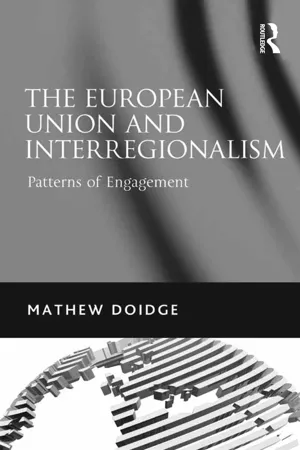
'The European Union and Interregionalism' is the most comprehensive study of interregionalism to date, providing a vigorous analysis of its role and functions in the architecture of global governance, and of the place of qualitative differences between regional actors in shaping interregional relationships. Regionalism itself is an established phenomenon, with regional politics becoming increasingly institutionalised. As a result, with the EU as forerunner, regions have begun to exert themselves in the external policy space, developing networks of relations including, prominently, interregional relations. We have thus seen the emergence of a new governance space at the interregional level, banded on one side by sites of global governance, and on the other by governance at the regional level. Important questions challenging the current literature of these interregional structures include, do interregional relationships conform to theoretical expectations?, and what patterns of engagement and interaction are emerging within the EU's core interregional partnerships, and are these replicated elsewhere? Exploring interregionalism beyond the core Europe-Asia partnerships, including the network of relations centred on ASEAN, this book should be read by all those engaged in consideration of interregional structures to understand how patterns of EU-centred interregional engagement, rather than being sui generis, are increasingly evident in the broader network of interregional relationships
Information
Chapter 1
Regional Actors and the Rise of Interregionalism
Since its inception as the European Coal and Steel Community (ECSC) in 1952, European integration has incorporated an external relations component; this is an element of the European project that has become increasingly significant in the more than half century of cooperation that has followed. Through progressive treaty reforms and enlargements from the six to the nine, the ten, the twelve, the fifteen, the twenty-five and now the twenty-seven, the EU’s scope and competence in its external relations has been extended and enhanced.
In the wake of the Treaty of Rome establishing the European Economic Community, which accorded the Community the right to create Association Agreements with third countries and organizations ‘involving reciprocal rights and obligations, common action and special procedures’ (Article 238), the Community established a dense network of multifaceted relationships engaging states and regional organizations in every part of the world, a process of international engagement that developed steadily in the following decades. With the end of the Cold War, and in the context of the permissive environment enabled by the absence of bipolar antagonism, the establishment of a European actor capacity has proceeded apace. Today, the European Union has a significant impact in the global arena, helping to shape rules and norms of interaction and contributing to the ‘civilizing’ of international relations, and constituting a prominent actor in a range of fields, including trade, development, humanitarian assistance, human rights, democratization and the environment.
In short, the European Union is an international actor of increasing substance. What is significant for this volume is that the Union’s international relations are to a great extent ordered through the framework of interregionalism, a reflection of its consistent search for settled structures within which to couch its relationships with external partners (Hill and Smith 2005: 12). Indeed, the importance of group-to-group relations is recognized in the Commission’s assertion that ‘regional integration is an opportunity to rationalize external relations and international cooperation’ (European Commission 1994a: 3). Interregionalism itself was an innovation first introduced through the EU’s external relations framework, tracing its origins to the Yaoundé Convention of 1963. It was a product of the EU’s status as the progenitor and pre-eminent actor of its type. In the years since has been witnessed the evolution of interregionalism as an external relations framework, and its emergence as a distinct layer in the architecture of global governance.
In the post-bipolar world, the place of interregionalism in global governance has, directly or indirectly, been widely recognized. In 2001, for example, Guy Verhofstadt, then President of the European Council, called for the transformation of the G8 into a ‘G8 of the regions’, explicitly positing the governance of globalization on a platform of regionalism and interregional partnerships. Further, with the collapse of WTO negotiations in Seattle in 1999 and the subsequent failure in Cancun in 2003, attempts to strengthen the institutional basis of trade at the global level seemed to have reached an impasse. In this context, regional and interregional trade negotiations have come to the fore, with the rise of interregionalism in the governance of global trade being increasingly acknowledged within the WTO Secretariat (Crawford and Fiorentino 2005) and the World Bank (2005). In short interregionalism has become a seemingly indelible part of the international system. Indeed, over the last two decades as the wave of new regionalism has spurred regional organizations to externalize their focus, taking the first tentative steps towards establishing themselves as actors on the international stage, the density of interregional contacts has intensified, taking the architecture of interregionalism beyond an EU-centred affair to one in which multiple actors play a part. Nevertheless, the interregionalism in which the EU engages remains of a different order, characterized by a high level of institutionalization, a product of the comparatively high level of integration of the Union itself. It is this evolution of interregionalism that is considered in detail in the remainder of this chapter.
Interregionalism: A Quick Definition
While the typology of interregionalism is extensive, this volume adopts a narrow approach. In this respect, interregionalism is defined as institutionalized relationships between groups of states from different regions, each coordinating to a greater or lesser degree (Hänggi 2006). Thus we run the gamut from highly institutionalized regional organizations – most prominently the European Union – to loose collectivities of states brought together for the purpose of engaging in interregional dialogues – the ‘imagined’ region that is the African, Caribbean and Pacific (ACP) grouping of states, for example. Three types of interregionalism are therefore disaggregated. The first, and most obvious, category of interregionalism involves dialogues between two regional organizations. This is the classic type, characteristic of Hänggi’s (42) ‘old interregionalism’ and Rüland’s (1999: 2–3) ‘bilateral interregionalism’ (for example EU–ASEAN, EU–MERCOSUR). The second type involves dialogues between a regional organization, and a more-or-less coordinated regional group of states (for example ASEM, EU–LAC), while the third involves dialogues between more-or-less coordinated regional groups (for example the Forum for East Asia–Latin American Cooperation, FEALAC). These latter two are more commonly termed ‘transregionalism’. The essence of interregionalism (including the transregional variant) is therefore its binary group-to-group structure,1 be it reflected in the practice of cooperation (as with relations between regional organizations) or simply a notional construction with states acting largely in their individual capacity (characteristic of loose transregional arrangements such as FEALAC).
Before moving on to discussion, a matter of terminology stemming from the above definition needs to be addressed. As has been presented, interregionalism is an umbrella term covering both interregional engagement between regional organizations, and transregional engagement involving looser aggregrations of states. In order to avoid confusion, where it proves necessary to distinguish between interregionalism as an umbrella term and interregionalism engaging regional organizations, this latter will be referred to as ‘bilateral interregionalism’.
Regionalism and Interregionalism
While interregionalism constitutes a distinct layer in the architecture of global governance, it cannot be understood without reference to the regionalism on which it is founded and of which it is an extension. Indeed, the shape and nature of interregional relations is premised to a great extent on the shape and nature of the regionalisms from which it is born, and it is the evolution of regionalism which has played the most significant part in the rise of interregionalism. In considering the emergence of interregionalism, therefore, it is necessary to recognise the emergence and changing nature of regional integration arrangements. But more than this, it is necessary to consider the evolution of one regional integration arrangement above all others – the European Union – for it is the projet européen that has played the greatest role in evolving and defining interregionalism in global governance, choosing from an early stage to engage in dialogues with other groupings of states, be these regional integration arrangements themselves, or, as Holland (2006: 254) suggests, ‘imagined’ regional groupings.
The evolution of regionalism, and consequently interregionalism, has been in three stages (Sideri 2000): the ‘imperial regionalism’ of the 1920s and 1930s, the ‘closed regionalism’ which emerged after the Second World War and lasted until around the middle of the 1970s, and the ‘open regionalism’ that has been evident since the late 1980s (and particularly since the end of the Cold War). The latter two periods have also been (somewhat uninspiringly) referred to as ‘old’ and ‘new’ regionalism.
Imperial Regionalism
The regionalism of the interwar years occurred within defined imperialist blocs dominated by hegemonial powers. It therefore differed markedly from the post-World War II experience, premised as it has been upon some recognition of the sovereign equality of states. The interwar initiatives, by contrast, were hegemonially driven, established to secure the pre-eminence of the great powers of Germany, France and the United Kingdom. The resulting blocs (Germany in Central and Eastern Europe; France through the ‘Little Entente’ with Czechoslovakia, Romania and Yugoslavia; and the United Kingdom in the Commonwealth)2 were geared towards the needs of each of these powers in economic, political and indeed military rivalry with the others. This involved, particularly in the German case, the use of these blocs as a means of securing the supply of raw materials for industrial production in the imperial core, thus reducing dependence on potential enemies and increasing the economic, and by implication military, strength of the hegemonial power.
The result was a system defined by closed and competitive regions designed to achieve the independence and self-reliance of the hegemonial master, rather than the collective development of all bloc members. Indeed, in the context of the subsequent iterations of regionalism, this imperial regionalism was the most closed and competitive. Unsurprisingly then, given its underlying nature, imperial regionalism failed to generate the essentially cooperative interregional architecture with which we are concerned in this volume, instead quickly deteriorating into bloodshed and war.3
Closed Regionalism
When regionalism re-emerged following the Second World War, it was of a markedly different tenor to that of the interwar years, being associated with the cooperation of states on the basis of sovereign equality and targeted towards achieving collective benefits for all members, rather than solely for a regional great power. Nevertheless, closed regionalism was still characterized by an inward focus and a relatively narrow (usually protectionist) range of objectives. Almost exclusively economic in focus, it was a structure designed to gain advantages of enlarged internal markets and at the same time to protect domestic producers from external competition. In Europe, it also incorporated a security component – the first steps towards European integration were explicitly focused on attempts to institutionalize peace on the European continent in the aftermath of the second ‘European civil war’ of the twentieth century. European integration, which quickly evolved from the security focus of the European Coal and Steel Community to an economic focus with the creation of the European Economic Community, became the archetype for cooperative regional arrangements elsewhere, and by the early 1970s had been joined by a range of imitators.
While the European example was the initiating factor behind other regional arrangements in the 1960s and 1970s, key motive forces are also to be found elsewhere which help to explain the shape and colour of the closed regionalism. Most important of these was the critique of the international economic structure (and the Modernization approach to development) forwarded by the dependistas.4 Dependency Theory called into question the possibility of developing countries achieving development given the structural asymmetries inherent within the international economic system which, it was argued, would lead to their being held in a peripheral position of permanent dependence upon the developed core. In the 1970s, this critique triggered the establishment of a developing world movement, embodied in organizations such as the Non-Aligned Movement (NAM) and Group of 77, dedicated to overcoming the structural economic and political asymmetries to which their development was held hostage, and demanding the establishment of a New International Economic Order (NIEO). Along with a refounding of the international economic system on a more equitable basis, the NIEO Programme of Action called for increased cooperation among developing countries themselves as a means of achieving ‘collective self-reliance’ (Oteiza and Sercovich 1976). At the practical policy level, Import Substitution Industrialization (ISI) – involving sheltering infant industries behind external tariff barriers, import quotas and foreign currency controls – quickly became the policy of choice for many developing countries.
Regionalism among developing countries emerged as a natural complement to these protectionist development strategies, with an expectation that, in the context of an ISI policy, the structural impediment of small markets and the high costs of industrialization bedevilling the process could be overcome by exploiting the economies of scale available as a result of regional integration (through raising common external tariffs, market- and industry-sharing agreements and so on). In addition, certain political incentives for the establishment of regional blocs were foreseen, specifically the greater bargaining power in relation to the developed world that would come with speaking with one voice. As such, regionalism was seen by Third World structuralists as a tool in the struggle to end the exploitative and dependent relationship between LDCs and the industrialized North. And so the 1960s and 1970s saw the proliferation of South–South regional integration arrangements, including inter alia the Central American Common Market (CACM) and the Latin American Free Trade Area (LAFTA) in 1960, the Central African Customs and Economic Union (CACEU/UDEAC) in 1964, the Caribbean Free Trade Area (CARIFTA) in 1968, and the Economic Community of West African States (ECOWAS) in 1975.
Despite the implicitly external focus of the NIEO Programme demand for greater collaboration among developing countries generally, for which the more geographically limited regionalism was conceived as a first step, these closed regionalisms in the South largely failed to develop networks of external relations. Their inward, developmental focus, shaped by the conclusions of the dependistas on the nature of the international system (including, at the extreme, advocacy of de-linking), meant a greater concern for domestic issues than external affairs. Further, many of the factors that eventually led to the failure of the closed regionalisms of the South also mitigated against the external focus necessary for the development of interregional relationships. An unwillingness on the part of the newly independent states of the South to countenance any cession of sovereignty to regional institutions, even in areas of functional cooperation related to their developmental efforts, limited the depth of regionalism. Instead, the concern for the majority of developing countries remained the building of state authority and state capability. Tentative regional institutions therefore remained strongly intergovernmental in character which, when combined with ongoing national rivalries and the problem of differing ideological and economic orientations (Ghai 1975), mitigated against collective endeavours at the regional level, let alone in the external realm. As a consequence, the majority of these closed regionalisms were largely reactive rather than proactive in their external relations, responding where necessary to the actions of others, but remaining largely passive themselves.
The situation in Europe differed markedly. European integration, from the outset, incorporated a (sometimes grudging) willingness to cede authority to supranational institutions, and the enshrinement of powers and responsibilities of collective institutions in international law – the Cartesian legalist approach. In addition, some external relations capabilities and consideration of external issues had been a feature of European regional integration from the outset, even if they were not always successfully pursued. The ECSC, the first regional institution to be established, had taken the first tentative steps towards an external competence in being accorded legal personality5 with which to perform its core functions (including, for example, the promotion of international trade).6 This external focus was further reinforced by the granting to the High Authority of the power to establish diplomatic relations with third countries (the first such representation being established in London in 1955) and the responsibility for maintaining relationships with the United Nations (UN), the Organization for European Economic Cooperation (OEEC),7 and the Council of Europe.8
While similar external powers were granted to EURATOM and the European Economic Community (EEC) by the twin Treaties of Rome in 1957, the European Economic Community’s external competencies largely expanded as a consequence of the nature of the policy areas over which it was granted authority. In particular, the attribution of competence for agricultural trade and development had direct external implications. Further, the formation of the common market necessitated ‘the establishment of a common customs tariff’, and therefore as a result, ‘of a common commercial policy towards third countries’ (Article 3(b)).
In addition, Article 3(k) stipulated ‘the association of the overseas countries and territories in order to increase trade and to promote jointly economic and social development’. There had been no intent to incorporate development policy within the Treaty of Rome, despite the ongoing linkages of four of the six EEC member states to their colonial and ex-colonial possessions. As Hewitt and Whiteman (2004: 134) acknowledge, ‘that the new democratic Europe should have colonial entanglements associated with the past era of aggressive nationalism, least of all by the Dutch (who had already lost Indonesia) and by the newly democratic Germans who saw empire as one more trapping of the Wilhelmine and Prussian past’ had not been envisaged until the French negotiators issued a last minute ultimatum. Confronted with its increasing inability throughout the 1950s to fund the heavy costs of its colonial possessions, France saw the putative Europe as an answer to its problems. In a somewhat cynical ploy to disburse the costs (particularly to Bonn) of maintaining its political influence in its colonial territories, the French government made an institutionalized and treaty-based relationship between the Community and the developing world (essentially francophone Africa) a condition of it...
Table of contents
- Cover Page
- Dedication
- Title Page
- Copyright Page
- Contents
- List of Figures
- List of Tables
- Preface
- List of Abbreviations
- 1 Regional Actors and the Rise of Interregionalism
- 2 The Functions of Interregionalism
- 3 The European Union and Bilateral Interregionalism: The EU–ASEAN Relationship
- 4 The European Union and Transregionalism: The ASEM Process
- 5 Interregionalism Beyond Europe–Asia Relations
- 6 Conclusion: The Shape of Interregionalism
- Bibliography
- Index
Trusted by 375,005 students
Access to over 1.5 million titles for a fair monthly price.
Study more efficiently using our study tools.
Frequently asked questions
Yes, you can cancel anytime from the Subscription tab in your account settings on the Perlego website. Your subscription will stay active until the end of your current billing period. Learn how to cancel your subscription
No, books cannot be downloaded as external files, such as PDFs, for use outside of Perlego. However, you can download books within the Perlego app for offline reading on mobile or tablet. Learn how to download books offline
Perlego offers two plans: Essential and Complete
- Essential is ideal for learners and professionals who enjoy exploring a wide range of subjects. Access the Essential Library with 800,000+ trusted titles and best-sellers across business, personal growth, and the humanities. Includes unlimited reading time and Standard Read Aloud voice.
- Complete: Perfect for advanced learners and researchers needing full, unrestricted access. Unlock 1.5M+ books across hundreds of subjects, including academic and specialized titles. The Complete Plan also includes advanced features like Premium Read Aloud and Research Assistant.
We are an online textbook subscription service, where you can get access to an entire online library for less than the price of a single book per month. With over 1.5 million books across 990+ topics, we’ve got you covered! Learn about our mission
Look out for the read-aloud symbol on your next book to see if you can listen to it. The read-aloud tool reads text aloud for you, highlighting the text as it is being read. You can pause it, speed it up and slow it down. Learn more about Read Aloud
Yes! You can use the Perlego app on both iOS and Android devices to read anytime, anywhere — even offline. Perfect for commutes or when you’re on the go.
Please note we cannot support devices running on iOS 13 and Android 7 or earlier. Learn more about using the app
Please note we cannot support devices running on iOS 13 and Android 7 or earlier. Learn more about using the app
Yes, you can access The European Union and Interregionalism by Mathew Doidge in PDF and/or ePUB format, as well as other popular books in Politics & International Relations & Intergovernmental Organizations. We have over 1.5 million books available in our catalogue for you to explore.