eBook - ePub
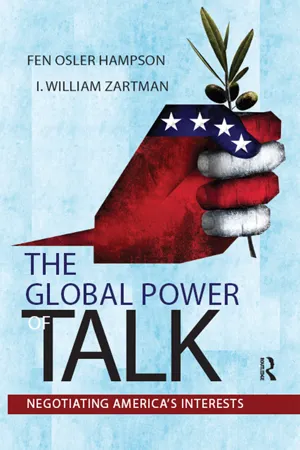
Global Power of Talk
Negotiating America's Interests
- 230 pages
- English
- ePUB (mobile friendly)
- Available on iOS & Android
eBook - ePub
About this book
The Global Power of Talk explores the power of negotiation and diplomacy in US foreign policy at a critical juncture in US history. Beginning with the failure of US diplomacy in relation to Saddam Hussein's regime in the 1980s, it shows how a series of diplomatic blunders has laid the foundations for the uninhibited use of 'gun power' over 'talk power' in the last two decades. It critically examines missed opportunities in America's handling of the Israeli-Palestinian conflict in both the Clinton and George W. Bush administrations. In a provocative conclusion, the authors argue that the United States can and should negotiate with the so-called 'unengageables' like Iran, North Korea, and Al-Qaeda, in order to find ways to defuse underlying tensions in the global system.
Information
PART I
TALKING

CHAPTER 1
TALK POWER FOR THE TOUGH-MINDED
Men nowadays are becoming more and more convinced that any disputes which may arise between nations must be resolved by negotiation and agreement, and not by recourse to arms.
—John Paul II, Pacem in Terris, 1963, Para 126
You can do a lot with diplomacy, but of course you can do a lot more with diplomacy backed up by firmness and force.
—Kofi Annan, New York Times, February 23, 1998
This book challenges two myths: that when America chooses the diplomatic path and tries to negotiate with its enemies it does so out of weakness, and that to stay the strong, sole-standing superpower, the United States has to rely above all on its military might. It is negotiation or Talk Power, as we argue in this book, that when wielded wisely is the most used and the most powerful tool in America’s arsenal. Negotiation is getting something by giving something, and in international conflicts it is the search for solutions that meet the foreign policy goals of one country while giving enough to another to motivate it to keep its promises. It is a tool that can be used to advance America’s interests, amplify America’s power and standing in the world, and win back old friends who have lost faith in its leadership. It is a tool that can forge new alliances to deal with today’s new security threats. In short, it is a tool that can do, and on occasion has done, much to advance America’s global positions and the cause of world peace. Talk Power is not the refuge of the weak. On the contrary, it is the fine-honed instrument of the hard-headed and tough-minded who understand its uses, purpose, and limitations.
Military force may win wars; diplomacy ends them. These days, the use of military force usually ends in a stalemate, and when it does better than that, its result is not to eliminate conflict but rather to create a new conflict situation, sowing the wind and reaping the whirlwind. It takes large doses of diplomatic talk and negotiation to clean up afterwards. When violent confrontations end in deadlock, this often sets the table for negotiation. Sometimes deadlock is necessary. Terrorists and rebels need to feel it before they abandon unrealistic goals and work to meet their opponents in the middle. But when force has done its job, the diplomat moves in to end violence and return peoples’ lives to normalcy. It takes diplomatic talk and negotiation to put a house in shambles back in order.
Cuba
No president understood this better than John F. Kennedy. Fifty years ago Kennedy faced the biggest crisis since World War II. On October 14, 1962, following a botched American attempt to land at the Bay of Pigs to overthrow the Communist regime of Fidel Castro, Kennedy received word that the Soviets were deploying nuclear-armed, offensive missiles on Cuban soil. Within weeks, the Soviets would be able to attack America’s cities and military bases without warning. America would become Russia’s hostage or worse unless the president acted fast and decisively.
In the days that followed, President Kennedy met with his advisors in the White House to consider his options. His top general, Curtis LeMay, head of the US Strategic Air Command, and others, argued emphatically that America should take swift and decisive military action. A knock-out punch by US air power would eliminate the threat and send a powerful message that the United States was not about to give in to the Soviet Union. But some of the president’s other advisors, including Secretary of Defense Robert McNamara, were not so sure. They worried that a preemptive strike against Soviet missile installations in Cuba could lead to World War III and nuclear Armageddon if the Soviets decided to retaliate. At the very least, the Soviets might be emboldened to seize West Berlin, a British, French, and American enclave deep inside East Germany behind the iron curtain.
From October 16 to October 22, 1962, President Kennedy and his closest advisors thrashed out, in secret, the problem of how to deal with the missiles. During those deliberations, six basic options were put on the table: (1) doing nothing; (2) diplomatic pressure; (3) a secret approach to Cuban leader Fidel Castro; (4) invasion; (5) a surgical air strike; and (6) a naval blockade. Ultimately, Kennedy chose a mixed approach of blockade and diplomacy, negotiated within those limits, and achieved his goals of avoiding war.
On Monday, October 22, the president went on national television to break the news to the world and announce the immediate imposition of a naval “quarantine,” to prevent the shipment of missiles to Cuba and pressure the Soviets to remove the ones already installed. At the same time, he launched a vigorous diplomatic offensive to deal with the crisis. He secured the formal support of the Americas’ hemispheric organization, the Organization of American States (OAS), and then of the United Nations. He opened negotiating channels to probe Soviet intentions and show how their actions threatened their own vital interests. Working against the clock, he drew a proposal from Soviet leader Premier Nikita Khrushchev, and under the pressure of time the two were rapidly able to strike a face-saving agreement: The Soviets agreed to withdraw their missiles and nuclear warheads from Cuba in exchange for a US promise not to invade Cuba, and a side deal sweetener on the removal of US nuclear-armed Jupiter missiles from Turkey (already decided by the United States). Kennedy then praised Khrushchev for having avoided war. President Kennedy’s superior negotiating skills clearly won the day, defusing a major crisis that could have become World War III.
It is worth stopping a moment here to consider the elements of the joint diplomatic victory. Each side gave diplomacy its “best effort” by being prepared to give something in order to get something to defuse the crisis. Coercive diplomacy or Tough Talk was complemented by reassurance and positive inducements, or Sweet Talk. However, President Kennedy offered inducements to the Soviets only after he had limited Soviet options through the naval blockade, making it clear as day to Khrushchev that his actions would lead to war if he did not comply with US demands. When he did, he was rewarded, in terms of his own interests. Tough Talk backed by US military power preceded Sweet Talk.
What is also important to note is that there was deep presidential engagement in these negotiations and a serious personal commitment to exploring with the Soviets what was possible and acceptable to both sides. Kennedy also worked the clock to his advantage. There was a finite bargaining period, a clear deadline, and a threat to resort to arms in the absence of a satisfactory response. International legitimacy for firm action was obtained through the support of international organizations, both regional and global. And, as a coda, the side that gained more thanked and congratulated the other.
Georgia
Fast forward forty years to the beginning of this century. On August 8, 2008, Russia invaded the neighboring break-away provinces of Abkhazia and South Ossetia in the independent Republic of Georgia in the Caucasus. The boundary the Russian army crossed had been established by the Soviet Union before Georgian independence in 1990, but the Russian army did not stop at the provincial boundaries; it penetrated 40 kilometers into Georgia, occupied the crossroads city of Gori, and threatened the capital of Tbilisi and the strategic Baku-Tbilisi-Ceyhan pipeline running through it. The Georgian army was whipped, Russia lost respect before broad international condemnation, ethnic cleansing swept the two areas, and the specter of the Cold War overshadowed East-West relations. Careful negotiation could have done much to prevent the conflict, but it was used clumsily if at all.
The two decades after the collapse of the Soviet Union were filled with mixed policies and signals concerning the former republics of the USSR. By the beginning of the new millennium, Russian policy hardened into a goal of undoing the Soviet breakup wherever possible, but nowhere more pointedly than in Georgia, the home country of Josef Djugashvili (Stalin), where the seaside Abkhazia region was the summer resort for many Russians and the mountainous South Ossetia region was caught up in its own identity crisis. Some members of the post-Soviet Commonwealth of Independent States (CIS) viewed the collapse of the Soviet Union as a Russian defeat to be sealed by the extension of the Western alliance—North Atlantic Treaty Organization (NATO)—to the very doorstep of Russia. The republics of the former Soviet Union could not agree more; out from under the protection of the Soviet Union, they sought protection from the Western alliance and the United States. The result was that the republics next door to Russia joined NATO, and the candidatures of Ukraine and Georgia, also next door to Russia, were laid on the table for NATO membership. US ex–Cold Warriors were triumphant at the idea of carrying NATO to the doors of Russia, across the former satellites of Eastern Europe into the very republics that had constricted the USSR down to simply the Russian Federation.
The Republic of Georgia underwent a number of swings in its internal politics. Eduard Shevarnadze, Mikhail Gorbachev’s foreign minister, acted as president until 2004, when Mikhail Saakashvili, a charismatic pro-Westerner, was elected president in a political revolt against Shevardnadze. He became the chosen ally of the democratic West and he denounced the Russian-backed secessionist movements in Abkhazia and South Ossetia, launching police operations to clean up both criminal and militant groups in the regions.
These actions were seen as a direct challenge to Russia and its interests in South Ossetia. In the early 1990s, Russia helped South Ossetia secure its de facto independence from Georgia and maintained close ties with the breakaway province ever since. In 1992, a four-member Joint Control Commission, made up of representatives from Russia, Georgia, and South and North Ossetia, was established to maintain a negotiated ceasefire in the region. A formal ceasefire agreement was concluded in Moscow on May 14, 1994. In accordance with the ceasefire agreement, Russia also established a “peacekeeping” force within South Ossetia. The truce, however, was an uneasy one. In June–August 2004, there were incursions by Georgian security forces into South Ossetia that Russia considered to be in violation of the earlier agreement. On November 5, a Russian-mediated meeting between Prime Minister of Georgia Zurab Zhvania and President of South Ossetia Eduard Kokoity was held in Sochi. Both parties agreed to a ceasefire and to withdraw all illegal armed formations from the conflict zone. However, in early 2005, President Saakashvili abandoned the Georgia–South Ossetia agreement. As relations deteriorated, Georgia launched police operations in the upper Kodori Valley of South Ossetia in attempt to restore “constitutional order” in the region.
Meanwhile, elsewhere on the international scene, events were evolving slowly in Kosovo, the breakaway province of Serbia in former Yugoslavia. Under NATO management since the breakdown of the Rambouillet negotiations and the bombing of Belgrade in 2000, Kosovo was handed to a conference presided by former Finnish President Martti Ahtisaari in 2007 for final disposition. Ahtisaari entered the negotiations with the conviction that independence was the only course available to avoid ethnic cleansing, ignoring other possibilities for autonomy of Kosovo’s Serbian regions. When his mediation between Serbia and Kosovo failed, Kosovo declared its independence on February 17, 2008, (a unilateral action prohibited by the NATO mediation guidelines), and was promptly recognized by the United States and many other NATO members, to the stern warnings of Serbia’s backer, Russia. Three days before US recognition, Russian President Vladimir Putin warned that recognition would bring increased Russian support for the separatists in Georgia.
A month later, President George W. Bush assured Saakashvili of his intent to press hard for Georgian entry into NATO, and a NATO meeting endorsed the proposal in principle, including Ukraine as well. As in the case of Kosovo, intermediate solutions, such as recognition of buffer status and special relationships short of full NATO membership in the Georgian case, were not considered. Before leaving the presidency to become prime minister, Putin established legal ties with the breakaway regimes in South Ossetia and Abkhazia. Russia violated Georgian airspace over the two regions in coming months, promising support against “aggression” for local populations and Russian citizens in the two regions and increased its “peacekeeping” force in Abkhazia; the Ossetian Georgians, in turn, geared up for more police action.
Despite the public US praise for Saakashvili, Secretary of State Condoleezza Rice in a visit in July warned Georgia privately not to provoke Russia, calling for a no-use-of-force pledge, and other high-level diplomatic officials continued to press for restraint in the following month. But the South Ossetians, encouraged by Russian support, stepped up the conflict, shelling Georgia proper from the shelter of the Russian peacekeepers and blowing up Georgian police traffic. On August 6, they fired again on Georgian villages; the next day Georgian troops moved into Tskhinvali to clear out the attackers, and the following day, Russian troops, tanks, and planes streamed into Georgia.
Diplomacy had failed and was seriously called into action only after the horse had been snatched from the stable. Thereafter, it took three days before French President Nicolas Sarkozy was able to broker a truce agreement, leaving large loopholes for the Russian troops to run through, and then another day before Secretary Rice was able to fill the breach and plug the holes with a revised agreement; always a difficult thing to accomplish when an initial accord has been reached. But it took another month before some of the Russians withdrew from Georgia proper back to Ossetia and Abkhazia, now recognized as independent states by Russia (and only two other countries in the world); Russian troops still remain years later despite the agreement to withdraw and leave only the “peacekeepers.”
Where did negotiation go wrong? From the very beginning. The French saying, attributed to Talleyrand, Pire qu’un crime, une faute (“Worse than a crime, a blunder”) captures the delicacy of diplomacy. At the turn of the millennium, the West began its blunder, stepping up its escalatory verbiage and challenging Russia at its doorstep with NATO membership offers for Georgia. Midway alternatives, such as special relationships within buffer zones, were blithely bypassed, and the bypass was repeated in dealing at the same time with Kosovo (the similarities were trumpeted by Moscow but vigorously denied in the West). Russia, of course, continued to blunder its way into the rebellious zones of a neighboring sovereign country, throwing down gauntlet after gauntlet. Filled with Western hype, the Georgian president picked them up; while in his right to try to quell rebellion in his northern provinces, he proceeded to blunder into direct military operations, thumbing Georgia’s official nose against a neighboring army twenty-five times the size of his and ignoring repeated, if belated, calls for calm from Washington. An escalation of blunders produced their culmination in the brutal Russian aggression against a small sovereign neighbor.
Much of the negotiation until the point of invasion was public, with signals given on the airwaves, although they were repeated face to face between the Russian and American presidents in April. Thereafter, toning down the rhetoric on the Western side would have signaled to the East to tone down, too, as had previously been done on the contentious missile defense system in Poland and the Czech Republic. More concrete considerations of intermediate steps in negotiations over Kosovo and restraint in Georgia would have sent further signals. Direct Russian and American contacts over Georgia, as took place over Cuba, were not pursued.
From its position of strength, Russia bargained hard with top world leaders until a balanced but unimplemented agreement was reached. Western multilateral diplomacy worked at its best in ratcheting the agreement into acceptable shape, an unusual display of negotiation after the crime was committed and horse stolen.
Talk Power in the Twenty-First Century
This book is a study of the uses and purposes of negotiation and diplomacy in America’s power projection capabilities in today’s world. We argue that the power of negotiation, when used wisely, can transform difficult situations and further US interests, as President Kennedy showed in the Cuban missile crisis. When used badly or belatedly as the case of Georgia-Ossetia illustrates, problems can get a lot worse. We will highlight the conditions and consequences of the effective use of Talk Power in subsequent chapters of this book.
As we look to the many foreign policy and security challenges President Barack Obama and his advisors confront today we will explore the role that Talk Power can play to advance America’s interests and promote global security. What kinds of diplomacy and bargaining strategies are appropriate for addressing current and future threats and security challenges? What can Americans and their president learn from past negotiations about how to deal with friends, enemies, and rivals? These are just some of the key questions we will take up.
Today, the United States confronts a wide assortment of different security challenges. They include the continuing threat of terrorism, renewed outbreaks of sectarian violence, the clash of cultures and religion, the ever-present danger of nuclear proliferation, the growth of transnational criminal networks, and so on. However, threat perceptions differ within the NATO alliance. For example, key European states have been at odds with the US about how to respond to civil unrest in the Middle East and North Africa and, as we saw earlier in this century, to US-led military interventions in Afghanistan and Iraq. The will and capacity for collective action have been diminished by these differences, along with a precipitous decline in defense spending as Western governments tighten their fiscal belts.
Although the terrorist attacks of September 11, 2001, were a watershed moment in history, many of the underlying causes of conflict in the twenty-first century have not changed. Consider, for example, the so-called clash of civilizations between the Islamic world and other cultures. While the members of al-Qaeda may be motivated by a common hatred of the United States and the West, the societies that they spring from are struggling with much more basic issues: the tensions of modernization, including unequal wealth distribution and unmet expectations; suppressed democracy; internal ethnic divisions; and unstable neighborhoods. Anti-Western sentiments in an already explosive environment further underscore the complexity of current security challenges.
There are other developments that also pose a threat to political stability. A wave of democratic protest and civil unrest is sweeping through the Middle East and North Africa from Tunisia, to Egypt, to Libya, Yemen, Algeria, Jordan, Bahrain, Syria, and even Saudi Arabia. Some of the region’s leaders have been toppled and more may follow with uncertain consequences for political stability in the region as a whole. Negotiations within these ...
Table of contents
- Cover Page
- Half Title page
- Title Page
- Copyright Page
- Contents
- Preface
- Part I Talking
- Chapter 1 Talk Power for the Tough-Minded
- Chapter 2 How America Lost Its Way Iraq and Palestine, and the Failure to Use Talk Power
- Chapter 3 The Tools of Talk Power
- Chapter 4 The Proven Success of Talk Power Lessons from the Middle East
- Part II Managing
- Chapter 5 Timely Talk to Prevent Violent Conflict
- Chapter 6 Engaging Unengageables
- Chapter 7 Talking with Terrorists
- Chapter 8 Taming Intractable Regional Conflicts
- Part III Teaming
- Chapter 9 Building “Teams of Rivals”
- Chapter 10 Talking with Friends and Allies
- Chapter 11 Talking Laterally on New Governance Challenges
- Chapter 12 Negotiating America's Interests
- Notes
- Suggestions for Further Reading
- Index
- About the Authors
Trusted by 375,005 students
Access to over 1.5 million titles for a fair monthly price.
Study more efficiently using our study tools.
Frequently asked questions
Yes, you can cancel anytime from the Subscription tab in your account settings on the Perlego website. Your subscription will stay active until the end of your current billing period. Learn how to cancel your subscription
No, books cannot be downloaded as external files, such as PDFs, for use outside of Perlego. However, you can download books within the Perlego app for offline reading on mobile or tablet. Learn how to download books offline
Perlego offers two plans: Essential and Complete
- Essential is ideal for learners and professionals who enjoy exploring a wide range of subjects. Access the Essential Library with 800,000+ trusted titles and best-sellers across business, personal growth, and the humanities. Includes unlimited reading time and Standard Read Aloud voice.
- Complete: Perfect for advanced learners and researchers needing full, unrestricted access. Unlock 1.5M+ books across hundreds of subjects, including academic and specialized titles. The Complete Plan also includes advanced features like Premium Read Aloud and Research Assistant.
We are an online textbook subscription service, where you can get access to an entire online library for less than the price of a single book per month. With over 1.5 million books across 990+ topics, we’ve got you covered! Learn about our mission
Look out for the read-aloud symbol on your next book to see if you can listen to it. The read-aloud tool reads text aloud for you, highlighting the text as it is being read. You can pause it, speed it up and slow it down. Learn more about Read Aloud
Yes! You can use the Perlego app on both iOS and Android devices to read anytime, anywhere — even offline. Perfect for commutes or when you’re on the go.
Please note we cannot support devices running on iOS 13 and Android 7 or earlier. Learn more about using the app
Please note we cannot support devices running on iOS 13 and Android 7 or earlier. Learn more about using the app
Yes, you can access Global Power of Talk by Fen Osler Hampson,I. William Zartman in PDF and/or ePUB format, as well as other popular books in Politics & International Relations & Diplomacy & Treaties. We have over 1.5 million books available in our catalogue for you to explore.