The Indian railway network began as a liberal experiment to promote trade and commerce, the distribution of food and military mobility. Sweeney's study focuses on Britain's largest overseas investment project during the nineteenth century, offering a new perspective on the Anglo-Indian experience.
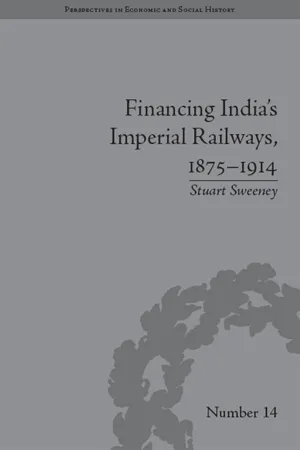
- 272 pages
- English
- ePUB (mobile friendly)
- Available on iOS & Android
eBook - ePub
Financing India's Imperial Railways, 1875-1914
About this book
1 ‘PRODUCTIVE’ INDIAN RAILWAYS, 1875–1914: SPACE FOR GENTLEMANLY CAPITALISTS AND INDUSTRIALISTS IN A MIXED ECONOMY
Introduction
When J. R. Seeley posed the question ‘cui bono?’ in the context of British annexations in India, his own answer was ‘English commerce’.1 J. Hobson tackled the same question later, focusing specifically on ‘the investor’ and the ‘speculators or financial dealers’ who ‘constitute … the gravest single factor in the economics of Imperialism’. Hobson proceeded to highlight that ‘every railway or mining concession wrung from some reluctant foreign potentate means profitable business in raising capital and floating companies’.2 The representatives of commerce and finance who attracted the attention of Seeley and Hobson were to become the focal point for a new debate on the motivation and outcome of British Imperialism, through Cain and Hopkins’s paradigm of ‘gentlemanly capitalism’. British commerce and industry were to be pursued, where possible, in the private sector (off the government’s balance sheet). However, Indian railway finance never escaped from the intrusions of government support, either directly through state lines or indirectly through government guarantees. The long-running debate on laissez-faire versus state ownership and management of railways continued over the late nineteenth and early twentieth centuries, with gentlemanly capitalists and industrialists equally involved. While many participants may have had ideological concerns about excessive state involvement in the process, it was obvious that the relative poverty of India made most of the railway lines unattractive investments, short of state support. Equally, industry could benefit from a government-directed ‘buy British’ policy pursued over the years. British commerce and finance would extract commission from a rising volume of foreign trade, albeit under the guise of India’s ‘deindustrialization’. In short, Indian railways provided opportunities to keep all British capitalist groups on side, but necessitated pragmatism on matters of political economy. Dissecting the importance or motivation of individual groups in this process is complicated but it is possible to identify consistent ambitions for the Indian economy, which united state and private sectors, operating in a ‘mixed economy’.
Evolution of Indian Railway’s ‘Mixed Economy’
As early as the 1840s, the commercial rationale for government support for Indian railways was illuminated by John Chapman, chief promoter of the Great Indian Peninsula Railway (GIPR)3. Chapman was an industrialist, financier, radical writer and Baptist deacon. He had absorbed the liberal political economy of the earlier nineteenth century, but faced the practical challenge of raising scarce capital for his ‘Chapman Line’. Chapman asserted that English capital would have been available without government support in the mid-1840s had the investment proposition been more clearly explained.4 However, the granting of Government guarantees to the EIR in Bengal was a damaging precedent which curtailed private capital. The guaranteed EIR stock crowded out investor demand for non-guaranteed GIPR equities and bonds. Earlier, the granting of railway guarantees in Jamaica and Ceylon under British guidance and subsequent guarantees of 4 per cent offered in France, had made resistance to guarantees in Bengal and Bombay problematical.5 In a private note, dated January 1849, Chapman produced a quantitative justification for the involvement of private companies in Indian railways. The note provides insight through a rare attempt to quantify the efficiencies of private over state enterprise, albeit without much analytical rigour. Chapman made a series of laissez-faire assertions about the inefficiency, lack of incentive and general tardiness of state-run industry which might have come from the pages of J. S. Mill’s ‘Principles of Political Economy’. Private companies were predicted to save an arbitrary amount of 30 per cent on all construction and operating costs relative to the public sector. Equally, their marketing efforts would generate some 30 per cent more in terms of ‘receipts per mile per annum’. These assumptions translated to a return on capital for a private railway company of 16 per cent against a meagre 4 per cent for railways constructed and operated by the government.6 In fact, the period of private management and ownership with guarantees from 1853 to 1869 failed to realize returns comparable to Chapman’s projections for private sector railways. Indian railway prospectuses from Chapman’s period assumed freight charges at English rates, but by 1866 the government’s annual report on railway performance complained of Indian freight and passenger fares ‘still … low as compared with European rates’.7 On the cost side, Chapman had projected £4,000 per mile for GIPR construction in 1845. However, average construction costs over the 1850s and 60s were a burdensome £18,000 per mile.8 The inability of private management to realize these ambitious expectations for high revenues and low costs was to be explained, under Chapman’s laissez-faire thinking, by the contagion effect of guarantees. By 1853 he described such guarantees, which he had fought for, as ‘a effectual quietus to [shareholders] … they care nothing about how fast or how slowly the works go on.’9
Viceroy Sir John Lawrence’s railway minute of January 1869 was a reaction to the failings of guarantees, but departed further from laissez-faire, as the state took on an increasing burden in India’s military dominated ‘mixed economy’. Lawrence emphasized the benefits of Indian railways to ‘traders and travellers’. This he quantified at more than £5 million per annum, even after the inflated cost base. Transport costs were halved by railways and the public would save on transport costs what they paid in taxes to fund the project. For the ‘commerce’ of India, the benefits were much larger than commonly understood. However, this did not justify average costs of construction over 1854–68 at an unacceptable £17,000 per mile. This bore no relation to the modest costs of production in India. It was reflective of the high import component from England, coupled with a tendency to over-engineer lines and stations. Lawrence could not imagine state-sector railways replicating these inefficiencies. Management of Indian railway contractors by distant London boards had been poor. The Viceroy struggled to identify a single example of action undertaken by a London board, which had given rise to benefits for India’s railway network. Lawrence quantified the additional cost of using the private companies, favoured by Chapman, at no less than £5,000 per mile. Hence, the next 5,000 miles of state railways might be constructed at about £12,000 per mile over the next fifteen to twenty years. This implied a cost of ‘laissez faire’ capitalism on construction alone of some £25 million. Of course, cost per mile might have been expected to fall under any ownership, as technology became tried and tested.10 Financing costs under state ownership were also lower. This was manifest in trading prices for India’s sterling stock against the best-rated railway company.11 Equally, private companies had inflated their capital budgets to originate more guaranteed securities and avoid taking costs to the profit and loss statement. This allowed them to massage upwards distributable profits for shareholders. However, in times of difficulty (war or ‘political danger’) in the financial market, these rail companies needed help from the government to raise more guaranteed money. In the previous monetary crisis, the GOI had stepped in to bail out a number of companies. The burden on the Indian taxpayer was doubly great, since half the excess profits of companies were paid out as surplus earnings. Hence, while the GOI was owed some £13.5 million of guaranteed payments up to 1869, the companies would have to earn £27 million to repay the advances.12
Secretary of State Argyll argued that the private sector should keep profitable commercial lines, while loss-making ‘political lines’ should stay with the state. This was said to be necessary to prevent an overhang of unpopular securities which ‘weighed down’ the market for Indian railway investments. In this, Whitehall was more sensitive to the needs of its near neighbours in the City than was Calcutta. Viceroy Lawrence worried that leaving the GOI with all the loss making enterprises would impact the reputation of the public sector for prudent financial management. This was an astute concern.13 Moreover, experience in England showed the extent to which performance at commercial railways in India might be improved. By 1869 English railway lines numbered twenty-seven against nine for the Indian subcontinent, with gross receipts per week per mile at £64, against £26 in India. Revenues would be constrained by India’s less developed manufacturing base (which arguably railways would further suppress), and the extent to which Indians were less ‘addicted to commerce’ than the British. Lawrence set out detailed plans for each region of India. The aggregate rail mileage under state control should rise from 5,000 miles to 15,000 miles over a thirty-year period, at a growth rate of 300 miles per annum. This would reflect the economic needs of the subcontinent. In fact, by 1900 total route mileage was some 24,000 miles or almost double the mileage recommended by Lawrence. In spite of this accelerated build programme, at substantially above the targeted £12,000 per mile, there was little sign of India overriding Lawrence’s observations about her meagre industrialization and limited appetite for ‘commerce’.14 Nevertheless, the old 5 per cent guaranteed companies, left in private ownership, had their contracts amended to be still more attractive to shareholders. According to Daniel Thorner, this gave ‘the companies a new lease on terms even more favourable to them than before’. This seems to have been an initiative of the City-friendly India Office and opposed in Calcutta.15
The arguments surrounding Lawrence’s railway minute of 1869, announcing the abandonment of private company finance, were widely debated within the India Office at the time.16 Secretary of State Argyll encouraged contributions from different sides of the public/private debate, with differing opinions on the motivation and effectiveness of private financiers/promoters, and the advantages to be reaped from exercising government buyback options. Military advisor, Sir Henry Rawlinson, was sceptical on the merits of private guaranteed companies. He reserved particular criticism for the Western Indian GIPR. The company was cosseted by 5 per cent guarantees, but guilty of ‘faulty execution’ and ‘notoriously bad conditions’. Under government ownership, the excesses of these companies would have been curbed. Construction costs might have been pruned to £10,000 per mile, against the £20,000 per mile incurred. Rawlinson quantified the unnecessary costs of these private companies at a minimum of £50 million (5,000 miles at £10,000 waste per mile). Added to this was the share of surplus profit channelled to shareholders above the 5 per cent guarantees. Moreover, had the India Office pursued state funding from the outset, it might have raised rupee loans directly in India. The Indian public were comfortable about investing in rupee government loans and would have seen railway loans as their equivalent, had ‘construction and maintenance’ of lines been the government’s responsibility. While the EIR buyback option (exercisable at 1874) offered an opportunity to reverse guaranteed arrangements on the largest line, the terms of that buyback were so advantageous to shareholders as to make it impossible to justify on ‘economical arguments alone’. However, the management and performance of Chapman’s GIPR was so poor as to justify a repurchase of its stock at almost any price, even on a hostile basis.17 Further, the cost of leaving the GIPR, Madras and Bombay Baroda companies under private management was high. In another India Office contribution, the member concerned registered that he had dissented from Whitehall’s decision to waive the buyback options on those railway securities at 1870. This decision had been made without any communication with Calcutta and was to be regretted. The cost of purchasing GIPR stock at market price on a nominal £22 million outstanding (about 120 per cent of par) was far less than the surfeit of coupon on the 5 per cent dividend plus profit share, plus the ‘extravagant expenses of the Home Boards’. The latter he estimated at not less than £50,000 per Railway Company per annum.18 Such costs were widely agreed to be out of kilter with the benefits to be derived from locating in London. Over time, it was hoped that mergers and consolidations of private companies might reduce overall administrative expenses. In a memo which pointed to the later strategy of Lord George Hamilton, Sir F. Currie pressed for this ‘consolidation’ process to begin. Like Hamilton’s efforts to encourage well-capitalized ‘private sector’ railway cartels in India, this approach risked building monopolistic lines immune to any price tension.19
Juland Danvers, Public Works member at the India Office, adopted a pragmatic approach to state/private sector arguments. Without the guarantee system, the network of India would have been much smaller than the 5,000 miles reached by 1869. The rail companies had raised capital of some £82 million, which in crises like the Mutiny would have been redirected to other purposes had railway finance come out of general government financing. In general, private sector discipline had placed curbs on the excesses complained of by sceptics, who lobbied Argyll for state control. It is certainly possible that the wastefulness of £20,000 per mile on construction costs would not have been replicated in operating expenses. After all, each £1 million of capital costs produced £1 million of guaranteed ‘gentlemanly capitalist’ securities for the investing public, while out of control operating expenses limited surplus profit payments. However, in contracts like the Southern Mahratta, where surplus payments came out of profit before interest, there were no incentives for operating cost controls. Further, certain railway companies practised ‘creative accounting’ by taking expenses to the ‘capital account’ of the financial statement, rather than through the profit and loss statement, so massaging distributable profits upwards for the guaranteed shareholders. The GOI was urged to monitor these financial statements more closely.20
This confidence in the overall approach to railway finance was rejected in another memo, written by Sir C. Mills. He saw rail finance as unsatisfactory under either state or private ownership. Governor Generals were said to press railways and other public works for a time, to demonstrate qualities of statesmanship and ‘promote the prosperity of India’. Initially, Secretaries of State in Whitehall might go along with that, but any financial problems would prompt them to abandon the exercise. This made long-term approaches under government funding impossible, and pushed government towards the private company solution, delegating the decision to someone else. However, the cost of private finance was made even more expensive by that time through the requirement to compete with ‘high yielding’ Russian and Canadian railway securities.21Weighing up these different contributions, Argyll, as Whig appointee of Gladstone, concluded that the cost of company financing was prohibitively expensive. Moreover, the role of agency for private companies (later stressed by Strachey) brought no benefits in terms of efficiency. Government was at least as well positioned to contract business to engineers and construction firms as a board of directors, seated 6,000 miles away from the business they were managing.22
Earlier, Lawrence had been warned by Tory Secretary of State Cranborne (later Lord Salisbury) that, if the state failed to attract funding for public works programmes, there would be renewed pressure from private promoters to own and manage the railway lines. The minute of 1869 had been an attempt to see off such pressures and rise to Cranborne’s challenge ‘to save India from being devoured by private companies’.23 Salisbury’s own involvement in British private railway companies positioned him well to understand this danger. By 1884, Salisbury’s concerns were proven prescient as the India Office and GOI prepared to revert to guaranteed private companies. A timely pamphlet was published in Calcutta which reasserted the benefits of Lawrence’s public-sector approach. The author tried to quantify the costs of private companies against state railways, using Rothschild’s Bengal Central as an illustration. While Bengal Central financed itself at 5.5 per cent on a perpetual basis, an ‘Imperial loan’ could be raised at 3.5 per cent. In present value terms this involved an ‘immediate present’ to the private sector of £3,500 for each £10,000 mile of railway line constructed, assuming Bengal Central was nationalized at the first repurchase date. If the Bengal Central stock were left outstanding, the additional cost rose to some 38 per cent. In this example the cost of initiating private finance was hugely expensive, while effecting buybacks later on was too late. While the involvement of a firm of the ‘high standing and reputation’ of N. M. Rothschild (underwriter on Bengal Central) might prompt greater investment than the state would allow, the cost of private capital was prohibitive. Each company would need to employ its own engineers in India and England, many of which would be poached from the government, which would oversee their training. The profits generated by the railway companies were out of kilter with the benefits derived. Not atypically, the author highlighted GIPR as an inefficient company, run exclusively for shareholders. There had been a bitter legal battle between GIPR and the Bombay Chamber of Commerce, demonstrating conflicts between chambers and railway companies. GIPR made profit margins of some 10 per cent on the transport of grain in western India, which left almost no money for food exporters. India’s food exports, the British believed, were necessary for India’s economic prosperity, and GIPR was constraining export growth. In 1884 when the EIR reduced rates by 20 per cent, their turnover increased, but profits hardly moved. Under private company management there was no incentive to make changes which were profit neutral and EIR abandoned the experiment. At the very least, the author suggested, the state needed to involve itself in regulating the excesses of private monopolies like GIPR. This would involve state inspections, maximum tariff rates, standard gauges and repurchase rights at regular intervals.24
Companies like Bengal Central and GIPR raised concerns about private funding. However, by the early 1880s, the financial burden of the Second Afghan War, famine relief expenditures and declining opium revenues placed enormous pressures on state funding. The government sought to control railway expenditure by placing limits on different categories of investment. ‘Productive’ public works could be funded by state loans up to £2.5 million. These railways needed to offer returns of 4 per cent per annum within five years (with capital including capitalized land value, pensio...
Table of contents
- Cover
- Half Title
- Title Page
- Copyright Page
- Dedication
- Table of Contents
- Introduction
- 1 ‘Productive’ Indian Railways, 1875–1914: Space for Gentlemanly Capitalists and Industrialists in a Mixed Economy
- 2 Indian Railways and Famines, 1875–1914: Magic Wheels and Empty Stomachs
- 3 Military Railways in India, 1875–1914: Russophobia, Technology and the Indian Taxpayer
- 4 Indian Railroading: Floating Railway Companies in the Late Nineteenth Century
- 5 Northern Wars and Southern Diplomacy: Sir Douglas Forsyth’s Second Career on the Indian Railways
- 6 Eminent ICS Victorians: Richard Strachey and Theodore Hope as Poachers and Gamekeepers
- 7 Background, Proceedings and Legacy of the Mackay Committee of 1908: Gentlemanly Capitalists, Indian Nationalists and Laissez-faire
- Conclusion
- Appendices
- Notes
- Works Cited
- Index
Trusted by 375,005 students
Access to over 1.5 million titles for a fair monthly price.
Study more efficiently using our study tools.
Frequently asked questions
Yes, you can cancel anytime from the Subscription tab in your account settings on the Perlego website. Your subscription will stay active until the end of your current billing period. Learn how to cancel your subscription
No, books cannot be downloaded as external files, such as PDFs, for use outside of Perlego. However, you can download books within the Perlego app for offline reading on mobile or tablet. Learn how to download books offline
Perlego offers two plans: Essential and Complete
- Essential is ideal for learners and professionals who enjoy exploring a wide range of subjects. Access the Essential Library with 800,000+ trusted titles and best-sellers across business, personal growth, and the humanities. Includes unlimited reading time and Standard Read Aloud voice.
- Complete: Perfect for advanced learners and researchers needing full, unrestricted access. Unlock 1.5M+ books across hundreds of subjects, including academic and specialized titles. The Complete Plan also includes advanced features like Premium Read Aloud and Research Assistant.
We are an online textbook subscription service, where you can get access to an entire online library for less than the price of a single book per month. With over 1.5 million books across 990+ topics, we’ve got you covered! Learn about our mission
Look out for the read-aloud symbol on your next book to see if you can listen to it. The read-aloud tool reads text aloud for you, highlighting the text as it is being read. You can pause it, speed it up and slow it down. Learn more about Read Aloud
Yes! You can use the Perlego app on both iOS and Android devices to read anytime, anywhere — even offline. Perfect for commutes or when you’re on the go.
Please note we cannot support devices running on iOS 13 and Android 7 or earlier. Learn more about using the app
Please note we cannot support devices running on iOS 13 and Android 7 or earlier. Learn more about using the app
Yes, you can access Financing India's Imperial Railways, 1875-1914 by Stuart Sweeney in PDF and/or ePUB format, as well as other popular books in Economics & Economic Theory. We have over 1.5 million books available in our catalogue for you to explore.