- 394 pages
- English
- ePUB (mobile friendly)
- Available on iOS & Android
eBook - ePub
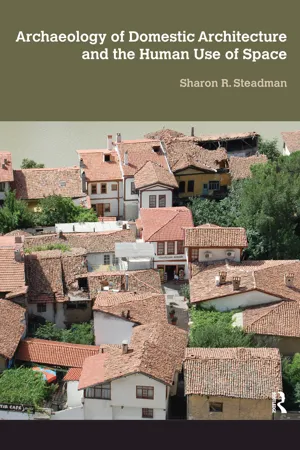
Archaeology of Domestic Architecture and the Human Use of Space
About this book
This volume is the first text to focus specifically on the archaeology of domestic architecture. Covering major theoretical and methodological developments over recent decades in areas like social institutions, settlement types, gender, status, and power, this book addresses the developing understanding of where and how people in the past created and used domestic space. It will be a useful synthesis for scholars and an ideal text for advanced undergraduate and graduate courses in archaeology and architecture. The book-covers the relationship of architectural decisions of ancient peoples with our understanding of social and cultural institutions;-includes cases from every continent and all time periods-- from the Paleolithic of Europe to present-day African villages;-is ideal for the growing number of courses on household archaeology, social archaeology, and historical and vernacular architecture.
Information
Chapter 1
Social Archaeology and the Study of Architecture
Introduction: Fonudations
It has taken well over a decade to write this book, or more accurately, I have been hoping to write it for that long. Other scholarly agendas seemed continually to thwart pursuit of this favored subject: the archaeology of architecture. Decades ago, I intended to write my dissertation on this topic, and even completed the literature review. However, circumstances swerved my dissertation topic dramatically to a very unarchitectural topic. When finally the dissertation process and its aftermath (publication) were completed, I returned to the study of architecture. I even managed to publish the "lit review" slated to be part of the original dissertation, and published a few architecturally based articles over the years. After being hired at my college two decades ago, I taught a course on the "Archaeology of Space and Place," which I still think is one of the best courses I have ever delivered. I intended to write this book to accompany that class.
Alas, other demands at the college again led me away from architecture and toward other academic areas. Other books were written or edited, none of them really about architecture, and an archaeological project that requires regular reports and synthetic works ate up time that could otherwise have been dedicated to architecture-based studies. At long last, I turned my attention back to my favorite, and first love, the archaeology of architecture. Two years later, I am writing this introduction, with a nearly complete manuscript in its wake.
Had I managed to sit down and write this book long ago, it would have been very different from the one I have now produced. Mainly, it would have been shorter, perhaps to the delight of readers and certainly to the relief of my publisher. Very recently, the field of architecture, as explored through the archaeological discipline, has risen to prominence much as it did in the 1970s through the 1990s. The number of books and articles that have appeared—really in the last five years—on architecture and related topics is really quite remarkable, and very exciting. I hope my inclusion of many of them in my discussions throughout these chapters has done justice to their excellent scholarship.
Upon setting out to write this book, I did not quite know what its nature would turn out to be. I knew what the subjects of the chapters would be, and roughly what I would discuss in each, but I did not know if this book would become a highly theoretical treatise on humans and their built environment, or a vehicle in which I explored my own ideas about humans and their spaces, or turn into something else entirely. Now, having completed the thing, I can say that it is, essentially, all three, but mostly the latter. This volume is, in many ways, a "how-to" manual, a guide to understanding the rich data provided to archaeologists by the architectural record.
Chapters review the theories and methodologies employed by many archaeologists over the years and offer many case studies from very successful investigations. In many of the chapters, I offer some of my own ideas on what ancient humans might have thought, intended, needed, or wanted, when they constructed their houses long ago. Writing a book is, of course, a very different activity from building a house. However, the joy that comes from completing a long-term project—especially if the work was enjoyable and the product, one hopes, is well constructed—must be rather similar whether the actor has built a house or written a book. I offer this project to you, the reader, after many years of unintended side trips away from this subject that is so integral to the archaeological field and so foundational to the human experience.
Social Archaeology and the Study of Architecture
Archaeologists have always been concerned with architecture. It was the palaces and temples of Mesopotamia and the stone monuments emerging from the jungle that launched archaeological expeditions to Iraq and Mesoamerica in the 19th century. Interest in the vastly built has been perennial. What is more recent, and is the concern of the present volume, is the opposite of the monumental: the domestic built environment. Of course, there are many large palaces and great houses to study, some of which are discussed in the following pages, but the majority of domestic structures of the past, or in the present, are not of that ilk. Where the interest in domestic architecture came from is the subject of the brief overview of scholarship here. As Wendy Ashmore (2000) notes, interest in the small-scale built environment is rooted in the florescence of social archaeology and the aspiration to understand the non-elite people inhabiting ancient places. The following is hardly a comprehensive overview of the origins and development of the archaeological study of domestic architecture. Rather, only a thumbnail sketch is presented, as the following chapters offer far greater depth and extensive citations.
Perhaps the best place to seat widespread interest in domestic architecture is in the field of settlement archaeology as it developed in the 1950s through to the 1970s (e.g., Adams 1965; Chang 1968; Clarke 1977; Parsons 1972; Trigger 1967; Ucko, Tringham, and Dimbleby 1972; Willey 1956). At the same time, a focus on the intersection between houses and cultural structure came not from the archaeological discipline but from the architectural field. Amos Rapoport published House Form and Culture (1969), and followed it up with The Mutual Interaction of People and Their Built Environment (1976), the latter an edited volume full of cross-cultural anthropological studies. The strong connection between human culture and the creation of places had been forged; this concept was more fully developed by Rapoport in The Meaning of the Built Environment (1982), in which he introduced the field known as "Environment-Behavior Studies" (EBS). Rapoport has continued his investigation of the intricacies of humans and their created environments in the decades since (e.g., 1988, 1990, 2005, 2006, 2008). Simultaneously, colleagues in the anthropology and geography disciplines were also exploring the physical aspects of the houses built by living cultures, and of the spaces inhabited by them (e.g., Carsten and Hugh-Jones 1995; Cieraad 1999; Feld and Basso 1996; Low and Lawrence-Zúñiga 2003; Pred 1990; Small and Tannenbaum 1999; Tuan 1974, 1977). These innovative approaches informed the origins and development of archaeological approaches to architecture.
Kent Flannery (1972) offered the archaeological world a powerful example of what architecture might reveal about socioeconomic structure, marriage and kinship patterns, and human behavior in general. His suggestions that house form and placement could signal whether the inhabiting population practiced pastoralism or agriculture, lived in nuclear or extended families, and potentially had monogamous versus polygynous marriage patterns elicited several decades of investigations in response to his publication (see chapters 4 and 6). Just a few years later, Flannery's Early Mesoamerican Village (1976) firmly established Latin American archaeology as the leader in the investigation of domestic architecture in prehistoric village settings. In concert with this, however, was the focus on vernacular architecture in historical settings, as defined by Henry Glassie in his Folk Housing in Middle Virginia (1975).
In combination with settlement archaeology came the desire to assess population in communities. This required detailed analysis of how much space people needed and how they used it; based on such analyses, a person per square meter equation might be developed. The earliest study was offered by Naroll in 1962, with numerous responses and adjustments to his calculations over the next two decades (see chapter 3). Population estimations were critical not only for those interested in houses and communities but also for those in the field of landscape archaeology, developing largely simultaneously with settlement archaeology in the 1970s, gaining in importance in the 1980s, and becoming a major area in archaeological research today (e.g., Ashmore and Knapp 1999; Aston and Rowley 1974; Bender 1995; Butzer 1982; David and Thomas 2008a; Rossignol and Wandsnider 1992; Tilley 1994, 2009; Wilkinson 2003; Wilkinson, Gibson, and Widell 2013; and see chapter 2).
The early 1980s saw the launch of two important architecturally based analytics: proxemics and access analysis, and household archaeology (see chapters 3 and 7). Based in semiotics—the study of signs and symbols that convey meaning—proxemics examines how humans construct the space around them and what this conveys with regard to behavior and spatial needs. Rapoport drew heavily on proxemics in the development of EBS. Bill Hillier and Julienne Hanson's development of methodologies to address access analysis (1984) truly brought the fields of proxemics, access analysis, and archaeology together (see chapter 3). These tools allowed archaeologists to identify whether various behavioral codes were present in a culture simply by examining the architectural layout: Were private areas important within the household? Were boundaries between dwellings a norm? Was territoriality expressed in the community? Proxemics and access analysis have become well ensconced as viable methodologies for acquiring valuable human behavioral data from the archaeological record (e.g., Banning 2002; Brusasco 2007; Gardin and Peebles 1992; Preucel 2006).
Household archaeology, first launched as a defined field by Richard Wilk and William Rathje in 1982, quickly captured the interest of archaeologists committed to understanding prehistoric communities. In its first iteration, household archaeology was developed as a method to identify the smallest economic unit in a community In particular, it allowed archaeologists to identify how many buildings and what types of human groupings made up a household unit, and what activities that unit engaged in cooperatively (e.g., Santley and Hirth 1993; see chapter 7). While the study of the socioeconomic unit remains fundamental in the household archaeology field, archaeologists in the last several decades have used these methodologies to examine the individuals within those households, focusing on gendered labor, status and rank, and ethnic or individualized identities (e.g., Aldenderfer 1993a; Allison 1999a; Blanton 1994; Coupland and Banning 1996; Hutson 2010; Madella et al. 2013; Roth 2010; Souvatzi 2008). Household archaeology has become one of the foundations for how any prehistorian must approach the architectural remains of an ancient community.
By the late 1980s and early 1990s, the house was increasingly recognized not just as a node of economic behavior but as a symbolic container of a culture's ideologies (Steadman 1996; and see chapters 5 and 10). Peter Wilson's The Domestication of the Human Species (1988) traces the many changes human society embraced as it transitioned from a mainly mobile hunting and gathering species to one engaged in cultivation in more permanently settled venues. He suggests that many of the beliefs and ideologies that were previously associated with the varied landscapes traveled by mobile peoples—deeply spiritual locations, places where ancestors rested, ritual sites—were brought into the abode through house structure, placement, layout, decoration, and other elements. Similarly, Ian Hodder, in The Domestication of Europe (1990), asserts that the first houses in Europe and Turkey served to divide space between the "wild out there" and the "domesticated in here." Things inside the house could be controlled, and thus critical aspects of life—economy, religious life, ancestor veneration—were brought inside to become part of the human experience that could be managed.
Other studies in the same vein argued the house was not only a symbolic container but one that shaped the behavior of its occupants. Such studies grew out of Rapoport's EBS but also drew heavily on anthropological thinking such as structuration theory by Anthony Giddens (1984) and habitus as discussed by Pierre Bourdieu (1977) (see chapters 5 and 9). As humans shaped their houses, so did dwelling patterns shape behavior (Kent 1990; Rapoport 1990; Steadman 2000). Employing the field of activity area research (Kent 1984), the examination of where specific tasks were accomplished and what socioeconomic or symbolic data might be gained from such knowledge, became valuable for understanding ancient social life. Archaeologists investigated the role of architecture in structuring behavior and ensuring the transmission of actions, ideologies, and patterns of movement, from one generation to the next. The house as symbolic container and as reproduced actions and behavior has become firmly embedded in the way archaeologists approach the study of domestic architecture (e.g., Bogucki 1999; Bradley 2005; Parker Pearson and Richards 1994; Samson 1990). A relatively recent development derived from the ideas put forward by Giddens and Bourdieu is the field now known as "agency" (Dobres and Robb 2000; Gardner 2008; Steadman and Ross 2010; and see chapter 5); architecture serves well as a tool for investigations of ancient agency (Steadman 2010, 2011).
Ruth Tringham (1991a, 1991b, 1994) plunged into the domestic architecture field with two recommendations for archaeologists: (1) she urged them to recognize the deep connection between the individuals who dwelled within a structure, and (2) she noted that some of those people were women. The lives lived by the humans became the "life history" of the house as well; what happened to the house itself may serve as a map to what happened to the people. A prime example of this interrelation between house and occupants is the "Burnt House" at her site in Eastern Europe. What if the house, rather than being consumed in an accidental fire, was intentionally burned by its owners once the head of the household died (Tringham 1991a)? Further, if those left behind were women, where did they then go to live? Tringham, among others (Hendon 1997; Nevett 1999; Spain 1992; Wright 1996), firmly installed the study of domestic architecture as a vital part of the burgeoning field of gender archaeology, which began in the late 1980s and floresced in the 1990s (Claasen and Joyce 1997; Conkey and Spector 1984; Gero and Conkey 1991; Gilchrist 1999; Wright 1996; see chapter 8). That the built environment can reveal men's and women's spaces and their associated activities, social status, attitudes, and potentially their gendered ideologies, is now a wholly accepted area of research in the archaeology of architecture (e.g., Nelson 2006).
A major area of research regarding houses, symbolism, and human behavior was launched by Claude Lévi-Strauss in his discussion of sociétés à maisons, or "house societies" (1987). Here the discussion returns to the symbolic, in which a dwelling—or sometimes a collection of buildings—serves as a symbolic representation of groups of people who see themselves in cooperative relationships, whether through religious, economic, kin-based, or other ties (see chapter 6). Cultural anthropologists were the first to launch extensive investigations into the relationships between the built environment and the "house society" (Carsten and Hugh-Jones 1995; Waterson 1990), but archaeologists were soon to follow with volumes that employed ethnography to inform archaeological settings (e.g., Beck 2007a; Joyce and Gillespie 2000). Many archaeologists find the pursuit of ancient house societies through architectural remains a tricky but worthwhile challenge that yields unexpected insights into ancient social life (e.g., Chesson 2003; Paz 2012).
Architectural evidence has always been a mainstay in the search for the wealthy and powerful in a community Beginning in the 1990s, the focus was relocated from the palaces and temples to the expression of wealth, status, and power in the domestic quarter (Blanton 1994; Crown 2000; Diehl 2000a; Moore 1996a; Santley and Hirth 1993; Smith 1987; Wason 1994), and it continues to be a critical component in measuring social and economic status within a community (see chapter 9). A continuing focus on what the domestic world can reveal about the larger society, whether it consists of hamlets or cities, will be a much welcomed addition to studies on wealth, power, and status in the ancient world.
The house as shrine or site of ritual action, already raised above, is also a major area of research (see chapter 10), as so beautifully illustrated by Suzanne Blier's research in Africa (1987). In most volumes treating the archaeological study of religion, at least one, and usually several, of the chapters will offer a case study on architectural approaches to illuminating ancient beliefs (e.g., Fogelin 2008; Hayden 2003; Insoll 2004; Parker Pearson 2000; Steadman 2009; Whitehouse and Martin 2004; Whitley and Hays-Gilpin 2008). The house as seat of all critical human cultural institutions is well demonstrated by these and other studies discussed in this volume.
The house in the urban community has also grown in importance. Decades ago, archaeologists such as Elizabeth Stone (1987) and René Millon (1976) demonstrated the usefulness of examining individual houses, clusters of dwellings, and residential neighborhoods for invaluable insights into the Socioeconomy, political structure, ethnic makeup, and even ideology of residents in ancient cities. Such methodologies have continued to be employed in studies on single cultures (e.g., Cahill 2002; Cooper 2006; van de Mieroop 1999; Nevett 2010; Stone and Zimansky 2004), and recently valuable cross-cultural studies have appeared (Marcus and Sabloff 2008a; Smith 2003a; Stone 2007). In addition, the dwelling's role in the organization and evolution of prehistoric communities has also been highlighted in recent years, in part initiated by Marcello Canuto and Jason Yaeger's innovative The Archaeology of Communities (2000; and see Ian Kuijt's study [2000c] on the Near East). Several other more recent contributions (Bandy and Fox 2010; Birch 2013; Düring 2006) demonstrate the continuing recognition by archaeologists that communities are of houses made.
Just prior to or during the preparation of this manuscript, a number of volumes have appeared, all either exploring archaeological studies of the architectural record or including architecture as an integral element of understanding ancient humans. Julia Hendon, a major figure in the study of Mesoamerican architecture, published Houses in a Landscape (2010), which recognizes that house architecture is a testament to human memory and that, if studied properly, architectural remains can be read as a type of text about an ancient society. In the same vein, Dennis Tedlock and Arthur Sz...
Table of contents
- Cover Page
- Half Title page
- Dedication
- Title Page
- Copyright Page
- Contents
- List of Illustrations
- Acknowledgments
- 1 Social Archaeology and the Study of Architecture
- Section I Initial Foundations: Theories and Methodologies in the Archaeology of Architecture
- Section II Scales of Architecture: From Mobile Home to Cityscape
- Section III Houses as Vessels of Social Institutions
- Section IV Symbolism and the Built Environment
- References
- Index
- About the Author
Trusted by 375,005 students
Access to over 1.5 million titles for a fair monthly price.
Study more efficiently using our study tools.
Frequently asked questions
Yes, you can cancel anytime from the Subscription tab in your account settings on the Perlego website. Your subscription will stay active until the end of your current billing period. Learn how to cancel your subscription
No, books cannot be downloaded as external files, such as PDFs, for use outside of Perlego. However, you can download books within the Perlego app for offline reading on mobile or tablet. Learn how to download books offline
Perlego offers two plans: Essential and Complete
- Essential is ideal for learners and professionals who enjoy exploring a wide range of subjects. Access the Essential Library with 800,000+ trusted titles and best-sellers across business, personal growth, and the humanities. Includes unlimited reading time and Standard Read Aloud voice.
- Complete: Perfect for advanced learners and researchers needing full, unrestricted access. Unlock 1.5M+ books across hundreds of subjects, including academic and specialized titles. The Complete Plan also includes advanced features like Premium Read Aloud and Research Assistant.
We are an online textbook subscription service, where you can get access to an entire online library for less than the price of a single book per month. With over 1.5 million books across 990+ topics, we’ve got you covered! Learn about our mission
Look out for the read-aloud symbol on your next book to see if you can listen to it. The read-aloud tool reads text aloud for you, highlighting the text as it is being read. You can pause it, speed it up and slow it down. Learn more about Read Aloud
Yes! You can use the Perlego app on both iOS and Android devices to read anytime, anywhere — even offline. Perfect for commutes or when you’re on the go.
Please note we cannot support devices running on iOS 13 and Android 7 or earlier. Learn more about using the app
Please note we cannot support devices running on iOS 13 and Android 7 or earlier. Learn more about using the app
Yes, you can access Archaeology of Domestic Architecture and the Human Use of Space by Sharon R Steadman in PDF and/or ePUB format, as well as other popular books in Social Sciences & Architecture General. We have over 1.5 million books available in our catalogue for you to explore.