eBook - ePub
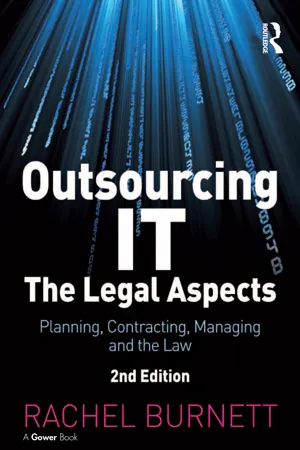
Outsourcing IT - The Legal Aspects
Planning, Contracting, Managing and the Law
- 254 pages
- English
- ePUB (mobile friendly)
- Available on iOS & Android
eBook - ePub
About this book
Outsourcing has increased and developed immensely in scope, sophistication and ambition over the last twenty years - and continues to evolve. Information technology outsourcing is potentially highly complex and risk-laden, especially for the fast growing areas of business process and transformational outsourcing, and where whole departments or business areas are outsourced. Decisions taken by the customer at the outset have long term ramifications: they need to ensure that the processes are flexible enough to deal with change, maintain necessary levels of security, avoid abandoning management of key resources and prevent costs spiralling out of control. It is essential to have a good contract to meet such challenges. All these issues and others, such as intellectual property arrangements, the complexities of transferring staff, property and other assets, tendering procedures and performance monitoring, must not be ignored and are addressed in the second edition of Rachel Burnett's successful Outsourcing IT. Whether you are a supplier or a customer, it is vital to have a properly negotiated formal contract if you are entering into an outsourcing arrangement. A good contract needs careful planning and this book provides a comprehensive guide to the whole process. Well-planned and well-structured outsourcing arrangements, by well-informed and well-advised customers, are far more likely to work for both customer and supplier alike and Outsourcing IT - The Legal Aspects: Planning, Contracting, Managing and the Law is the perfect place to start.
CHAPTER 1
Contract Planning, Structuring and Negotiating
Surveys on successes and failures of outsourcing consistently emphasize that satisfied customers had signed comprehensive contracts where the issues had been thought through, and dissatisfied customers had not signed contracts which were clear or detailed. Whether as a supplier or as a customer, it is vital to have a properly negotiated contract in writing with the other party to the outsourcing arrangements, covering legal, commercial and service requirements.
In this chapter, some points relating to the contract structure are examined. These include the planning necessary before starting to draft the wording, the decisions on the resources to use, the framework for the contents, the philosophy behind it, the law which should apply, and other basic formalities.
Broadly, the contract will cover, amongst other things, the services to be provided, the charges, the rights and responsibilities of each side, the management of the contract, the extent of the parties’ liabilities, how variations to the services may be made and how the contract may be brought to an end. There may be separate documents for the transfer of assets or the business, for staff transfer, and for the services agreements.
Because the outsourcing arrangement relates to one particular business and organization and to carefully defined services to be supplied, the contract – which may consist of a series of linked documents – must be tailor-made.
The reasons for having a contract
There are at least three good reasons for formal terms to be drawn up and agreed.
The first is that the contract framework will also serve as a structure for the negotiating process. This will guide discussion on all the matters to be covered and eventually help consensus to be reached, so that both parties to the contract understand exactly what it is they are agreeing, unambiguously.
The second is that the contract should be a source of reference during the provision of the outsourcing services. The contract will serve as a working document, detailing information about what has been agreed, such as the charging methods or the reporting procedure, or the benchmarks for measuring the service levels which are achieved in practice.
Thirdly, however amicable and trusting the apparent relationship between the parties at the outset, the individuals involved in negotiating the contract cannot be regarded as permanent fixtures over the course of the outsourcing. The supplier will have a number of staff working day-to-day on the contract who will not have been concerned in the contract negotation and who may vary over time. The managers and representatives of either party may be promoted, retire, change role or move organization. The directors of each party may decide on a new strategy for their business one or two or five years hence. For all these reasons and more, the contract should, in common with all contracts, set out each party’s respective rights and responsibilities clearly, so that in the final analysis the contract can be enforced if any of the important obligations fail to be carried out and the relationship deteriorates. For both parties, the objectives of what they are trying to achieve from entering into an agreement for outsourcing need always to be borne in mind. A successful outsourcing contract should accurately reflect in its detail the context of the unique relationship between the supplier and the customer for the purposes of the business objectives of the outsourcing. In other words, the contract document must accurately reflect the individual components of the transaction which the parties believe they have made. This will involve close attention to both operational and technical matters. However, it will be negotiated under the pressures of a deadline where solutions to different perspectives and opinions must be agreed, and under these constraints, it will never be perfect.
The parties to the contract
Who are the parties to the contract to be? A contract must be between legal entities to be enforceable. Corporations, the majority of which are companies formed under the Companies Acts, and charities, which are companies subject to special regulations, are entitled to make contracts. The Crown and other emanations of the State such as Government departments may enter into contracts, as may local authorities. Organizations set up under other statutes – some quasi-public Commissions would fall under this heading – are able to exist legally according to what they are permitted to do under the statute concerned, which would normally allow contracts to be made by them. Individuals and partnerships are also legal persons.
A holding company, as shareholder of its subsidiary company, is under English company law a separate legal entity from it, and cannot, simply because of that relationship, speak for the subsidiary or enter into contracts on the subsidiary’s behalf. Similarly the subsidiary has no legal obligation to act as directed by the holding company. On the contrary, the directors of the subsidiary are required to consider its interests independently and may incur personal liability if they fail to do so.
It sometimes happens that either the supplier or the customer may regard itself as a self-contained organization, yet be without any distinct legal identity of its own, being in fact merely an operating division within a company. The contract should then be entered into by the main corporate body itself, which will be the party legally responsible. A statement at the start of the contract can make it clear that the contract is between ‘X Company Limited’ and ‘Headco plc by its Systems Division’. In the body of the contract, the company may be referred to by the abbreviated version of the name with which everyone is familiar, such as ‘Systems’, or the name by which the division or department is known, if this will make the contract more user friendly and the rights and obligations more readily comprehensible.
Provided that all the terms have been agreed, it is not essential under English law for most contracts to be signed. However, there may be operating rules for the supplier or customer organization about entering into contracts, and if one of the parties is an organization established under the laws of another jurisdiction, it will have to abide by the legislation applicable to its formation and operation. In any event, it is good business practice to record formally the commitment of each party to the agreement that has been reached, signifying the conclusion of the negotiations. Indeed, the event of signing the contract is often marked as a special occasion with suitable publicity arrangements, photographs taken to record the cordial handshakes, the press release issued, and the first cheque handed over.
The contract should therefore be signed by representatives with the authority to do so, according to the legal requirements of the jurisdiction which governs the establishment of the company or other organization. It is not necessary in English law to have witnesses to signatures to a contract which is not a deed. A deed is a special kind of contract, which is required to be used in certain circumstances, such as for the sale of land. Outsourcing contracts do not need to conform to the formalities associated with deeds. However, local authorities and other public organizations may have standing orders which require contracts above a certain value to be executed as deeds. If a contract is to be a deed, it must be clear from its contents that it is intended to be a deed, and it must be executed under the corporate common seal or signed on behalf of a company by any person acting under the company’s authority. A document signed by a director and the secretary of a company or by two directors of the company and expressed as being executed by the company has the same effect as if executed under the common seal of the company. Rules for the correct execution of contracts by supplier or customer organizations not governed by English law must be conformed to.
Third parties who are involved in the outsourcing, such as end users of the customer, or sub-contractors of the supplier, must have their own contracts with the customer or supplier respectively, which will mirror the relevant rights and obligations appearing in the outsourcing agreement.
Assignment and novation
unless there is an express prohibition against assignment in the contract, under English law either party may assign the benefit of the contract to another party. An assignment is the transfer of part or all of the benefits of the contract. The contract remains in effect, but the rights of one party, ‘the assignor’, such as the supplier’s right to payment, may be transferred to another party, ‘the assignee’. The assignee may then enforce the payment terms in the contract against the customer. The customer will still be able to enforce the contract against the original supplier, whose obligations of providing services are not transferred through the assignment.
It is normal for the contract to place some restrictions on either party’s ability to assign it. A clause prohibiting assignment without the prior consent of the other party to the contract is commonly found. This gives the option of refusal of a proposed new relationship with an unsuitable or undesirable assignee. In practice, a customer may want the right to assign the contract if it is likely that during the term of the contract its corporate structure of associated companies should change, or if the part of the organization for which the services are being supplied is to be sold off. In this case, the customer might require a clause stating that assignment by the customer to its related companies or to a third party will be permitted. In circumstances in which the assignor is a company within a group of companies and the proposed assignee is another company in that group, assignment may be acceptable to the supplier.
If assignment is to be permitted, a safeguard may be introduced by making the assignment subject to the other party’s consent. It may be agreed that this consent should not be withheld unreasonably. This will give an opportunity to examine the financial viability of the proposed assignee company and any previous unsatisfactory relationship between the non-assigning company and the proposed assignee.
Sometimes reciprocity is required in the negotiated assignment provisions, or there may be special reasons for permitting or forbidding assignment altogether.
A ‘novation’ agreement replaces a contract. This will be desirable if the terms and conditions are being significantly varied, or in a situation where the original parties to the contract agree that a third party should take the place of one of them. The effect of a novation agreement is to extinguish the original contract and create a new one. This is often a useful opportunity to review the terms to ensure that they are all still applicable, and to consider whether new terms should be negotiated. As a new contract, the novation agreement should state the rights and obligations of each of the three parties; both the original parties and the party taking over, and all of them should sign it.
Intention to proceed
It occasionally happens that the supplier’s sales representatives want to get an early assurance by the customer that its intent to proceed is serious, especially where it is appreciated that negotiations may be protracted. A letter of intent may be requested. Other names for documents with equivalent purposes are ‘heads of terms’, ‘heads of agreement’, ‘memorandum of understanding’. The language and format of the document are matters of choice. It may be worded as an informal letter or it may be constructed as an intimidating-looking paper. It will set out the intentions of one party or of both, and outline any key terms already known.
It should be a matter for careful decision whether such a document is really necessary. It may be of some benefit where it is desirable to keep the Board of either organization informed, or to avoid misunderstandings, or to clarify the steps to be taken, or to flush out major areas of contention early. It may be of no advantage where it is requested only because of a sales representative’s anticipated commission.
The document will need care in drafting, to avoid unlooked for obligations and also because it will set the tone for further negotiations, the scope for which should not be unnecessarily constrained. It may not be intended to be legally binding, and it is normally highly advisable that it should not have the status of legal enforceability when the parties are in the early stages of negotiations. The most usual way of indicating this is by using the words ‘subject to contract’, to show that it is not intended to commit the parties. This is a well understood formula, although not foolproof. Other similar phrases do not have the same conciseness and wide acceptance – for example terms such as ‘subject to Board approval’ or ‘provisional’ or ‘awaiting formal contract’ may be ambiguous as to whether an enforceable agreement has been made in any respect, and therefore should not be used.
In drafting the letter of intent, only the agreed commercial principles should be set out, not any details. It must be clear that all the statements made will be subject to any third party involvement, such as the consents required for assignment of software licences. It may be appropriate to suggest a contract timetable. It should be openly acknowledged that it is not a complete statement of the parties’ objectives.
Separately from the letter of intent itself, other agreements preliminary to the contract may be required. If confidentiality is of concern, a binding non-disclosure agreement should be separately made, as discussed in Chapter 2. There may be circumstances in which the supplier can request a ‘lock-out’ agreement, meaning that the customer will not negotiate with third parties for a specified period, perhaps in return for the supplier entering into negotiations with third party software suppliers or starting its investigation of the customer’s service level requirements.
An ‘agreement to agree’ is not legally enforceable under English law. There are too many potential escapes.
Planning the contract
A good contract will need careful planning from the early stages of considering outsourcing.
At the stage of inviting tenders, some of the contract criteria will already be known. For example, local authority contracts often have standard provisions about compliance with non-discriminatory legislation. It is advisable for a customer to include a contract outline or a basic contract with its invitation to tender. Suppliers themselves will have basic terms on which it is profitable for them to conduct business, and may wish to include these as part of their tender responses.
There are different views on what terms should be set out by the customer in the contract attached to the invitation to tender. One opinion held by some experienced contract negotiators is that all the terms should be included to which the customer would ideally wish the supplier to be committed. An alternative valid negotiating position is that only those terms which are essential and not negotiable, or which are highly desirable, should be set out in the documentation for the invitation to tender. There is no point in deterring potential bidders by contract requirements which are more idealistic than realistic and which bidders know that they would not be able to accept.
Once the supplier has been selected, the provisions of the contract need to be negotiated and agreed. If the contract is for a large scale outsourcing, the supplier will need to obtain accurate information about all aspects of the services being outsourced, similar to the process of ‘due diligence’ which is carried out on the sale of a business. In this case its purpose is to investigate, inspect, evaluate and verify the information, condition and legal status of what is being outsourced. The customer will disclose such matters as third party contracts, software licences and support agreements, financial details, insurances, leases, property and other proprietary rights, contractor contracts, employment policies, union affairs, disciplinary issues, terms of employment. A limited part of this information could be supplied at the stage when the invitation to tender is made, so that suppliers have sufficient knowledge to submit ‘educated’ bids. Much will be too sensitive to disclose at this early point, even in the unlikely event of it being readily available.
Most of this information will need to be included in the contract or incorporated into it, or referred to in it. At the outset of negotiations a substantial amount of detail will not be known and the information will have to be collated. A data room may be set up for this process, a location which can be dedicated to storing relevant information and copies of documents, much of which may be confidential.
The customer may already have defined the service levels, in which case the supplier needs to confirm that they are reasonable and can continue to be achieved, but it is far more usual for them to be drawn up and agreed during the negotiations. The time involved in this must not be underestimated. Occasionally they are not agreed until after the contract formally comes into effect – although this is highly inadvisable from the customer’s perspective, and not to be recommended. Many other decisions which need to be taken will emerge during the negotiations, such as how much weekly or monthly management liaison there should be.
Generally speaking, there is likely to be an enormous amount of work to be done in gathering and establishing the information required. This exercise may be carried out by the customer alone or with the supplier’s participation.
For these reasons, an outsourcing contract will take some time to finalise. It can take several months to sort out the commercial aspects and technical issues as well as the legal requirements. The earlier the process is initiated, the fewer pressures there will be to take quick decisions just to keep the process moving. Decisions taken impulsively in th...
Table of contents
- Cover Page
- Title Page
- Copyright Page
- Contents
- Foreword to the Second Edition
- Foreword to the First Edition
- Preface to the Second Edition
- Introduction
- Chapter 1 Contract Planning, Structuring and Negotiating
- Chapter 2 Selecting a Supplier
- Chapter 3 Public Procurement
- Chapter 4 Services and Service Level Agreements
- Chapter 5 Business Assets: Premises and Equipment
- Chapter 6 Human Resources
- Chapter 7 Software
- Chapter 8 Costs and Charges
- Chapter 9 Management Liaison and Review
- Chapter 10 Allowing for Change
- Chapter 11 Confidentiality, Data Protection and Security
- Chapter 12 Contract Duration, Termination and Transition Management
- Chapter 13 Redressing Fault and Failure
- Chapter 14 Offshore Outsourcing
- Chapter 15 Conclusion
- Index
Trusted by 375,005 students
Access to over 1.5 million titles for a fair monthly price.
Study more efficiently using our study tools.
Frequently asked questions
Yes, you can cancel anytime from the Subscription tab in your account settings on the Perlego website. Your subscription will stay active until the end of your current billing period. Learn how to cancel your subscription
No, books cannot be downloaded as external files, such as PDFs, for use outside of Perlego. However, you can download books within the Perlego app for offline reading on mobile or tablet. Learn how to download books offline
Perlego offers two plans: Essential and Complete
- Essential is ideal for learners and professionals who enjoy exploring a wide range of subjects. Access the Essential Library with 800,000+ trusted titles and best-sellers across business, personal growth, and the humanities. Includes unlimited reading time and Standard Read Aloud voice.
- Complete: Perfect for advanced learners and researchers needing full, unrestricted access. Unlock 1.5M+ books across hundreds of subjects, including academic and specialized titles. The Complete Plan also includes advanced features like Premium Read Aloud and Research Assistant.
We are an online textbook subscription service, where you can get access to an entire online library for less than the price of a single book per month. With over 1.5 million books across 990+ topics, we’ve got you covered! Learn about our mission
Look out for the read-aloud symbol on your next book to see if you can listen to it. The read-aloud tool reads text aloud for you, highlighting the text as it is being read. You can pause it, speed it up and slow it down. Learn more about Read Aloud
Yes! You can use the Perlego app on both iOS and Android devices to read anytime, anywhere — even offline. Perfect for commutes or when you’re on the go.
Please note we cannot support devices running on iOS 13 and Android 7 or earlier. Learn more about using the app
Please note we cannot support devices running on iOS 13 and Android 7 or earlier. Learn more about using the app
Yes, you can access Outsourcing IT - The Legal Aspects by Rachel Burnett in PDF and/or ePUB format, as well as other popular books in Business & Business General. We have over 1.5 million books available in our catalogue for you to explore.