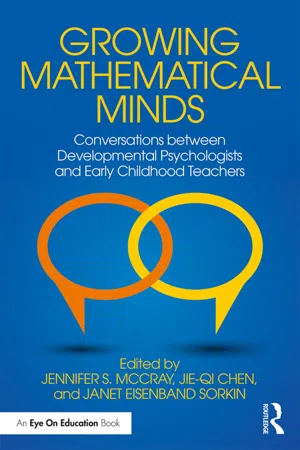
Growing Mathematical Minds is the documentation of an innovative, bi-directional process of connecting research and practice in early childhood mathematics. The book translates research on early mathematics from developmental psychology into terms that are meaningful to teachers and readily applicable in early childhood classrooms. It documents teacher responses, and conveys their thoughts and questions back to representative researchers, who reply in turn. In so doing, this highly useful book creates a conversation, in which researchers and teachers each bring their expertise to bear; their communication about these topics—informed by the thinking, commitment, and experience of both groups—helps us better understand how developmental psychology can improve math teaching, and how math teaching can, in turn, inform developmental science. The book bridges the gap between research and practice, helping teachers to adopt evidence-based practices and apply cutting-edge research findings, and prompting developmental researchers to consider their work within the framework of practice. Growing Mathematical Minds identifies and elucidates research with profound implications for teaching children from three to eight years so they develop foundational math knowledge and skills, positive attitudes toward math, and basic abilities to think mathematically.
eBook - ePub
Growing Mathematical Minds
Conversations Between Developmental Psychologists and Early Childhood Teachers
- 214 pages
- English
- ePUB (mobile friendly)
- Available on iOS & Android
eBook - ePub
Growing Mathematical Minds
Conversations Between Developmental Psychologists and Early Childhood Teachers
About this book
Information
Table of contents
- Cover
- Title
- Copyright
- Contents
- Acknowledgements
- Introduction: Bridging the Gap Between Research and Practice in Early Mathematics
- 1 Mathematical Language and Early Math Learning
- 2 The Role of Adult and Environmental Input in Children’s Math Learning
- 3 The Use of Concrete Objects in Early Mathematical Learning
- 4 The Role of Gesture in Teaching and Learning Math
- 5 Variability in Children’s Mathematical Thinking and Learning
- 6 Pathways to Basic Combination Fluency in the Primary Grades
- 7 Math Anxiety and Math Performance: How Do They Relate?
- Conclusion: What Have We Learned?
- Index
Trusted by 375,005 students
Access to over 1.5 million titles for a fair monthly price.
Study more efficiently using our study tools.
Frequently asked questions
Yes, you can cancel anytime from the Subscription tab in your account settings on the Perlego website. Your subscription will stay active until the end of your current billing period. Learn how to cancel your subscription
No, books cannot be downloaded as external files, such as PDFs, for use outside of Perlego. However, you can download books within the Perlego app for offline reading on mobile or tablet. Learn how to download books offline
Perlego offers two plans: Essential and Complete
- Essential is ideal for learners and professionals who enjoy exploring a wide range of subjects. Access the Essential Library with 800,000+ trusted titles and best-sellers across business, personal growth, and the humanities. Includes unlimited reading time and Standard Read Aloud voice.
- Complete: Perfect for advanced learners and researchers needing full, unrestricted access. Unlock 1.5M+ books across hundreds of subjects, including academic and specialized titles. The Complete Plan also includes advanced features like Premium Read Aloud and Research Assistant.
We are an online textbook subscription service, where you can get access to an entire online library for less than the price of a single book per month. With over 1.5 million books across 990+ topics, we’ve got you covered! Learn about our mission
Look out for the read-aloud symbol on your next book to see if you can listen to it. The read-aloud tool reads text aloud for you, highlighting the text as it is being read. You can pause it, speed it up and slow it down. Learn more about Read Aloud
Yes! You can use the Perlego app on both iOS and Android devices to read anytime, anywhere — even offline. Perfect for commutes or when you’re on the go.
Please note we cannot support devices running on iOS 13 and Android 7 or earlier. Learn more about using the app
Please note we cannot support devices running on iOS 13 and Android 7 or earlier. Learn more about using the app
Yes, you can access Growing Mathematical Minds by Jennifer S. McCray,Jie-Qi Chen,Janet Eisenband Sorkin in PDF and/or ePUB format, as well as other popular books in Bildung & Frühkindliche Bildung. We have over 1.5 million books available in our catalogue for you to explore.